You’re unloading the dishwasher when your Corelle plate suddenly explodes into thousands of tiny shards.
No warning, no visible damage, just an instant detonation that sends glass flying across your kitchen.
If this sounds familiar, you’re not alone. While Corelle dishes are known for durability, their unique tempered glass construction can lead to catastrophic failures under certain conditions.
These explosions are relatively rare but genuinely dangerous, causing eye injuries, cuts, and widespread contamination.
Understanding why Corelle explodes, recognizing warning signs, and following prevention strategies can protect your family.
This guide covers the science behind explosive shattering, common triggers, safety risks, and practical steps to prevent incidents, plus when it’s time to retire your dishes for good.
- Why Do Corelle Dishes Explode?
- Common Causes of Corelle Dishes Exploding
- What Are Corelle Dishes Made Of? (Understanding Vitrelle Glass)
- Safety Risks When Corelle Dishes Explode
- Signs Your Corelle Dish May Be About to Fail
- How to Prevent Corelle from Exploding
- What to Do If Your Corelle Dish Explodes
- Are Older Corelle Plates More Likely to Explode?
- Corelle’s Official Safety Recommendations and Consumer Reports
- Safer Alternatives to Tempered Glass Dishes
- FAQ — Corelle Dishes Exploding
- Final Thoughts — Corelle Is Durable, but Not Indestructible
Why Do Corelle Dishes Explode?
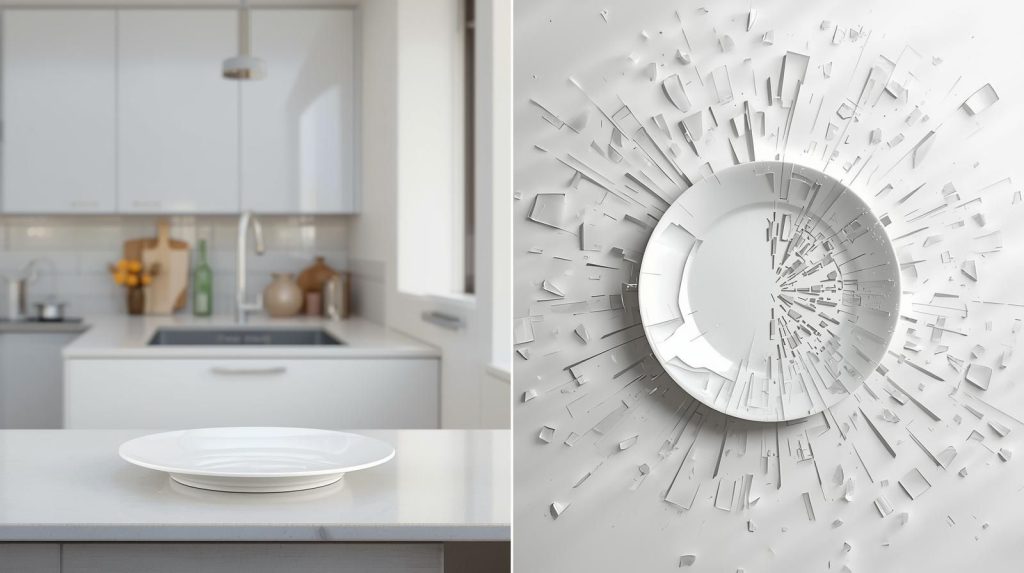
How Vitrelle Glass Creates Explosive Shattering
Corelle dishes are made from Vitrelle—three layers of glass thermally bonded under extreme pressure.
This creates internal tension throughout the material, like a coiled spring held compressed. The outer layers are under compression while the core is under tension.
This design makes Corelle lightweight and chip-resistant, but when one layer fails, the stored energy releases instantly.
The entire structure disintegrates simultaneously, sending thousands of razor-sharp fragments in all directions at high velocity rather than cracking slowly like regular glass.
Why It Explodes Instead of Just Cracking
Regular glass breaks progressively; a crack spreads gradually. Tempered glass, like Vitrelle, fails catastrophically because of built-in mechanical stress.
When the surface is breached through impact, thermal shock, or aging damage, the tension balance collapses.
The energy stored during manufacturing releases all at once, causing instantaneous disintegration.
Shards travel 15-20 feet from the explosion point. This isn’t a defect; it’s an inherent property of tempered glass construction.
The same tension that makes Corelle strong also makes failures explosive.
The Two Types of Corelle Failures
Impact-triggered explosions occur when dishes experience sudden force: dropping, striking hard surfaces, or thermal shock from temperature extremes.
These are predictable and preventable. More concerning are spontaneous explosions—dishes exploding while sitting unused on shelves or in cabinets.
These happen when cumulative damage from years of temperature cycling, micro-impacts, and aging weakens the internal structure until random vibration or temperature change triggers failure.
Spontaneous explosions typically occur in dishes 10+ years old with invisible micro-fractures.
Both types scatter dangerous shards widely, but spontaneous failures are particularly alarming because they happen without warning.
Common Causes of Corelle Dishes Exploding
Thermal Shock (The #1 Culprit)
Thermal shock causes most Corelle explosions. This occurs when dishes experience rapid temperature changes:
a) hot plate onto cold granite counters,
b) microwaved dish directly into the refrigerator,
c) or a cold dish placed in a preheated oven.
The glass layers expand or contract at different rates, creating stress that exceeds structural limits.
Even Corelle, rated as “oven-safe,” can explode under extreme temperature transitions.
The greater the temperature difference and the faster the change, the higher the explosion risk. Room temperature transitions are safest.
Age and Hidden Structural Damage
Dishes older than 10 years face an increased explosion risk even without visible damage.
Repeated temperature cycling causes microscopic stress fractures invisible to the naked eye.
Each thermal expansion and contraction weakens the laminate bond slightly.
Over decades, these micro-fractures accumulate until structural integrity fails.
Many Corelle users believe that Manufacturing changes when production moved to China in the late 1990s-early 2000s also created quality variations, but Official supply chain disclosures focus on ethical supplier expectations without quality equivalence statements.
Older dishes lose resilience, becoming brittle and unstable.
Many spontaneous explosions may involve vintage Corelle from the 1970s-1990s that appeared perfect but had reached the structural failure point.
Chips, Cracks, and Manufacturing Defects
Even tiny rim chips compromise Corelle’s entire structure by breaking the surface tension seal.
What looks like minor damage creates a failure point where internal stress concentrates.
Hairline cracks act similarly—they may seem superficial, but penetrate deep enough to destabilize the laminate layers.
Dropping dishes, striking them against faucets or other hard objects, and stacking them all create damage.
Rare manufacturing defects like uneven tension distribution or incomplete bonding between layers can also cause premature failure.
Any visible damage means immediate disposal; the entire dish is compromised, not just the damaged area.
What Are Corelle Dishes Made Of? (Understanding Vitrelle Glass)
The Three-Layer Laminated Design
Vitrelle consists of three glass layers bonded at over 1,000°F.
Two outer “skin” layers sandwich a core layer, each with different thermal expansion properties.
During manufacturing, the assembly is heated then rapidly cooled, creating permanent mechanical stress—the outer layers compress inward while the core layer stretches outward.
This tension makes Corelle exceptionally strong and lightweight compared to traditional ceramic.
Dishes resist normal chips and impacts well. However, this same tension causes explosive failure when the balance is disrupted by damage, age, or thermal stress.
Benefits, Risks, and How Aging Affects Structure
Benefits include lightweight portability, space-saving stackability, and general durability for everyday use.
The risk is catastrophic failure rather than gradual deterioration. You can’t “fix” damaged Corelle—once compromised, it’s hazardous.
Aging gradually weakens the laminate bond through repeated thermal cycling and microscopic surface degradation.
The glass becomes brittle, tension distribution becomes uneven, and the structure loses resilience.
After 10-15 years of regular use, even undamaged-looking dishes may spontaneously fail.
Unlike ceramic, which chips progressively, Vitrelle maintains its appearance until sudden complete failure, making age-based replacement crucial for safety.
Safety Risks When Corelle Dishes Explode
The Shard Danger Zone
Corelle explosions propel thousands of tiny, razor-sharp glass fragments 15-20 feet in all directions.
Shards embed in walls, ceilings, food, counters, and floors. Unlike regular broken dishes with larger, manageable pieces, Corelle creates a contamination field of nearly invisible fragments.
Many pieces are too small to see but large enough to cause injury. The explosion radius extends far beyond where the dish broke, affecting entire rooms.
Documented Injuries and Risks to Children/Pets
Reported injuries include eye lacerations requiring stitches, traumatic cataracts from glass shards, deep cuts to hands and face, and embedded fragments requiring medical removal.
Burns occur when hot food-filled dishes explode during heating.
Children and pets face heightened risk because they’re closer to the ground where shards settle and may not recognize danger.
Paw injuries and cut feet are common. Glass contamination in food preparation areas poses ingestion risks.
The Micro-Shard Contamination Problem
Complete cleanup after Corelle explosions is nearly impossible. Microscopic shards embed in porous surfaces, carpet fibers, crevices around appliances, and textured countertops.
Vacuuming removes visible pieces but misses embedded fragments. Areas may remain hazardous for days or weeks.
Shards in food preparation zones risk contaminating meals. Some situations require professional cleaning or accepting long-term contamination.
The cleanup difficulty often surprises people experiencing their first Corelle explosion.
Signs Your Corelle Dish May Be About to Fail
Visible and Invisible Warning Signs
Visible warnings include chips along rims (even tiny ones), cloudiness or haziness indicating stress damage, slight warping or bowing, and discoloration around edges.
Any surface damage is a red flag. Invisible damage is more dangerous: micro-fractures from years of thermal cycling, stress damage throughout the structure, and degraded laminate bonds.
Perform a sound test, tap the dish gently with a spoon. A clear ring indicates good structure; a dull thud suggests internal damage. Trust your instincts if dishes feel different.
Age as the Primary Risk Factor
Age matters more than appearance. Dishes used regularly for 10+ years have accumulated stress damage regardless of visible condition.
Vintage Corelle from the 1970s-1990s poses an elevated risk due to older manufacturing processes and decades of use.
Pre-2005 dishes also carry lead contamination risk in decorative patterns, a separate serious concern.
Retire dishes based on age, even if they look perfect. Consider a 10-15-year maximum lifespan for frequently used pieces.
Occasional-use dishes may last longer, but monitor them closely after a decade.
How to Prevent Corelle from Exploding
Temperature Transition Rules
Never subject Corelle to sudden temperature changes. Let heated dishes cool to room temperature before placing them on cold surfaces.
Don’t refrigerate hot dishes or place cold dishes in preheated ovens. When microwaving, use medium power and allow gradual heating.
Place hot dishes on trivets, pot holders, or wooden boards—never directly on cold granite, marble, or metal.
Avoid moving dishes from the freezer to the microwave. Room temperature staging prevents thermal shock, the primary explosion cause.
Regular Inspection and Safe Usage
Inspect dishes monthly for chips, cracks, cloudiness, or warping. Perform tap tests for structural integrity.
Immediately discard any damaged pieces; the entire dish is compromised, not just the damaged area.
Never use Corelle on stovetops or under broilers, even if labeled oven-safe. Avoid extreme temperature applications altogether.
Handle carefully during washing to prevent impacts against sinks or faucets. Stack carefully with padding to prevent contact stress.
Proper handling extends lifespan and prevents damage that leads to explosions.
When to Replace Your Corelle
Replace immediately: any visible damage, dishes that sound dull when tapped, cloudy or discolored pieces.
Replace based on age: 10-15 years for regular-use dishes, any vintage pieces from the 1970s-1990s, and pre-2005 dishes with decorative patterns (lead risk).
Better safe than sorry, replacement cost is minimal compared to injury risk and a cleanup nightmare.
If you inherited vintage Corelle or bought it secondhand, assume it’s reached end-of-life regardless of appearance. Sentimental value isn’t worth safety risks.
What to Do If Your Corelle Dish Explodes
Immediate Response and Cleanup
Clear people and pets from the area immediately, and check for injuries, especially to the eyes.
Wear closed-toe shoes and heavy gloves before cleanup.
Vacuum thoroughly in all directions, covering a 15-20 foot radius from the explosion point.
Use damp paper towels to wipe surfaces; wet towels catch fragments that dry wiping misses.
Dispose of immediately in sealed bags. Mop hard floors multiple times. Check walls, counters, and appliances for embedded shards.
Vacuum upholstered furniture and carpets repeatedly over several days.
Post-Explosion Safety
Understand that the area remains potentially hazardous for days. Tiny invisible shards may persist despite thorough cleaning.
Be cautious when walking barefoot. Inspect food preparation areas carefully before cooking—contamination risk exists.
Consider professional cleaning for severe explosions, especially in carpeted areas.
Replace cutting boards and porous items that contact with shards.
Monitor for injuries in the following days—small cuts may appear later. If an explosion occurred near food, discard anything potentially contaminated. Safety outweighs waste concerns.
Are Older Corelle Plates More Likely to Explode?
Yes, older Corelle plates are significantly more likely to explode. Statistical reports show increased failures after 10+ years of use.
Aging causes cumulative micro-damage from thermal cycling, structural fatigue, and degraded laminate bonds.
Vintage Corelle from the 1970s-1990s faces triple risk: decades of use, older manufacturing formulas with different stress properties.
User reports consistently link spontaneous explosions to vintage sets. The glass becomes brittle over time, losing the resilience that once made it durable.
Age-related deterioration is invisible but progressive and irreversible.
Corelle’s Official Safety Recommendations and Consumer Reports
Manufacturer Guidelines
Corelle’s official recommendations include:
a) immediately discard any chipped or cracked dishes—do not use damaged pieces under any circumstances;
b) avoid extreme temperature shifts—allow gradual temperature transitions;
c) never use on stovetops or under broilers regardless of labeling;
d) follow care instructions for microwave and dishwasher use.
The company acknowledges tempered glass’s explosive failure characteristic while maintaining products are safe when used properly.
Warranty typically doesn’t cover misuse, thermal shock, or age-related failure. Report incidents through customer service.
Modern formulas claim improved stability, though independent verification is limited.
Real Consumer Experience Patterns
User reports show thermal shock causes most explosions—hot-to-cold transitions dominate incident descriptions.
Spontaneous explosions during storage cluster around vintage dishes 15+ years old.
Frequency is relatively low considering millions sold, but incidents are traumatic and dangerous when they occur.
Patterns show age correlation strongly—newer dishes rarely explode without an obvious cause.
Comparisons to other tempered glass brands (Duralex, Pyrex) reveal similar physics, but Corelle’s widespread use means more reported incidents.
Most users have safe experiences, but those experiencing explosions universally describe the violence and cleanup difficulty as shocking.
Safer Alternatives to Tempered Glass Dishes
When Corelle’s explosion risk feels unacceptable—households with young children, elderly members, or simply low risk tolerance—alternatives exist.
Stoneware is heavy but durable, breaking into manageable pieces without explosive shattering.
Brands like Fiesta offer colorful, microwave-safe options.
Porcelain dinnerware provides elegance and durability with progressive failure rather than explosions, though it chips more easily than Corelle. Weight is comparable.
Pure ceramic options like Xtrema are non-toxic and extremely durable, but expensive.
Stainless steel dishes work perfectly for children—completely unbreakable and safe, though limited to casual use and not microwave-safe.
Each alternative trades Corelle’s lightweight convenience for safer failure modes. Stoneware and porcelain break into large pieces easily collected.
They lack Corelle’s explosive shattering and micro-shard contamination.
Consider switching if you’ve experienced Corelle explosions, have vintage sets you’re unwilling to discard, or prioritize absolute safety over convenience.
Modern Corelle remains suitable for careful users willing to follow prevention guidelines and age-based replacement schedules.
FAQ — Corelle Dishes Exploding
Yes. Corelle can explode in microwaves if dishes have hidden damage, are too old, or experience thermal shock.
Heating unevenly or placing hot dishes on cold surfaces after microwaving triggers explosions.
Use medium power, avoid cold surfaces, and replace dishes over 10 years old to reduce the risk significantly.
Sometimes. Dropping can cause immediate explosion on impact or create micro-fractures that lead to later failure.
The outcome depends on drop height, surface hardness, dish age, and existing damage.
Even if a dropped dish appears intact, internal damage may cause a delayed explosion.
Inspect carefully and consider replacing dropped dishes.
It depends on your years of usage and maintenance culture.
From my personal use of Corelle dishes, I recommend you replace Corelle after maybe 10-15 years, regardless of appearance.
Older dishes may sometimes accumulate invisible structural damage, making them explosion-prone.
It’s possible for spontaneous explosions to occur when accumulated micro-damage from years of use reaches critical levels.
Dishes explode while sitting unused on shelves or in cabinets—triggered by minor vibration, temperature changes, or random stress.
This primarily affects dishes 10+ years old with invisible structural deterioration. Spontaneous explosions are unpredictable and particularly dangerous.
Absolutely not. Any chip, crack, or damage compromises the entire dish’s structural integrity—not just the damaged spot.
The internal tension becomes concentrated at damage points, dramatically increasing explosion risk.
Even tiny rim chips make dishes unsafe. Discard damaged Corelle immediately. Using damaged pieces risks catastrophic failure with widespread shard contamination.
Wear gloves and closed-toe shoes. Vacuum thoroughly multiple times, covering a wide radius.
Use damp paper towels to catch remaining fragments, and dispose of them immediately in sealed bags. Mop floors repeatedly.
Double-bag all debris. Check 15-20 feet from the explosion point, including walls and ceilings.
Don’t rush—fragments scatter widely, and cleanup takes time.
No. Corelle Brands LLC provides a three-year limited warranty on Vitrelle glass dinnerware (plates and bowls), covering cracks, breaks, or chips from normal household use.
This excludes accidental breakage, misuse, negligence, or damage from impacts, and porcelain/stoneware mugs are not included.
The warranty requires following the safety instructions, such as avoiding sudden temperature changes that could lead to shattering.
Final Thoughts — Corelle Is Durable, but Not Indestructible
Corelle dishes offer genuine benefits: lightweight convenience, space efficiency, and general durability for everyday use.
Millions of households use them safely for years. However, the same tempered glass technology that creates these advantages makes catastrophic failure possible when dishes are damaged, aged, or thermally shocked.
Understanding this trade-off lets you make informed decisions. Follow prevention guidelines religiously: avoid temperature extremes, inspect regularly, and replace based on age rather than appearance.
Retire vintage pieces and any damaged dishes immediately—these simple steps dramatically reduce explosion risk.
If you’ve experienced Corelle explosions or have high-risk household members, safer alternatives exist.
For careful users willing to maintain and replace appropriately, Corelle remains serviceable. Balance convenience against safety priorities for your specific situation.