You’ve narrowed your dinnerware search down to two brands, but the more you research, the more conflicted you feel.
Both look elegant, both promise durability, and yet nobody is giving you a clear, honest breakdown of what actually sets them apart in daily use. That frustration is valid and surprisingly common.
Choosing based on aesthetics or brand popularity alone is a trap; what’s underneath the glaze tells the real story.
This post tackles La Opala vs Cello dinnerware head-on, breaking down material composition, thermal resistance, chip durability, design variety, and long-term value, giving you a practical, side-by-side picture that product pages deliberately leave out.
The dinnerware that looks best on your table and the one that performs best in your kitchen are rarely the same choice, and knowing the difference saves you from an expensive regret.
Who Makes Each Brand: The Heritage Gap Nobody Talks About
La Opala: India’s Opalware Pioneer
La Opala RG Limited was incorporated in 1987 by Sushil Jhunjhunwala in Kolkata, West Bengal. Opal glass technology had been developed in France and was considered rare and technically difficult to produce.
Jhunjhunwala encountered it on a foreign business trip in 1986 and made it his mission to bring opal glass manufacturing to India, which he achieved in 1988, making La Opala the first and, for many years, the only opalware producer in India.
The company is publicly listed on both the BSE and NSE, employs approximately 777 people, and operates manufacturing plants in Sitargunj, Uttarakhand, and Madhupur, Bihar, with a combined production capacity of 36,000 metric tonnes per annum. It exports to approximately 40 countries across Asia, Africa, Europe, and the Americas.
La Opala’s product portfolio is built entirely around opalware and glassware. It is a category specialist, not a diversified houseware company.
Its brands include La Opala (the accessible everyday flagship), Diva from La Opala (the premium tier launched in 2008 from a state-of-the-art, fully automated plant with European technology at Sitargunj), Solitaire Crystal (handcrafted 24% lead crystal products), and Cook Serve Store (borosilicate glass range).
Cello: The Diversified Giant That Entered Opalware in 2017
Cello World Limited’s story begins in 1967 in a cramped factory in Goregaon, Mumbai, where Ghisulal Rathod started manufacturing plastic bangles and PVC footwear.
From those humble origins, the Rathod family built one of India’s most diversified consumer houseware companies, expanding into thermoware in 1986, moulded furniture in the 1990s, writing instruments, glassware, and eventually opalware.
The opalware segment was launched in 2017 by Gaurav Rathod, the third generation of the family, who recognized that aspirational Indian middle-class consumers wanted dinnerware better than plastic but more affordable than fine china.
Cello set up what it describes as the largest opalware manufacturing plant in India for this purpose, using German technology and producing to European quality standards. Within three years, Gaurav had built the segment into a ₹200 crore business.
Cello World was publicly listed on NSE and BSE in November 2023. It operates 13-14 manufacturing facilities across five to six locations in India and reaches over 145,000 retailers through more than 3,800 distributors.
Its product portfolio spans plastic houseware, thermoware, opalware, glassware, melamine, stainless steel, moulded furniture, kitchen appliances, and writing instruments with over 5,000 SKUs across all categories.
Cello signed Amitabh Bachchan as its brand ambassador in October 2020, a strategic move to build trust and aspirational appeal across demographics.
What this heritage difference means practically
La Opala has 37 years of accumulated expertise in opal glass formulation, tempering, and quality control. Cello has 8 years.
When you buy La Opala, you are buying from a company for which opalware is the entire business and institutional knowledge.
When you buy Cello, you are buying opalware from a company for which it is one of many product categories. Both produce good products, but the depth of category specialization differs.
The Material: What Both Brands Actually Use
Both La Opala and Cello produce dinnerware from opal glass, a material made from glass, feldspar, silica, and fluorine compounds, processed under controlled thermal conditions.
The fluorine compounds create the characteristic opaque milky-white appearance. The glass is then tempered, subjected to controlled heating and rapid cooling, which creates compressive surface stress that significantly increases mechanical strength.
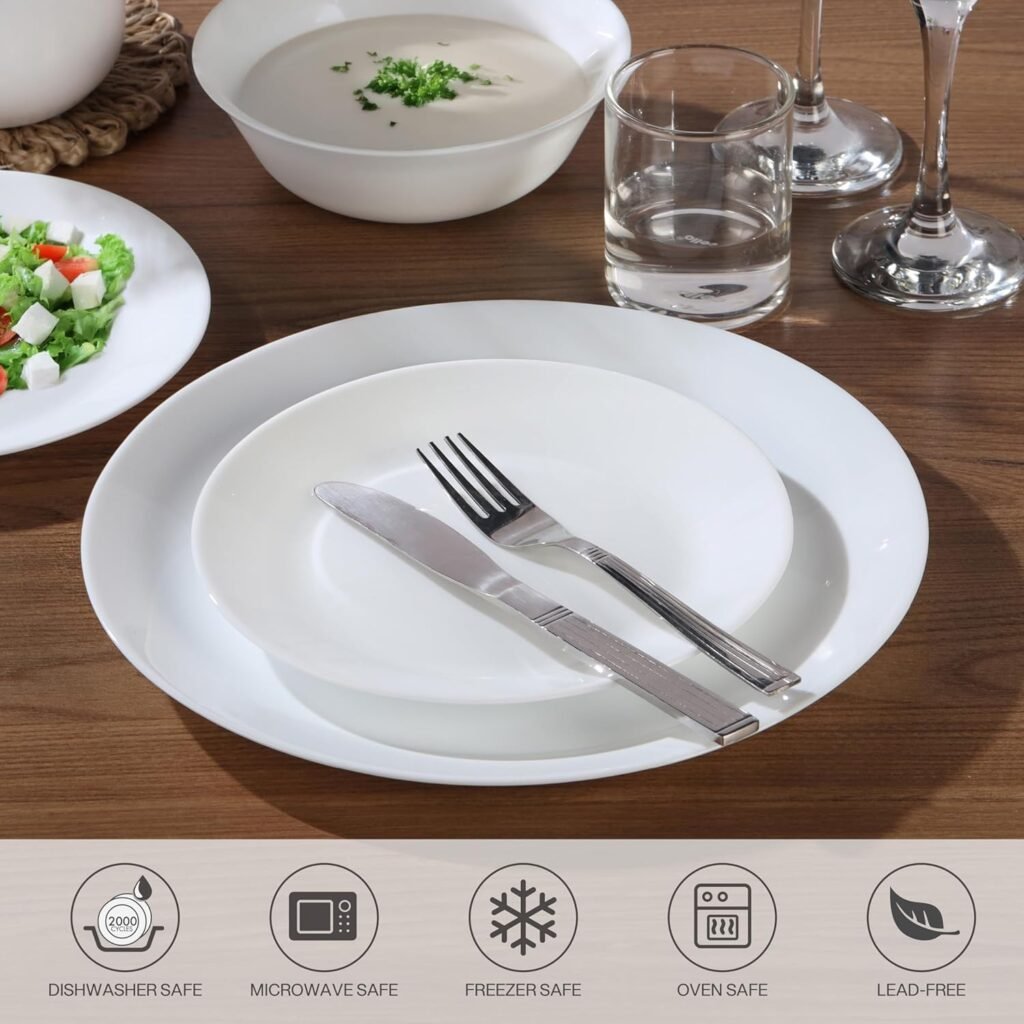
Both brands market their opalware with broadly similar property claims: break-resistant (not breakproof), chip-resistant, scratch-resistant, non-porous, microwave safe, dishwasher safe, freezer safe, 100% bone ash free (vegetarian), hygienic, and lightweight.
These claims are accurate for the material category. Opalware genuinely delivers all of these properties relative to regular glass, ceramics, and melamine.
The differentiation between brands at this level, therefore, does not come from the material itself.
It comes from the specific glass formulation, tempering quality and consistency, glaze application, decoration technique, and manufacturing precision areas where La Opala’s longer category experience is a genuine structural advantage, even if the end-consumer benefits are difficult to quantify without side-by-side testing.
Cello specifically markets its opalware as manufactured using German technology as per European quality standards, a claim that addresses the technology gap of entering the category 29 years after La Opala by anchoring to international manufacturing benchmarks.
This is a meaningful differentiator from unbranded or lower-quality opalware producers, but it does not close the experiential gap with La Opala’s three decades of proprietary process development.
The Product Tier Structure: Where They Differ Most Clearly
This is the most practically important difference between the two brands, and the one most comparison articles omit.
La Opala’s Two-Tier Architecture
La Opala operates two distinct product tiers under separate brand names:
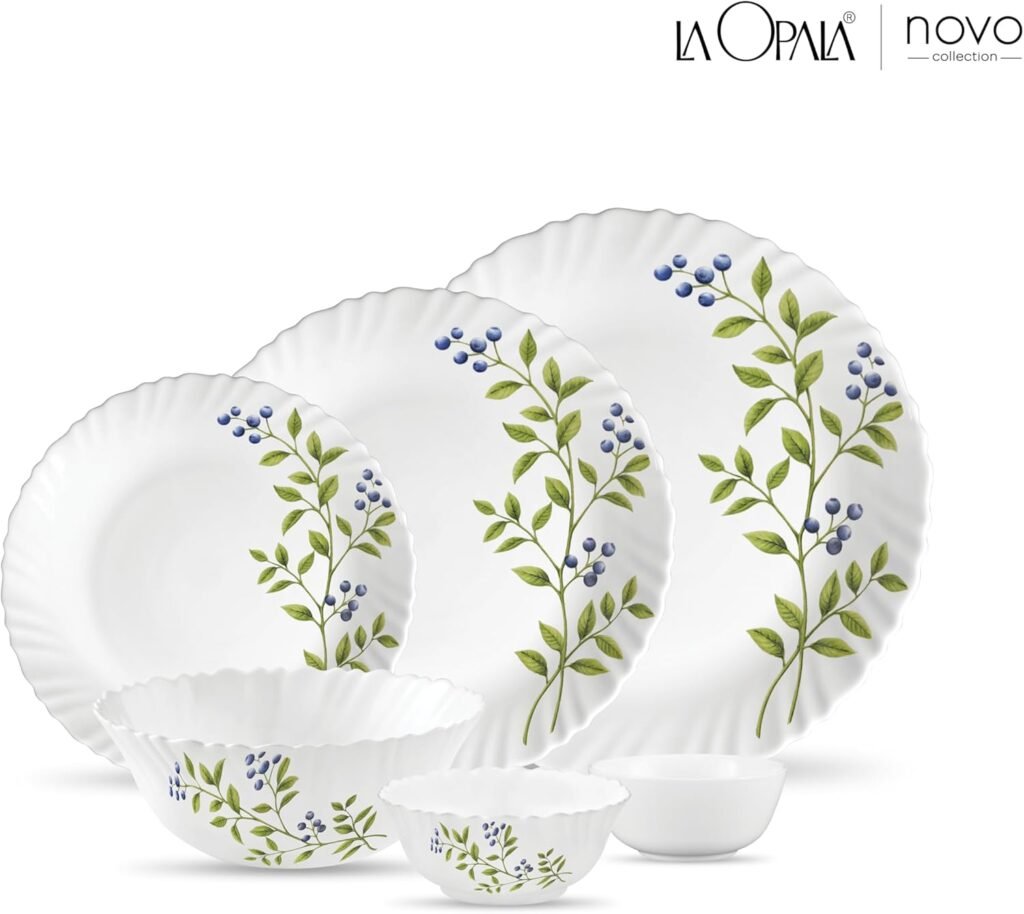
La Opala (flagship everyday brand): The accessible tier, positioned for daily household use across Indian homes at affordable price points. Collections under this brand include the Novo collection (patterns such as Autumn Flowers, Trinity Green, Vivid Green, Eros, English Lavender, Blissful Green, Radiant Curves) and a range of simpler designs with floral motifs on white backgrounds. This tier competes directly with Cello on price and everyday appeal.
Diva from La Opala (premium tier, launched 2008): A distinctly higher-positioned line manufactured at the Sitargunj plant with European automation technology. Diva offers multiple named collections — Classique (distinctive fluted design with dainty floral motifs), Ivory (smooth milky glaze with international styling), Cosmo (designed for HORECA — hotels, restaurants, catering), Quadra, Sovrana, Pearl, Velvett, and a Tea & Coffee series. Diva is explicitly positioned for gifting, formal dining, and buyers who want premium Indian opalware with international design sensibility. It is priced at a meaningful premium over the La Opala flagship range.
This two-tier structure means La Opala can serve buyers from the everyday affordable segment all the way to premium gifting occasions within a single brand family using opalware throughout, but at meaningfully differentiated quality and design levels.
Cello’s Single-Tier Opalware Range
Cello’s opalware range operates primarily at a single consumer tier — accessible, value-for-money dinnerware with good quality and broad design variety.
Cello does not have an equivalent to Diva: there is no Cello opalware sub-brand explicitly positioned as premium or formal. Its competitive advantage is pricing aggressiveness and distribution reach, not a premium tier.
This means the comparison shifts depending on which La Opala tier you put Cello against:
- Cello vs. La Opala (flagship): Genuine competition on similar ground, both accessible, both everyday opalware, Cello typically is more affordable in price than La Opala, La Opala with a slight edge in design refinement and brand heritage.
- Cello vs. Diva from La Opala: Not the same category — Diva is a premium product with no equivalent in Cello’s current opalware range. Buyers seeking premium gifting or formal dining opalware are shopping a category that Cello does not currently serve.
Head-to-Head on the Factors That Matter
Price
Cello is more affordable than the La Opala Opalware dinnerware brand.
Design Range and Aesthetic Quality
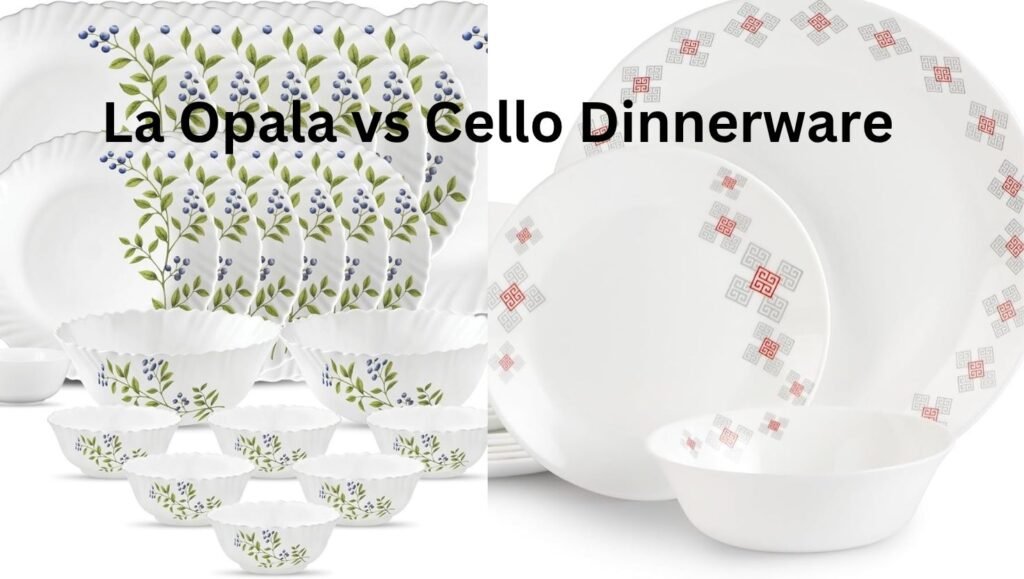
Both brands offer wide design ranges with floral, geometric, and contemporary motifs. La Opala’s flagship range is noted for “minimalist designs and excellent quality” with contoured edges and a restrained, modern Indian aesthetic.
The Diva range adds fluted rims, soft milky ivory glazes, and explicitly international design sensibility across its multiple collections.
Cello’s design range is broad; the company leverages its extensive SKU catalog to offer variety across price points, and its designs are “minimal yet royal-looking” according to consumer assessments.
However, Cello’s opalware design identity is less clearly differentiated than La Opala’s multi-tier approach, which assigns distinct visual personalities to each sub-brand and collection.
Distribution and Retail Availability
Cello has a decisive advantage in distribution reach. With over 3,800 distributors and 145,000+ retail touchpoints, Cello opalware is available at small local kitchenware shops, large modern retail, and e-commerce platforms across India.
La Opala has strong distribution in urban markets and established dealer networks but has a narrower retail footprint than Cello and — as the MNCL research confirms — experienced a “temporary dip in market share due to dealer rationalisation” in 2024-2025.
If you are in a smaller city or town, Cello is more likely to be available locally than La Opala.
Gifting Suitability
Opalware is one of the most popular gifting categories in India for weddings, anniversaries, housewarmings, and festive occasions. Industry research confirms opalware remains “a popular gifting choice” with demand particularly strong around weddings.
For gifting, the La Opala Diva range, especially Classique, Ivory, and Sovrana, is the more compelling choice: the premium positioning, distinctive packaging, and elegant aesthetic make it feel like a gift worth giving.
Cello’s opalware, while perfectly good quality, lacks a gift-tier sub-brand that signals premium intent in the way Diva does.
For everyday purchase (not gifting), this distinction disappears; both brands deliver good-quality opalware that suits daily use.
Market Position and Brand Perception
Three-way retail channel research across Western and Northern India (MNCL Group, November 2025) provides the clearest independent summary of how each brand is perceived at retail:
- Cello: “Fastest-moving brand, supported by strong retailer push and rising consumer preference.” Wins on price aggressiveness and distribution depth.
- La Opala: “Pioneer in Opalware, retains premium positioning owing to its product quality.” Had a temporary market share dip, but “given its high product quality, remains optimistic about regaining its footing.”
Cello winning on velocity and distribution, La Opala winning on quality heritage and premium positioning, is the most accurate single summary of how the two brands actually differ at retail.
Full Comparison Table
| Factor | La Opala | Cello |
|---|---|---|
| Opalware experience | Since 1988 (37 years) | Since 2017 (8 years) |
| Manufacturing technology | Proprietary process + European tech (Diva) | German technology, European standards |
| Product tiers | Two: La Opala (everyday) + Diva (premium) | One: single accessible-premium opalware tier |
| Price positioning | Flagship: mid; Diva: premium | Aggressive/competitive pricing |
| Distribution reach | Strong urban; narrower overall | Very wide: 3,800+ distributors, 145,000+ retailers |
| Design differentiation | Highly distinct collections per sub-brand | Broad variety, less sub-brand differentiation |
| Gifting suitability | Excellent (especially Diva) | Good for everyday gifting; no premium tier |
| Category focus | Opalware and glassware specialist | Diversified housewares (opalware is one category) |
| Listed company | Yes (BSE/NSE) | Yes (NSE/BSE, since Nov 2023) |
| Manufacturing base | Sitargunj (Uttarakhand) + Madhupur (Bihar) | 13 facilities across 5-6 India locations |
| Export presence | ~40 countries | Primarily India-focused |
Who Should Choose Each Brand
Choose La Opala if:
- You are buying for gifting — a wedding, anniversary, or housewarming — and want opalware that feels premium and reads as a considered choice. The Diva range is specifically designed for this.
- You value category expertise and want the brand that has been doing opalware the longest in India with the deepest manufacturing knowledge.
- You want a broader range of design aesthetics, including truly premium collections (Ivory, Classique, Sovrana) with no equivalent in Cello’s range.
- You are buying for export or international gifting — La Opala exports to 40 countries, and its international brand recognition is stronger than Cello’s outside India.
- You want the reassurance of buying from a company whose entire identity and institutional expertise is opalware, not one of many product categories.
Choose Cello if:
- You want the lowest price for good-quality opalware from a reputable Indian brand — Cello’s aggressive pricing strategy consistently delivers value at the entry level.
- You are in a smaller city or town where La Opala’s distribution is thinner — Cello’s 145,000+ retail points make it far easier to find locally.
- You are buying for everyday daily use without premium gifting considerations and want to maximize set size per rupee.
- You already trust the Cello brand across other product categories in your home and want to extend that relationship to dinnerware.
- You want a wide variety of designs across a single brand with no need to navigate sub-brands.
The honest verdict: For everyday affordable opalware, both brands deliver comparable quality, and neither will disappoint.
For premium gifting, formal dining, or buyers who value category heritage, La Opala — specifically the Diva range — is the stronger choice with no direct Cello equivalent. For the widest retail access and most competitive pricing, Cello wins.
For more context on how opalware compares to other dinnerware materials and brands, see our La Opala vs Corelle comparison and our non-toxic dinnerware guide for a full ranking of materials by chemical safety.
Frequently Asked Questions
Is La Opala better than Cello?
For premium gifting and design, La Opala — particularly the Diva range — is better, with no direct Cello equivalent at that tier. For everyday affordable opalware and the widest retail availability, Cello is more competitive on price and distribution.
For standard daily household use, both brands deliver comparable quality from the same material category.
Which brand is better for gifting — La Opala or Cello?
La Opala’s Diva range — collections like Classique, Ivory, and Sovrana are the stronger gifting choice.
The premium positioning, distinctive aesthetics, and packaging are designed for the gifting occasion in a way that Cello’s current opalware range is not.
For everyday gifting at moderate price points, both brands work well; for a notable gift that signals quality and care, Diva from La Opala is the clear choice.
Is Cello opalware as good quality as La Opala?
In the everyday accessible segment, Cello opalware is of good quality, produced to German technology standards, and broadly comparable to La Opala’s flagship range.
The quality gap between La Opala and Cello becomes more visible when comparing La Opala Diva — which benefits from 37 years of proprietary opal glass expertise and dedicated European-technology manufacturing — against Cello’s opalware, which entered the category in 2017.
Category expertise and manufacturing heritage do produce measurable quality differences over time, though both brands meet consumer expectations for daily opalware use.
Which brand has better retail availability in India?
Cello has a significantly wider retail distribution — over 3,800 distributors and 145,000+ retail touchpoints across India.
La Opala has a strong urban retail presence but a narrower overall footprint, and experienced a recent temporary market share dip attributed partly to dealer rationalisation.
For buyers in smaller cities and towns, Cello is more reliably available at local retail.
Do both La Opala and Cello use bone ash?
No. Both brands explicitly market their opalware as bone ash-free and 100% vegetarian.
Opal glass is made from mineral compounds, such as glass, feldspar, silica, fluorine, with no animal-derived ingredients.
This is a shared attribute that distinguishes both from bone china, which by definition contains a minimum percentage of calcined animal bone.