Baccarat crystal patterns represent centuries of French craftsmanship, with each design reflecting specific cutting techniques, artistic periods, and manufacturing traditions.
Identifying these patterns helps authenticate pieces, determine production dates, and assess market value.
From the bold geometric cuts of Harcourt to the radiating diamonds of Masséna, Baccarat’s signature patterns distinguish authentic pieces from generic cut crystal and competing brands.
Pattern recognition requires examining cut motifs, density, symmetry, and overall design philosophy that evolved from 19th-century classical styles through Art Deco innovations to contemporary minimalism.
This comprehensive guide explores how to recognize Baccarat’s most iconic patterns, differentiate them from similar crystal designs, and use pattern identification alongside Baccarat crystal marks for complete authentication and valuation.
Why Baccarat Crystal Patterns Matter
Patterns serve as visual signatures that identify Baccarat pieces, influence market value, and reflect the brand’s artistic heritage across different production periods.

Patterns as Brand Signatures
Baccarat’s distinctive cutting patterns function like trademarks, instantly recognizable to collectors and experts.
Each named pattern follows precise specifications passed down through generations of master cutters.
These designs distinguish Baccarat from generic cut crystal and competing manufacturers, representing the company’s artistic identity and technical excellence.
Collectibility and Resale Value
Specific patterns command different prices based on rarity, popularity, and production period.
Iconic designs like Harcourt retain exceptional value due to their timeless appeal and continuous production since 1841.

Limited edition patterns or discontinued designs often appreciate significantly. Pattern identification directly impacts appraisal values and collector interest levels.
Pattern Consistency Across Forms
Baccarat maintains pattern integrity whether applied to wine glasses, decanters, vases, or chandeliers.
This consistency allows collectors to build matching sets and confirms authenticity through design uniformity.
A pattern’s execution quality should remain identical regardless of piece size or function, demonstrating manufacturing precision.
How Baccarat Crystal Patterns Are Created
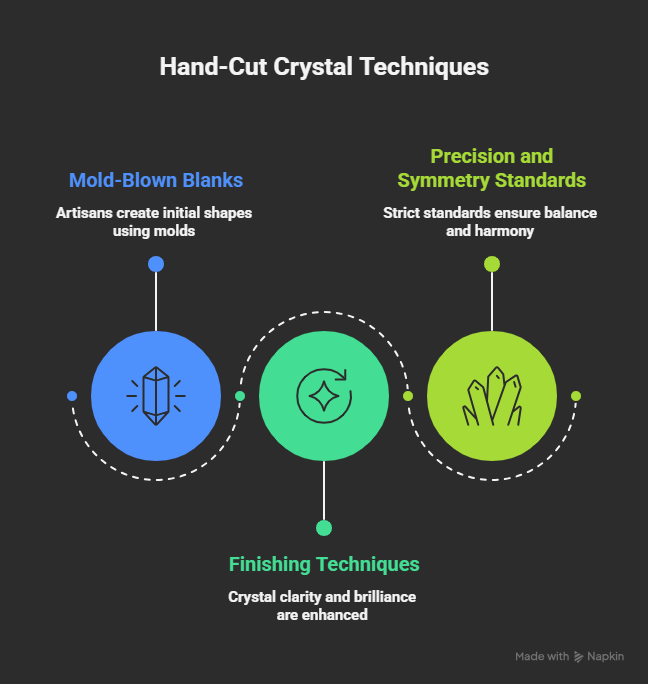
Understanding Baccarat’s manufacturing process explains why patterns appear so precise and how craftsmanship distinguishes authentic pieces from imitations.
Hand-Cut Crystal Techniques
Master cutters use rotating copper wheels with diamond abrasives to carve patterns into finished crystal pieces.
Each cut requires precise angle control, consistent pressure, and exact depth to match pattern specifications.
This hand-cutting produces sharp edges, perfect symmetry, and the characteristic brilliance that machine cutting cannot replicate.
Mold-Blown Blanks and Finishing
Baccarat creates base forms through mold-blowing molten crystal into preliminary shapes. After cooling, these blanks undergo hand-cutting to add decorative patterns.
The combination of molded forms and hand-finished patterns ensures consistency while maintaining artisanal quality.
Final polishing removes any roughness, creating glass-smooth surfaces.
Precision and Symmetry Standards
Baccarat’s quality control demands mathematical precision in pattern execution. Cuts must align perfectly around circumferences, with identical depths and angles.
Any deviation results in rejection. This exacting standard produces the flawless symmetry and pattern repetition that authenticate genuine Baccarat pieces and justify premium pricing.
Key Visual Elements Used to Identify Baccarat Patterns
Recognizing specific cutting elements and their arrangements helps identify patterns and distinguish Baccarat from other crystal manufacturers.
Cut Motifs
Baccarat employs recurring geometric shapes that define pattern character and visual impact.
Diamonds
Diamond cuts create faceted surfaces arranged in crosshatch or radiating patterns. These geometric cuts produce maximum light refraction and sparkle.
Diamond motifs vary from small, densely packed facets to large, bold diamonds, depending on the specific pattern design.
Fans
Fan-shaped cuts radiate outward from central points, creating semicircular or quarter-circle patterns.
These decorative elements add movement and elegance, often appearing on bowl bases or stem tops. Fans range from simple radiating lines to complex multilayered designs.
Stars
Star patterns feature pointed rays extending from central hubs, creating sunburst effects. These cuts often appear on bases or as accent elements within larger patterns.
Star complexity varies from simple four-point designs to elaborate multi-pointed configurations.
Panels
Flat panel cuts create smooth, uncut sections bordered by cut edges. This technique, prominent in Harcourt and Talleyrand patterns, produces architectural boldness and modern aesthetics.
Panels contrast sharply with densely cut areas, creating dramatic visual effects.
Pattern Density
The spacing and depth of cuts significantly impact pattern identification and visual character.
Deep vs Shallow Cuts
Deep cuts create dramatic shadows and bold visual impact, characteristic of traditional Baccarat patterns.
Shallow cuts produce subtle elegance and contemporary aesthetics. Cut depth affects light refraction intensity and pattern visibility.
Genuine Baccarat maintains consistent depth throughout each pattern element.
Tight vs Open Spacing
Tightly spaced cuts cover surfaces densely, maximizing sparkle and complexity. Open spacing emphasizes individual cut elements with more uncut crystal between motifs.
Spacing consistency indicates authentic Baccarat, while irregular spacing suggests inferior quality or imitation pieces.
Repetition & Symmetry
Pattern organization and alignment reveal manufacturing quality and authentication markers.
Consistency Around the Piece
Authentic Baccarat patterns repeat identically around the entire circumference without variation or alignment errors.
Check that diamond cuts, fans, or other motifs match perfectly when rotating the piece. Any irregularity in repetition indicates lower quality production or potential counterfeit.
Most Popular Baccarat Crystal Patterns
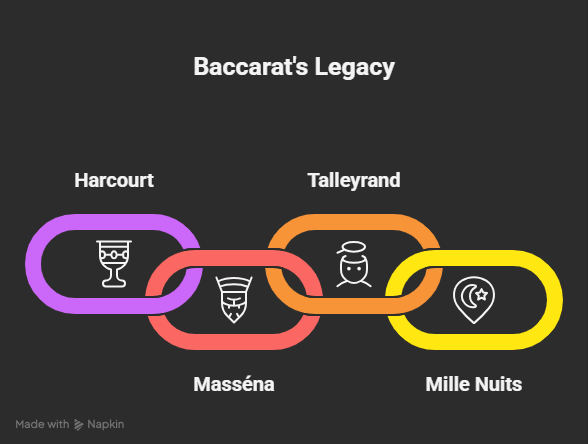
These iconic designs represent Baccarat’s most recognized and collected patterns, each with distinctive visual characteristics.
Harcourt
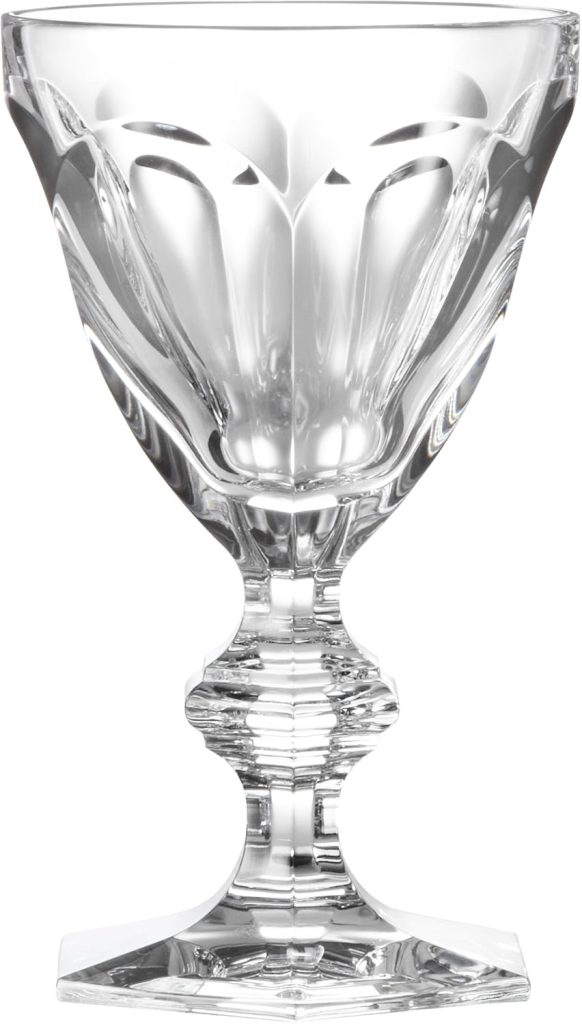
First created in 1841, Harcourt remains Baccarat’s most famous pattern, commissioned by King Louis-Philippe for his château.
Bold Geometry
Harcourt features flat hexagonal panels alternating with vertical cuts, creating architectural boldness.
The design emphasizes clean lines and geometric precision over ornate decoration. Large uncut panels showcase crystal clarity while cut sections provide contrasting brilliance.
Architectural Cuts
Sharp angles and flat surfaces give Harcourt a modern, structural aesthetic despite its 19th-century origins.
The pattern’s geometry resembles Art Deco architecture decades before that movement emerged. This timeless quality ensures continued popularity and high collectibility.
Masséna
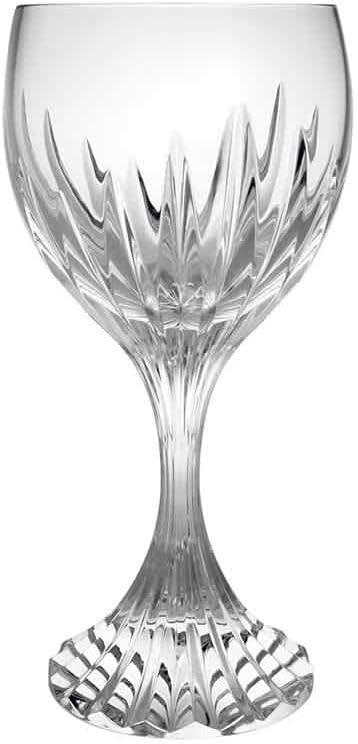
Named after Napoleon’s marshal, Masséna showcases elaborate diamond cutting that maximizes light refraction and sparkle.
Radiating Diamond Cuts
Masséna employs densely packed diamond facets radiating from central points, creating complex geometric patterns.
Multiple layers of diamonds intersect at varying angles, producing exceptional brilliance. This intricate cutting requires exceptional skill and precision.
Highly Reflective
The pattern’s dense faceting creates maximum light refraction, making Masséna pieces particularly sparkly and eye-catching.
Light bounces through multiple diamond surfaces, creating rainbow effects. This reflectivity distinguishes Masséna from simpler cut patterns.
Talleyrand
Created in the 1930s, Talleyrand offers a streamlined interpretation of Baccarat’s cutting heritage with vertical emphasis.
Vertical Panel Cuts
Talleyrand features tall, narrow panels separated by vertical cuts running from base to rim. This elongated geometry creates elegant, modern proportions.
The vertical emphasis flatters stemware shapes and adds contemporary sophistication.
Modern Aesthetic
Despite vintage origins, Talleyrand’s clean lines and minimal ornamentation feel thoroughly modern.
The pattern demonstrates Baccarat’s ability to evolve aesthetically while maintaining technical excellence. Its simplicity appeals to contemporary collectors seeking understated elegance.
Mille Nuits

Designed by Mathias in 2002, Mille Nuits reinterprets traditional cutting with contemporary sensibility and optical innovation.
Contemporary Reinterpretation
Mille Nuits combines traditional diamond cutting with modern proportions and placement. The pattern references historical Baccarat designs while feeling distinctly 21st-century.
This bridge between tradition and innovation attracts both classic and contemporary collectors.
Optical Distortion
The pattern’s dense, multilayered cutting creates intentional optical effects, making images viewed through the crystal appear refracted and artistic.
This visual playfulness distinguishes Mille Nuits from strictly traditional patterns, showcasing Baccarat’s continued innovation.
How to Identify an Unknown Baccarat Pattern
Systematic examination and comparison help attribute unmarked or unfamiliar patterns to specific Baccarat designs.
Count and Map Cut Elements
Document the types, quantities, and arrangement of cutting elements. Note how many diamond cuts appear per inch, whether fan motifs repeat consistently, and where panels or stars occur.
Creating a simple sketch helps compare against reference images. This methodical approach reveals pattern structure.
Examine Base, Bowl, and Stem Separately
Different sections often feature distinct cutting patterns. Bases frequently display star or fan motifs, bowls show the primary pattern, and stems may have simple cuts or remain plain.
Analyze each area independently, then consider how they combine into the complete design aesthetic.
Compare Against Reference Catalogs
Consult Baccarat pattern books, museum collections, or auction house archives showing named patterns.
Match your piece’s cutting elements, density, and arrangement to documented examples. Online databases and collector resources provide comparison images.
For comprehensive authentication, review the Baccarat crystal identification process.
Cross-Check with Markings
Verify any Baccarat crystal marks present on the piece to confirm authenticity before attributing patterns.
Genuine marks combined with recognized pattern elements provide strong authentication.
However, remember that pre-1936 pieces lack marks despite having authentic patterns.
Baccarat Pattern Variations by Era
Pattern styles evolved across Baccarat’s history, reflecting changing artistic movements and consumer preferences.
19th-Century Classic Patterns
Early Baccarat favored elaborate, densely cut patterns with complex geometric arrangements.
Designs emphasized craftsmanship, virtuosity, and ornamental richness appropriate to Victorian tastes.
Patterns like Masséna and early Harcourt variations showcase this period’s decorative abundance and technical ambition.
Art Deco-Era Designs
The 1920s-1930s brought geometric simplification and streamlined aesthetics to Baccarat patterns.
Designs emphasized bold lines, symmetry, and architectural qualities. Talleyrand exemplifies this era’s modern sensibility while maintaining Baccarat’s quality standards.
Art Deco patterns balance decoration with restraint.
Modern Minimalist Patterns
Contemporary Baccarat incorporates clean lines, strategic cutting placement, and negative space.
Modern patterns use fewer but more impactful cuts, emphasizing crystal clarity alongside decoration.
Designs like Mille Nuits demonstrate continued innovation while respecting traditional craftsmanship techniques.
Baccarat Patterns vs Similar Crystal Patterns
Understanding distinctions between Baccarat and competing manufacturers helps prevent misattribution and confirms authenticity.
Baccarat vs Waterford
Both produce premium cut crystal, but pattern execution and material properties differ noticeably.
Cut Sharpness
Baccarat cuts feel exceptionally sharp and precise with glass-smooth polishing. Waterford cuts, while high quality, typically feel slightly less crisp.
Running fingers over patterns reveals these tactile differences. Baccarat’s superior polishing creates remarkable smoothness despite intricate cutting.
Weight and Clarity
Baccarat’s higher lead content produces greater weight and superior clarity compared to Waterford.
When comparing similar pieces, Baccarat feels noticeably heavier. The crystal clarity appears more water-clear, with superior light refraction.
These material differences complement pattern distinctions.
Baccarat vs Val Saint Lambert
The Belgian crystal manufacturer produces quality cut crystal, but with detectable differences from Baccarat.
Pattern Depth
Baccarat maintains more consistent cut depths throughout patterns compared to Val Saint Lambert’s occasionally variable depths.
Baccarat’s quality control ensures uniform cutting across all pattern elements. Val Saint Lambert pieces sometimes show slight depth variations within the same pattern.
Symmetry Consistency
Baccarat’s pattern symmetry proves more mathematically precise than Val Saint Lambert’s generally good but not perfect alignment.
Examine how patterns meet when rotating pieces. Baccarat shows flawless repetition, while Val Saint Lambert may display minor irregularities detectable upon close inspection.
Common Mistakes When Identifying Baccarat Patterns
Avoiding these frequent errors improves identification accuracy and prevents misattribution.
Confusing Generic Cut Crystal with Baccarat
Many manufacturers produce diamond-cut crystal resembling Baccarat patterns. Generic cut glass lacks Baccarat’s weight, clarity, and cutting precision.
Don’t assume any cut crystal with diamonds or fans is Baccarat; examine material quality, weight, and craftsmanship details alongside pattern recognition.
Relying on Pattern Alone Without Marks
Patterns help identify pieces, but shouldn’t be the sole authentication factor. Other manufacturers copied popular Baccarat designs.
Always verify marks when present, assess material properties, and evaluate overall craftsmanship quality.
Pattern familiarity complements rather than replaces comprehensive authentication.
Ignoring Craftsmanship Quality
Focus on execution quality, not just pattern type. Genuine Baccarat demonstrates perfect symmetry, consistent cut depth, and flawless polishing.
Poor quality cutting, irregular patterns, or rough edges indicate non-Baccarat origin regardless of pattern similarity to authentic designs.
Using Pattern Identification to Determine Value
Pattern recognition directly impacts market valuation and collector desirability across different factors.
Rare vs Common Patterns
Limited production patterns, discontinued designs, and special commissions command premium prices.
Harcourt remains valuable due to its iconic status despite continuous production.
Rare patterns in excellent condition often exceed common patterns regardless of age. Research production history and availability when valuing pieces.
Pattern Condition and Wear
Chips, scratches, or worn cutting edges reduce value significantly. Examine cut edges for damage and surfaces for scratches.
Deep cuts show wear more visibly than shallow designs. Pristine pattern condition maximizes value, while damage substantially decreases worth even for rare patterns.
Completeness of Sets
Complete matching sets in single patterns command premium pricing over individual pieces.
A full Harcourt stemware service holds significantly more value than random mixed pieces.
Collectors pay substantially more for complete, matching pattern sets versus assembled groupings.
Tools & Resources for Baccarat Pattern Identification
Multiple reference sources aid pattern identification and authentication verification.
Baccarat Archives
The Baccarat Museum in Paris maintains comprehensive historical records, including pattern catalogs, production dates, and design documentation.
Contact them with detailed photographs for pattern identification assistance.
They provide authoritative information for unusual or rare patterns not documented in general references.
Collector Books and Catalogs
Reference books like “Baccarat: The Ultimate Collection” document patterns with photographs and production histories.
Vintage Baccarat catalogs show original marketing materials. These resources provide visual comparisons and contextual information essential for accurate identification.
Auction House Databases
Major auction houses publish online archives of sold Baccarat items with pattern attributions and photographs.
Search Christie’s, Sotheby’s, and regional auction records to find comparable pieces. These databases show market values alongside pattern identifications.
Expert Appraisers
Certified appraisers specializing in decorative arts and crystal provide professional pattern identification.
They access comprehensive reference libraries and comparison collections. Professional authentication offers documentation valuable for insurance, estate planning, or resale purposes.
FAQ — Baccarat Crystal Pattern Identification
How many Baccarat crystal patterns exist?
Baccarat has created hundreds of patterns since 1764, though many are discontinued.
Approximately 50-75 patterns remain in current production.
Vintage and antique patterns significantly expand the total number requiring identification expertise.
Can patterns help date Baccarat crystal?
Yes. Certain patterns were produced during specific periods, helping date pieces. Art Deco patterns indicate 1920s-1930s production.
However, popular patterns like Harcourt span decades, requiring additional dating methods beyond the pattern alone.
Are modern Baccarat patterns less valuable?
Not necessarily. Limited edition contemporary patterns can be highly valuable. Value depends more on rarity, condition, and demand than age alone.
Some modern patterns command higher prices than common vintage designs.
Do all Baccarat patterns have names?
No. While iconic patterns like Harcourt and Masséna have official names, many patterns, especially older or less prominent designs, lack documented names.
Collectors sometimes use descriptive terms for unnamed patterns.
Final Verdict — Identifying Baccarat Crystal Patterns With Confidence
Successful Baccarat pattern identification requires systematic examination combining multiple verification methods.
Begin by analyzing key visual elements, document cut motifs like diamonds, fans, stars, or panels present in the pattern.
Assess pattern density through cut depth and spacing, noting whether designs appear bold or subtle.
Examine symmetry and repetition quality around the entire piece, confirming mathematical precision that distinguishes authentic Baccarat.
Compare your findings against reference materials, including collector books, museum archives, and auction databases, to match observed characteristics with documented patterns.
Cross-reference pattern identification with any marks present, remembering that unmarked pieces require additional authentication through weight, clarity, and craftsmanship evaluation.
Consider the piece’s era by evaluating whether cutting style reflects 19th-century elaboration, Art Deco streamlining, or contemporary minimalism.
Avoid common mistakes by not assuming all cut crystal is Baccarat or relying solely on patterns without confirming material quality and manufacturing precision.
When uncertainty persists, consult professional appraisers or contact Baccarat archives for expert verification, especially for rare or unusual patterns requiring specialized knowledge.