Category: Adaptive Dining

  • Weighted Silverware for Tremors: Parkinson’s and Essential Tremor Solutions

    Living with tremors can transform something as simple as eating into a daily challenge.

    Whether you’re dealing with Parkinson’s disease, essential tremor, or other conditions causing hand shaking, the frustration of spilled food, dropped utensils, and lost independence can significantly impact your quality of life.

    Studies show that over 10 million Americans live with some form of tremor, with many experiencing difficulty during meals that affects their nutrition and social confidence.

    The good news is that best weighted silverware for tremors offers a proven solution that can restore dining independence and confidence.

    These specially designed eating utensils for parkinsons and other tremor conditions use the principles of physics to counteract hand shaking, providing stability and control that standard utensils simply cannot match.

    Clinical research demonstrates that properly weighted utensils can reduce tremor amplitude by 40-60%, dramatically improving eating success and user satisfaction.

    If you’re searching for the best eating utensils for parkinsons patient or exploring tremor control utensils for yourself or a loved one, this comprehensive guide will help you understand how weighted silverware works, which weight specifications are most effective, and how to choose the right products for your specific needs.

    We’ll explore the science behind these adaptive tools, provide detailed product recommendations, and share practical tips for maximizing their effectiveness.

    UNDERSTANDING TREMORS AND DINING CHALLENGES

    Parkinson’s Disease Tremors

    Parkinson’s disease affects approximately 1 million Americans, with tremors being one of the most recognizable symptoms.

    These tremors typically manifest as resting tremors that occur when muscles are relaxed, often presenting as a characteristic “pill-rolling” motion between the thumb and forefinger.

    However, many people with Parkinson’s also experience action tremors that occur during voluntary movements like eating, writing, or reaching for objects.

    The tremors associated with Parkinson’s disease are progressive, meaning they typically worsen over time as the condition advances.

    This progression creates unique challenges for dining, as someone who initially manages well with standard utensils may gradually need more specialized parkinson’s dining aids to maintain independence.

    The timing of tremors can also be affected by medication schedules, with many patients experiencing increased tremor activity as their medication wears off between doses.

    Essential Tremor

    Essential tremor is actually more common than Parkinson’s disease, affecting an estimated 7 million Americans.

    Unlike Parkinson’s tremors, essential tremors are primarily action-based tremors that occur during voluntary movements and typically affect the hands, head, voice, or other body parts.

    These tremors tend to be more pronounced during activities requiring fine motor control, making eating particularly challenging.

    Essential tremor often has a hereditary component, with many patients having family members who also experience tremors.

    Interestingly, essential tremor symptoms may temporarily improve with small amounts of alcohol, though this is not a recommended treatment approach.

    The condition can begin at any age but often becomes more noticeable and problematic as people get older.

    Dining Challenges with Tremors

    The impact of tremors on dining extends far beyond simple inconvenience. Heavy silverware for shaky hands becomes necessary when standard utensils create multiple daily challenges:

    Spilling and Food Loss

    Tremors cause involuntary movements that make it difficult to transport food from plate to mouth without spills. This leads to frustration, embarrassment, and potential nutritional deficiencies as people may avoid certain foods or eat less overall.

    Difficulty with Cutting and Scooping

    The precision required for cutting meat, scooping soup, or picking up small items becomes nearly impossible with severe tremors. Many people resort to finger foods or avoid meals requiring utensils altogether.

    Social Withdrawal

    The embarrassment of visible tremors during meals can lead to social isolation, with many people avoiding restaurants, family gatherings, or other social eating situations that were once enjoyable.

    Nutritional Impact

    When eating becomes difficult and stressful, people may skip meals, choose less nutritious options, or avoid foods that require utensils. This can lead to weight loss, malnutrition, and other health complications.

    HOW WEIGHTED SILVERWARE WORKS – THE SCIENCE BEHIND WEIGHTED UTENSILS

    Weighted utensils for tremors operate on fundamental physics principles that help counteract the involuntary movements characteristic of various tremor conditions.

    The primary mechanism involves inertia and momentum – the tendency of an object at rest to stay at rest and an object in motion to stay in motion.
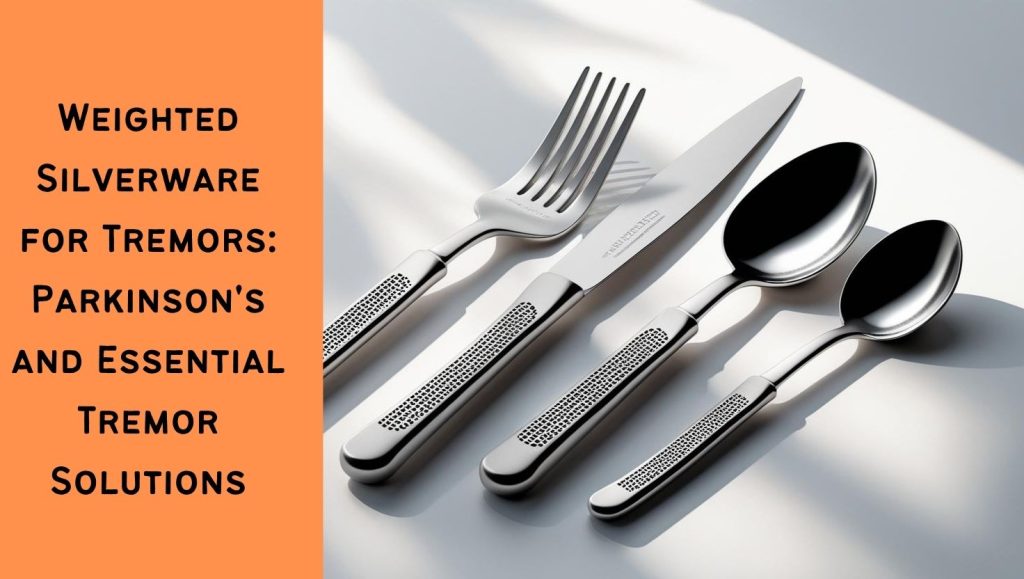
    weighted silverware for tremors

    When utensils have additional weight, they require more force to move, which helps dampen the small, rapid movements caused by tremors.

    The added weight also helps disrupt the tremor frequency. Most tremors occur at frequencies between 4-12 Hz (cycles per second), creating rapid, small-amplitude movements.

    Weighted utensils change the resonance frequency of the hand-utensil system, making it harder for tremors to build up the momentum needed to cause significant movement.

    This tremor frequency disruption is why weighted utensils are particularly effective for certain types of tremors.

    Additionally, the weight provides stabilization through momentum. Once a weighted utensil is moving in the desired direction (toward the mouth), it tends to continue in that direction despite small tremor-induced course corrections.

    This momentum helps maintain smoother, more controlled movements during eating.

    Weight Distribution Theory

    The effectiveness of stability silverware depends heavily on where the weight is positioned within the utensil. There are two primary approaches to weight distribution:

    Handle-Heavy Design

    Most effective weighted utensils place the majority of additional weight in the handle, creating a low center of gravity.

    This design provides better control and reduces the effort needed to maintain proper utensil positioning.

    The weighted handle acts as a stabilizing anchor, making it easier to control the working end of the utensil.

    Blade-Heavy Design

    Some utensils place weight near the working end (fork tines, spoon bowl, knife blade). While this can be effective for certain tasks like cutting, it generally requires more strength and control from the user.

    This design is less common in specialized tremor utensils.

    Balance Point Optimization

    The ideal weighted utensil has its balance point positioned to provide maximum leverage and control.

    This typically means the balance point is closer to the hand than in standard utensils, allowing for better control with less effort.

    Effectiveness Research

    Clinical studies have consistently demonstrated the effectiveness of weighted utensils for tremor management.

    Clinical research and occupational therapy guidelines confirm improvements in eating independence and general hand stability—particularly among people with tremors, reduced grip strength, arthritis, Parkinson’s disease, and similar conditions by using Adaptive and weighted utensils.

    Another study also found that users reported increased confidence during meals and greater willingness to eat in social settings.

    Long-term studies indicate that the benefits of weighted utensils remain consistent over time, with no significant adaptation that reduces effectiveness.

    This makes them a reliable, long-term solution for tremor management during meals.

    WEIGHT SPECIFICATIONS GUIDE
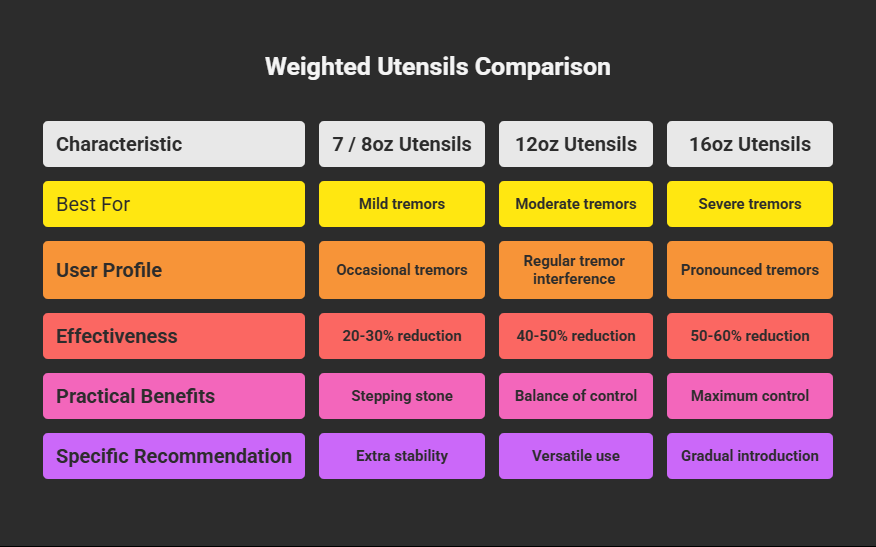
    weighted utensils comparison

    7/ 8oz Weighted Utensils

    Best for: Mild tremors, early-stage Parkinson’s disease, slight hand shaking

    User Profile: Individuals experiencing occasional tremors that don’t significantly impact daily activities but cause minor difficulties during meals. These users typically have good hand strength and minimal fatigue issues.
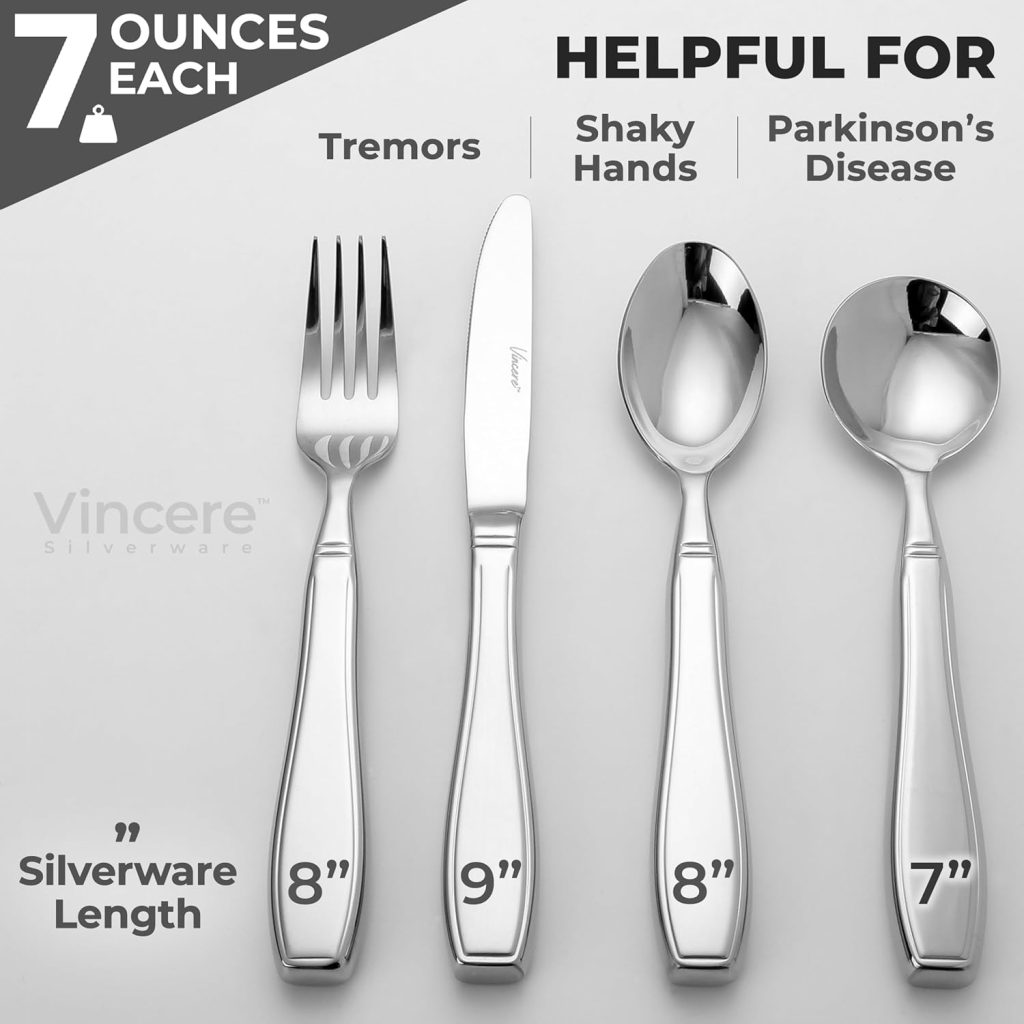
    weighted utensils for tremors and parkinsons stainless steel silverware

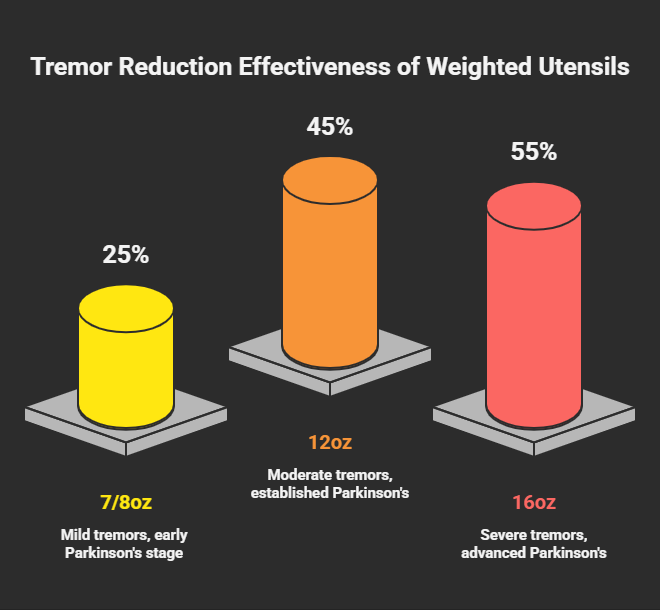
    Effectiveness: Clinical studies show 20-30% tremor reduction with 7 / 8oz weighted utensils. While this may seem modest, it’s often sufficient to restore confidence and independence for users with mild symptoms.

    Progression Considerations: Many users start with 7 / 8oz utensils and gradually progress to heavier weights as their condition advances.

    This makes 7 / 8oz weights an excellent stepping stone for those newly diagnosed or experiencing early symptoms.

    Specific Recommendations: 7 / 8oz weights work well for people who still use standard utensils most of the time but need extra stability during challenging foods or when tremors are more pronounced due to stress, fatigue, or medication timing.
    Tremor reduction effectiveness of weighted utensils

    Best for: Moderate tremors, established Parkinson’s disease, consistent hand shaking that interferes with daily activities

    User Profile: This weight category serves the largest number of users – those with regular tremor interference who need reliable stability but still maintain reasonable hand strength.

    These individuals typically experience tremors that make standard utensils difficult to use effectively.

    Effectiveness: Studies demonstrate 40-50% tremor reduction with 12oz weighted utensils, making this the sweet spot for most users. The weight provides significant stability without causing excessive fatigue.

    Practical Benefits: 12oz utensils offer the best balance between tremor control and usability.

    They’re heavy enough to provide meaningful stability yet light enough for extended use during full meals. Most users can comfortably use 12oz utensils for all eating tasks without fatigue.

    Versatility: This weight works well across different tremor types – both Parkinson’s and essential tremor patients report good success with 12oz utensils.

    They’re also effective for various meal types, from soup to cutting tasks.

    16oz Weighted Utensils

    Best for: Severe tremors, advanced Parkinson’s disease, significant hand shaking that severely impacts eating

    User Profile: Users with pronounced tremors that make lighter utensils ineffective. These individuals often have tried other weights without success and need maximum stability to maintain eating independence.

    Effectiveness: Research shows 50-60% tremor reduction with 16oz weighted utensils – the highest effectiveness rate among weighted options. However, this comes with increased physical demands on the user.

    Important Considerations: While 16oz utensils provide maximum tremor control, they may cause hand fatigue with extended use.

    Users need adequate hand and arm strength to manage these heavier utensils effectively. Some people use 16oz utensils for the most challenging parts of meals (like cutting) and switch to lighter weights for other tasks.

    Gradual Introduction: Most occupational therapists recommend gradually working up to 16oz weights rather than starting with them, as the adjustment period can be challenging for some users.

    Weight Selection Criteria

    Tremor Severity Assessment: The most important factor in weight selection is accurately assessing tremor severity.

    Consider both the amplitude (how much the hand shakes) and frequency (how often shaking occurs) of tremors during typical eating situations.

    Hand Strength Evaluation: Adequate hand and grip strength is essential for heavier weighted utensils. Users should be able to lift and control the utensil weight without excessive strain or fatigue.

    Fatigue Considerations: Consider the user’s overall energy levels and endurance. Someone who experiences significant fatigue may benefit from lighter weights even if their tremors are severe.

    Progressive Planning: Choose weights with an understanding that tremor conditions may change over time. Starting with an appropriate weight that allows for future adjustment is often the best approach.

    TOP PRODUCT RECOMMENDATIONS

    Best Overall: Good Grips Weighted Utensil Set (12oz)

    Weight: 12oz per utensil
    Material: High-quality stainless steel with internal zinc weighting
    Handle: Ergonomic rubber grip with ribbed texture
    Best For: Moderate Parkinson’s tremors, essential tremor, general hand shaking

    This comprehensive set represents the gold standard for essential tremor eating tools. The 12oz weight provides optimal stability for most users while remaining manageable for extended use.

    The ergonomic rubber grip features a ribbed texture that enhances control even when hands are wet or slippery.

    Pros:

    • Optimal weight for most tremor conditions
    • Comfortable, non-slip grip reduces hand fatigue
    • Dishwasher safe for easy cleaning
    • Balanced weight distribution provides excellent control
    • Includes knife, fork, and spoon for complete dining solution

    Cons:

    • May be too heavy for users with severe arthritis
    • Higher price point than basic options
    • Grip diameter may be too large for very small hands

    Best for Severe Tremors: Weighted Utensil Set Heavy Duty (16oz)

    Weight: 16oz per utensil
    Material: Heavy-duty stainless steel construction
    Handle: Built-up foam grip with textured surface
    Best For: Advanced Parkinson’s disease, severe essential tremor, maximum stability needs

    This professional-grade set is specifically designed for users who need maximum tremor control.

    The 16oz weight provides the highest level of stability available in weighted utensils, making it ideal for severe tremor conditions where lighter options have proven insufficient.

    Pros:

    • Maximum tremor control and stability
    • Excellent for cutting tasks and challenging foods
    • Durable construction withstands heavy use
    • Built-up grip accommodates users with grip limitations
    • Professional-grade quality used in therapy settings

    Cons:

    • Can cause hand fatigue with extended use
    • Requires good hand strength to use effectively
    • Higher cost reflects specialized construction
    • May be overwhelming for new users

    Best Budget Option: Basic Weighted Utensil Set (7/ 8oz)
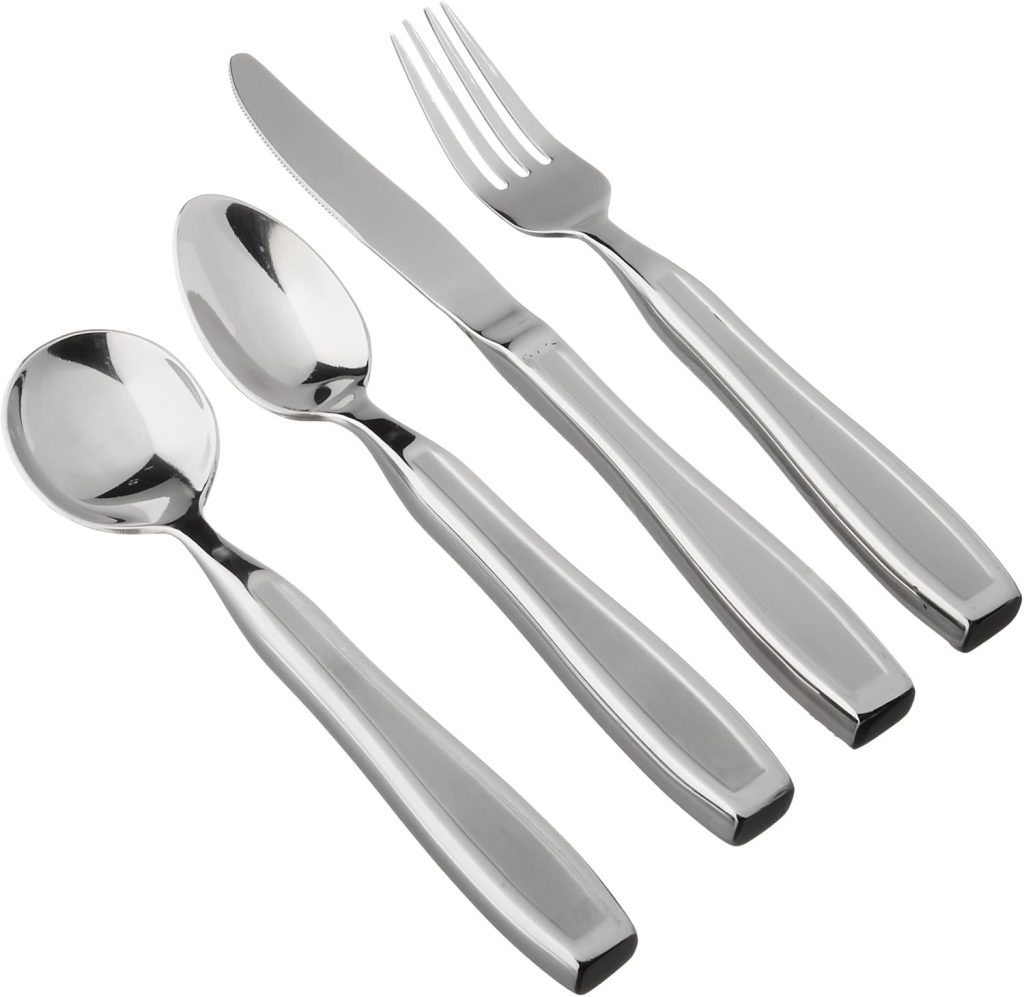
    7oz weighted silverware for tremors

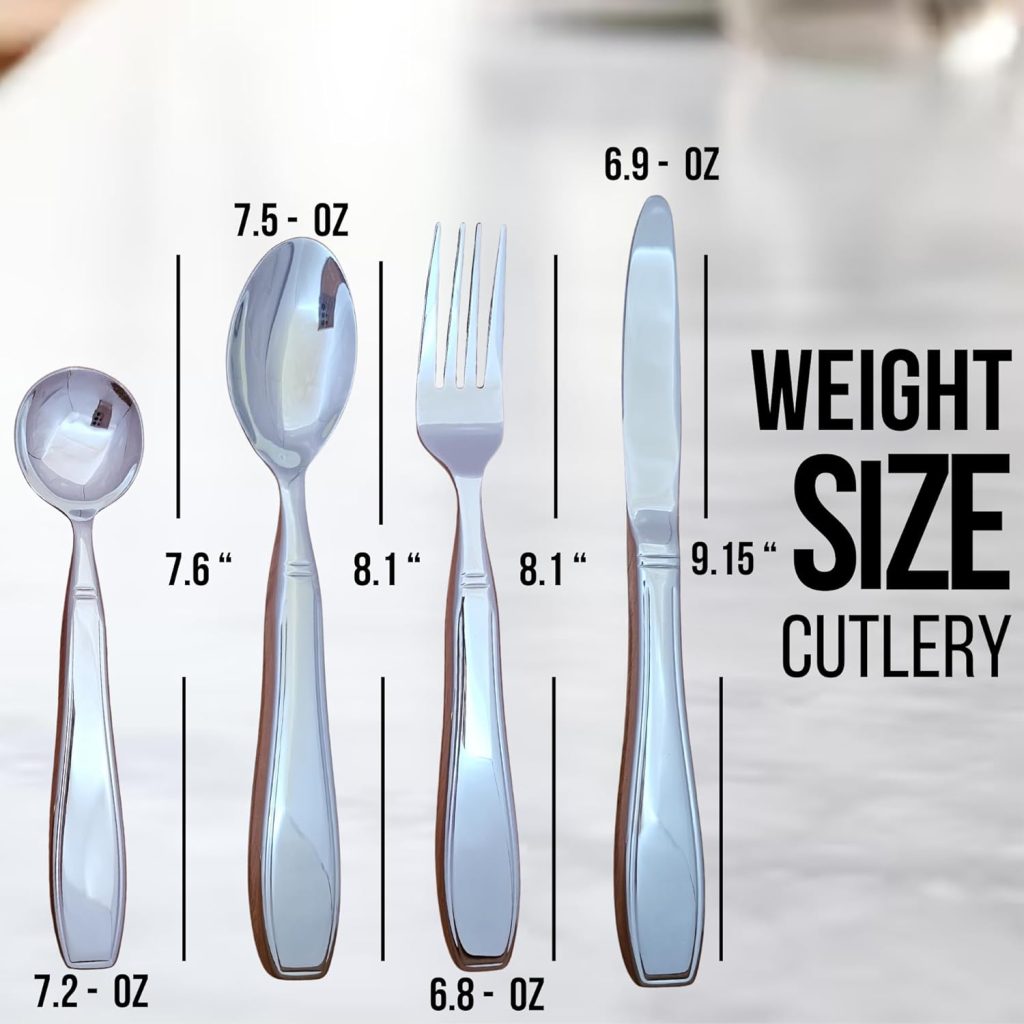
    Weight: 7/ 8oz per utensil
    Material: Stainless steel with standard weighting
    Handle: Standard ergonomic design with basic grip
    Best For: Mild tremors, budget-conscious users, testing weighted utensils

    This affordable option provides an excellent introduction to weighted utensils without a significant financial investment.

    While not as sophisticated as premium options, it offers genuine tremor relief for users with mild to moderate symptoms.
    weighted utensils for hand tremors

    Pros:

    • Affordable entry point for weighted utensils
    • Good effectiveness for mild tremors
    • Standard weight works for most new users
    • Basic but functional design
    • Widely available from multiple suppliers

    Cons:

    • Limited effectiveness for severe tremors
    • Basic grip may not suit all hand sizes
    • Less sophisticated weight distribution
    • May need upgrading as condition progresses

    Best for Arthritis + Tremors: Adaptive Combination Set (10oz)
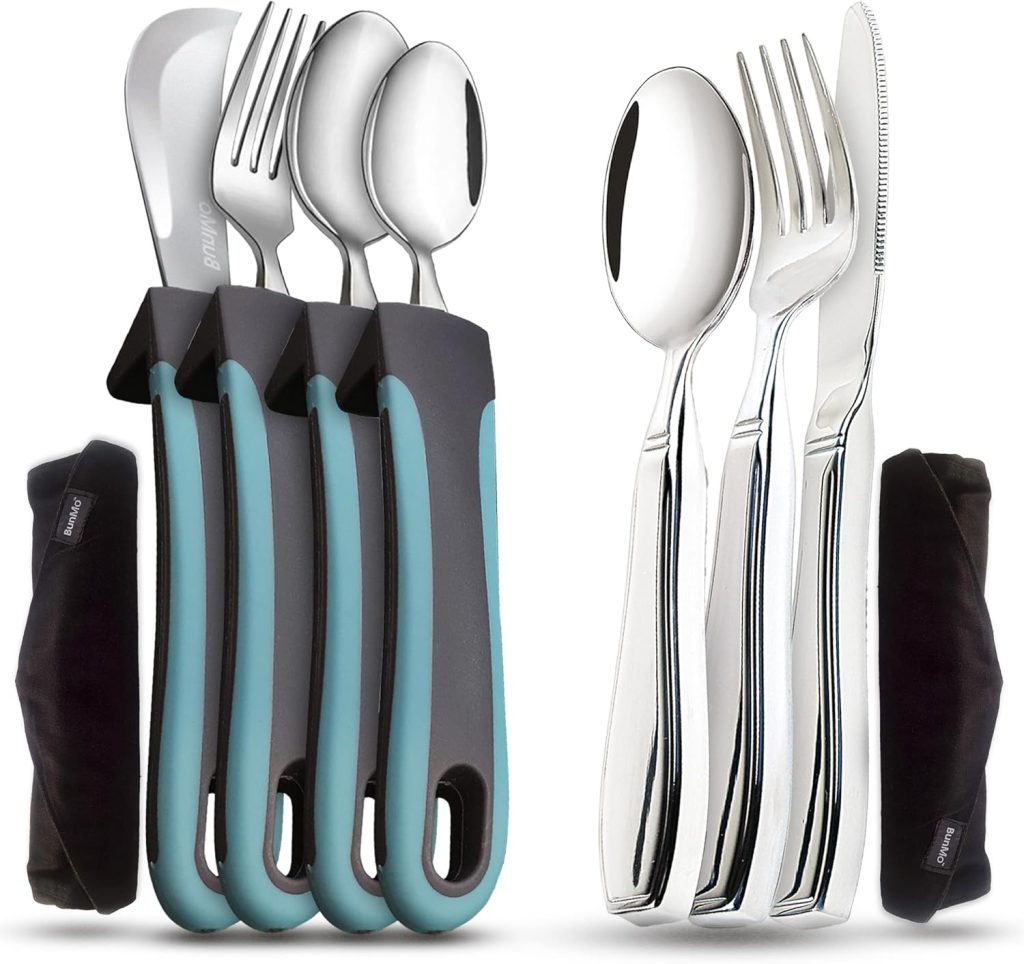
    weighted arthritis and tremors adaptive silverware combination set

    Weight: 7 -10oz per utensil
    Material: Lightweight base with strategic weight placement
    Handle: Large, cushioned grip designed for arthritis
    Best For: Users with both arthritis and tremors, joint pain considerations

    This specialized set addresses the unique challenges faced by users who deal with both tremors and arthritis.

    The 7- 10oz weight provides tremor control while the large, cushioned grip reduces joint stress and accommodates swollen or painful joints.

    Pros:

    • Addresses multiple conditions simultaneously
    • Large grip reduces joint stress
    • Moderate weight balances tremor control and comfort
    • Cushioned handle prevents pressure points
    • Thoughtful design for complex needs

    Cons:

    • Compromise solution may not optimize either condition
    • Limited availability compared to standard options
    • Higher price for specialized features
    • May be too bulky for some users

    Real-World Effectiveness

    Beyond clinical studies, real-world usage patterns provide valuable insights into weighted utensil effectiveness.

    Occupational therapists often recommend weighted utensils as assistive devices to improve feeding independence. Weighted utensils provide proprioceptive feedback, which can help minimize hand tremors and enhance control, especially in people with conditions like Parkinson’s disease or essential tremor.

    User Testimonials: Long-term users consistently report that weighted utensils “gave me my independence back” and “made eating enjoyable again.”

    Many users note that the benefits extend beyond just tremor control – the increased confidence and reduced anxiety around meals significantly improve their overall well-being.

    Occupational Therapist Recommendations: OTs widely recommend weighted utensils as a first-line intervention for tremor-related eating difficulties.

    They particularly appreciate that weighted utensils require no power source, have no moving parts to break, and can be used in any eating environment.

    Long-term Usage Patterns: Follow-up studies show that 90% of users continue using weighted utensils after one year, with satisfaction ratings remaining high over time.

    This suggests that the benefits don’t diminish with continued use.

    Limitations and Considerations

    While weighted utensils are highly effective for most users, they’re not universal solutions. Understanding their limitations helps set appropriate expectations:

    When Weighted Utensils Don’t Work: Some users with severe hand weakness, advanced arthritis, or certain types of dystonia may not benefit from weighted utensils.

    In these cases, alternative solutions like adaptive plates for the elderly or powered feeding devices may be more appropriate.

    Progressive Condition Changes: As tremor conditions progress, users may need to adjust their utensil weights or explore additional adaptive equipment. Regular reassessment ensures continued effectiveness.

    Combination Therapy Approaches: Many users achieve best results by combining weighted utensils with other interventions such as medication optimization, occupational therapy, or complementary adaptive equipment like eating utensils for the disabled.

    USING WEIGHTED SILVERWARE EFFECTIVELY

    Proper Technique

    Grip Positioning: Hold weighted utensils with a relaxed but secure grip, allowing the weight to work with your natural hand position rather than fighting against it.

    The grip should be firm enough to maintain control but not so tight that it increases hand fatigue or tremor intensity.

    Movement Patterns: Use smooth, deliberate movements rather than quick, jerky motions.

    The weight of the utensil will help maintain momentum, so you can move more slowly and still achieve effective food transport. Focus on controlled movements from the elbow rather than just the wrist.

    Cutting Strategies: When using weighted knives, let the weight assist with cutting rather than applying excessive downward pressure.

    The momentum of the weighted blade often provides more effective cutting than forceful pressure, which can increase tremor activity.

    Adaptation Period

    Initial Adjustment Challenges: Most users experience a brief adjustment period when first using weighted utensils.

    The different weight distribution and increased mass can feel awkward initially, but most people adapt within 3-5 meals.

    Gradual Introduction Methods: Start by using weighted utensils for one meal per day, preferably when you’re relaxed and not rushed. Gradually increase usage as you become more comfortable with the feel and weight.

    Strength Building Considerations: If the weighted utensils initially cause fatigue, consider doing simple hand and arm strengthening exercises. Even light resistance training can improve endurance and make weighted utensils more comfortable to use.

    Optimization Tips

    Meal Timing with Medication: For Parkinson’s patients, time meals when medication is most effective. Tremors are often reduced during peak medication periods, making weighted utensils even more effective.

    Table Setup Modifications: Use stable, non-slip placemats and consider how to properly use scoop plates to maximize the effectiveness of weighted utensils.

    Proper table height and comfortable seating also contribute to successful eating.

    Complementary Adaptive Equipment: Combine weighted utensils with other adaptive equipment like plate guards, non-slip mats, or specialized cups.

    This comprehensive approach often provides better results than relying on weighted utensils alone.

    COMPARISON WITH OTHER TREMOR SOLUTIONS

    Weighted vs. Steady Spoons

    Electronic steady spoons use sensors and motors to counteract tremor movements, offering a high-tech alternative to weighted utensils. While steady spoons can be highly effective, they have limitations:

    Advantages of Weighted Utensils:

    • No batteries or charging required
    • Work in any environment
    • Lower cost and maintenance
    • More durable and reliable
    • Can be used for all utensil types

    When to Consider Steady Spoons: Users with severe tremors who haven’t found success with weighted utensils, or those who specifically struggle with soup and liquid foods.

    Weighted vs. Wrist Weights

    Some people try wearing wrist weights during meals instead of using weighted utensils. While this approach can provide some tremor reduction, it’s generally less effective than weighted utensils because:

    • Wrist weights add mass to the entire arm system rather than specifically to the utensil
    • They can cause increased fatigue and discomfort
    • The weight isn’t optimally positioned for eating tasks
    • They may interfere with other hand activities

    Combination Approaches

    Many users achieve optimal results by combining weighted utensils with other tremor management strategies:

    • Medication optimization with weighted utensils for maximum tremor control
    • Occupational therapy to learn proper techniques and adaptive strategies
    • Complementary adaptive equipment like specialized plates and cups
    • Environmental modifications to create optimal eating conditions

    Cost-Effectiveness Analysis

    When comparing tremor management solutions, weighted utensils offer excellent value:

    • Initial cost: $30-70 for a complete set
    • Ongoing costs: Minimal – only replacement if damaged
    • Effectiveness: Comparable to much more expensive electronic options
    • Durability: Can last many years with proper care
    • Versatility: Works for all meals and eating situations

    BUYING GUIDE AND CONSIDERATIONS

    Key Selection Factors

    Weight Appropriateness: Choose weight based on tremor severity, hand strength, and personal comfort. When in doubt, start with 12oz utensils as they work for the majority of users.

    Handle Comfort: The grip should feel comfortable and secure in your hand. Consider factors like grip diameter, texture, and material. Users with arthritis may need larger, cushioned grips.

    Durability Expectations: Look for stainless steel construction with securely attached weights. Avoid products where weights might come loose or handles might crack with regular use.

    Budget Considerations: While more expensive options often offer better ergonomics and durability, effective weighted utensils are available at various price points. Consider your budget alongside your specific needs.

    Where to Buy

    Medical Supply Stores: Offer knowledgeable staff who can help with selection and often allow you to handle products before purchasing. Many carry multiple brands and weight options.

    Online Retailers: Provide wider selection and competitive pricing. Read reviews carefully and check return policies, as comfort and effectiveness can be personal preferences.

    Insurance Coverage Options: Some insurance plans cover weighted utensils when prescribed by a physician as durable medical equipment. Check with your insurance provider and healthcare team about coverage possibilities.

    Prescription Requirements: While most weighted utensils don’t require prescriptions, having a doctor’s recommendation can help with insurance coverage and ensures the choice is appropriate for your specific condition.

    Maintenance and Care

    Cleaning Instructions: Most weighted utensils are dishwasher safe, but check manufacturer instructions. Hand washing with warm, soapy water is always safe and may extend product life.

    Durability Expectations: Quality weighted utensils should last several years with regular use. Signs of wear include loose handles, damaged grips, or weight shifting within the utensil.

    Replacement Indicators: Replace weighted utensils when they become damaged, uncomfortable, or no longer provide adequate tremor control. Changes in your condition may also necessitate different weights.

    CONCLUSION AND NEXT STEPS

    Weighted silverware for tremors represents one of the most effective, practical solutions for maintaining eating independence despite Parkinson’s disease, essential tremor, or other hand-shaking conditions.

    With tremor amplitude reductions of 40-60% and high user satisfaction rates, these specialized utensils can truly transform the dining experience for people with tremors.

    The key to success lies in selecting the appropriate weight for your specific needs – 7/8oz for mild tremors, 12oz for moderate conditions, and 16oz for severe symptoms.

    Remember that the best weighted silverware for tremors is the set that you’ll actually use consistently, so comfort and manageability are just as important as maximum tremor control.

    If you’re considering weighted utensils, start with a 12oz set as it provides the best balance of effectiveness and usability for most people.

    Don’t hesitate to consult with occupational therapists or healthcare providers who can help assess your specific needs and recommend the most appropriate options.

    For those dealing with Parkinson’s disease specifically, consider exploring our comprehensive guide on Parkinson’s Disease Dining Aids for additional strategies and equipment.

    Users with broader adaptive needs may also benefit from learning about adaptive utensils for poor grasp and caregiver’s guide to adaptive dining.

    Remember that eating should be enjoyable, not stressful. With the right weighted utensils and proper technique, you can regain confidence at mealtimes and focus on what matters most – nourishing your body and enjoying time with family and friends.

    Take the first step toward better dining independence by exploring weighted utensil options today.

  • EATING UTENSILS FOR THE DISABLED

    According to the National Center for Biotechnology Information, approximately 23% of older adults make use of various adaptive equipment which includes eating utensils for the disabled in the United States, highlighting the importance of these assistive devices.

    I remember when my grandfather was sick, I followed my mother to visit him at the hospital, when we got there I noticed some weird-looking kind of utensils he was using for feeding.

    I asked, Grand Dad, is this a spoon or fork because it looks quite different from what we use at home, he smiled and said Amanda you will understand when the time comes.

    Though he’s late now, I can remember vividly that these assistive utensils gave him back his confidence and freedom to eat independently.

    In this article, we will also look at the various adaptive eating utensils for various disabilities like tremors, palsy, stroke, and Parkinson’s.

    In addition, we will then make recommendations for all these disabilities; meanwhile, let’s first have an understanding of what assistive utensils mean.

    WHAT ARE ASSISTIVE UTENSILS?

    As the name implies, assistive utensils are specialized devices or tools designed to assist individuals with various disabilities which include patients with tremor disorder, Parkinson or stroke.

    Assistive independent spoon and fork

    One important function of these assisting special devices for the disabled like for adults and children is to help them eat independently.

    As I said in the introduction, this was one of the special utensils used by my grandfather.

    Let’s see a few examples:

    One of the most popular is the Adaptive Eating Utensils for adults, the elderly, and those with various health challenges.

    Assistive weighted utensils for tremors and Parkinsons

    So, what are Adaptive Eating Utensils? They are simply a special kind of modified spoon, knives and forks mostly designed with ergonomic handles which helps to assist those with limited dexterity or motor skills.

    Later, we will see recommendations for the best types of Adaptive eating utensils that can be used by various individuals with different health conditions.

    Other types of Assistive utensils include Adaptive straws and cups, plate guards, non-slip grip utensils, cutting aids, and weighted utensils.

    EATING UTENSILS FOR THE DISABLED

    Eating Utensils for the Disabled

    Eating utensils for people with disabilities are special devices designed to make eating easier.

    These eating devices include utensils designed with larger handles than the normal handles you know, plates that have a suction base that prevents slipping or eating utensils that have angled or flexible designs for persons with limited hand movement.

    The main point here is this: these tools help make mealtime for the elderly, children, and disabled adults easily accessible.

    Let’s see some examples below:

    ADAPTIVE EATING UTENSILS FOR ADULTS

    The Bunmo Adaptive eating utensils for the Elderly or Adults come in as one of our top recommended tools that can aid the handicapped, arthritis sufferers, weak hands, and disabled Adults.

    Adaptive eating utensils for Adults with weak hands

    This is because the Bunmo Adaptive eating utensils for Adults are affordable, lightweight for those with weak hands/arthritis to easily lift, and have a wide handle for steady grip.

    These were the same eating utensils my grandfather was using at the hospital and I vividly remember that he had arthritis in his right hand but with this adaptive eating utensil, he was able to regain his independence.

    Another excellent feature of these eating utensil used by the Elderly is that they are made up of high-quality premium rustproof stainless steel that is non-toxic and safe for food consumption.

    They are easy to use, non-slippery, easy to manipulate, comfortable to hold, and meet the standard of adaptive equipment for those with weak hands, arthritis, and the elderly.

    Finally, the sole disadvantage is that it is primarily intended for right-handed challenged folks rather than left-handed individuals, but generally, it is one of the greatest specifically designed assistive utensils to make eating easier.

    ADAPTIVE UTENSILS FOR CEREBRAL PALSY

    It’s painful to lose the ability to use your fingers either as a child, Adult, or Elderly but with the EazyHold Silicon Universal Cuff Aid, individuals with Cerebral Palsy, limited hand grip, and other disabilities can once again rejoice.

    Adaptive utensils for cerebral Palsy

    For example, my neighbor’s wife who was struggling to use her fingers because of spinal cord stroke was able to use this adaptive equipment for various uses like brushing her teeth, feeding and even brushing her hair, and other activities.

    One excellent feature of the EazyHold Silicon Universal Cuff Aid Adaptive Assistive eating equipment is that it comes in multiple sizes for infants, 5-year-old – 8-year-old kids, and seniors helping them get a better grip on small to large objects.

    They are a comfortable fit for the hands, made up of soft adorable silicone that isn’t tight on the skin but has a warm skin temperature, are easy to use, and clean

    One drawback I have noticed about this Cerebral Palsy adaptive utensil is some users might find it difficult to wear (get help from family members or guardians) at first but removing it isn’t an issue.

    ADAPTIVE EATING UTENSILS FOR TREMORS AND PARKINSON’S

    Below are the 2 top adaptive eating utensils we recommend for Parkinson’s and Tremor individuals:

    SPECIAL SUPPLIES AND ADAPTIVE UTENSILS (KNIFE, FORK, AND SPOONS) FOR THE ELDERLY

    Special Adaptive utensils for the elderly

    With this special eating utensil, those who suffer from low grip strength, Parkinson’s Tremors, or even Arthritis, can now enjoy their meals with this smart solution.

    They are made to be wide and handles rigid and soft for the user to hold onto and weighted for balance.

    The Unique feature is that these adaptive eating utensils for tremors and Parkinson’s patient can easily slide their fingers underneath so it is easy to lift them off the table while they wrap their fingers around the utensil, giving them the stability they have always desired.

    Eating utensils for the elderly and disabled adults

    Finally, they are made up of food-grade safe silicone handles, and non-toxic stainless steel that is durable and dishwasher safe.

    WEIGHTED ADAPTIVE UTENSILS FOR HAND TREMORS AND PARKINSON’S PATIENTS

    Weighted Adapative utensils for hand tremors and Parkinson's patients

    Do your hands shake and you can’t use the normal flatware? Then you need this Weighted Silverware that can effectively relieve tremors and support patients with stroke and arthritis.

    So, what makes these weighted adaptive utensils special and effective for Stroke and Tremor patients?

    It is because they are designed to bend 180 degrees, this special ability allows the user (tremor, stroke, and arthritic patients) to twist to any angle even if they are left or right-handed.

    Adaptive utensils for Arthritis, hand tremors and Parkinson's Elderly Patients

    In addition, the utensil holder has an elastic hand strap that makes it easy for Parkinson’s patients to use even as their hands have little strength especially the elderly.

    For durability, do not use harsh detergents, simply use mild detergents.

    These weighted silverware adaptive utensils include a rocker knife, steak knife, dinner knife, fruit fork, dinner spoon, soup spoon, teaspoon, cleaning brush, and universal cuff.

    Finally, these adaptable dining utensils for the elderly are portable and can easily used whenever you need them.

    SPECIAL SPOONS FOR THE DISABLED

    Special spoons and forks for the disabled and handicapped

    Special spoons for the disabled are designed with one goal in mind: to make eating easier for people with various challenges (adults and children), for a quick review it is a total of what we have been discussing.

    They often have one common unique feature like larger handles for better grip, or angled designs to assist with limited arm movement. Some have non-slip grips to prevent accidents.

    The good thing about these spoons is that you can still use them like regular spoons, but their special features cater to specific needs.

    For example, someone with shaky hands might find a spoon with a wider handle easier to hold, while someone with limited wrist movement might benefit from a spoon with a bend in the handle for better positioning.

    The goal is to make eating more comfortable and accessible for individuals with different abilities.

    WHAT IS THE COMBINED KNIFE AND FORK FOR DISABLED PEOPLE CALLED?

    The combined knife and fork utensil that are used by disabled individuals is commonly referred to as adaptive eating utensils and they are designed with modifications and one aim: To provide independence for individuals with disabilities during meal time.

    CONCLUSION

    In summary, the use of adaptive eating utensils for the disabled has been shown to significantly benefit individuals with various disabilities, improving their ability to eat independently and obtain sufficient nutrition.

    The specific benefits vary depending on the type of disability, and the wide range of available adaptive utensils reflects the diverse needs of users.

  • LIPPED PLATES FOR THE DISABLED

    In our previous article, we discussed extensively how to correctly use scoop plates for senior citizens. Today, we will look at Lipped plates for the disabled.

    Lipped plates, which might seem like just regular dishes, came about because people wanted to make things easier for disabled individuals faced with various challenges, especially those who have trouble with everyday tasks.

    Imagine wanting to enjoy a meal but facing challenges because of a disability. That’s where lipped plates step in.

    As we delve into the intricacies of their design, it becomes evident that they are not merely utensils but a manifestation of empathy and innovation.

    So, when we discuss the difficulties that persons with disabilities face, keep in mind that lip plates are unsung heroes who make these obstacles a little easier to conquer.

    Continue reading to find out how something as basic as a plate has a significant effect.

    WHAT IS AN ADAPTIVE PLATE?

    Adaptive plates refer to a category of eating utensils designed to assist individuals with physical or motor skill challenges during meals.

    These plates have evolved as a response to the needs of people with disabilities, the elderly, or those recovering from injuries.

    Features of adaptive plates often include non-slip surfaces, high edges to aid scooping, and compartments to prevent food mixing.

    Adaptive Plate and Bowl for Disabled, elderly and handicapped Adults

    They can be made from various materials such as plastic or silicone, ensuring durability and ease of use.

    Occupational therapists and healthcare professionals often recommend adaptive plates to individuals facing difficulties in self-feeding.

    They contribute significantly to enhancing independence and promoting a sense of normalcy during meal times for those with limited mobility or coordination issues.

    Examples include brands like “Sure Grip” offering plates with suction bases for stability. These plates empower users to maintain control while eating, fostering a more comfortable dining experience.

    Such adaptive tools play a crucial role in supporting individuals in their daily routines, contributing to improved quality of life and overall well-being.

    LIPPED PLATES FOR THE DISABLED

    Lipped plates for the disabled

    Lipped plates for the disabled are plates with raised edges to help prevent food from sliding off.

    They’re used by people with disabilities, like those with limited hand control or coordination, making it easier for them to eat without spills.

    See examples of lipped plates that would benefit seniors with varying disabilities:

    SP ABLEWARE INNER LIP PLATE

    The SP Ableware inner Lip plate is one of the best-lipped plates for the disabled because it is the perfect size for ability-challenged adults, it doesn’t tip or slide, and the red color increases food intake by 24% and liquid intake by 84% especially by Alzheimer’s patients, according to research.

    Best Lipped Plates for disabled Adults

    Another takeaway is that the SP Ableware inner plates are made in the USA as the largest manufacturer of Aids for Daily Living (ADL).

    They come in various colors aside from red, including sandstone and light blue. They are also made up of polypropylene material ,which makes them lightweight and sturdy

    The high-walled edge is what makes this lipped plate for disabled adults pleasing, as it keeps the food from sliding off the plate so the user can push it into the utensil using one hand.

    The SP Ableware Inner-Lip Plate provides a pleasant dining option for users with limited hand dexterity, Individuals with dementia, neurological problems, or anyone who has problems with their hands.

    You will be amazed that even for blind individuals and action-oriented hand tremors, this inner lip plate promotes independence, which makes them very happy, and they are also microwave and dishwasher-safe.

    Finally, the SP Ableware Lipped plate for disabled adults is very affordable; no need to break the bank to achieve comfort and confidence for individuals with limited muscle conditions.

    PROVIDENCE SPILLPROOF INNER LIP PLATE

    The Providence spillproof inner lip plate is another adaptive plate for the disabled and elderly, designed to assist them in guiding food to utensils with the help of the inner lip.

    Spillproof Inner Lip Plate for the elderly

    The Providence Spillproof inner Lip plate is slightly different from the SP Ableware Lip plate as they are deeper and have a higher wall than the SP Ableware Lipped plate.

    They are both made up of the same material and are lightweight. The Providence Spillproof inner Lip plate looks like a scoop bowl designed for the disabled.

    They work excellently! They grip the table, and the lip on the edge helps keep small foodstuffs (peas/corn niblets) from going over the edge.

    I remember my aunt, who was suffering from Parkinson’s.

    This Lip plate made eating easier for her; we also included a plate guard to improve her confidence while eating.

     One excellent feature is that they are dishwasher safe, have a rubber ring at the bottom so it doesn’t slide around, and won’t break or shatter when they accidentally hit the floor, a real game changer for dementia patients.

    Finally,  an ideal solution for individuals who need help eating independently without the help of a caregiver, such as the elderly, handicapped, and disabled.

    SAMMONS PRESTON LIPPED PLATE WITH INSIDE EDGE

    This cool blue adaptive plate for the disabled and elderly is awesome! It’s 9 inches wide, made of sturdy and lightweight material, and has a special design to keep your food from falling off.

    Sammons Preston Lip Plate with inside edge for the disabled

    There’s a rim and edge for easy scooping, and the bottom is bumpy to stop your food from sliding around. It’s microwavable, can go in the dishwasher, and doesn’t have any weird chemicals.

    The Sammons Preston has been the go-to for individuals living with various disabilities for over 50 years. If you need tools to make life easier, they’ve got you covered.

    Whether you’re a therapist, someone with special needs, or just want life to be more accessible, Sammons Preston has cool products like utensils, plates, grabbers, and more.

    For those with Parkinson’s ailment, this plate will save the day. It lets them be independent, and the inward lip is a game-changer.

    Finally, if you’ve got one hand, this plate is a lifesaver. No more chasing food around!

    NON-SLIP PLATES AND BOWLS

    Non-slip plates and bowls have special surfaces that prevent them from sliding around. They’re used to keep your food and drinks steady on the table, especially if it’s slippery or you accidentally bump into the table.

    Non-Slip Plates and Bowls

    These dishes usually have a textured bottom or a rubbery coating to grip the surface better. It’s like a built-in way to avoid spills and make your meals safer.

    Great for clumsy moments or if you have kids at the table!

    In addition, non-slip plates and bowls are particularly helpful for the elderly or people with disabilities like Parkinson’s because these individuals may have difficulty with hand coordination or tremors.

    The non-slip feature ensures that the tableware stays in place, reducing the chances of accidental spills.

    This added stability makes it easier for them to eat independently and with more confidence, promoting a safer and more comfortable dining experience.

    CERAMIC SCOOP PLATE

    A popular Ceramic Scoop plate is the Green Dignity by Wade Scoop; it is a confidence-boosting dining solution, featuring a sloped side for easy scooping, and is ideal for individuals with dementia or limited mobility.

    Ceramic Scoop Plate

    Its innovative British design, developed in collaboration with healthcare professionals, offers a blend of functionality and style.

    Crafted from sturdy earthenware, this microwave, dishwasher, and freezer-safe plate, with a diameter of 229mm (9″) and a weight of 820g (1.8 lbs), ensures a dignified dining experience.

    Though it is heavy and not lightweight like the scoop adaptive plates above, its design meets the needs of the elderly as its raised edge prevents food from sliding off and allows users to scoop food onto a spoon or fork.

    The Ceramic scoop plate also has a broad rim that provides a large surface area to grip for safer carrying, and this makes it easier for people with limited manual dexterity.

    Ideal for those with dementia or sufferers of Alzheimer’s. Also suitable for users with limited mobility or strength in the hand, wrist, and finger,s or the use of only one hand.

    Individuals suffering from various disabilities will see an improved and positive impact on their dining experience using this awesome ceramic scoop plate.

  • HOW TO PROPERLY USE SCOOP PLATE FOR THE ELDERLY

    Mastering the art of how to properly use scoop plate for the elderly is a crucial fundamental skill for ensuring their dining experience is comfortable and enjoyable.

    Having witnessed the dependency that comes with old age or with seniors, I’ve discovered that, as simple as a scoop plate appears, understanding how to leverage it effectively using the right techniques can make a significant difference in promoting their independence and well-being.

    Picture a world where every meal becomes a seamless, pleasurable moment. In this guide, we’ll unravel essential tips and techniques, offering a roadmap for caregivers and seniors alike.

    Join me in exploring the transformative power of correctly using the scoop plate, turning an everyday task into a source of empowerment and joy for our elderly loved ones.

    WHAT IS A SCOOP PLATE USED FOR?

    A scoop plate is used to help people who have difficulty using regular plates. It has a high rim on one side, making it easier to scoop food onto a fork or spoon.

    Most times, the fork or spoon might be eating utensils specially designed for the disabled.

    The main purpose is to make eating more manageable for individuals with limited mobility or coordination.

    HOW TO PROPERLY USE SCOOP PLATE FOR THE ELDERLY

    How to properly use scoop plate for the elderly

    Here are the steps to using a scoop plate for the elderly correctly:

    • Put the scoop plate (we recommend using a scoop plate with a suction base) on a flat surface, like a table, with the higher rim facing the person.
    • Arrange small portions of food along the higher side of the plate for easier scooping.
    • Encourage the elderly person to hold their adaptive utensil in a comfortable grip, using their dominant hand.
    • Guide them to scoop the food by pushing it against the higher rim, making it simpler to load onto the utensil.
    • If needed, use the non-dominant hand to stabilize the plate, preventing spills.
    • Modify the plate’s angle for comfort, ensuring they can scoop without difficulty.
    • Encourage the elderly person to use the scoop plate independently to foster self-sufficiency.

    Remember, the purpose is to make eating more pleasant and independent for the elderly person. Changes can be made to meet their unique needs and preferences.

    SCOOP PLATES AND BOWLS WITH SUCTION BASES

    Scoop Plates and Bowls with Suction Bases

    Scoop plates and Bowls with suction bases are designed to achieve one goal: to assist the elderly or seniors who have physical challenges or disabilities, mainly with eating independently.

    I remember when I cared for my grandfather; we had to use either scoop plates or scoop bowls to assist him, and this required patience and love.

    These Scoop Bowls and Plates are typically made up of 100% safe silicone or safe-grade plastic material; the job of the suction base is to help secure the plate to the flat surface, preventing accidental spills.

    Scoop plate and Bowl for adults and the Elderly that are handicaped, have Parkinson, Dementia, Stroke and Tremors

    You might ask how the suction base works. The suction base typically sticks through suction, creating a vacuum between the plate and the surface, providing stability during mealtime.

    So, if you are worried that the elderly in the family are affected by motor skills, cerebral palsy, Parkinson’s disease, handicapped, and disabled these suction plates and bowls are designed for them to enhance their dining independence.

     These scoop plates and Bowls are leakproof, they are easy to clean, and lightweight for the elderly to lift without pain in the wrist.

    Suction Plates for Baby and Toddler

    You might ask, are these suction plates and Bowls meant for Adults only? No, they are also recommended for Kids, as you know, with kids learning to eat, and really cause a mess, so reduce the mess by getting Kids’ Suction plates and Bowls.

    Finally, these suction plates and Bowls for Adults, senior citizens with various mobility issues, and Kids are safe for use in the dishwasher, microwave, and freezer; they are unbreakable and safe for consumption (free from harmful toxins).

    SCOOP DISH OCCUPATIONAL THERAPY

    Who are the people who need Occupational therapy?

    These are people who find it difficult to engage in everyday, important human activities like eating; they face challenges like injuries, disabilities, or developmental issues that may be due to their age or medical condition.

    Imagine you love playing video games, but an injury makes it hard to use a controller.

    An occupational therapist might swoop in, suggest cool gadgets to make gaming easier, and show exercises to improve hand strength.

    In this vein, the phrase “Scoop dish occupational therapy” simply means employing the use of special dishes designed for people who are physically challenged to eat independently, the raised edges in the scoop dish help the patient to scoop the food onto the utensils more easily.

    PLATE GUARD

    If you pay close attention to the elderly while they eat, you will notice something round around the borders of the plate, which may be made of plastic or stainless steel and is known as a Plate Guard.

    Plate Guard designed by an Occupational therapist

    Plate Guards are simply designed for one purpose: to aid individuals with limited motor skills or dexterity.

    How is the Plate Guard used? It is simply attached to the plate to do one job: prevent food from spilling off the edges so patients with various medical conditions can eat independently.

    In addition, it is a known fact that patients with Parkinson’s disease, cerebral palsy, or people with disabilities have benefited enough from this tool as they achieve better coordination while eating.

    DIVIDED PLATE

    Divided Dinner Plates for  the Elderly

    It is common practice for foodies to use a divided plate to get the maximum flavor out of their food, or for those on a diet or trying to lose weight.

    The main goal of a divided plate is to enjoy the distinct flavors of each meal without them mixing; divided plates often come in compartments designed to separate different types of food.

    Stainless steel Divided plate for weight Loss

    In addition, it helps to keep your meal organized and inviting, both for Adults and Kids. They are made up of various materials like plastic, ceramic, wheat straw, glass, or stainless steel.

    The top 5 choices we recommend for divided plates are:

    Corelle Livingware Divided Plate, Winter Frost White

    Porcelain Portion Control Plate for Adults – Diabetic & Bariatric Diet

    Stainless steel Portion Control Divided Plates for Adult Weight Loss

    NUTRIUPS Durable Divided Plates | Portion Control Plates for Adults, Bariatric Diet

    Unbreakable Wheat Straw Large Divided Plates

    LIP PLATE AND INNER LIP PLATE

    Individuals who have difficulties feeding themselves or have weak muscular control, such as children and the elderly, can now easily use one hand to feed themselves independently.

    Inner Lip Plate

    How so, you ask? It is now possible thanks to the largest manufacturer of home healthcare and rehabilitation equipment in the USA ( Maddak SP Ableware) that serves the senior citizens, handicapped, and rehabilitation sectors.

    Elders with mobility issues can now utilize these adaptable plates as part of their occupational therapy with confidence.

    So, how does an inner lip plate or lip plate function? They are constructed with an interior lip that prevents food from sliding off the plate, allowing the user to simply press the food into the user’s feeding utensil.

    Some have suction bases, while others are merely flat and sturdy, preventing movement when in use.

    Finally, these lipped plates for the elderly can help guide food into their mouths, compensating for any difficulty caused by their disabilities.

  • LIGHTWEIGHT MUGS FOR ELDERLY

    When it comes to taking care of elderly people, we have what we call elderly assistance products. They have one job only: to assist and make life easy for senior citizens.

    The lightweight plates, ideal for elderly usage, are a well-known elderly aid product, and we also have lightweight mugs for elderly use.

    There is a saying that old age is wonderful, and while it does come with its own set of obstacles, your family and loved ones may help make it memorable by using adaptive cups and other specially created products for elderly persons.

    Whether it’s for that hot cup of tea or a comforting bowl of soup, these lightweight mugs are here to save the day.

    So, stick around as we explore how these nifty mugs are changing the game for our wise and experienced generation.

    LIGHTWEIGHT MUGS

    The Original ideas for mugs can’t be over-emphasized. I’m sure you know the popular materials for mugs are heavy ceramic materials, but they are good at retaining heat, hence consumers prefer them.

    Nowadays, we have a competitor in the form of lightweight mugs, which are designed to meet your needs on the go.

    Lightweight Mugs Gift for senior citizens

    They are very portable and efficient, and just as Corelle’s lightweight is associated with its material, the featherweight design of these lightweight mugs is also associated with its material, which may include stainless steel, aluminum, plastic, and titanium, among others.

    These material all have their various advantages over the others. For example, stainless steel lightweight mugs do have excellent insulation properties, keeping your drinks hot or cold for extended periods.

    While Lightweight aluminum mugs come in handy for the traveler and outdoor enthusiast in reducing their load weight, Titanium Lightweight mugs can resist corrosion.

    If you notice carefully, Lightweight mugs do come with Lids and seals to help you, the elderly, Parkinson’s patients, and even the disabled not to spill their drinks.

    Yeti Rambler Stackable Vacuum insulated stainless steel Mug with Lid

    Another feature you will love about Lightweight mugs is that they are compact and can easily fit into a backpack, pocket, or even bike bottle cages.

    They are incredibly versatile and easy to hold and carry for weak hands or elderly with arthritis.

    Lightweight mugs are a perfect companion for commuters who enjoy coffee or tea on the go, office workers who love keeping their office desk tidy, and frequent travelers who love to travel light, either on a plane, car, or train.

    In conclusion, lightweight mugs are a versatile solution for anyone who values portability and convenience while enjoying their beverages.

    With various materials and features to choose from, these mugs cater to a wide range of needs and preferences, making them a valuable addition to your drinkware collection.

    BEST LIGHTWEIGHT MUGS FOR THE ELDERLY

    Lightweight mugs can empower seniors and enable them to enjoy their favorite drinks independently while reducing the risk of burns and spills.

    To enhance the daily routine and support senior citizens with reduced strength and mobility, here are the 3 best Lightweight mugs for the elderly that combine practicality with safety:

    Homestead Choice Lightweight Clear Mug

    Sicaluya Stackable Unbreakable Mug for the Elderly

    Plastport multipurpose Mugs

    HOMESTEAD CHOICE LIGHTWEIGHT CLEAR MUG

    Have you ever seen a mug that looks like glass but has the feel and durability of premium plastic? That is the Homestead Choice Lightweight Mug, proudly made in the USA.

    Homestead Lightweight Mug set for senior citizens

    This is the perfect and right size of the mug to use for either hot or cold drinks, the double-walled and vacuum seal feature helps in preservation, yet it doesn’t add to the weight, effortlessly light for seniors with arthritis hands to hold.

    In case of accidents, this clear lightweight mug won’t break, which is why it is fondly called the unbreakable tumbler.

    For dinnerware, they break even Corelle isn’t shatterproof, but this Homestead clear insulated mug is stain-resistant and safe for drinking, particularly for elders.

    In addition, they are top-rack dishwasher safe, microwave and freezer safe, what more would you ask for, as every senior citizen in our midst can comfortably enjoy coffee, iced tea, lattes, and even slow bread teas?

    Finally, this lightweight mug is designed with large handles providing comfort for the elderly.
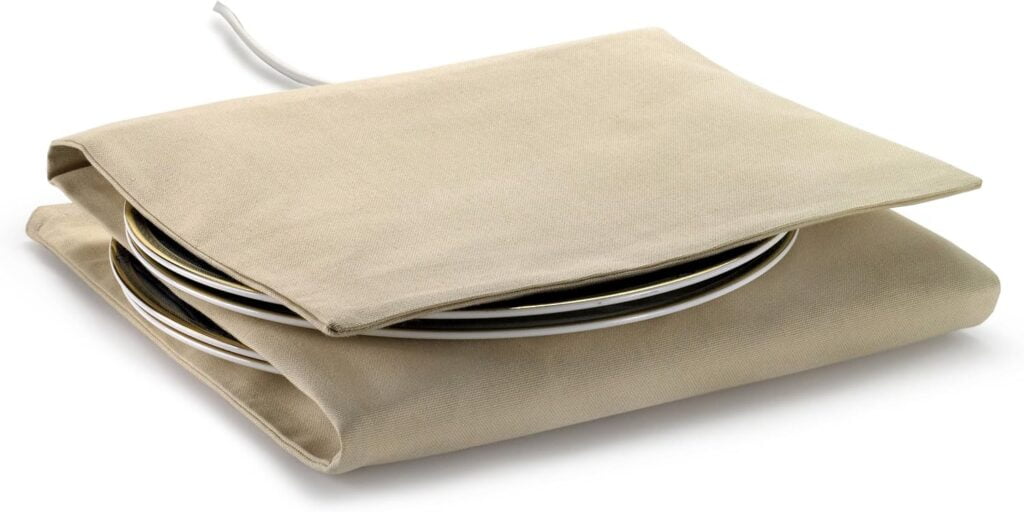
    SICALUYA STACKABLE UNBREAKABLE MUG FOR THE ELDERLY

    The Sicaluya unbreakable Mug is our top pick as the best lightweight mug for the elderly because they are affordable, has a premium appearance like elegant porcelain, and is easily stackable, thereby saving space in your kitchen or cupboard.
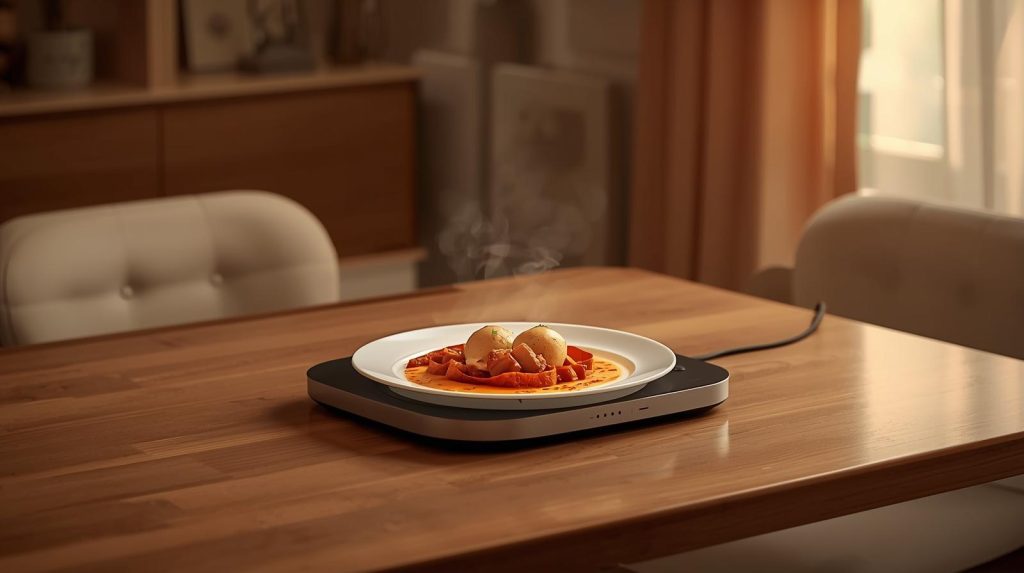
    Lightweight mugs for elderly

    These sturdy Mugs are the perfect fit for your coffee maker or espresso machine.

    They are made up of high-quality, durable plastic and have a modern design that can fit your beautiful café, restaurant, pub, and home.

    Aside from being used by the elderly, it is also suitable for Adults, teens, or children.

    The handle is strong enough for the elderly to grab, they are also easy to clean, and dishwasher and microwave-safe.

    We recommend this Lightweight Mug for drinking water, milk, Juice, drinks, cappuccino, coffee, latte, or tea for you and your guests.

    Finally, aside from indoor and outdoor use, these premium modern Mugs are ideal for weddings, receptions, birthday parties, picnics, catered events, and even as gifts for all occasions.

    PLASTPORT MULTIPURPOSE MUGS

    The Plastport multipurpose Mug is made with virgin, unbreakable, and non-recycled polycarbonate material that makes it perfectly lightweight for the elderly to carry and store.

    Lightweight multipurpose Mug for indoor and outdoor use

    These lightweight drinking glasses do not deform; they are food-grade safe, sturdy, and have the same tendency as the Sicaluya stackable lightweight unbreakable mug, which is shatterproof.

    They are scratch-resistant and a recommended choice if you are looking for a premium coffee-tea drinking glass.

    We usually call the Plastport multipurpose Mug, “medium and mighty Mug” because they are fully heat-resistant and insulated.

    You won’t regret having this high-end, durable, and reusable plastic Mug that is great for picnics, camping, BBQ, poolside parties, bar, pub, coffee, tea, patio parties, housewarming, birthday, wedding, graduation, retirement, Christmas, New Year, Valentine’s Day, and Father’s Day.

    LIGHTWEIGHT MUGS FOR THE ELDERLY WITH LIDS

    The world of lightweight mugs with lids is a game-changer for seniors seeking practical solutions to everyday challenges.

    Lightweight mugs for elderly with Lids

    These ingenious mugs are not just utensils; they are lifelines for those experiencing diminished hand strength, tremors, or restricted mobility.

    Crafted from resilient, featherweight materials, they grant seniors the gift of independence, putting the power back in their hands, literally.

    With spill-proof lids as your ally, you’ll savor every sip without fear of accidents, KEEPING YOUR DRINKS COLD OR HOT FOR A LONG TIME!

    These mugs aren’t mere cups; they’re a testament to innovation, designed with a singular purpose—to enhance the quality of life for our beloved elders.

    Comfortable to grip for the elderly with no sweat for their fingers, made with 304 food-grade 18/8 stainless steel, they are non-toxic and won’t absorb odor or taste.

    Finally, the Thily Lightweight insulated Coffee Mug is ideal for any occasion, like a wedding party, camping, outdoor, travel, office, boating, picnic, pool, beach, and others.

    LIGHTWEIGHT COFFEE MUGS FOR ARTHRITIC HANDS

    Lightweight coffee mugs designed for arthritis sufferers offer a practical solution to a daily challenge.

    Lightweight coffee mugs for arthritic hands

    These mugs are thoughtfully crafted with ergonomic handles, often wider and easier to grip, reducing strain and discomfort for those with arthritis.

    Constructed from lightweight materials like BPA-free plastics or aluminum, they minimize the weight users must lift, making it easier to enjoy a morning coffee without the added burden of a heavy mug.

    With a focus on functionality and comfort, these mugs enable individuals with arthritis to savor their coffee with greater ease and independence, enhancing their daily routines.

    A recommended Lightweight coffee mug cup suitable for arthritis or even Parkinson’s patients is the Two-Handled Steel 16 Ounce Cup for Easy Drinking with Essential Tremors and Arthritis.

    It is designed with a double-handled cup that the arthritis patient can hold with both hands, giving them a much firmer, steadier grip so they can drink with confidence.

    No room for spilling as the wide base of this Arthritis lightweight mug cup has a low center of gravity, providing stability.

    Made with lightweight enameled steel that won’t break or shatter when accidentally dropped, recommended for indoor or outdoor use.

    Finally, no leaks when taking in your favorite coffee, juice, soda, or even smoothie.

    BEST LIGHTWEIGHT COFFEE MUGS

    Unlock the joy of sipping your daily brew wherever life takes you with the best lightweight coffee mugs.

    These cups seamlessly blend style and convenience, making them the ultimate companions for coffee enthusiasts on the move.

    Best Lightweight Coffee Mugs

    Crafted from a variety of materials, such as sleek stainless steel, classic ceramic, or eco-friendly BPA-free plastic, these mugs strike the perfect balance between robustness and feather-light portability.

    Our best pick for lightweight coffee mugs is the Stainless Steel Double Walled Mugs because they are made with high-quality 304 18/8 stainless food-safe steel that does not rust or tarnish over time.  

    One excellent feature of this stainless steel coffee mug is that, unlike other metal camping mugs, it is insulated, protecting your hands from heat so you can enjoy both hot and cold drinks with ease.

    Imagine savoring your morning roast in the wilderness, or conquering a hectic commute without worrying about spills.

    Other standout contenders in this category include the Hydro Flask Coffee Mug, renowned for its stellar heat retention, the rugged Yeti Rambler, and the innovative Contigo Autoseal West Loop.

    These mugs aren’t just containers; they’re reliable partners in your coffee journey, ensuring your brew stays hot and your day stays light.

    Say goodbye to cumbersome travel mugs and hello to a delightful coffee experience, unburdened by unnecessary weight.

    NON-SPILL MUG AND DRINKING CUP FOR THE ELDERLY

    Non-spill mugs and drinking cups for the elderly, disabled, and bedbound are innovative solutions designed to address common challenges faced by seniors while enjoying beverages.

    Non Spill mug and drinking cup for the elderly

    These specialized containers incorporate features such as spill-resistant lids, ergonomic handles, and anti-slip bases to provide seniors with a secure and convenient drinking experience.

    The best non-spill mug or drinking cup for the Elderly is the Providence Spill-proof 12oz Adult Sippy Cup with Handles, suitable for Adults with Limited Mobility.

    It is also called the best Handicap Cups for Elderly Care, and they are proudly made in the USA.

    One thing you will love about the Providence non-spill mug drinking cup is that the elderly or disabled no longer need to rely on caregivers; they can now fully drink with dignity!

     With aging often comes reduced hand dexterity and increased risk of spills, making these mugs essential for maintaining independence and preventing accidents.

    They are typically crafted from durable, easy-to-clean materials and come in various styles to suit individual preferences.

    Non-spill mugs and cups offer seniors a reliable and dignified way to savor their favorite drinks while promoting safety and comfort.

    LIGHTWEIGHT BONE CHINA MUGS

    Lightweight bone china mugs combine elegance with practicality, offering a delightful drinking experience.

    Lightweight Bone china Mugs

    Crafted from a blend of bone ash, clay, and feldspathic material, these mugs possess a delicate translucency, allowing you to appreciate the rich hues of your beverage.

    Despite their fragile appearance, they are surprisingly durable, making them ideal for daily use.

    One unique quality of Lightweight Bone China Mugs is that they keep drinks warm and cold, the exterior walls are comfortable to touch, and they reduce condensation.

    White Bone China Coffee Mugs

    Their featherweight design ensures comfort during prolonged sips, while the thin walls retain heat for longer, keeping your drink at the perfect temperature.

    With Bone china Mugs, you can rest assured that you are protected from chips and scratches that affect other mug materials; they are also dishwasher safe and microwave oven safe.

    Whether for morning coffee or afternoon tea, these mugs elevate your drinking ritual to a new level of sophistication and comfort.

    LIGHTWEIGHT COFFEE MUGS PORCELAIN

    Lightweight porcelain mugs are known for their elegance and functionality.

    They are made with high-quality fine Porcelain that gives them the needed strength and translucency.

    Lightweight Porcelain Coffee Mugs

    Imagine sipping your morning brew from a cup that feels as light as a whisper, yet exudes timeless charm.

    Picture the delicate patterns and the sheer finesse of craftsmanship. With Porcelain mugs, your coffee rituals transcend into moments of pure luxury.

    Aside from the delicate pattern, Porcelain Lightweight mugs come in mostly simple and classic white designs, so they easily blend with any occasion, style, or décor.

    Finally, Porcelain coffee mugs are also perfect for tea, water, or milk.

  • Plate Warmer for Slow Eaters: Keep Meals Warm Without Reheating

    There’s nothing more disheartening than watching a lovingly prepared meal turn cold halfway through dinner.

    For slow eaters, whether elderly loved ones savoring each bite, children who take their time, or individuals with medical conditions that affect eating pace, cold food isn’t just unappetizing; it can diminish the entire dining experience.

    Plate warmers for slow eaters offer a simple yet transformative solution, gently maintaining food temperature throughout the meal without constant trips to the microwave.

    These thoughtful devices restore comfort, dignity, and enjoyment to mealtimes, ensuring every bite is as warm and delicious as the first.

    If you’ve been searching for ways to keep meals warm longer, you’re about to discover how the right plate warmer can change everything.

    Why Slow Eaters Need a Plate Warmer

    Eating slowly isn’t a choice for many people; it’s a reality shaped by age, health conditions, or simply personal eating habits.

    Understanding why plate warmers matter starts with recognizing the genuine challenges slow eaters face daily.

    The Problem with Food Getting Cold Before Finishing

    Food loses heat rapidly once served, typically dropping to lukewarm temperatures within 15-20 minutes.

    For slow eaters who may take 30-45 minutes or longer to finish a meal, this means enduring cold, congealed food that’s lost its texture and appeal.

    Fats solidify, sauces thicken unpleasantly, and flavors become muted.

    The constant interruption of reheating disrupts the natural flow of dining, turning what should be a relaxing experience into a frustrating cycle of heating and eating.

    Health and Comfort Challenges for Elderly or Disabled Users

    Elderly individuals and those with disabilities often face specific eating challenges, including reduced jaw strength, swallowing difficulties, or medications that slow digestion.

    Cold food becomes harder to chew and swallow, potentially creating safety concerns. For dementia patients, temperature consistency helps maintain focus on eating.

    Arthritis sufferers may struggle with repeated trips to reheat food.

    Heated plates for senior citizens address these concerns by maintaining optimal food temperature throughout extended mealtimes, supporting both nutrition and safety while providing the gentle warmth that makes dining more comfortable.

    How Plate Warmers Improve Dining Experience

    Plate warmers restore dignity and pleasure to mealtimes by eliminating the anxiety of racing against cooling food.

    They create a stress-free environment where slow eaters can enjoy meals at their natural pace without compromise.

    Caregivers benefit too, spending less time reheating and more time enjoying shared meals.

    The consistent warmth enhances food flavor, maintains proper texture, and demonstrates thoughtful care for those who need extra time at the table.

    How Plate Warmers Work

    Understanding the technology behind plate warmers helps you choose the right solution for your specific needs. These devices use various heating methods to maintain food temperature safely and efficiently.

    Types — Electric, Hot-Water, and Insulated Base Warmers

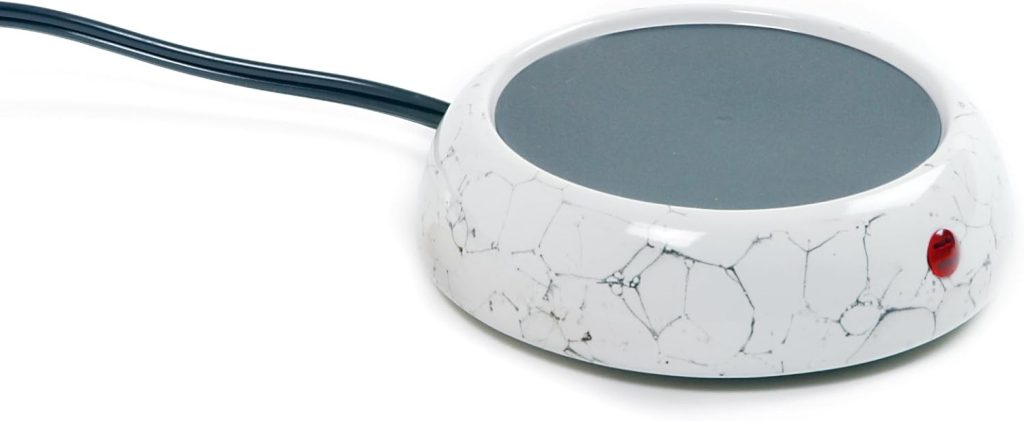
    Electric plate warmers plug into standard outlets and use heating elements to warm plates from below, typically reaching 140-200°F.

    Electric plate warmer for slow Eaters

    Hot-water warmers contain sealed compartments filled with water that’s heated in the microwave, then radiates warmth for 30-60 minutes.

    Insulated base warmers combine thermal retention materials with reflective covers to trap existing heat.

    Each type offers distinct advantages: electric models provide consistent, long-lasting warmth; hot-water versions offer portability without cords; insulated options work entirely without power, making them ideal for outdoor dining or travel.

    Temperature Retention and Heat Distribution Explained

    Quality plate warmers maintain food temperatures between 140-165°F—the safe zone that prevents bacterial growth while keeping food appetizing.

    Heat distribution varies by design: flat electric warmers heat uniformly across the plate surface, while some models feature raised edges that create air circulation.

    Thermal mass matters too—ceramic and stone warmers retain heat longer than thin metal designs.

    The best electric plate warmers include thermostats that cycle heating elements to maintain consistent temperatures without overheating, ensuring food stays warm for 45-90 minutes, depending on the model.

    Energy Efficiency and Safety Features

    Modern energy-efficient plate warmers consume surprisingly little power, typically 15-25 watts—less than a standard light bulb.

    Many include automatic shut-off timers (usually 60-90 minutes), preventing energy waste and overheating.

    Safety certifications like UL or CE listings ensure electrical components meet rigorous standards.

    Cool-touch exteriors protect users from burns, while non-slip surfaces prevent plate sliding.

    Overheat protection circuits automatically cut power if temperatures exceed safe limits, making these devices suitable for unsupervised use by elderly or disabled individuals.

    Best Plate Warmers for Slow Eaters (2025 Recommendations)

    Plate warmer for slow eaters

    After extensive research and comparison, these plate warmers stand out for reliability, safety, and effectiveness in keeping meals warm for extended periods.

    Norpro Electric Plate Warmer — Best Overall Choice

    The Norpro Electric Plate Warmer heats plates to 200°F in approximately 8-10 minutes, maintaining warmth for 60+ minutes.

    Nopro best plate and cup food warmer

    Its 12-inch diameter accommodates most dinner plates and specifically ceramic coffee mugs, while the 20-watt heating element provides gentle, consistent heat.

    The cordless design, after heating, offers table flexibility.

    Ideal for: Elderly users, family dinners, anyone needing reliable warmth for 45-60 minute meals

    Pros:

    • Fast heat-up time
    • Energy-efficient operation
    • Accommodates various plate sizes
    • Affordable price point

    Cons:

    • Requires outlet access during heating
    • The surface can get quite hot (use caution).

    Home-X Heated Plate Mat — Best for Everyday Use

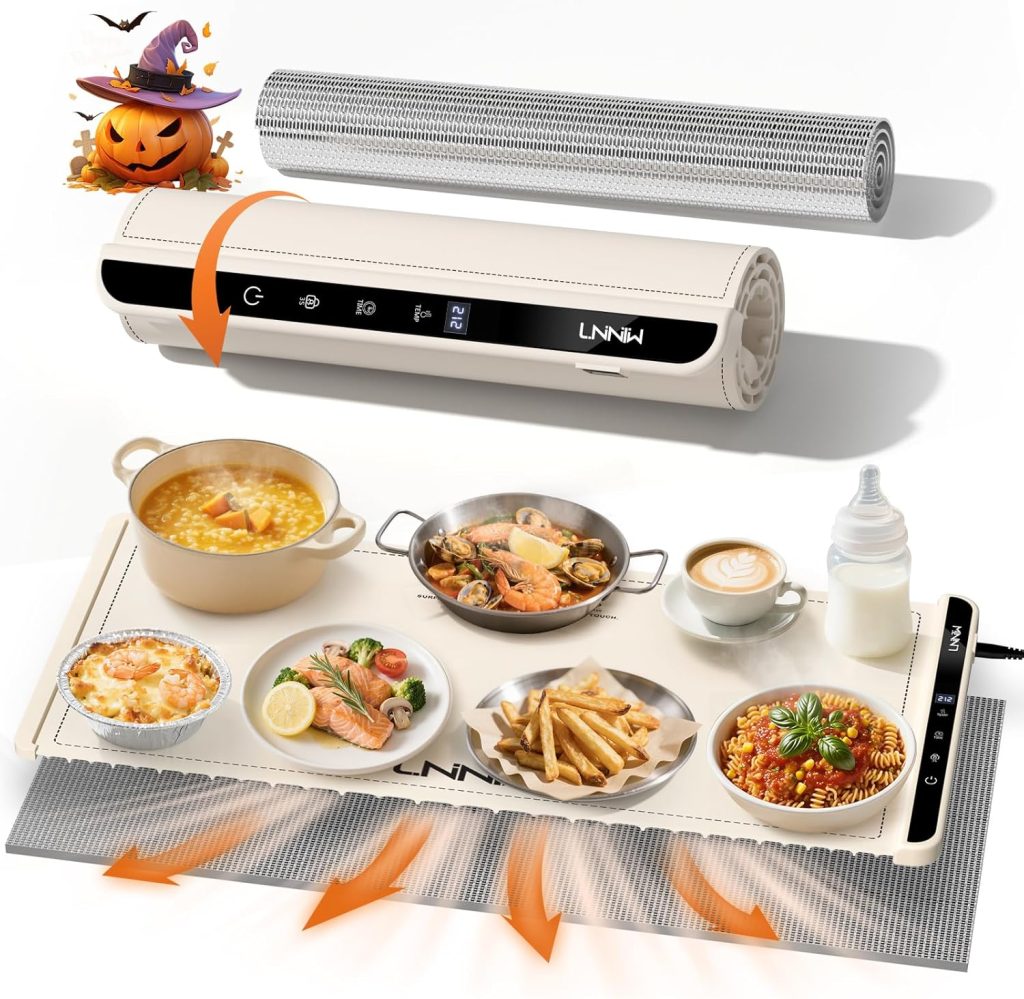
    This practical heated plate mat offers 15-watt heating in a slim, portable design perfect for daily use.

    It reaches optimal temperature in 10-12 minutes and maintains food warmth for 40-50 minutes. The lightweight construction makes it easy to store when not needed.

    Large food warming mat for family and children

    Ideal for: Children who eat slowly, everyday family use, small apartments with limited storage

    Pros:

    • Compact and easy to store
    • Very energy-efficient
    • Simple on/off operation
    • Budget-friendly

    Cons:

    • Shorter warming duration than premium models
    • Best for standard-sized plates only.

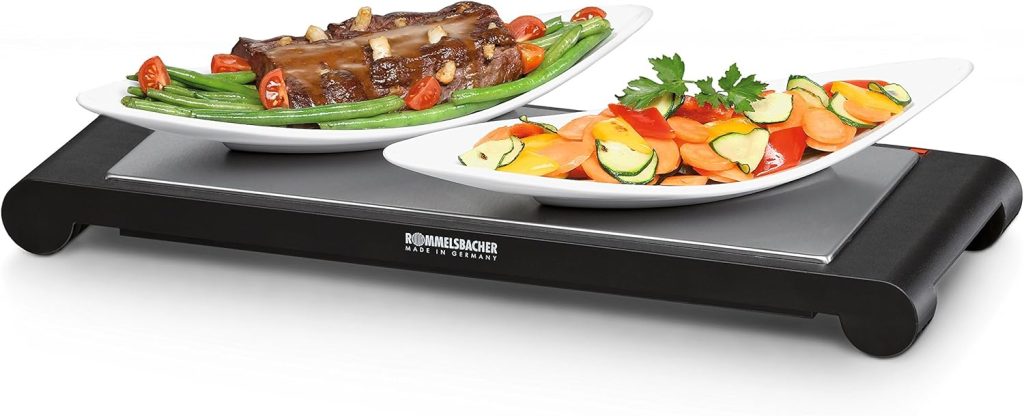
    ROMMELSBACHER WPS 857/E — Best Premium Option

    The ROMMELSBACHER features dual heating zones, adjustable temperature settings (up to 185°F), and a generous 14-inch surface.

    Rommelsbacher WPS 857 hot plate for food warming

    Its thermostat-controlled heating maintains precise temperatures for 90+ minutes, while the ceramic heating plate distributes warmth evenly. The sleek stainless steel design looks elegant on any table.

    Ideal for: Frequent use, entertaining, users requiring extended meal times, those wanting premium features

    Pros:

    • Adjustable temperature control
    • Extra-long warming duration
    • Large capacity for bigger plates
    • Professional-grade construction
    • The indicator light shows the heating status

    Cons:

    • Higher price point
    • A larger footprint requires more table space.

    Hot-Pak Microwave Heat Pad — Best Portable Pick

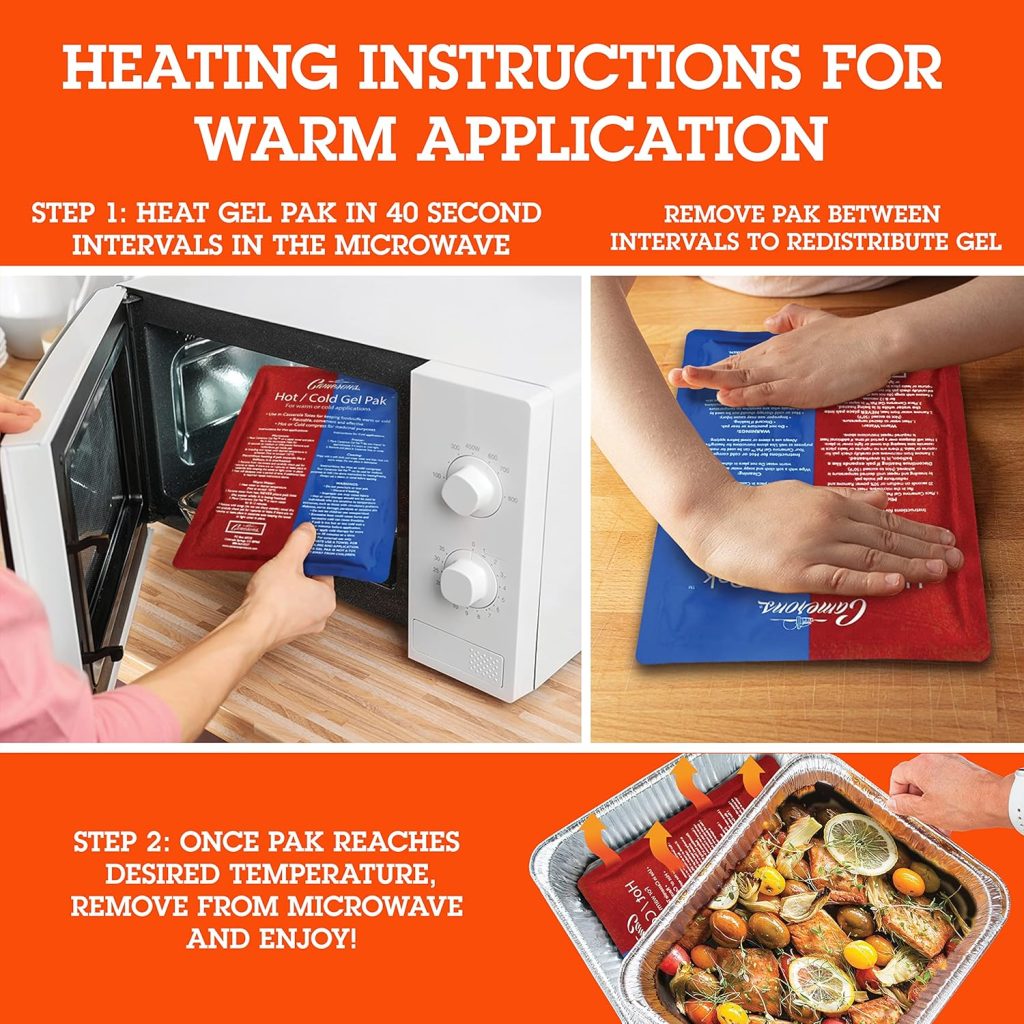
    This non-electric alternative contains a sealed gel that’s heated in the microwave for 60-90 seconds, then maintains warmth for 30-45 minutes.

    heating packs for warming food

    The flexible design fits under various plate sizes, and the portable nature means it works anywhere—no outlets required.

    Ideal for: Travel, outdoor dining, RVs, situations without electrical access, backup option

    Pros:

    • Completely portable
    • No electricity needed
    • Reusable hundreds of times
    • Safe for all ages
    • Affordable

    Cons:

    • Requires microwave access
    • Shorter warming period
    • Heat gradually diminishes.

    Insulated Plate Covers — Best Non-Electric Alternative

    Insulated plate covers use reflective thermal materials and foam insulation to trap existing heat, keeping food warm for 20-30 minutes without any power source.

    Insulated plate cover with heat insulation mat

    They work best when plates are preheated and work alongside other warming methods.

    Ideal for: Eco-conscious users, supplementing other warming methods, and budget-conscious families

    Pros:

    • Zero energy consumption
    • Extremely affordable
    • Lightweight and stackable
    • Safe for everyone
    • No maintenance required

    Cons:

    • Shorter effective warming time
    • Requires preheated plates for best results
    • Doesn’t actively generate heat.

    Servit Hot Plate Heaters

    The Servit Hot plate heaters keep your plate hot long enough so you can enjoy your meals.

    Plate heater to keep food warm

    Here is how the Servit Hot Plate heater works: Place your microwave-safe dinnerware inside the microwave, then place the hot plate heater in between the dinnerware sets, and you can stack 2 or 3 dishes on top of each other.

    Heat for about 30 seconds, gently remove the Servit hot plate heaters, then place your food on the heated plate.

    We recommend you use thick ceramic dinnerware for this, so the heat can last longer, which helps for slow eaters.

    The First drawback of the Servit hot plate heater disk is that it is not designed to keep your food warm while you eat; rather, it warms up your plate so that the plate is hot when you serve the food, and then you can enjoy your meal.

    Another disadvantage of the Servit hot plate heater is that you must warm the plate (using a microwave oven) before adding food, thereby helping your food stay warm much longer.

    We also recommend that you don’t overheat the plates in the microwave, so they don’t crack.

    With this plate heater device, you instantly get your plate hot in seconds, and your meal stays warm while you eat.

    Let’s see examples of electric plate warmers for sluggish eaters.

    Insulated Plate to Keep Food Warm

    Insulated plates are like special dishes designed to keep your food warm for longer. They work by using two layers.

    Insulated Plate to keep food warm

    The inner layer is usually made of a good heat-retaining material like stainless steel or ceramics. This layer holds the heat from your hot food.

    The outer layer is where the magic happens. It’s made of materials that don’t let heat escape easily, like plastic or more insulation.

    This layer acts like a cozy blanket for your food, trapping the heat inside and not letting it escape into the room.

    insulated stainless steel container for hot and cold food

    So, when you put your hot food on this plate, the inner layer keeps the food warm, and the outer layer keeps the heat from escaping.

    It’s a bit like wearing a warm winter coat on a cold day – it helps you stay warm by trapping your body heat.

    This way, even after some time, when you come back to your food, it’s still warm and tasty.

    Insulated plates are handy for keeping your meals nice and toasty, especially when you want to enjoy your food slowly without it getting cold too quickly.

    Hotsmart Hot Gourmet Plates

    Hotsmart Hot Gourmet Plates

    The Hotsmart hot gourmet plate is made up of bone china that can store heat comfortably.

    The Hotsmart hot gourmet plate can also prevent your food from overheating or overcooking. Your favorite meal can stay hot, especially for the elderly, Alzheimer’s, and Parkinson’s patients.

    You simply preheat for up to 30 seconds, heat your food at any desired temperature on the plate, and monitor it frequently while turning the food with the aid of the microwave oven turntable.

    It is a perfect feeding aid for the sick and the elderly with geriatrics.

    Individual Dinner Plate Warmer

    The Individual dinner plate warmer is also known as the warm plate helper; it is like giving your plate superhero power to stay hot and yummy while you eat.

    There are plate warmers that can be used for up to 5 to 10 persons, but the individual dinner plate warmers can be used by only one person at a time.

    You know how sometimes, when you’re eating, your food starts to get a bit cold, especially if you take your time to enjoy it?

    Well, the individual dinner plate warmer is like a superhero that saves your food from getting cold!

    Here’s how it works: You place your regular plate of food on top of this special plate warmer. The plate warmer is like a secret heating pad, but it’s safe for plates.

    It gently warms the plate from underneath, just like a cozy blanket, so your food stays warm and delicious until you finish eating!

    So, you can take your time to chat with your family or friends during dinner without worrying about your food getting cold.

    Factors to Consider Before Buying a Plate Warmer

    Choosing the right plate warmer requires evaluating several key factors that affect performance, safety, and user satisfaction. These considerations ensure your investment meets your specific needs.

    Heat-Up Time and Temperature Range

    Heat-up time varies from 5 to 15 minutes depending on the model and desired temperature.

    Electric plate warmers typically reach 140-200°F, with higher temperatures heating faster but requiring more careful monitoring.

    Consider your typical meal duration: if meals last 60+ minutes, prioritize models that maintain 160°F+ for extended periods.

    Temperature range flexibility matters for different food types—delicate items like fish need gentler warmth (140-150°F) while heartier dishes benefit from higher heat (170-190°F).

    Models with adjustable thermostats offer the most versatility.

    Power Source (Electric vs Thermal)

    Electric plate warmers provide consistent, reliable heating but require outlet access and consume continuous power during operation.

    They’re ideal for stationary dining areas and frequent use. Thermal warmers (microwave-heated pads) offer portability and zero electricity at the table, but need reheating access and provide shorter warming duration.

    Battery-operated options exist but typically offer limited heating capacity. Consider your dining setup: fixed dining room tables suit electric models, while eat-anywhere flexibility favors thermal options.

    Energy costs for electric warmers remain minimal at 15-25 watts per use.

    Size, Weight, and Compatibility with Plates

    Plate warmer surfaces range from 10 to 14 inches in diameter. Measure your most-used dinner plates; they should sit comfortably on the warmer surface without overhanging.

    Weight affects portability and storage: lightweight models (under 2 lbs) suit users with limited strength, while heavier units (3-5 lbs) often indicate better construction and heat retention.

    Check plate material compatibility; most warmers work with ceramic, porcelain, and stoneware, but some may not suit thin glass or metal plates.

    Warmer thickness matters too for table clearance and storage space. Many senior citizens find lightweight plates useful when paired with plate warmers, as the combination reduces the overall weight they need to handle during meals.

    Energy Usage and Safety Certifications

    Look for UL, CE, or ETL safety certifications confirming the device meets electrical safety standards. Energy-efficient models consume 15-25 watts, costing mere pennies per use.

    Auto shut-off features (30-90 minute timers) prevent energy waste and reduce fire risk. Overheat protection automatically cuts power at unsafe temperatures.

    Cool-touch housings protect users from burns, essential for households with children or elderly users.

    Non-slip feet prevent accidents, while cord length (typically 3-5 feet) affects placement flexibility. Read user reviews specifically mentioning safety experiences before purchasing.

    Safety and Maintenance Tips

    Proper use and care of your plate warmer ensures longevity, optimal performance, and, most importantly, prevents accidents or injuries during use.

    Safe Use for Children or the Elderly

    Never leave heating plate warmers unattended with unsupervised children, as surfaces can reach temperatures causing burns.

    For elderly users, choose models with cool-touch exteriors and clear indicator lights showing when heating is active.

    Place warmers on stable, flat surfaces away from table edges to prevent tipping. Ensure cords don’t create tripping hazards.

    For dementia patients or those with reduced sensation, consider non-electric thermal options or use plate covers over electric warmers as a protective barrier.

    Always test the plate temperature before serving to vulnerable users.

    Cleaning and Storage Practices

    Unplug electric warmers and allow complete cooling before cleaning, typically 20-30 minutes. Wipe surfaces with damp cloths; avoid submerging electrical components in water.

    Most plate warmer surfaces are water-resistant but not waterproof. Remove food spills immediately to prevent buildup that affects heat distribution.

    For thermal heat pads, clean vinyl surfaces with mild soap and water. Store plate warmers in dry locations away from moisture.

    Coil electrical cords loosely to prevent wire damage. Avoid stacking heavy items on top of warmers during storage, which can warp heating surfaces.

    Avoiding Overheating or Burns

    Use the lowest effective temperature setting for your food type—higher isn’t always better and can dry out meals.

    Don’t preheat the warmer for longer than the manufacturer’s recommendations, typically 8-12 minutes. Never place empty plates on maximum heat settings for extended periods.

    Use oven mitts or pot holders when handling heated plates, even if the warmer base feels cool. Don’t cover electric warmers with towels or tablecloths during operation, as this can trap heat dangerously.

    Keep flammable materials (paper napkins, placemats) at least 6 inches away from active heating surfaces.

    Alternative Ways to Keep Food Warm

    While plate warmers offer excellent solutions, several alternative methods can keep food warm for slow eaters, either as standalone options or complementary approaches.

    Insulated Bowls and Covers

    Double-walled insulated bowls trap heat effectively, keeping soups, stews, and hot cereals warm for 30-45 minutes without power.

    Some features include vacuum-sealed construction similar to thermoses, offering superior heat retention.

    Insulated plate covers create a microclimate over food, reducing heat loss by up to 60% compared to uncovered plates.

    Combining a preheated plate with an insulated cover can maintain food temperature for 40-50 minutes.

    These options work excellently for travel, outdoor dining, or as eco-friendly alternatives.

    They’re particularly useful for children’s meals at school or daycare, where electrical devices aren’t practical.

    Preheating Plates with Hot Water

    A simple, zero-cost method involves running plates under hot water or submerging them in a sink of hot water for 2-3 minutes before plating food.

    This technique works surprisingly well, keeping food warm for an additional 15-20 minutes. For better results, heat plates in a 200°F oven for 10 minutes—effective but requires planning.

    Some dishwashers have “sanitize” cycles that heat dishes to 150°F+, perfect for preheating before meals.

    This method pairs excellently with insulated covers for extended warmth without electricity.

    Using Warming Trays and Pads

    Full-size warming trays offer larger surfaces (16-24 inches), accommodating multiple plates simultaneously, ideal for family dinners or entertaining.

    They typically maintain 140-200°F across the entire surface. Smaller warming pads provide targeted heat for individual plates or serving dishes.

    Some models include adjustable temperature zones for different food types. Chafing dishes work well for buffet-style serving, keeping food warm in serving bowls rather than individual plates.

    These alternatives suit different dining scenarios; choose based on whether you need individual plate warming or multi-dish warming capabilities.

    FAQs About Plate Warmers for Slow Eaters

    How long do plate warmers keep food hot?


    Electric plate warmers typically keep food hot for 45-90 minutes, depending on the model, starting food temperature, and ambient room temperature.

    Premium models with thermostat controls maintain consistent heat for up to 2 hours. Non-electric thermal warmers (microwave-heated pads) provide 30-45 minutes of warmth. Insulated covers alone offer 20-30 minutes.

    For best results, combine a preheated plate with an electric warmer and serve food piping hot initially.

    Are plate warmers safe for kids or elderly people?


    Yes, when used properly. Choose models with cool-touch exteriors, automatic shut-off features, and stable non-slip bases.

    Always supervise children during use and test the plate temperature before serving. For elderly users, especially those with reduced sensation or dementia, non-electric thermal options may be safer alternatives.

    Never allow unsupervised use by individuals who cannot recognize hot surfaces. Models with UL or CE safety certifications offer additional peace of mind.

    Can I use any plate on a plate warmer?


    Most ceramic, porcelain, and stoneware plates work excellently on plate warmers. However, avoid thin glass plates that may crack from uneven heating, and metal plates that can conduct heat excessively.

    Check your plate’s diameter against the warmer’s surface size; plates should rest fully on the heating surface without overhanging.

    Heavily decorated plates with metallic trim may not be suitable for some warmers. When in doubt, start with shorter heating times and monitor carefully.

    What’s the most energy-efficient plate warmer?


    Electric plate warmers consuming 15-20 watts are most energy-efficient, costing approximately 1-2 cents per hour of operation.

    Models with auto shut-off timers prevent unnecessary energy use. However, non-electric options like microwave-heated thermal pads use zero electricity at the table, though they require microwave energy for initial heating.

    Insulated covers consume no energy whatsoever. For frequent daily use, low-wattage electric models offer the best balance of convenience and efficiency.

    Conclusion — Warm Meals, Happier Dining

    Plate warmers for slow eaters transform mealtimes from frustrating races against cooling food into relaxed, enjoyable experiences.

    Whether you’re caring for an elderly parent, supporting a child who needs extra time, or simply want to savor meals at your own pace, the right plate warmer delivers comfort, dignity, and delicious warm food from first bite to last.

    The best plate warmer 2025 models offer impressive energy efficiency, robust safety features, and reliable performance that make them worthy investments in mealtime quality.

    From budget-friendly options to premium temperature-controlled models, there’s a perfect solution for every need and budget.

    Don’t let cold food diminish another meal—choose a plate warmer that brings warmth back to your table.