Mealtimes should feel like a moment of comfort and connection, but for many caregivers, they come with anxiety, frustration, and worry.
The person you care for is struggling to hold a spoon, choking on liquids, or losing interest in eating altogether.
You want to help without taking over, but knowing exactly what to do is not always obvious.
This caregiver’s guide to adaptive dining exists because those challenges are real, and the right tools and techniques make an enormous difference.
Adaptive dining is not just about specialised equipment; it is about restoring dignity, encouraging independence, and making every meal safer and more enjoyable.
What comes next might change how you approach every mealtime going forward.
What Is Adaptive Dining?
Adaptive dining refers to the practice of modifying eating tools, food textures, the physical environment, and caregiver techniques to support individuals who face physical or cognitive challenges during meals.
The goal is not to take over the eating process; it is to remove the barriers that make independent eating difficult, unsafe, or exhausting.
Definition of Adaptive Dining
At its core, adaptive dining is about meeting people where they are physically and cognitively.
That might mean swapping a standard fork for one with a built-up handle that is easier to grip, adjusting a chair so the person sits at the right height for the table, or modifying food textures to reduce choking risk.
The tools and adjustments vary by individual, but the underlying principle is always the same: preserve as much independence and dignity as possible while keeping the person safe.
Who Benefits from Adaptive Dining
Adaptive dining supports a wide range of individuals. Older adults dealing with reduced grip strength, joint pain, or general mobility decline benefit significantly from thoughtfully chosen tools.
People with neurological conditions such as Parkinson’s disease, multiple sclerosis, or stroke often face specific challenges with tremors, coordination, and swallowing that adaptive dining directly addresses.
Individuals recovering from surgery, injury, or illness may also need temporary adaptive support while they regain function.
The common thread is any condition that makes standard mealtimes harder than they need to be.
Common Eating Challenges Caregivers May Encounter

Understanding the specific challenges your person faces is the first step toward choosing the right tools and techniques.
Adaptive dining is not one-size-fits-all — what helps one person may not be relevant for another.
Limited Hand Strength or Dexterity
Reduced grip strength is one of the most common barriers to independent eating. Arthritis causes joint pain and stiffness that makes gripping thin utensil handles genuinely painful.
Tremors — whether from Parkinson’s, essential tremor, or medication side effects — make it difficult to guide food to the mouth without spilling.
General weakness in the hands and fingers, common in older adults, adds to the challenge.
Tools designed for adaptive utensils for poor grasp directly address these issues with wider handles, non-slip grips, and weight distribution that works with the hand rather than against it.
Difficulty Swallowing (Dysphagia)
Dysphagia — difficulty swallowing — is a serious and underrecognised challenge that affects many people with neurological conditions, stroke histories, and advanced age.
It creates a real choking risk, increases the chance of food or liquid entering the lungs (aspiration), and can cause people to avoid eating altogether out of fear.
Managing dysphagia involves modifying food textures to match what the person can safely swallow, from soft and moist foods through to fully pureed diets, and using appropriate cups and utensils that control the pace and volume of intake.
Limited Mobility or Coordination
Some individuals can grip a utensil adequately but struggle to lift it, guide it accurately, or coordinate the sequence of movements required to bring food to the mouth.
This is particularly common after a stroke, with conditions affecting muscle control, or in advanced stages of neurological disease.
Angled utensils, lightweight alternatives, and plate guards that give something to push food against can all help compensate for reduced coordination and range of motion.
Cognitive Challenges
Dementia and other memory-related conditions affect eating in ways that go beyond physical limitations.
A person with dementia may forget they are eating mid-meal, become distracted easily, lose the ability to sequence the steps involved in eating, or no longer recognise food or utensils.
Cognitive challenges require a different kind of adaptive approach, one that focuses on simplifying the environment, using familiar and clearly recognisable tools, providing gentle verbal cues, and maintaining a calm, consistent mealtime routine.
Essential Adaptive Dining Tools
The right tools genuinely change what is possible at mealtimes. This is not about gadgets for the sake of it — each category of adaptive equipment addresses a specific, real challenge.
Adaptive Utensils
Adaptive utensils are the foundation of any caregiver’s adaptive dining toolkit.
Weighted silverware for tremors adds gentle resistance that helps steady the hand and reduces spilling during the journey from plate to mouth, a simple but highly effective intervention for people with essential tremor or Parkinson’s.
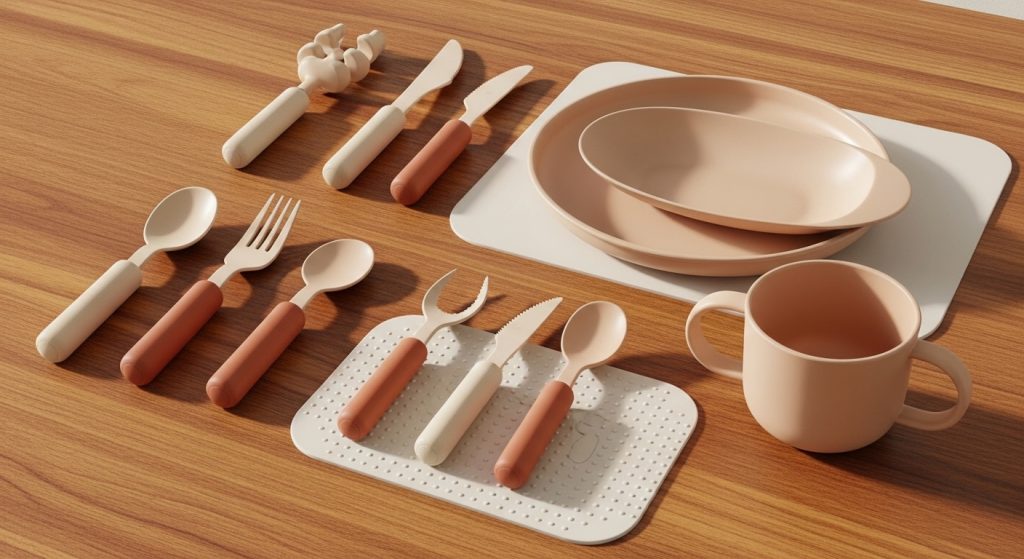
Built-up handle utensils feature wider, cushioned grips that are far easier to hold for anyone with arthritis or reduced hand strength.
Angled spoons and forks are bent at a fixed angle that keeps food on the utensil even when wrist rotation is limited, making self-feeding possible for people who would otherwise need full assistance.
Adaptive Plates and Bowls
Standard flat plates create a real problem for people with limited coordination — food slides off or gets pushed to the edge with no way to scoop it up.
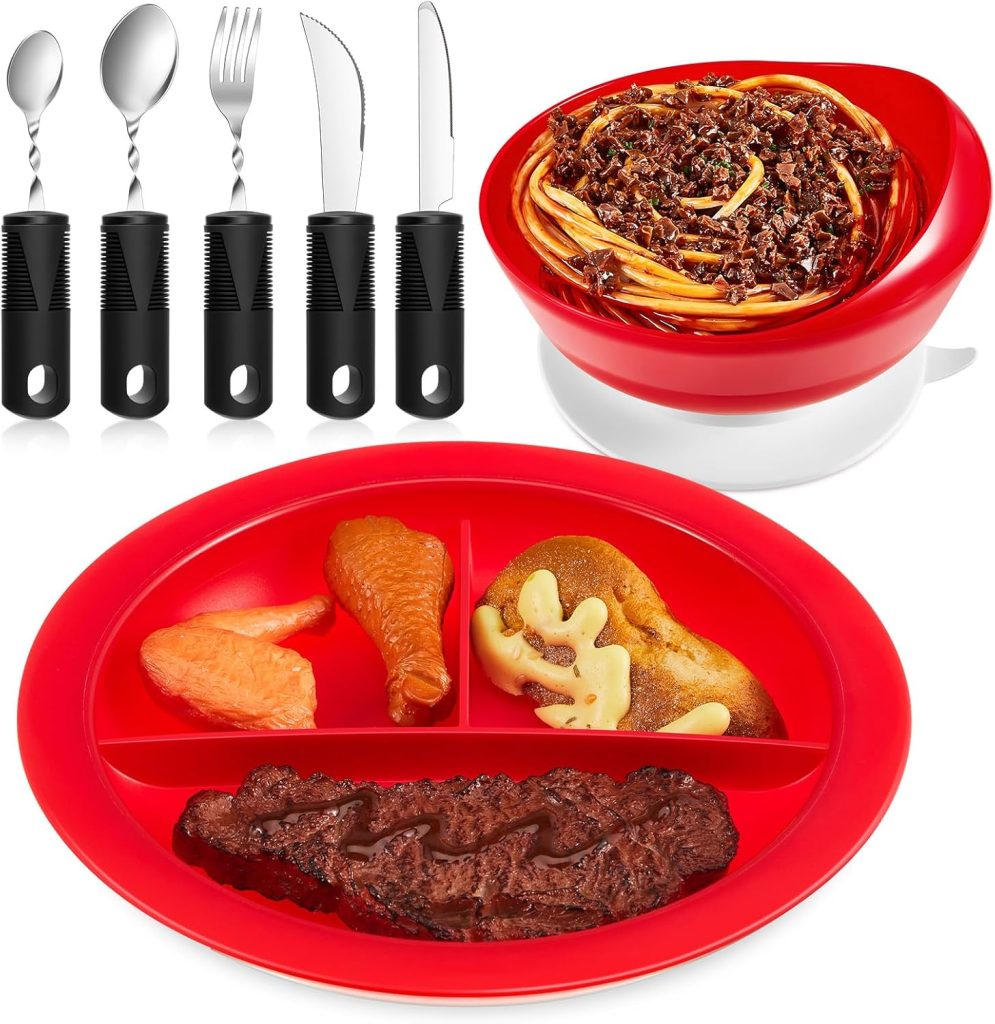
Adaptive plates for the elderly solve this through several design features. Plate guards clip onto the rim of a regular plate and create a raised edge to push food against.
Scoop dishes have a curved inner wall built into the design that serves the same function.
Non-slip bowls and plates with suction bases stay firmly in place on the table, removing the frustration of chasing a moving plate.
These tools give people something to work with and dramatically reduce the mess and effort involved in self-feeding.
Adaptive Cups and Drinking Aids
Drinking presents its own set of challenges.
Standard cups and glasses require two things that many people find difficult: the grip strength to hold them securely, and the ability to tilt the head back to drink without choking.
Spill-proof cups with weighted bases reduce the risk of tipping. Cups designed with two handles distribute the weight and allow a more stable two-handed grip.
Nosey cutout cups allow the person to drink without tilting their head back, which is particularly useful for people with limited neck mobility or swallowing difficulties.
Straws can help some individuals, but should be used cautiously with dysphagia, as they can increase the risk of aspiration if not properly supervised.
Setting Up an Adaptive Dining Environment
The physical environment matters as much as the tools themselves.
Even the best adaptive utensils will underperform if the person is seated awkwardly, distracted, or unable to reach their food comfortably.
Proper Seating and Positioning
Upright posture is essential for safe eating, particularly for anyone with swallowing difficulties.
The person should be seated with their back in the chair, feet flat on the floor (or on a footrest), and the table at a height that allows elbows to rest comfortably on the surface.
Slouching or reclining while eating significantly increases the risk of choking and aspiration.
If the person uses a wheelchair, ensure it is locked and positioned close enough to the table that they do not need to reach or lean forward to eat.
Creating a Calm Eating Environment
Distractions make mealtimes harder for everyone, but for someone with cognitive challenges, a noisy or busy environment can derail eating entirely.
Turn off the television, reduce background noise where possible, and limit the number of people moving around during the meal.
Keep the table setting simple, only what is needed for the current meal.
A calm, unhurried atmosphere communicates that there is no rush, which helps the person relax and focus on eating at their own pace.
Ensuring Accessibility
Everything the person needs for the meal should be within easy reach before the meal begins — utensils, cup, condiments, and napkin.
Non-slip placemats under plates and bowls prevent sliding and give the person a stable surface to work with.
For people with one-sided weakness (common after stroke), position tools on the stronger side.
Minimise the number of items on the table to reduce cognitive load and make it easier to focus on the meal itself.
Caregiver Techniques for Supporting Safe Eating
How a caregiver behaves during meals is just as important as the tools being used.
The right techniques protect dignity, encourage effort, and keep the person as independent as possible for as long as possible.
Encouraging Independence
The instinct to help is natural, but stepping in too quickly actually reduces the person’s ability to maintain their own skills over time.
Allow extra time for self-feeding. Sit at eye level rather than standing over the person.
Use eating utensils for the disabled that are specifically designed to enable independent feeding, and introduce them one at a time so the person can get comfortable with each tool.
Acknowledge effort and small wins. The goal is not perfection — it is participation.
Assisting Without Overhelping
When assistance is genuinely needed, offer the minimum required.
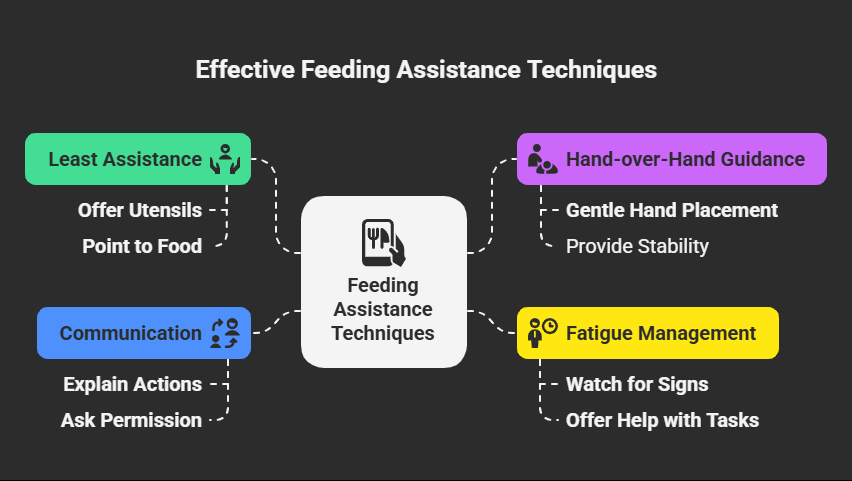
Hand-over-hand guidance — where the caregiver places their hand gently over the person’s hand to support the movement — allows the person to remain part of the action rather than being fed passively.
Verbal cues (“pick up the spoon,” “take a small bite”) can help prompt the sequence of actions without physical intervention.
Always ask before assisting, and frame it as support rather than takeover.
Preserving dignity during meals has a real impact on a person’s overall well-being and willingness to engage at mealtimes.
Monitoring for Safety
Stay attentive throughout the meal without hovering anxiously. Watch for early signs of choking: coughing, throat clearing, a wet or gurgly voice after swallowing, or a pained expression.
If the person eats very quickly, gently encourage them to slow down between bites.
Check that food is being swallowed fully before the next bite is taken.
If swallowing difficulties are a known issue, follow the advice of a speech-language therapist regarding safe food textures and positioning during meals.
Nutrition Considerations in Adaptive Dining
Adaptive dining is not only about safe eating — it is also about ensuring the person continues to receive adequate nutrition and hydration.
Physical and cognitive challenges can quietly erode nutritional intake if they are not actively managed.
Texture-Modified Diets
When swallowing difficulties are present, food textures must be modified to match what the person can safely manage.
Pureed diets involve blending all foods to a smooth, lump-free consistency. Soft diets allow moist, tender foods that require minimal chewing.
The International Dysphagia Diet Standardisation Initiative (IDDSI) provides a standardised framework of texture levels that helps caregivers and healthcare professionals communicate clearly about what is appropriate for a specific individual.
Always follow professional guidance when modifying textures. The wrong texture can increase rather than reduce risk.
Maintaining Balanced Nutrition
People who struggle with eating often consume less than they need, which leads to unintended weight loss, fatigue, and reduced resilience.
Prioritise calorie and nutrient density in every meal, adding healthy fats like avocado, nut butter, or olive oil to foods increases caloric value without increasing volume.
Small, frequent meals are often better tolerated than three large ones. Track weight and appetite over time, and flag any significant decline to the person’s healthcare team promptly.
Hydration Support
Dehydration is a serious and frequently underrecognised risk for older adults and people with physical limitations.
Difficulty drinking — due to grip problems, swallowing concerns, or simply forgetting — can quickly lead to dehydration with consequences for cognition, energy, and health.
Using plates that keep food warm alongside insulated cups that maintain fluid temperature can make meals and drinks more appealing and encourage better intake.
Offer fluids regularly throughout the day rather than waiting for the person to ask, and consider thickened liquids if recommended by a speech therapist for dysphagia management.
Common Mistakes Caregivers Should Avoid
Rushing Meals
Rushing is one of the most common and most damaging mistakes in adaptive dining.
When a caregiver is pressed for time, the pace of the meal speeds up, the person feels pressured, and the risk of choking increases significantly.
Build enough time into the daily schedule for meals to proceed at the person’s natural pace. A relaxed mealtime is a safer mealtime.
Using Incorrect Utensils
Using standard utensils out of habit or convenience — when adaptive tools are available and appropriate — makes every meal harder than it needs to be.
The wrong utensil can turn an achievable task into a frustrating failure, which discourages the person from trying to feed themselves at all.
Take the time to match each tool to the specific challenge the person faces, and revisit that match periodically as needs change.
Ignoring Comfort and Positioning
Poor positioning is one of the most overlooked contributors to difficult mealtimes.
An uncomfortable person, leaning to one side, or seated too far from the table, will struggle regardless of how good the adaptive tools are.
Make positioning checks part of the pre-meal routine every time, before the meal begins.
It takes thirty seconds and makes a measurable difference to both safety and the person’s ability to eat independently.
Tips for Improving the Adaptive Dining Experience
Personalizing Tools for the Individual
Adaptive dining works best when tools are chosen for the specific person rather than adopted generically.
A utensil that works beautifully for someone with tremors may be unnecessary or even awkward for someone whose primary challenge is limited grip strength.
Involve the person in choosing their tools where possible; having a say in what they use increases buy-in and willingness to engage with the tools consistently.
Occupational therapists can provide valuable assessments and recommendations tailored to the individual’s exact needs.
Practicing Consistent Mealtime Routines
Consistency is particularly important for people with cognitive challenges, but it benefits everyone receiving adaptive dining support.
Eating at the same time each day, in the same seat, with the same setup, reduces the cognitive load involved in getting started and helps the person know what to expect.
Over time, a consistent routine builds a kind of muscle memory around mealtimes that supports more independent and confident eating.
Consulting Healthcare Professionals
No guide replaces the assessment of a qualified professional.
An occupational therapist can evaluate the person’s specific physical limitations and recommend appropriate adaptive tools with far more precision than a general guide can offer.
A speech-language therapist should be consulted whenever swallowing is a concern. A dietitian can address nutritional gaps.
These professionals are allies; use them early, before challenges escalate, rather than as a last resort.
Conclusion
Adaptive dining is one of the most practical and impactful areas of caregiving and one of the most underestimated.
The right tools, techniques, and environment turn mealtimes from a source of stress into a moment of genuine connection and restored independence.
Start with the specific challenges the person you care for actually faces. Choose tools that match those challenges.
Slow down, position well, and resist the urge to take over. Where swallowing, nutrition, or complex physical needs are involved, bring in the right professionals early.
Every meal is an opportunity to support not just physical health but dignity, comfort, and quality of life, and that is always worth getting right.