Determining when Baccarat crystal was manufactured requires understanding how marking practices evolved throughout the company’s 260-year history.
Baccarat marks serve as temporal indicators, with distinct styles corresponding to specific production periods from the unmarked pre-1936 era through modern standardized logos.
Dating Baccarat pieces accurately helps establish value, verify authenticity, and understand historical context.
However, marks alone don’t tell the complete story—pattern styles, cutting techniques, and craftsmanship quality provide essential corroborating evidence.
This comprehensive guide explores Baccarat’s marking timeline, explains how to identify marks from different eras, and demonstrates the step-by-step process for dating pieces using marks alongside other authentication factors to establish accurate production periods with confidence.
Why Baccarat Marks Are Used to Date Crystal
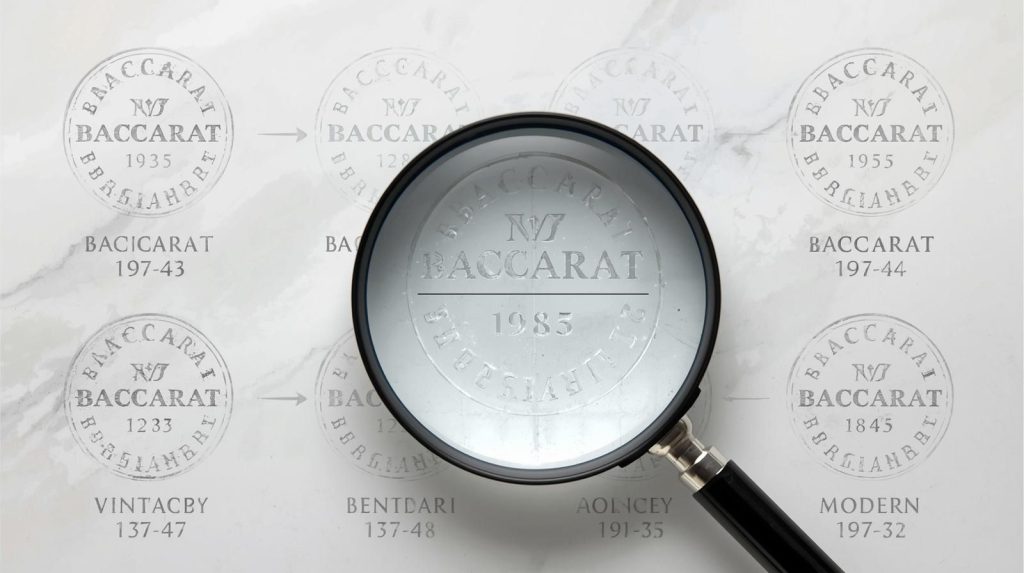
Baccarat marks provide the most direct evidence for determining manufacturing periods, though they function best when combined with other dating methods for complete accuracy.
Marks as Manufacturing Indicators
Baccarat’s marking practices changed systematically throughout the company’s history, creating identifiable chronological markers.
The presence, absence, style, and clarity of marks immediately narrow production timeframes.
Early pieces lack marks entirely, mid-century items show transitional etching styles, and contemporary pieces display standardized logos.
These marking evolution stages create a reliable timeline framework for dating authentic Baccarat crystal when properly understood and applied.
Why Baccarat Changed Marks Over Time
Baccarat evolved, marking practices in response to counterfeiting concerns, changing manufacturing technologies, and brand protection needs.
Early confidence in craftsmanship quality made marks unnecessary. As crystal markets expanded and imitations proliferated, permanent identification became essential.
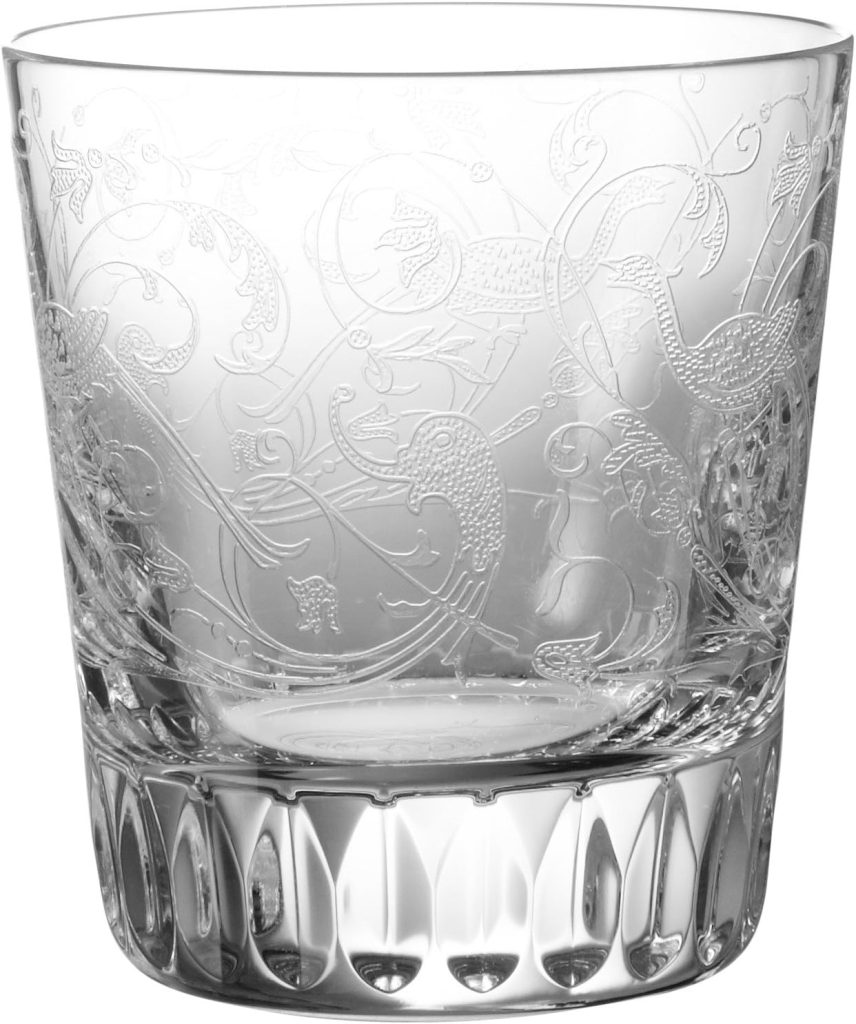
Technical advances in acid-etching and later laser technology improved mark clarity and consistency.
Each marking change reflected broader manufacturing and market conditions during specific historical periods.
Relationship Between Marks and Production Eras
Specific mark styles correlate directly with defined production periods, creating a chronological framework for dating.

Pre-1936 pieces typically lack marks, 1936-1950s items show early, shallow etching, 1960s-1980s pieces display clearer logos, and post-1990s crystal features standardized modern marks.
Understanding Baccarat stamps within these temporal contexts allows collectors to assign approximate production dates based primarily on mark characteristics observed on individual pieces.
Overview of Baccarat Mark History
Baccarat’s marking evolution spans three major phases reflecting changing manufacturing priorities, market conditions, and brand protection strategies across centuries.
Early Unmarked Period
From Baccarat’s 1764 founding through the mid-1930s, the company rarely marked pieces permanently.
Craftsmen relied on superior quality and design recognition for authentication. Occasional paper labels provided temporary identification but rarely survived.
This 170-year unmarked period means many valuable antique Baccarat items legitimately lack any manufacturer’s stamp, requiring alternative dating methods through pattern documentation and craftsmanship evaluation.
Introduction of Acid-Etched Marks
Around 1936, Baccarat began systematically applying acid-etched circular logos to finished pieces.
Early implementations produced shallow, sometimes faint impressions requiring careful examination.
This transitional period shows varying mark depths and placements as techniques are standardized.
The introduction of permanent marks represented Baccarat’s response to expanding markets and growing counterfeit concerns, establishing brand protection through indelible identification.
Standardization of Branding
By the 1990s, Baccarat achieved complete mark standardization with consistent logo designs, uniform etching depths, and predictable placements.
Modern manufacturing controls ensure every marked piece displays identical logo characteristics regardless of item type.
This standardization simplifies authentication and dating for contemporary pieces while creating clear distinctions from earlier, more variable marking periods that reflected evolving manufacturing capabilities.
Baccarat Crystal Marks by Time Period
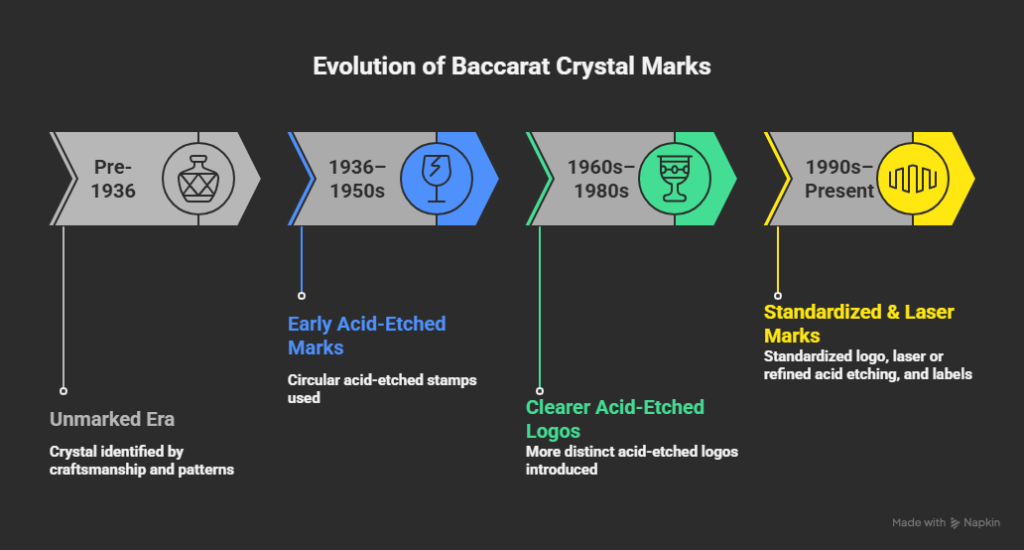
Understanding chronological mark evolution provides the foundation for accurate dating based on observable stamp characteristics.
Pre-1936 Baccarat Crystal (Unmarked Era)
Baccarat pieces manufactured before approximately 1936 typically bear no permanent marks whatsoever.
This extensive period encompasses some of Baccarat’s most valuable antique items, including early Harcourt patterns and Victorian-era designs.
No Permanent Marks
The complete absence of acid-etched stamps, engraved signatures, or molded marks characterizes this era.
Any pre-1936 piece claiming Baccarat origin without marks is potentially authentic, while marked pieces claiming early 19th-century dates warrant suspicion.
Some pieces carried paper labels that have since disappeared, leaving no authentication trace beyond quality indicators.
Identified by Craftsmanship & Patterns
Dating unmarked pieces requires examining hand-cutting precision, crystal weight, and clarity, and comparing designs against historical catalogs and museum collections.
Pattern-based dating support becomes essential when marks are absent, using documented production periods for specific cutting styles.
Victorian elaborate patterns versus Art Nouveau flowing designs help narrow manufacturing timeframes through stylistic analysis.
1936–1950s Baccarat Marks
The introduction period for acid-etched marks shows transitional characteristics as Baccarat established marking protocols and refined etching techniques for consistent application.
Early Acid-Etched Circular Stamps
Initial acid-etched logos appear as circular designs containing “BACCARAT” text and glass icons similar to modern marks but executed with less consistency.
The circular border, internal text arrangement, and icon details match later versions, though execution quality varies.
These pioneering marks established the design template Baccarat would standardize over subsequent decades.
Often Faint and Shallow
Early etching technology and developing techniques produced marks with noticeably shallower depth than modern versions.
Many 1936-1950s marks require angled lighting and careful examination to detect. This faintness doesn’t indicate wear but reflects period manufacturing capabilities.
Collectors should expect subtler marks from this era compared to bold contemporary stamping.
1960s–1980s Baccarat Marks
The mid-to-late 20th century marks show improved clarity and consistency as acid-etching techniques matured and quality control standardized.
Clearer Acid-Etched Logos
Marks from this period display enhanced visibility with deeper etching and sharper definition compared to earlier attempts.
The circular border appears more distinct, the text shows better clarity, and the glass icon achieves finer detail.
Technological improvements in acid application and etching precision created more reliably readable marks across all piece types.
Increased Consistency
Manufacturing standardization ensured marks appeared more uniformly across different items and production runs.
Variation between pieces decreased significantly, with mark depth, size, and placement becoming predictable.
This consistency aids dating—highly uniform marks suggest 1960s or later production, while variable marks indicate earlier manufacture.
1990s–Present Baccarat Marks
Contemporary Baccarat marks achieve complete standardization with modern manufacturing technologies producing perfectly consistent identification across all items.
Standardized Logo
Current marks display identical characteristics regardless of piece type, size, or production location.
The circular logo, text placement, and icon details follow exact specifications.
Every contemporary Baccarat piece receives marking meeting strict quality standards, creating immediate visual recognition of modern manufacture through mark perfection.
Laser or Refined Acid Etching
Modern technology enables extremely precise, consistent mark application.
Whether using advanced acid-etching or laser techniques, contemporary marks show exceptional clarity and depth uniformity.
The technology produces marks clearly visible without special lighting while maintaining the subtle elegance appropriate to luxury crystal.
Supplemented by Labels
Many current pieces include removable paper or foil labels providing additional information like pattern names, country of origin, and model numbers.
These temporary labels complement permanent etched marks rather than replacing them, offering purchasers immediate authentication confidence while maintaining permanent identification after label removal.
Types of Baccarat Marks Used for Dating
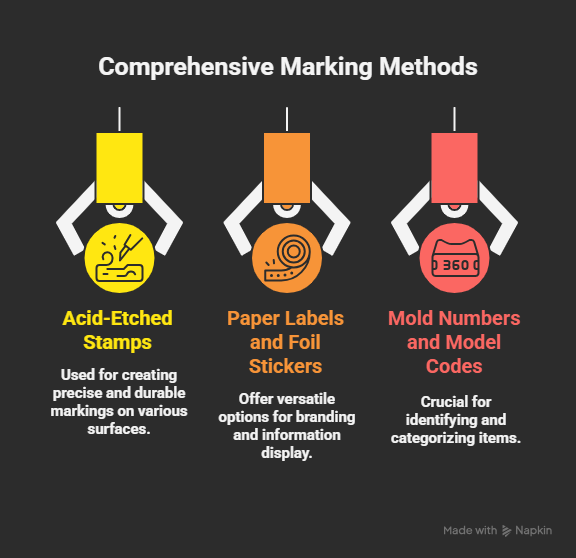
Different mark types provide varying dating information, with some offering more precise temporal indicators than others.
Acid-Etched Stamps
The primary permanent marking method consists of acid-etched circular logos applied after piece completion.
These indelible marks survive indefinitely, providing the most reliable dating evidence.
Mark style evolution—from shallow early versions to bold modern stamps—allows chronological placement within defined production periods based on etching depth, clarity, and consistency characteristics.
Paper Labels and Foil Stickers
Temporary labels appear on many pieces, particularly from recent decades.
These removable identifiers include “Baccarat” text and often additional details. Labels indicate relatively recent manufacture since older pieces have typically lost them.
However, label absence doesn’t indicate age—many contemporary pieces lose labels quickly. Labels supplement but don’t replace permanent mark dating.
Mold Numbers and Model Codes
Some Baccarat pieces include small molded numbers or codes indicating specific patterns or production runs.
These identifiers rarely appear on visible surfaces, sometimes hidden inside bases or under feet.
When present and cross-referenced against Baccarat records or reference materials, these codes can narrow dating more precisely than general mark styles alone.
What Does Not Indicate Age
Certain characteristics mistakenly interpreted as dating indicators actually don’t reliably establish age.
Crystal clarity, weight, and general quality remained consistently excellent throughout Baccarat’s history.
Pattern popularity or perceived style also misleads—Harcourt spans nearly 200 years while looking “modern.”
Focus on actual mark characteristics rather than subjective quality or aesthetic impressions.
Where to Find Baccarat Marks on a Piece
Mark location varies somewhat by piece type, though several standard placements apply across most Baccarat crystal items.
Base or Foot
The most common location for acid-etched marks is centered on the flat bottom surface where pieces rest on tables.
Stemware shows marks on the circular foot bottom, while flat-bottomed vases, bowls, and decanters carry marks on their base centers.
This placement keeps marks visible for authentication while remaining unobtrusive during display and use.
Under Bowls or Stems
Some pieces, particularly those with complex bases or decorative feet, place marks on stem undersides or where bowls meet stems.
Examine junction points between different structural elements. Tilt pieces and check all potential marking surfaces when base centers show no stamps.
Unusual base designs sometimes necessitate alternative mark placements.
Why Marks May Be Worn Away
While acid-etched marks are permanent and won’t disappear through normal handling, they can become less visible under certain circumstances.
Extremely aggressive polishing over many decades might lighten marks slightly, though this rarely occurs with proper care.
More commonly, scratches near marks or poor lighting make detection difficult, rather than actual mark degradation.
How to Date Baccarat Crystal Using Marks (Step-by-Step)
A systematic approach combining mark analysis with corroborating evidence produces the most accurate dating results.
Locate the Mark
Begin by thoroughly examining all potential marking locations, starting with the base center. Use bright direct lighting and rotate the piece to catch light at various angles.
Check feet, stems, and bowl undersides if base examination proves unsuccessful.
Remember that pre-1936 pieces legitimately lack marks entirely, so absence doesn’t always indicate non-Baccarat origin.
Identify Mark Style
Once located, carefully assess the mark’s characteristics, including etching depth, clarity, circle precision, and overall consistency.
Note whether the mark appears faint and shallow (1936-1950s), moderately clear (1960s-1980s), or boldly standardized (1990s-present).
Compare observed characteristics against known examples from different periods to establish the likely manufacturing era.
Match to Known Timelines
Cross-reference your mark’s characteristics against the established Baccarat marking chronology.
Shallow, faint marks suggest 1936-1950s production, clearer marks indicate 1960s-1980s manufacture, and perfectly consistent marks point to 1990s or later production.
Complete mark absence combined with authentic characteristics indicates pre-1936 manufacture requiring alternative dating methods.
Confirm with Pattern & Craftsmanship
Verify your mark-based dating against pattern style and cutting technique characteristics.
Art Deco patterns support 1920s-1930s dates, and contemporary designs confirm recent manufacture.
Hand-cutting precision, crystal clarity, and overall craftsmanship should align with your proposed date.
The full authentication process combines marks with multiple corroborating factors for confident dating.
Dating Baccarat Crystal Without Marks
Many authentic Baccarat pieces, particularly antiques, lack marks entirely and require alternative dating approaches using style and craftsmanship indicators.
Pattern Identification
Specific patterns were produced during defined periods, providing strong dating evidence when marks are absent.
Research when particular designs were introduced, remained in production, or were discontinued.
Pattern catalogs and museum collections document production timelines.
Matching your piece’s pattern to documented examples establishes likely manufacturing periods through design attribution.
Cut Style and Symmetry
Cutting techniques evolved throughout Baccarat’s history, with Victorian elaborate patterns, Art Deco geometric simplicity, and modern minimalism reflecting different eras.
Examine cutting density, motif types, and overall aesthetic philosophy. Hand-cutting precision remained consistently excellent, but stylistic approaches changed with artistic movements, providing temporal context for unmarked pieces.
Weight and Clarity
While Baccarat maintained high quality throughout its history, subtle material and manufacturing differences exist between eras.
Extremely heavy pieces with very high lead content often indicate earlier manufacture. Production techniques evolved gradually, affecting crystal characteristics in ways expert examination can detect.
Material analysis complements pattern and style dating when marks are unavailable.
Historical Catalogs
Consult Baccarat’s historical sales catalogs, museum archives, and reference books documenting patterns and production periods.
Many libraries and online resources provide access to vintage catalog scans.
Matching your piece’s design to catalog illustrations establishes manufacturing timeframes through documented production evidence, essential for accurately dating unmarked items.
Common Mistakes When Dating Baccarat Marks
Avoiding frequent errors improves dating accuracy and prevents misattribution or incorrect chronological placement.
Assuming All Pieces Are Marked
Many collectors mistakenly believe all authentic Baccarat carries marks, leading them to dismiss genuinely unmarked antique pieces.
The entire pre-1936 period produced unmarked items, and even later pieces occasionally lack stamps.
Don’t automatically assume an unmarked crystal isn’t Baccarat; instead, apply comprehensive authentication methods examining craftsmanship, patterns, and material quality alongside mark presence.
Confusing Labels with Permanent Marks
Paper and foil labels provide useful information, but don’t reliably date pieces since they’re easily removed or lost.
Some collectors assume label presence indicates recent manufacture while absence suggests age, but labels disappear quickly regardless of actual production date.
Focus on permanent acid-etched marks for dating rather than temporary labels.
Over-Reliance on One Indicator
Dating based solely on marks without confirming through pattern styles, cutting techniques, and craftsmanship quality produces unreliable results.
Counterfeiters can replicate marks, and authentic unmarked pieces exist.
Always combine mark analysis with multiple authentication factors, including weight, clarity, pattern documentation, and manufacturing details for confident, accurate dating.
How Mark Dating Affects Baccarat Crystal Value
Accurately dating pieces through marks and other indicators directly impacts market valuation and collector interest across different factors.
Antique vs Vintage vs Modern
Market categorization depends partly on age: antiques (pre-1920s), vintage (1920s-1980s), and modern (1990s-present) command different prices.
Generally, antique pieces in excellent condition with rare patterns achieve premium pricing. However, age alone doesn’t determine value—some contemporary limited editions exceed common antique values.
Dating establishes a proper market category, affecting valuation significantly.
Collector Demand by Era
Different collector segments prefer specific periods.
Some specialize in Victorian elaborate patterns, others focus on Art Deco streamlined designs, while contemporary collectors seek current limited editions.
Accurately dating pieces helps target appropriate collector markets.
Certain eras, like Art Deco or early Harcourt production, command particular enthusiasm, affecting prices beyond general age considerations.
Completeness and Condition
Dating helps assess whether complete sets remain obtainable or whether pieces represent rare survivors from discontinued production.
Sets from still-produced patterns allow completion, while discontinued era pieces cannot be supplemented.
Condition expectations also vary by age—minor wear seems acceptable on 19th-century pieces, but reduces modern item values substantially.
Professional Ways to Confirm Baccarat Dating
Expert verification provides definitive dating when self-assessment proves insufficient or high-value pieces require documentation.
Auction Houses
Major auction houses like Sotheby’s and Christie’s employ crystal specialists who expertly date Baccarat pieces through mark analysis, pattern identification, and manufacturing technique assessment.
They access comprehensive reference libraries and comparison collections.
Professional dating documentation from recognized auction houses provides valuable authentication for insurance, estate, and resale purposes.
Antique Crystal Appraisers
Certified appraisers specializing in decorative arts and crystal provide professional dating services.
They examine marks, patterns, craftsmanship, and material properties to establish manufacturing periods.
Written appraisals document dating conclusions with supporting evidence, offering authoritative authentication.
Select appraisers with specific Baccarat expertise for the most reliable results.
Baccarat Brand Archives
The Baccarat Museum in Paris maintains historical manufacturing records, pattern catalogs, and production documentation.
Contact them with detailed photographs showing marks, overall design, and construction details.
While response times vary, archive staff can sometimes provide dating information for unusual pieces or confirm production periods through internal records unavailable elsewhere.
FAQ — Dating Baccarat Marks
Can Baccarat marks tell the exact year?
No. Marks indicate general production periods (pre-1936, 1936-1950s, 1960s-1980s, 1990s-present) but rarely pinpoint exact years.
Pattern introduction dates and design style sometimes narrow timeframes further when combined with mark characteristics.
Why do some authentic pieces have no marks?
Baccarat didn’t systematically mark pieces before 1936. All pre-1936 crystal typically lacks permanent stamps.
Additionally, some items originally had paper labels that were removed, leaving authentic pieces without any visible identification.
Do newer Baccarat marks reduce value?
Not necessarily. While antiques sometimes command premiums, modern limited editions and rare contemporary patterns can exceed older pieces in value.
Quality, rarity, and demand matter more than age alone for determining market prices.
Can marks be added or faked?
Yes. Counterfeiters attempt to replicate Baccarat marks, though fake stamps usually show poor etching quality, incorrect proportions, or improper placement.
Always verify marks alongside craftsmanship quality, weight, clarity, and pattern authenticity for complete authentication.
Final Verdict — How Reliable Are Baccarat Marks for Dating?
Baccarat marks provide valuable dating evidence when properly understood within a historical context and combined with corroborating authentication factors.
A mark’s presence or absence immediately establishes broad timeframes: unmarked pieces suggest pre-1936 manufacture, shallow, faint marks indicate 1936-1950s production, clearer marks point to 1960s-1980s manufacture, and perfectly standardized marks confirm 1990s or later production.
However, marks alone don’t tell the complete story—pattern styles, cutting techniques, and craftsmanship quality must align with proposed dates for confident attribution.
Successfully dating Baccarat crystal requires examining mark characteristics first, then confirming through pattern identification, manufacturing technique assessment, and material property evaluation.
Avoid common mistakes like dismissing unmarked antiques or over-relying on single indicators without comprehensive verification.
When uncertainty persists, or high-value pieces require documentation, seek professional authentication through auction houses, certified appraisers, or Baccarat archives.
The most reliable dating combines mark analysis with pattern documentation and craftsmanship evaluation, creating multiple supporting evidence points that together establish accurate manufacturing periods with confidence.