Choosing the right cookware can make or break your cooking experience. Whether you’re a seasoned chef or a kitchen novice, the comparison between granite cookware and stainless steel has likely crossed your path.
With both materials promising superior cooking performance, the decision isn’t always straightforward.
The confusion often stems from conflicting information about durability, safety, and cooking performance.
Some swear by the non-stick convenience of granite cookware, while others champion the professional-grade reliability of stainless steel.
The truth is, both have their place in our homes, but understanding their distinct characteristics is crucial for making an informed decision.
This comprehensive comparison will dissect every aspect of granite versus stainless steel cookware.
We’ll explore their construction, analyse cooking performance, examine health implications, and evaluate long-term value.
By the end of this guide, you’ll have a clear understanding of which cookware aligns with your cooking style, budget, and kitchen goals.
The Truth About “Granite” Cookware (It’s Not What You Think)
Before diving deep, it’s important to clarify what granite cookware is. Despite its name, granite cookware isn’t made from solid granite rock.
Instead, it features an aluminium or carbon steel base coated with a granite-inspired non-stick surface that mimics the appearance and some properties of natural stone.
This distinction is crucial for understanding its performance characteristics compared to traditional stainless steel.
Quick Comparison: Granite Cookware vs Stainless Steel

| Feature | Granite Cookware | Stainless Steel |
| Construction | Aluminium base + granite coating | Steel alloy with chromium |
| Heat Distribution | Good (aluminium core) | Varies (excellent with multi-ply) |
| Non-stick Properties | Excellent initially | Minimal (requires technique) |
| Durability | Moderate (coating dependent) | Excellent (decades with care) |
| Maintenance | Easy cleaning | Moderate (requires specific techniques) |
| Health Safety | Generally safe (coating dependent) | Excellent (inert material) |
| Price Range | Low to mid | Mid to premium |
| Professional Use | Limited | Extensive |
| Scratch Resistance | Low to moderate | High |
| Oven Safe Temperature | Limited (varies by coating) | Very high (500°F+) |
Understanding the Materials
What is Granite Cookware?
Granite cookware represents a modern approach to non-stick cooking surfaces.
The construction typically involves an aluminium or carbon steel base topped with multiple layers of coating designed to mimic granite’s appearance and properties.
This coating typically consists of ceramic particles, minerals, and occasionally actual granite particles suspended in a polymer matrix.
The manufacturing process involves applying several layers of the granite-inspired coating through spraying or dipping, followed by high-temperature curing.
This creates a relatively non-stick surface with a speckled appearance resembling natural granite.
The aluminium base provides excellent heat conductivity, while the coating aims to deliver easy food release and simplified clean up.
However, not all granite cookware is created equal. Some manufacturers use higher-quality coatings with better durability, while others prioritise cost-effectiveness.
The thickness and composition of both the base metal and coating significantly impact performance and longevity.
Quality granite cookware should feel substantial and feature even coating distribution without visible defects.
What is Stainless Steel Cookware?
Stainless steel cookware is constructed from steel alloys containing chromium, which provides corrosion resistance and the characteristic lustrous finish.
The most common grades used in cookware are 304 (18/10) and 316, with the numbers indicating the chromium and nickel content, respectively.
The 18/10 designation means 18% chromium and 10% nickel, creating an ideal balance of durability and cooking performance.
Construction varies significantly across stainless steel cookware. Single-ply (or single-layer) consists entirely of stainless steel, offering durability but sometimes uneven heating.
Multi-ply construction sandwiches aluminium or copper cores between stainless steel layers, combining stainless steel’s durability with the superior heat conductivity of other metals.
The manufacturing process involves forming the steel into cookware shapes, welding handles and components, and finishing surfaces to achieve the desired appearance and functionality.
Quality stainless steel cookware features even thickness, well-constructed handles, and smooth interior surfaces that facilitate cooking and cleaning.
Head-to-Head Performance Comparison
Heat Performance Analysis
Heat distribution represents one of the most critical performance factors in cookware selection.
Granite cookware typically excels in this area due to its aluminium base, which conducts heat approximately four times better than stainless steel.
This superior conductivity translates to more even heating across the cooking surface and faster response to temperature adjustments.
The aluminium core in granite cookware heats quickly and distributes that heat uniformly, reducing hot spots that can cause uneven cooking or burning.
This makes it particularly suitable for delicate cooking techniques requiring precise temperature control, such as making sauces or cooking eggs.
Stainless steel’s heat performance varies dramatically based on construction. Single-ply stainless steel performs poorly in heat distribution, often creating hot spots directly over burner flames or heating elements.
However, multi-ply construction with aluminium or copper cores can match or exceed granite cookware’s heat distribution while maintaining stainless steel’s other advantages.
Heat retention differs between the materials as well. Stainless steel, particularly thicker constructions, retains heat longer than granite cookware.
This characteristic proves beneficial for searing meats or maintaining cooking temperatures when transferring from the stovetop to the table.
Granite cookware cools more quickly, offering better control for temperature-sensitive preparations.
Cooking Performance Evaluation
The non-stick properties of granite cookware provide its most significant cooking advantage.
Food releases easily with minimal oil or butter, making it ideal for cooking delicate items like fish, eggs, or pancakes.
This characteristic also facilitates healthier cooking by reducing the required fats and oils.
However, granite cookware’s non-stick surface limits browning capabilities compared to stainless steel.
The Maillard reaction, responsible for developing complex flavours and appealing colours in browned foods, occurs less effectively on non-stick surfaces.
This makes granite cookware less suitable for techniques requiring deep browning or fond development.
Stainless steel excels in browning and searing applications. Its reactive surface readily browns proteins and develops fond (the browned bits that enhance sauce flavours).
Professional chefs often prefer stainless steel for its ability to achieve proper browning and its compatibility with all cooking techniques, from delicate sauce-making to high-heat searing.
Versatility favours stainless steel, which handles acidic ingredients without concern for surface damage.
Granite cookware may be sensitive to highly acidic foods, depending on coating composition.
Additionally, stainless steel’s higher temperature tolerance makes it suitable for oven finishing and broiling applications that might damage granite coatings.
Health and Safety Considerations
Safety concerns often drive cookware selection, particularly regarding potential chemical exposure during cooking.
Modern granite cookware is generally considered safe when manufactured by reputable companies following safety standards.
However, the coating’s composition varies between manufacturers, and some may contain materials of concern.
The primary safety advantage of granite cookware lies in its PFOA and PTFE-free formulation (in most quality brands).
These chemicals, found in traditional non-stick coatings, have raised health concerns. Quality granite coatings typically use ceramic-based formulations that remain stable at normal cooking temperatures.
Stainless steel offers excellent safety credentials as an essentially inert material. It doesn’t react with foods, release chemicals, or degrade under normal cooking conditions.
Both materials are generally safe when used properly. However, stainless steel’s proven long-term safety record and extensive use in commercial food service provide additional confidence for health-conscious consumers.
To learn more about safety considerations, see our detailed guide on granite cookware materials and manufacturing processes.
Durability and Longevity Assessment
Durability represents a crucial factor in cookware value, and here stainless steel demonstrates clear advantages.
Quality stainless steel cookware can last decades with proper care, often becoming family heirlooms passed between generations.
Its scratch resistance, chemical stability, and structural integrity remain largely unchanged throughout its lifespan.
The non-stick coating will eventually wear away with use, particularly if subjected to high heat, abrasive cleaning, or metal utensils.
Quality granite cookware may provide 3-5 years of optimal performance before coating degradation becomes noticeable.
Scratch resistance favours stainless steel significantly. While it can show scratches with heavy use, these typically don’t affect performance and may even improve non-stick properties over time as the surface develops a patina.
The warping resistance of both materials depends on construction quality and base thickness.
Top Product Recommendations
Outstanding Granite Cookware Choice
The CAROTE 26PCS Pots and Pans Set represents excellent value in granite cookware.
This collection features a reinforced die-cast aluminium construction that ensures long-term durability and reliability.
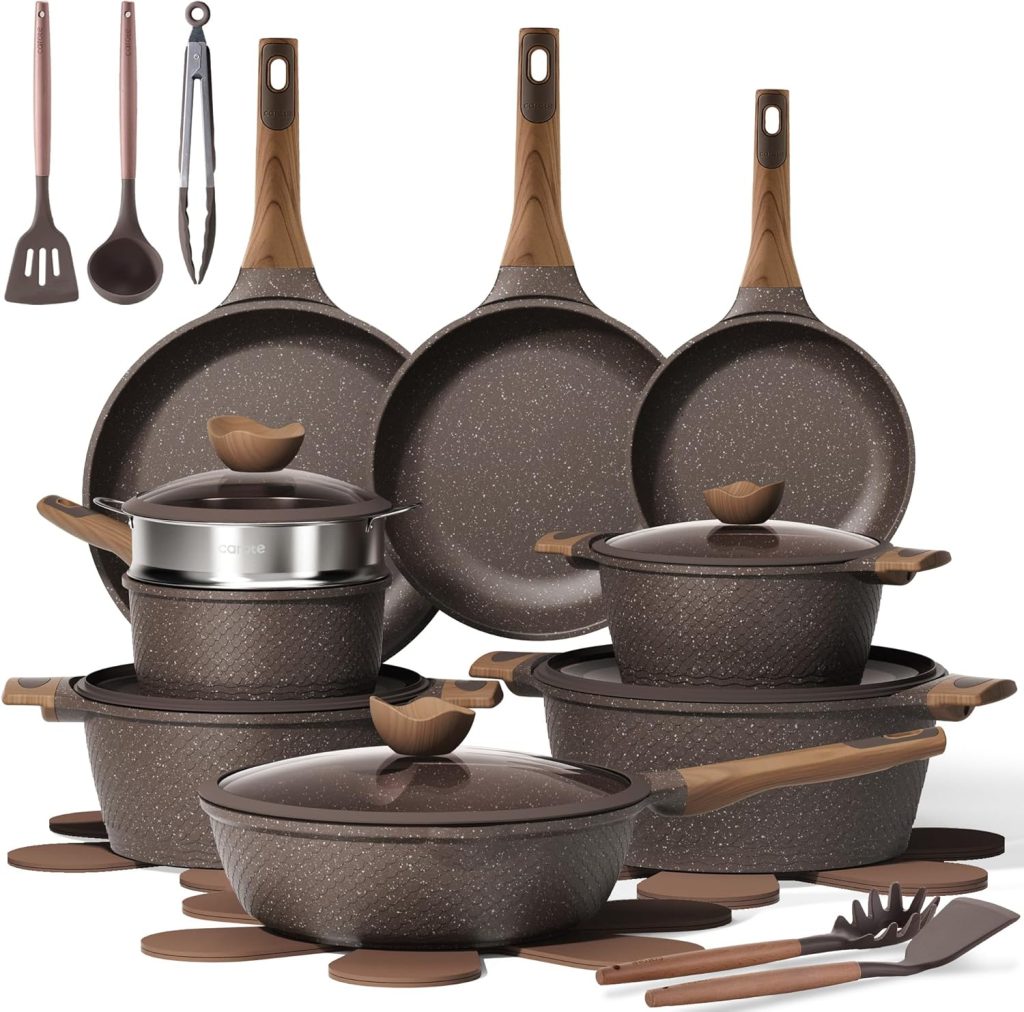
Heats up quickly and evenly with an extended bottom design on all cooktops, including induction.
It is designed with a top-level, harder non-stick granite material with 10x Ultra Non-stick performance, which ensures your daily cooking is always safer and healthier.
This set includes essential pieces sized for most cooking needs, from individual servings to family meals.
The attractive colour options complement various kitchen aesthetics while providing reliable performance for daily cooking tasks.
Premier Stainless Steel Selection
The All-Clad D3 Tri-Ply Stainless Steel set stands as a professional-grade choice for serious home cooks.
This construction features an aluminium core bonded between stainless steel layers, combining superior heat conductivity with stainless steel’s durability and versatility.

The even heating and precise temperature control rival commercial cookware’s performance.
Each piece in this collection demonstrates exceptional construction quality, from perfectly balanced handles to seamless interior surfaces.
The tri-ply construction extends through the sides and bottom, ensuring even heating across the entire cooking surface. This set represents a lifetime investment for cooks prioritising performance and longevity.
Budget-Friendly Option
The SENSARTE Non-stick granite cookware set offers excellent entry-level performance for budget-conscious cooks.
The non-stick coating is free of intentionally added PFOA, PFOS, APEO, lead, and cadmium.

Sturdy & Induction Compatible – Cast Aluminium Cookware, sturdy and not easy to warp. Highly magnetic, conductive stainless-steel base allows the frying pans to work on all cooktops, including induction.
The cast aluminium construction makes the pans heat up quickly and evenly. Temp. up to 450 °F.
These budget-friendly granite frying pans are easy to clean. All you need to do is add a drizzle of oil, and the food slides smoothly. Wipe with a towel or rinse with water, and the skillets get clean.
For beginning cooks or those seeking quality non-stick performance without premium pricing, this set delivers solid value.
Premium Choice
The Hestan NanoBond Stainless Steel collection represents the pinnacle of stainless steel cookware engineering.
This Italian-made cookware features molecular titanium bonding technology that creates an incredibly durable, non-reactive cooking surface.

The tri-ply construction with aluminium core provides professional-grade heat distribution and retention.
Each piece showcases meticulous attention to detail, from the proprietary ProCore aluminium base to the ergonomically designed handles.
The NanoBond technology creates a cooking surface that’s easier to clean than traditional stainless steel while maintaining all the browning and versatility advantages.
This represents the ultimate investment for discerning cooks seeking the absolute best in stainless steel performance.
Maintenance and Care Requirements
Granite Cookware Maintenance
Granite cookware maintenance is remarkably straightforward, which contributes to its popularity among busy home cooks.
Daily Cleaning:
- Use warm, soapy water and a soft sponge or cloth
- Non-stick surface releases food easily
- No soaking or aggressive scrubbing needed.
Deep Cleaning:
- Make a paste of baking soda and water for stubborn residues
- This method won’t damage the surface.
What to Avoid:
- Abrasive cleaners
- Steel wool
- Harsh chemicals
- Temperature extremes (don’t transfer hot cookware to cold surfaces or vice versa).
Maintenance:
- Some manufacturers recommend periodic seasoning with small amounts of cooking oil
- This maintains optimal non-stick properties.
Dishwashing:
- Most granite cookware is dishwasher safe
- Hand washing extends coating life.
Storage:
- Store pieces carefully to prevent scratching
- Use pan protectors or nest carefully to avoid surface contact.
General Care Practices:
- Use wooden, silicone, or plastic utensils to prevent scratching
- Maintain moderate cooking temperatures to preserve coating integrity
- The coating’s longevity depends largely on care practices
- Proper care significantly extends the useful life of granite cookware’s non-stick properties.
Stainless Steel Maintenance
Daily Cleaning:
- Use hot, soapy water
- Dry thoroughly to prevent water spots
- For stuck-on foods: soak first, then gently scrub with non-abrasive cleaners.
Common Issues:
- Discolouration and staining are common, but don’t affect performance
- Heat stains appear as rainbow-colored patches
- Protein stains create white, chalky residues.
Stain Removal:
- Use specialised stainless steel cleaners
- Home remedies: vinegar and baking soda work well
- For stubborn stains: Barkeeper’s Friend or similar oxalic acid-based cleaners
- These cleaners effectively restore the original finish
- Safe for stainless steel when used as directed.
Alternative Perspective:
- Some home cooks prefer the patina that develops over time
- View it as character rather than damage.
Dishwashing:
- Dishwasher safety varies by manufacturer
- Most quality stainless steel cookware handles dishwasher cleaning without issue
- Hand washing provides better control over cleaning
- Hand washing helps maintain the surface finish.
Drying:
- Proper drying prevents water spots
- Water spots can dull the surface’s appearance.
General Notes:
- Requires more technique than other materials
- Offers greater flexibility in cleaning methods.
Cost Analysis and Value Proposition
Understanding the financial investment required for each cookware type involves examining both initial costs and long-term value.
Granite cookware typically falls into the low to mid price range, making it accessible for budget-conscious consumers seeking non-stick convenience.
Entry-level sets are available in the low price category, while premium granite cookware with advanced coatings reaches mid-range pricing.
Stainless steel cookware spans a broader price spectrum, from mid-range to premium categories.
Quality entry-level stainless steel costs more than basic granite cookware but offers superior longevity.
Premium stainless steel, particularly tri-ply and multi-ply constructions, commands premium prices but provides professional-grade performance and decades of service.
Long-term value calculations favour stainless steel significantly. While the initial investment may be higher, the cost per year of use often proves lower due to extended lifespan.
Granite cookware requires eventual replacement as coatings wear, making it a recurring expense for committed home cooks.
Energy efficiency considerations also impact long-term costs. Granite cookware’s superior heat conductivity can reduce cooking times and energy consumption, providing modest savings over time.
However, these savings rarely offset the replacement costs associated with coating deterioration.
For budget-conscious consumers, the calculation depends on cooking frequency and technique preferences.
Best Use Cases and Recommendations
When to Choose Granite Cookware
Granite cookware excels in specific cooking scenarios and kitchen environments.
Its non-stick properties make it ideal for cooking delicate foods that typically stick to traditional surfaces.
Eggs, pancakes, crepes, and delicate fish preparations benefit significantly from granite cookware’s easy-release properties.
Do you prioritise convenience and easy clean up? If yes, you will find granite cookware appealing.
The minimal oil requirement supports healthier cooking goals, while simplified cleaning reduces kitchen time investment.
This makes it especially suitable for busy families or individuals with limited time for elaborate food preparation and clean up.
If you are a beginning cook, you will benefit from granite cookware’s forgiving nature. The non-stick surface reduces the likelihood of burning foods and makes temperature control less critical.
This allows you, as a novice cook, to build confidence without dealing with the technique requirements of traditional surfaces.
For cooking styles emphasising quick, straightforward preparations over complex browning techniques, granite cookware provides excellent value.
Stir-frying, sautéing vegetables, and preparing simple proteins work well with granite surfaces. However, those seeking to develop advanced cooking techniques may find its limitations restrictive.
When to Choose Stainless Steel
Stainless steel cookware suits cooks prioritising versatility, durability, and professional-grade performance.
Its ability to achieve proper browning makes it essential for techniques requiring Maillard reactions, such as searing meats, developing fond for pan sauces, or creating complex flavour layers.
Professional cooking applications heavily favour stainless steel due to its reliability, temperature tolerance, and easy maintenance in commercial environments.
Home cooks serious about culinary technique often prefer stainless steel for its ability to handle any cooking method or ingredient without limitation.
Long-term investment considerations make stainless steel attractive for cooks planning to use their cookware extensively over many years.
The higher initial cost becomes justified through extended service life and consistent performance. For families establishing kitchen foundations, stainless steel provides a lifetime solution.
Cooks frequently preparing acidic foods benefit from stainless steel’s non-reactive properties. Tomato-based sauces, wine reductions, and citrus preparations pose no concerns for stainless steel, while they might affect granite coatings over time.
This versatility proves particularly valuable for diverse cooking styles.
For those interested in comparing granite cookware options before making a decision, researching various models helps identify the best granite cookware for specific needs and budgets.
Additionally, to gain deeper insights into granite cookware characteristics and potential limitations, examining comparisons with other materials provides a valuable perspective.
To learn about the pros and cons of granite cookware, read our guide on cast iron vs granite cookware, which offers a detailed analysis of performance trade-offs.
Hybrid Kitchen Approach
Many experienced home cooks adopt a hybrid approach, incorporating both granite and stainless steel cookware to maximise cooking versatility while managing costs.
This strategy leverages each material’s strengths while minimising weaknesses through strategic selection.
A typical hybrid setup might include granite cookware for daily egg cooking, delicate proteins, and quick sautéing, while reserving stainless steel for browning, sauce-making, and oven applications.
This approach provides convenience for routine cooking while maintaining the capability for advanced techniques.
Budget-conscious hybrid approaches prioritise essential pieces in each material. A quality granite skillet for eggs and delicate items, combined with a stainless steel sauté pan for browning and sauce work, covers most cooking needs without requiring complete sets in both materials.
The hybrid approach also allows gradual cookware development.
You can start with the basics in one material and add pieces in the other as cooking skills and needs evolve. This prevents over-investment in unused pieces while maintaining flexibility for culinary growth.
Frequently Asked Questions
Stainless steel cookware typically lasts decades with proper care, while granite cookware generally provides 3-5 years of optimal performance before the coating shows significant wear.
The longevity difference makes stainless steel a better long-term investment for frequent cooks.
Yes, quality stainless steel is essentially non-reactive and won’t interact with acidic or alkaline foods.
This makes it safe for all types of cooking, including tomato-based sauces, wine reductions, and citrus preparations that might affect other materials.
Granite cookware is generally easier for daily cleaning due to its non-stick properties.
However, stainless steel offers more flexibility in cleaning methods and can handle more aggressive cleaning when necessary.
Both require specific care techniques for optimal longevity.
Making Your Decision
The choice between granite cookware and stainless steel ultimately depends on your cooking style, experience level, and long-term kitchen goals.
Granite cookware excels in convenience, ease of use, and non-stick performance, making it an ideal choice for busy households and novice cooks.
Its lower initial cost and simplified cleaning appeal to many home cooks seeking efficient kitchen solutions.
Stainless steel cookware offers superior durability, versatility, and professional-grade performance.
While requiring more technique and a higher initial investment, it provides decades of reliable service and handles any cooking method or ingredient.
For serious cooks and those viewing cookware as a long-term investment, stainless steel delivers exceptional value.
Consider your cooking frequency, technique interests, and budget when making this decision.
Heavy users benefit from stainless steel’s longevity, while occasional cooks may prefer granite cookware’s convenience.
Many successful kitchens incorporate both materials, leveraging each one’s strengths for specific cooking tasks.
Whatever you choose, investing in quality cookware from reputable manufacturers ensures better performance and longer service life.
Your cookware decision should support your culinary journey, whether that involves mastering professional techniques or simply preparing nutritious, delicious meals efficiently for your family.