Moser glass represents one of Europe’s most distinguished glassmaking traditions, cherished by collectors worldwide for its exceptional artistry and lead-free crystal composition.
Identifying authentic Moser pieces requires understanding specific marks, material characteristics, and craftsmanship details that set this Bohemian glassware apart from other luxury brands.
Whether you’ve inherited a stunning vase, discovered a piece at an estate sale, or are considering a purchase, knowing how to authenticate Moser glass protects your investment and ensures you’re acquiring genuine craftsmanship.
This comprehensive guide walks you through expert identification methods, from recognizing acid-etched signatures to understanding the unique weight and sound properties that distinguish Moser’s lead-free formula from traditional lead crystal alternatives.
What Is Moser Glass?
Moser glass is a prestigious brand of decorative glassware originating from the Bohemian region of what is now the Czech Republic.
Founded by Ludwig Moser in 1857, the company has maintained its reputation for producing exceptional hand-crafted glass using traditional techniques passed down through generations.
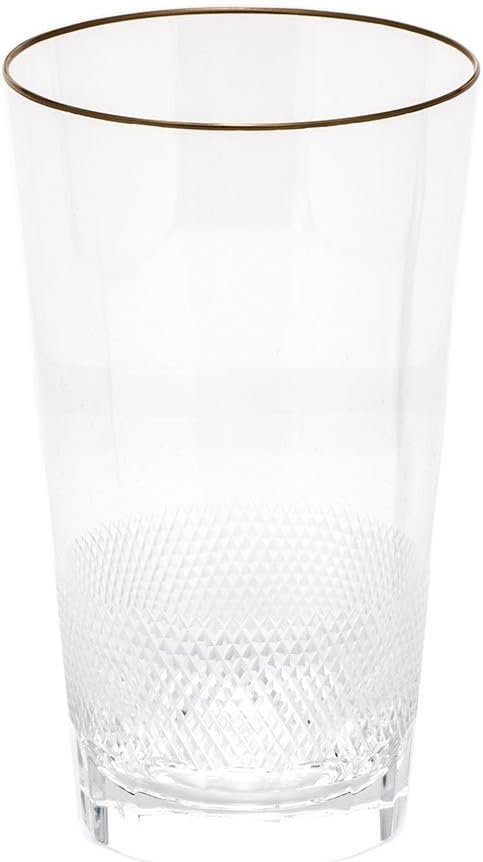
Moser pieces are distinguished by their lead-free crystal composition, vibrant colors, intricate hand engravings, and enamel decorations featuring gold accents.
The brand specializes in luxury tableware, vases, stemware, and decorative objects that showcase the pinnacle of European glass artistry.
History of Moser (Czech Republic / Bohemia)
Ludwig Moser established his glassworks in Karlovy Vary (Carlsbad), Bohemia, in 1857, quickly gaining recognition for innovative designs and superior craftsmanship.
The workshop supplied royal courts across Europe, earning the distinction of “King of Glass, Glass of Kings.”
Moser survived political upheavals, including two world wars and Communist nationalization, while preserving traditional techniques.
After the Velvet Revolution in 1989, Moser regained independence and continues operating from its original location.
The company’s legacy spans over 165 years, making it one of the oldest continuously operating luxury glass manufacturers in Europe, with pieces displayed in museums worldwide.
Why Moser Is Known as Luxury Lead-Free Crystal
Moser revolutionized glassmaking by developing a proprietary lead-free crystal formula using potash and lime instead of lead oxide.
This composition produces exceptional clarity and brilliance while eliminating health concerns associated with lead crystal.
The formula allows for deeper, more vibrant colors that remain stable during the intensive heating required for detailed hand engraving and enamel work.
This lead crystal comparison reveals that Moser’s lead-free composition doesn’t compromise optical quality; it actually enhances the glass’s ability to showcase intricate decorative techniques.
The company’s commitment to lead-free production predated modern health awareness, demonstrating forward-thinking craftsmanship.
Moser’s Role in European Decorative Glass
Moser established standards for artistic glass that influenced generations of European glassmakers.
The company pioneered combining Bohemian cutting traditions with innovative enamel painting techniques and sculptural forms.
Moser’s signature aesthetic—rich colors, nature-inspired motifs, and gold embellishments—defined Art Nouveau and Art Deco luxury glass movements.
The brand supplied imperial courts, including those of Emperor Franz Joseph I and the Persian Shah, elevating Bohemian glass to diplomatic gift status.
Moser’s commitment to hand craftsmanship preserved traditional skills during industrialization, making it a guardian of European decorative arts heritage and continuing to inspire contemporary glass artists globally.
Why Identifying Authentic Moser Glass Matters
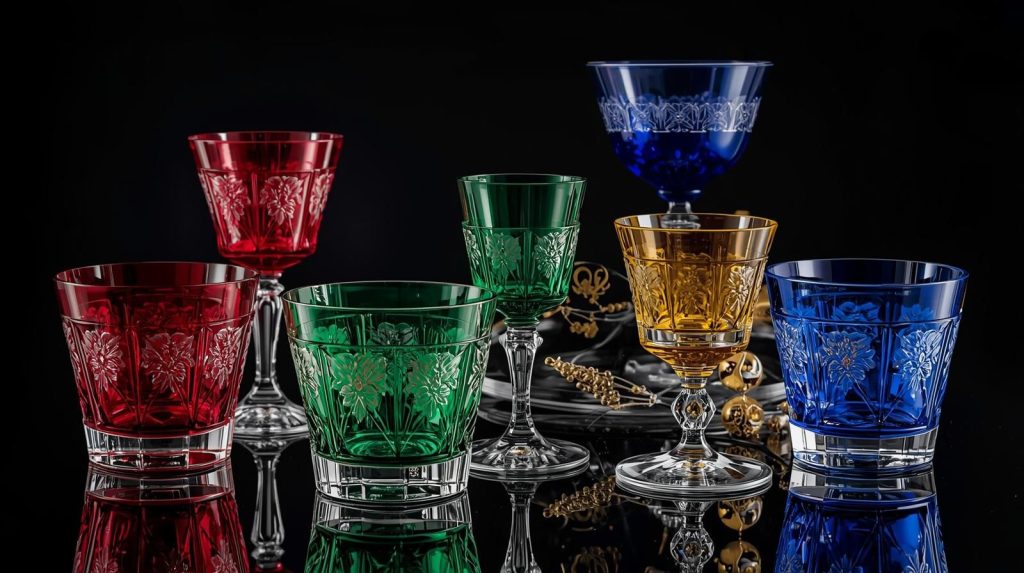
Authentic Moser glass commands premium prices in the collector’s market due to the brand’s reputation, craftsmanship, and historical significance.
Proper identification protects buyers from purchasing misattributed pieces or reproductions sold at inflated prices.
For collectors, authentication ensures their collections maintain value and provenance documentation for future sales or insurance purposes.
Heirs inheriting glassware need accurate identification to make informed decisions about keeping, selling, or insuring pieces.
Collector and Resale Value
Authenticated Moser pieces consistently achieve strong auction results, with rare examples fetching thousands of dollars from serious collectors worldwide.
The brand’s market remains stable because production quantities are limited by the time-intensive hand-crafting process.
Documented provenance and pristine condition significantly increase value, particularly for pieces from historically significant periods like the Art Nouveau era.
Common Confusion With Lead Crystal
Many buyers mistakenly assume all luxury glass contains lead, creating confusion when evaluating Moser’s lead-free composition.
Moser glass feels lighter than traditional lead crystal, sometimes causing inexperienced buyers to question authenticity rather than recognize this as a characteristic.
The shorter, softer ring when tapped differs from lead crystal’s distinctive resonance, another source of misidentification.
Some sellers incorrectly market Moser as lead crystal, perpetuating misinformation.
Understanding these material differences prevents rejecting authentic pieces based on expectations formed by exposure to lead crystal brands.
If you want to learn about Lenox crystal patterns, you’ll notice similar confusion exists across luxury glass brands.
Protecting Buyers and Heirs
Authentication knowledge prevents financial losses from purchasing misattributed or fake pieces marketed as Moser.
Heirs liquidating estates often lack the expertise to evaluate inherited glassware accurately, risking undervaluation or disposal of valuable pieces.
Unscrupulous dealers exploit this knowledge gap, offering lowball prices for authentic items or overcharging for questionable pieces.
Professional authentication through appraisers, auction specialists, or Moser’s archives provides documentation for insurance coverage and estate planning.
Understanding brand marking differences empowers consumers to make confident decisions without sole reliance on dealer representations, ensuring fair transactions and preserving family heirlooms’ proper value for future generations.
Moser Glass Marks and Signatures
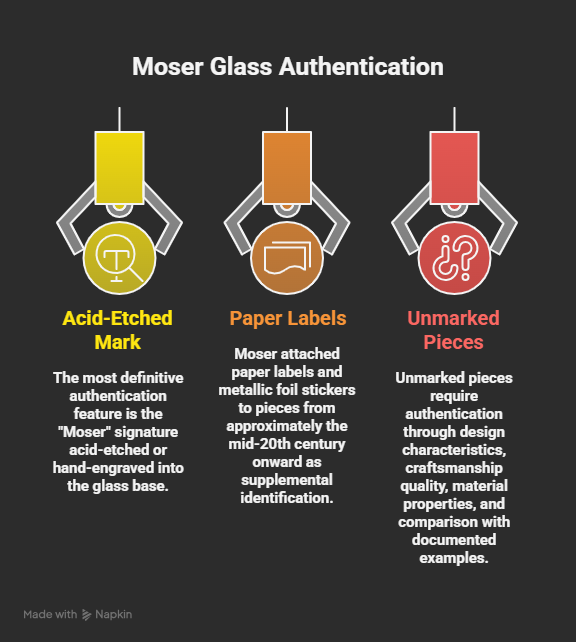
Moser employed various marking systems throughout its history, with signatures serving as primary authentication tools when present.
The most reliable marks appear acid-etched or hand-engraved directly into the glass, typically on bases or inconspicuous surfaces.
Paper labels and foil stickers supplement permanent marks but often detach over time, making their absence common on older pieces.
Not all authentic Moser carries marks—unmarked pieces from certain periods or production lines require authentication through design characteristics and craftsmanship quality.
Understanding marking evolution helps date pieces and distinguish between factory production standards across different eras of Moser’s long manufacturing history.
Acid-Etched or Engraved “Moser” Mark
The most definitive authentication feature is the “Moser” signature acid-etched or hand-engraved into the glass base.
These permanent marks typically appear in script lettering, sometimes accompanied by “Karlovy Vary” or “Carlsbad” (the German name for the city).
Acid-etched marks feel slightly recessed when touched, while hand-engraved signatures show tool marks under magnification.
Later pieces may include “Made in Czechoslovakia” or “Czech Republic”, depending on production date.
The mark’s placement varies—bases are most common, but some pieces feature signatures on stems or hidden surfaces.
Examining the mark under good lighting reveals the careful execution characteristic of authentic factory markings versus crude reproductions.
Paper Labels and Foil Stickers
Moser attached paper labels and metallic foil stickers to pieces from approximately the mid-20th century onward as supplemental identification.
These labels typically feature the Moser logo, sometimes with additional text indicating lead-free composition or origin.
While helpful when present, labels are easily removed during cleaning or normal use, making their absence unremarkable on authentic pieces.
Surviving labels provide valuable dating information and immediate authentication, but their fragility means collectors shouldn’t reject unmarked pieces solely due to missing labels.
Reproductions sometimes feature fake labels, so labels should confirm rather than solely establish authenticity.
Original labels show age-appropriate wear, printing quality, and adhesive characteristics.
When Moser Glass Has No Mark
Many authentic Moser pieces, particularly older examples and certain production categories, carry no factory marks.
Art glass and decorative pieces sometimes lacked signatures, with manufacturers relying on retailers to maintain attribution.
Custom commissions and diplomatic gifts occasionally remained unmarked per patron specifications.
Production standards shifted over time, with marking practices varying between consistent and sporadic.
Unmarked pieces require authentication through design characteristics, craftsmanship quality, material properties, and comparison with documented examples.
Expert appraisers recognize distinctive Moser design elements—specific engraving styles, color formulations, and construction techniques that confirm attribution without signatures.
Documentation like original receipts or family provenance supports the authentication of unmarked pieces.
Material Characteristics of Moser Glass
Moser’s proprietary lead-free crystal formula creates distinctive material properties that aid identification.
The glass composition affects weight, clarity, light refraction, sound when struck, and suitability for decorative techniques.
Understanding these physical characteristics allows authentication even when marks are absent or questionable.
The lead-free formula produces glass lighter than traditional lead crystal but maintains exceptional clarity and brilliance.
Moser glass exhibits specific tactile qualities—smooth surfaces, refined weight distribution, and balanced proportions that reflect expert craftsmanship.
These material signatures remain consistent across production periods, making them reliable authentication tools when combined with visual examination of craftsmanship and design elements.
Lead-Free Crystal
Moser’s lead-free formula substitutes potash (potassium carbonate) and lime (calcium oxide) for the lead oxide used in traditional crystal.
This composition achieves a high refractive index and clarity without lead’s health risks or weight.
The formula withstands repeated heating cycles required for complex hand engraving and enamel application without degrading.
Lead-free glass accepts deeper, more vibrant colors that remain stable through decorating processes.
The composition meets modern safety standards for food contact, unlike lead crystal, which poses contamination risks.
Moser’s formula represents technical innovation, achieving crystal-like optical properties through alternative chemistry while enabling decorative techniques difficult with lead-containing glass, demonstrating that luxury and safety coexist successfully.
Weight and Feel
Moser glass feels noticeably lighter than comparable lead crystal pieces due to its lead-free composition.
Despite reduced weight, authentic pieces maintain balanced proportions and substantial presence—they don’t feel fragile or insubstantial.
The glass surface exhibits exceptional smoothness from expert finishing, with no rough spots or uneven areas.
Well-made pieces distribute weight logically, with stable bases and comfortable handling characteristics.
Stemware balances properly when lifted, while vases and bowls sit securely without wobbling.
The refined weight reflects careful design—Moser artisans compensated for lighter material through proportional adjustments.
Experiencing this characteristic “heft” requires handling multiple pieces to develop sensitivity, but once recognized, the distinctive feel aids quick authentication.
Sound Test
Tapping authentic Moser glass produces a shorter, softer ring compared to lead crystal’s prolonged, bell-like resonance.
The sound results from the lead-free composition’s different acoustic properties—potash-lime glass dampens vibrations faster than lead-containing formulas.
The tone quality remains pleasant and musical, just briefer in duration. Testing requires gentle tapping with a fingernail or soft tool on the rim or body of stemware or the side of decorative pieces.
Comparing Moser’s sound to known lead crystal samples calibrates expectations. This non-destructive test works on unmarked pieces and complements visual examination.
However, sound alone shouldn’t determine authenticity; thick walls, complex shapes, or damage affect resonance regardless of composition.
Craftsmanship Features That Signal Moser Glass
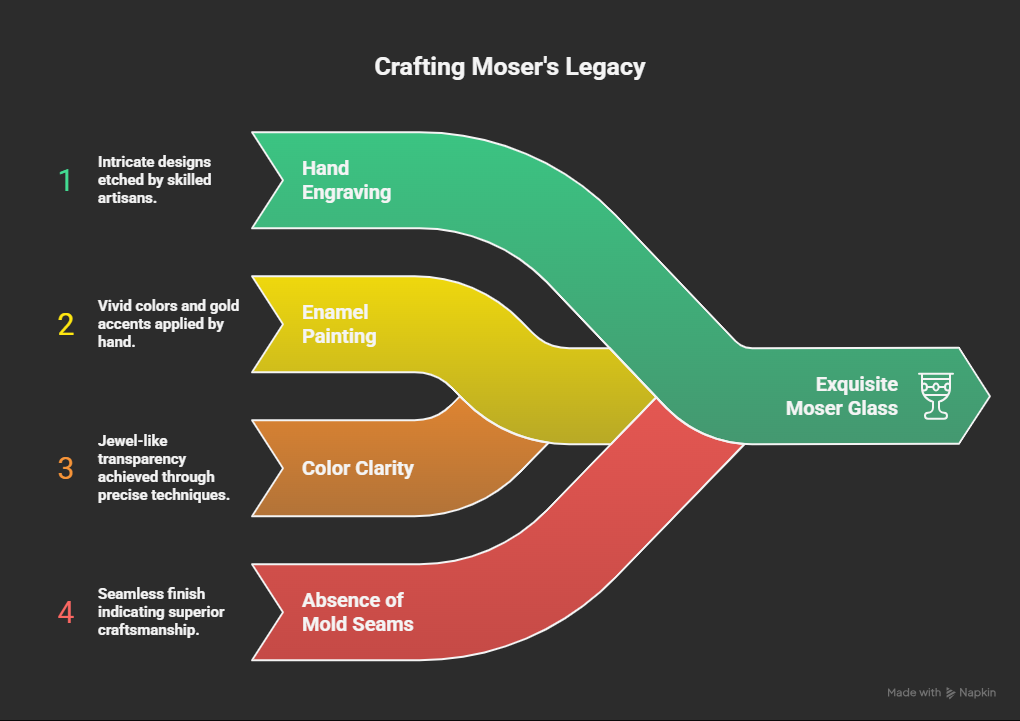
Moser’s reputation rests on exceptional hand-craftsmanship evident in finished pieces.
Distinctive decorative techniques, particularly hand engraving, enamel painting, and jewel-like color application, signal authentic production.
The absence of mold seams and the presence of hand-finished surfaces demonstrate individual artisan attention rather than mass production.
These craft signatures remain consistent across Moser’s history, though specific styles evolved with artistic movements and changing tastes.
Recognizing these features requires examining pieces closely under good lighting, ideally with magnification for fine details.
Understanding traditional Bohemian glass techniques helps distinguish Moser’s refined execution from similar regional production and modern reproductions that approximate but don’t replicate hand-crafted quality.
Hand Engraving (Intaglio)
Moser’s signature decoration technique involves hand-engraving designs into the glass surface using copper wheels and abrasive compounds.
This intaglio method creates recessed patterns with varying depths that catch light beautifully, producing dimensional effects.
Skilled engravers execute intricate motifs—florals, wildlife, geometric patterns—with remarkable precision and artistic flair.
Under magnification, hand engraving shows slight irregularities and tool marks that distinguish it from acid-etched or machine-cut decoration.
The engraving depth varies subtly across designs, creating shadowing and highlighting impossible with uniform processes.
This labor-intensive technique requires years of training, making authentic examples valuable.
The engraving quality, crispness, detail refinement, and artistic composition immediately distinguish Moser from mass-produced alternatives.
Enamel Painting and Gold Accents
Moser artisans apply vitreous enamels and gold leaf decoration to glass surfaces, firing pieces multiple times to fuse embellishments permanently.
The enamel colors exhibit exceptional richness and clarity, applied with painterly precision to create detailed, naturalistic, or stylized motifs.
Gold accents often highlight engraved areas or form independent designs show careful application without drips or uneven coverage.
The fired enamel fuses smoothly with the glass surface, feeling integrated rather than applied.
Colors remain vibrant without fading or flaking, though antique pieces may show wear appropriate to age.
This decoration technique requires precise temperature control and artistic skill, making quality execution a hallmark of authentic Moser production and a feature difficult for counterfeiters to replicate convincingly.
Jewel-Like Color Clarity
Moser’s colored glass exhibits extraordinary depth, saturation, and optical clarity that collectors describe as “jewel-like.”
The proprietary lead-free formula accepts metallic oxide colorants that produce rich hues—deep ruby reds, brilliant emerald greens, sapphire blues, and unique amber tones.
Colors appear consistent throughout the glass body without streaking or cloudiness. Transparent colored pieces show clarity, allowing light to pass beautifully while maintaining color intensity.
The glass surface polishes to exceptional smoothness, enhancing color brilliance. Moser’s color formulations evolved, with certain shades becoming signature identifiers for specific periods.
The combination of color purity, clarity, and surface finish creates visual impact, distinguishing Moser from ordinary colored glass or pieces using inferior colorants.
Absence of Mold Seams
Authentic Moser pieces show no mold seams because production emphasizes hand-forming and finishing techniques.
While some shaping involves molds, artisans carefully polish away seam evidence during finishing.
Examining pieces for seam lines, particularly on stems, handles, and body junctions, helps distinguish hand-crafted work from mass-produced glass.
Even Moser pieces with simpler forms receive hand-finishing attention that removes manufacturing traces.
The seamless appearance reflects quality standards and labor investment, separating luxury production from commercial glassware.
Running fingers over surfaces detects subtle seams invisible to the eyes.
Contemporary production maintains these standards despite modern manufacturing capabilities, preserving Moser’s hand-crafted identity.
Read our guide on how to identify Ajka crystal glassware, and you’ll notice similar attention to finishing quality.
How to Tell Moser Glass From Lead Crystal
Distinguishing Moser’s lead-free glass from traditional lead crystal requires understanding material composition differences and their effects on physical properties.
Lead crystal contains lead oxide (typically 24% or more), increasing weight, refractive index, and producing characteristic resonance.
Moser’s potash-lime formula achieves similar clarity and brilliance through alternative chemistry without lead’s distinctive weight and sound.
Decorative techniques also differ—lead crystal typically features deep cutting that exploits lead’s softness, while Moser emphasizes engraving and enamel work suited to its harder lead-free composition.
These distinctions help collectors avoid misattribution and appreciate each glass type’s unique qualities rather than judging one against the other’s standards.
Lead Crystal vs Lead-Free Glass
Lead crystal’s lead oxide content creates a material significantly heavier and softer than lead-free alternatives.
This softness facilitates deep cutting but makes lead crystal more susceptible to scratching and damage.
Lead-free glass, like Moser’s formula, feels lighter but exhibits greater durability and scratch resistance.
Lead crystal’s high refractive index produces exceptional sparkle and “fire,” though Moser’s formula achieves impressive brilliance through expert craftsmanship and polishing.
Health considerations favor lead-free compositions—lead can leach into acidic beverages stored in lead crystal, while Moser glass remains food-safe.
Neither composition is superior overall; they represent different approaches to luxury glass with distinct aesthetic and practical characteristics deserving appreciation on individual merits.
Weight and Sound Comparison
Holding comparable Moser and lead crystal pieces reveals a noticeable weight difference—lead crystal feels substantially heavier due to lead oxide’s density.
A lead crystal goblet might weigh 50% more than a similar-sized Moser piece. This weight difference shouldn’t suggest inferior quality; it reflects compositional differences with distinct advantages.
Sound testing reveals lead crystal’s prolonged, bell-like ring lasting several seconds, while Moser produces a shorter, softer tone, dampening within a second.
Both sounds are pleasant but distinctly different. Testing requires gentle tapping on appropriate surfaces—rims for stemware, sides for vases.
Neither characteristic alone confirms authenticity, but combined with other features, they provide valuable authentication clues when comparing pieces.
Cut vs Engraved Decoration
Lead crystal’s softness makes it ideal for deep cutting with stone wheels, creating faceted patterns that catch light dramatically.
Waterford and Baccarat exemplify this cutting tradition, producing geometric patterns with sharp edges and deep relief.
Moser’s harder lead-free glass resists cutting, leading artisans to develop superior engraving techniques using copper wheels and fine abrasives.
Engraving creates subtler, more artistic effects—flowing patterns, naturalistic motifs, and detailed imagery rather than geometric faceting.
Cut decoration emphasizes architectural geometry and light refraction; engraved decoration prioritizes artistic expression and pictorial storytelling.
Recognizing these different decorative philosophies prevents mistaking one style for another and helps attribute unmarked pieces based on the decorative approach.
Moser Glass vs Other Luxury Crystal Brands
Comparing Moser with other prestigious glass manufacturers highlights distinctive characteristics that aid identification.
Each luxury brand developed signature styles, techniques, and material formulations reflecting regional traditions and aesthetic philosophies.
Baccarat and Waterford represent different approaches to luxury glass—Baccarat combines French elegance with lead crystal brilliance, while Waterford emphasizes Irish cutting traditions.
Understanding these distinctions prevents misattribution and deepens appreciation for each manufacturer’s contributions.
Collectors often specialize in particular brands, making accurate identification crucial for building coherent collections.
These comparisons also inform purchasing decisions by clarifying which brand’s aesthetic and technical approach best suits individual preferences and collecting goals.
Moser vs Baccarat
Baccarat, founded in 1764 in France, produces lead crystal known for exceptional clarity and brilliance.
While both brands represent luxury glassmaking, their material compositions and decorative emphasis differ significantly.
Baccarat uses traditional lead crystal formulations, producing heavier pieces with bell-like resonance, while Moser’s lead-free glass feels lighter with softer sound.
Decoratively, Baccarat emphasizes cutting and faceting that exploits lead crystal’s refractive properties, creating geometric patterns and prismatic effects.
Moser prioritizes hand-engraving and enamel painting, showcasing artistic detail and color vibrancy.
Baccarat pieces typically feature clear crystal, though the company produces colored glass; Moser’s jewel-tone colors constitute signature elements.
Both brands maintain exceptional quality standards and command premium prices, representing different but equally valid luxury glass traditions.
Moser vs Waterford
Waterford Crystal, established in Ireland in 1783, epitomizes deep-cut lead crystal in geometric patterns.
The brand’s heavy pieces feature intricate cutting with sharp edges and dramatic light refraction. Moser’s lighter lead-free glass and engraved decoration represent opposite technical and aesthetic approaches.
Waterford’s cuts emphasize architectural geometry—diamonds, wedges, and crosshatching—creating sparkle and formality.
Moser’s engravings flow organically with naturalistic motifs and artistic freedom.
Waterford rarely incorporates color, maintaining a clear crystal tradition; Moser’s colored glass represents core identity.
Both brands mark pieces, though systems differ. Neither approach is superior—they reflect distinct cultural traditions and technical possibilities.
Collectors often appreciate both but recognize immediate visual and tactile differences, making misattribution unlikely with minimal experience.
Dating Moser Glass by Marks and Style
Determining production dates helps establish value, historical context, and authenticity.
Moser’s marking systems evolved over 165 years, with signature styles indicating general periods.
Older pieces typically feature hand-engraved marks in cursive script, while modern production uses acid-etching with block lettering.
Geographic designations changed with political shifts—”Carlsbad” indicates pre-1918 Austro-Hungarian production, “Czechoslovakia” marks 1918-1993 pieces, and “Czech Republic” confirms post-1993 manufacture.
Stylistic evolution also aids dating—Art Nouveau floral motifs dominated the early 20th century, Art Deco geometry characterized the interwar period, and contemporary pieces reflect modern design sensibilities.
Combining mark analysis with style recognition provides approximate dating, though precise attribution often requires consulting Moser archives or expert appraisers familiar with production history.
Older Engraved Signatures
Early Moser pieces feature hand-engraved signatures executed by skilled craftsmen using fine cutting tools.
These marks appear in flowing script, often reading “Moser Karlsbad” or simply “Moser” in elegant cursive lettering.
The engraving depth varies slightly, showing hand execution rather than mechanical uniformity. Under magnification, tool marks and minor irregularities confirm hand-engraved authenticity.
Pre-WWI pieces might include “Carlsbad” (German name) rather than Czech designations.
These signatures represent premium authentication, as hand-engraving requires time and skill, making counterfeiting difficult and expensive.
Older marks sometimes show wear from handling and cleaning, appropriate to age.
The signature placement, lettering style, and execution quality all provide clues for dating and authentication when combined with design characteristics.
Modern Etched Marks
Contemporary Moser uses acid-etching for consistent, efficient marking without compromising quality.
Modern marks typically appear in block lettering, reading “MOSER” or “Moser Karlovy Vary” with the “Czech Republic” designation.
Acid-etching creates uniform depth and precise lettering impossible with hand-engraving, appearing sharper under magnification.
The process produces slightly frosted white marks contrasting with clear or colored glass. Modern pieces may include additional information, such as pattern names, size designations, or production codes.
These standardized marks facilitate authentication and reflect current manufacturing practices.
While less romantically “handmade” than engraved signatures, etched marks maintain permanence and clarity.
The transition from hand-engraved to etched marking occurred gradually, with both methods coexisting during transitional periods, making mark style a useful but not absolute dating tool.
Design Evolution Over Time
Moser’s designs reflect prevailing artistic movements and changing tastes across its history.
Late 19th-century pieces feature historicist styles—neo-Renaissance and neo-Baroque elements with elaborate decoration.
Art Nouveau (1890-1910) introduced flowing organic forms, botanical motifs, and innovative enamel work in Moser’s most collectible period.
Art Deco (1920s-1930s) brought geometric patterns, stylized forms, and bold color combinations.
Post-WWII production emphasized traditional craftsmanship with conservative designs.
Contemporary Moser balances heritage techniques with modern aesthetics, collaborating with international designers.
Recognizing these stylistic periods aids in dating unmarked pieces.
Design evolution also reflects technical developments.
Certain colors, engraving styles, and decorative techniques characterize specific eras, providing authentication clues when combined with other identification methods.
Common Mistakes When Identifying Moser Glass
Authentication errors typically stem from misconceptions about luxury glass characteristics.
Many assume all fine glass contains lead, causing them to question Moser’s lighter weight and softer sound.
Understanding that lead-free formulas achieve comparable brilliance prevents rejecting authentic pieces based on incorrect expectations.
Assuming All Luxury Glass Is Lead Crystal
Many buyers incorrectly believe luxury “crystal” requires lead content, questioning Moser’s authenticity when discovering its lead-free composition.
The term “crystal” legally demands only clarity standards, not lead. Moser demonstrates that alternative formulations achieve exceptional brilliance through expert craftsmanship.
This misconception causes collectors to reject lighter authentic pieces, mistakenly believing weight indicates quality.
Different manufacturers made legitimate material choices based on technical capabilities and health considerations.
Confusing Bohemian Cut Glass With Moser
Bohemia produced abundant cut glass from numerous manufacturers, creating confusion with Moser’s specific brand.
Regional pieces often feature similar motifs—geometric patterns, florals, colored overlays—making superficial resemblance likely.
However, Moser’s superior execution—precise engraving, exceptional color clarity, refined finishing—distinguishes it from commercial Bohemian production.
The presence of Bohemian characteristics alone doesn’t confirm Moser attribution; specific quality markers and signatures provide certainty.
Professional appraisal resolves uncertain attributions.
Over-Reliance on Labels
Paper labels provide convenient authentication, but their fragility makes their absence common on authentic pieces.
Relying solely on labels causes collectors to reject unmarked genuine items or accept labeled fakes.
Labels detach during washing or handling, and counterfeiters reproduce them more easily than replicating Moser’s craftsmanship.
Authentic pieces exhibit quality markers—engraving precision, color clarity, material properties—regardless of label presence.
Smart collectors consider labels helpful confirmation, but evaluate pieces comprehensively.
How to Verify Moser Glass Professionally
Professional authentication provides certainty when personal knowledge proves insufficient or significant value justifies expert consultation.
Specialists offer authentication services with varying expertise and costs, preventing costly mistakes while providing documentation supporting value claims.
Antique Dealers & Appraisers
Reputable antique dealers specializing in European glass recognize subtle quality markers and period characteristics from extensive market exposure.
Certified appraisers provide formal valuations with documentation suitable for insurance and estate purposes.
Select professionals by researching credentials, specializations, and reputations through organizations like the International Society of Appraisers.
Quality experts examine pieces in person, explaining authentication reasoning transparently. Fees vary based on service scope.
Auction House Specialists
Major auction houses employ decorative arts specialists with deep European glass expertise.
These experts authenticate pieces for auction inclusion using extensive databases and career-long exposure to exceptional examples.
Their market knowledge helps identify characteristics commanding premium prices.
Many houses offer informal authentication services for potential consignments, though they typically focus on higher-value pieces.
Auction catalogs also serve as valuable research tools.
Moser Brand Archives
Moser maintains archives documenting historical production, though access varies by inquiry specifics.
The company can authenticate pieces based on design records and mark characteristics, working best for exceptional or historically significant items.
Archive consultations require submitting detailed photographs and measurements. Response times vary as the company prioritizes current production.
Direct manufacturer authentication represents ultimate verification when accessible.
FAQ — Identifying Moser Glass
Is all Moser glass lead-free?
Yes, Moser has always used lead-free crystal formulations based on potash and lime rather than lead oxide.
This proprietary composition produces lighter glass than traditional lead crystal while maintaining exceptional clarity, allowing vibrant colors and safe food contact.
Does Moser glass always have a mark?
No, many authentic Moser pieces carry no factory marks, particularly older examples and certain production categories.
Unmarked pieces require authentication through design characteristics, craftsmanship quality, and material properties rather than relying solely on signatures or labels.
Is Moser glass valuable compared to crystal?
Authentic Moser commands premium prices comparable to or exceeding lead crystal brands due to hand-craftsmanship, artistic quality, and brand prestige.
Values depend on age, condition, rarity, and decorative complexity rather than lead content, with exceptional pieces fetching thousands.
Can Moser glass be used for food and drink?
Yes, Moser’s lead-free composition makes it completely safe for food and beverage service without leaching concerns.
Unlike lead crystal, which can contaminate acidic liquids, Moser glass maintains safety regardless of contents or storage duration, combining beauty with functionality.
Final Verdict — How to Confidently Identify Moser Glass
Authenticating Moser requires a systematic evaluation across multiple characteristics.
Examine the base for acid-etched or engraved “Moser” signatures, noting that unmarked pieces can be authentic.
Assess material properties: lighter weight, softer sound, exceptional clarity—that distinguish lead-free glass.
Evaluate craftsmanship, including hand-engraving precision, enamel refinement, jewel-like colors, and seamless finishing.
Compare pieces against documented designs and authenticated examples. When uncertain, consult specialized dealers, auction experts, or Moser’s archives.
Knowledge protects your investment. Understanding Moser’s distinctive qualities prevents costly mistakes while deepening appreciation for exceptional Bohemian glassmaking traditions.
Develop authentication confidence through handling multiple pieces, studying references, and learning from experts to recognize authentic Moser through its unmistakable technical excellence and artistic mastery.