Choosing the right glass bakeware isn’t just about cooking performance; it’s about safety.
Both Ocuisine and Pyrex dominate the market, but they differ significantly in material composition and failure behavior.
Pyrex’s regional manufacturing split creates confusion: European Pyrex uses borosilicate glass, while American Pyrex switched to tempered soda-lime glass decades ago.
This change affects thermal shock resistance and shattering patterns. Ocuisine maintains borosilicate construction across all markets, offering consistent performance.
Understanding these differences helps you avoid dangerous kitchen accidents, from explosive glass failures to food contamination.
This guide examines material makeup, behaviour, safety records, and real-world performance to determine which bakeware deserves space in your kitchen.
Why Glass Bakeware Material Matters
Glass bakeware isn’t created equal. The molecular structure determines how it responds to temperature changes, impacts, and daily stress.
Borosilicate glass contains boron trioxide, giving it a low thermal expansion coefficient.
Soda-lime glass, the most common type, expands more rapidly when heated. This fundamental difference affects everything from oven safety to longevity.
Material choice also influences failure modes, whether glass cracks gradually or shatters explosively.
For kitchens where bakeware transitions between freezer, countertop, and oven, material composition becomes a critical safety factor.
Daily Exposure to Heat
Glass bakeware faces intense thermal cycling. Roasting at 400°F, then cooling to room temperature, then dishwasher heat, these cycles stress the molecular bonds.
Borosilicate glass handles this expansion and contraction with minimal stress accumulation.
Tempered soda-lime glass, while strong against impact, develops internal tension from repeated heating.
Over months of use, invisible stress patterns form, weakening the structure until sudden failure occurs.
Thermal Shock vs Chemical Safety
Thermal shock happens when temperature differentials create uneven expansion within glass.
Placing cold bakeware into a hot oven generates rapid surface heating while the interior remains cool.
Borosilicate’s low expansion coefficient minimizes this stress. Chemical safety is equally important—glass doesn’t leach chemicals into food, unlike some plastics or coated metals.
Both Ocuisine and Pyrex excel at chemical inertness, but thermal shock resistance separates their performance profiles.
Why Glass Type Determines Failure Mode
Borosilicate glass cracks predictably, forming visible fractures that warn users before complete failure.
The material’s flexibility allows it to absorb stress without catastrophic collapse. Tempered soda-lime glass stores internal tension throughout its structure.
When this tension is released, from a chip, scratch, or thermal stress, the entire piece can explode into small fragments.
This difference isn’t theoretical; consumer safety reports document injuries from explosive Pyrex failures, particularly with post-1998 American-made pieces.
What Is Ocuisine?
Ocuisine represents Arc International’s premium glass bakeware line, manufactured in France with consistent quality standards.
The brand focuses on borosilicate construction across its entire product range, from baking dishes to storage containers.
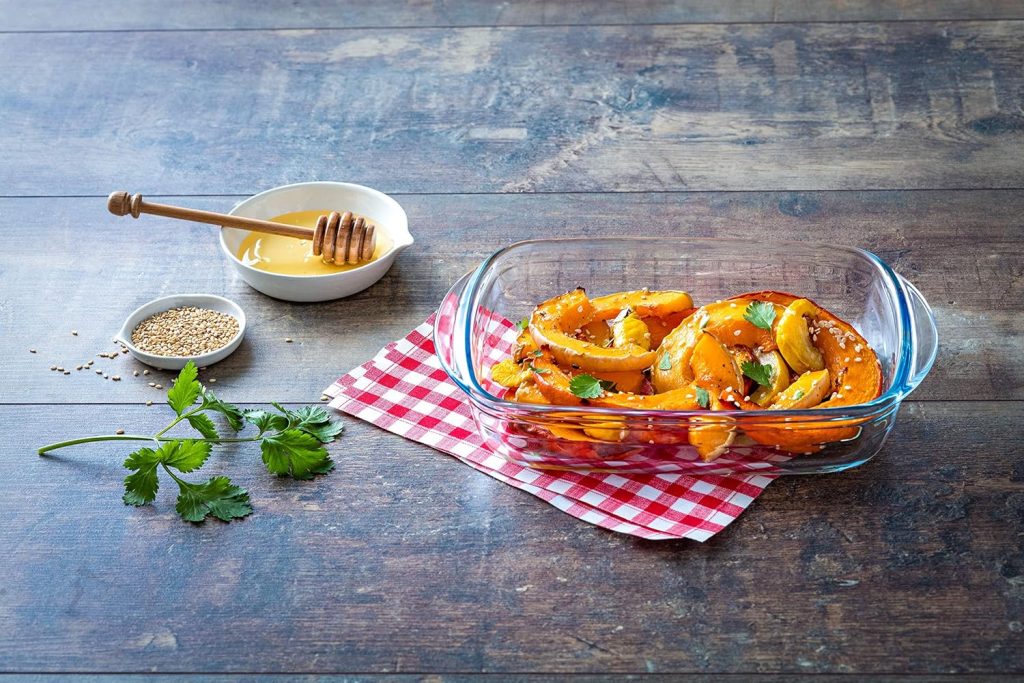
Unlike brands with regional manufacturing variations, Ocuisine maintains uniform material specifications globally.
This consistency makes it easier for consumers to predict performance regardless of where they purchase.
The brand emphasizes French engineering and thermal performance as core selling points.
French Brand (Arc International)
Arc International, founded in 1825, brings nearly two centuries of glass manufacturing expertise to Ocuisine.
The company operates production facilities primarily in France, maintaining strict quality control over composition and tempering processes.
This centralized manufacturing approach prevents the material inconsistencies that plague brands with multiple global suppliers.
Arc International’s reputation in professional kitchenware adds credibility to Ocuisine’s safety claims.
Made from Borosilicate Glass
Borosilicate glass contains 70-80% silica and 7-13% boron trioxide, creating a material with exceptional thermal properties.
This composition gives Ocuisine a thermal expansion coefficient of approximately 3.3 × 10⁻⁶ K⁻¹, roughly one-third that of soda-lime glass.
The material withstands temperature differentials up to 220°C (400°F) without cracking.
Laboratory testing confirms Ocuisine maintains structural integrity through repeated freezer-to-oven transitions that would shatter tempered soda-lime alternatives.
Designed for Oven, Microwave, Freezer
Ocuisine bakeware safely transitions between temperature extremes.
The product line includes dishes rated for oven temperatures up to 300°C (572°F), though practical cooking rarely exceeds 250°C.
Microwave safety comes from the glass’s transparency to microwave radiation; it heats food without absorbing energy itself.
Freezer storage down to -40°C poses no risk, and pieces can move directly from freezer to preheated oven without gradual warming.
Known for Thermal Shock Resistance
Thermal shock resistance defines Ocuisine’s market positioning. Independent testing shows the bakeware withstands 165°C temperature differentials, meaning a dish at -15°C can enter a 150°C oven safely.
This performance exceeds most cooking scenarios. The resistance comes from material properties, not just tempering.
While tempered glass gains strength through compression, borosilicate inherently resists thermal stress through its molecular structure.
What Is Pyrex? (Important Regional Differences)
Pyrex began as a Corning Glass Works trademark in 1915, originally using borosilicate glass exclusively.
In 1998, Corning licensed the Pyrex brand for kitchenware to World Kitchen, which reformulated American products using tempered soda-lime glass.
Meanwhile, European Pyrex remained under different licensing, continuing borosilicate production.
This split creates significant confusion; two products share the same name but use fundamentally different materials.
Consumers often don’t realize that Pyrex’s safety profile depends entirely on manufacturing origin.
Pyrex (Europe & International)
European Pyrex, manufactured primarily by Arc International (the same company behind Ocuisine), maintains the original borosilicate formulation.
Products sold in Europe, the Middle East, Africa, and most of Asia use this composition. The glass exhibits thermal shock resistance comparable to Ocuisine, with gradual failure modes that provide a warning before complete breakage.
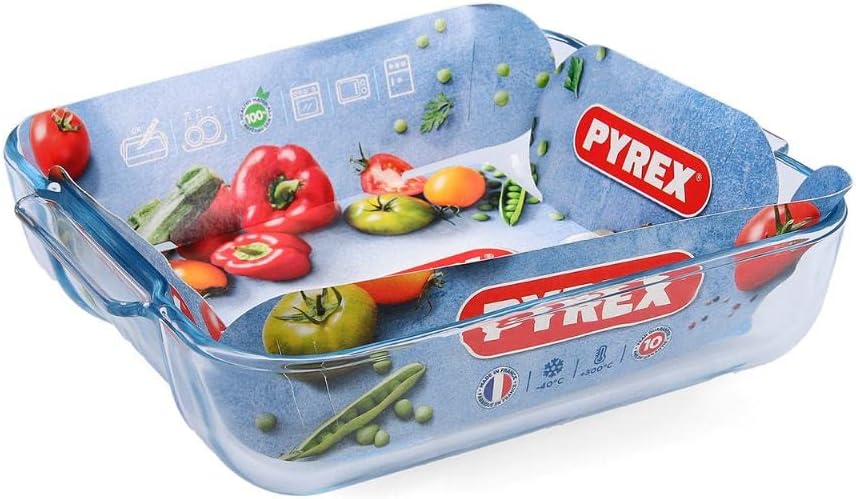
European Pyrex carries manufacturing codes indicating borosilicate construction, though average consumers rarely check these markings.
Borosilicate European Pyrex handles temperature differentials exceeding 150°C, suitable for all standard cooking applications.
The material’s transparency and non-reactive surface make it ideal for acidic foods, marinades, and long-term storage.
Users report decades of reliable service from European Pyrex, with pieces often outlasting their original owners.
The consistency between European Pyrex and Ocuisine stems from shared manufacturing facilities and material sources.
Pyrex (United States)
American Pyrex switched to tempered soda-lime glass in 1998 when World Kitchen acquired the brand.
This change reduced manufacturing costs while maintaining adequate performance for most users.
Tempered soda-lime glass undergoes heat treatment, creating surface compression and internal tension, increasing impact resistance compared to annealed glass.
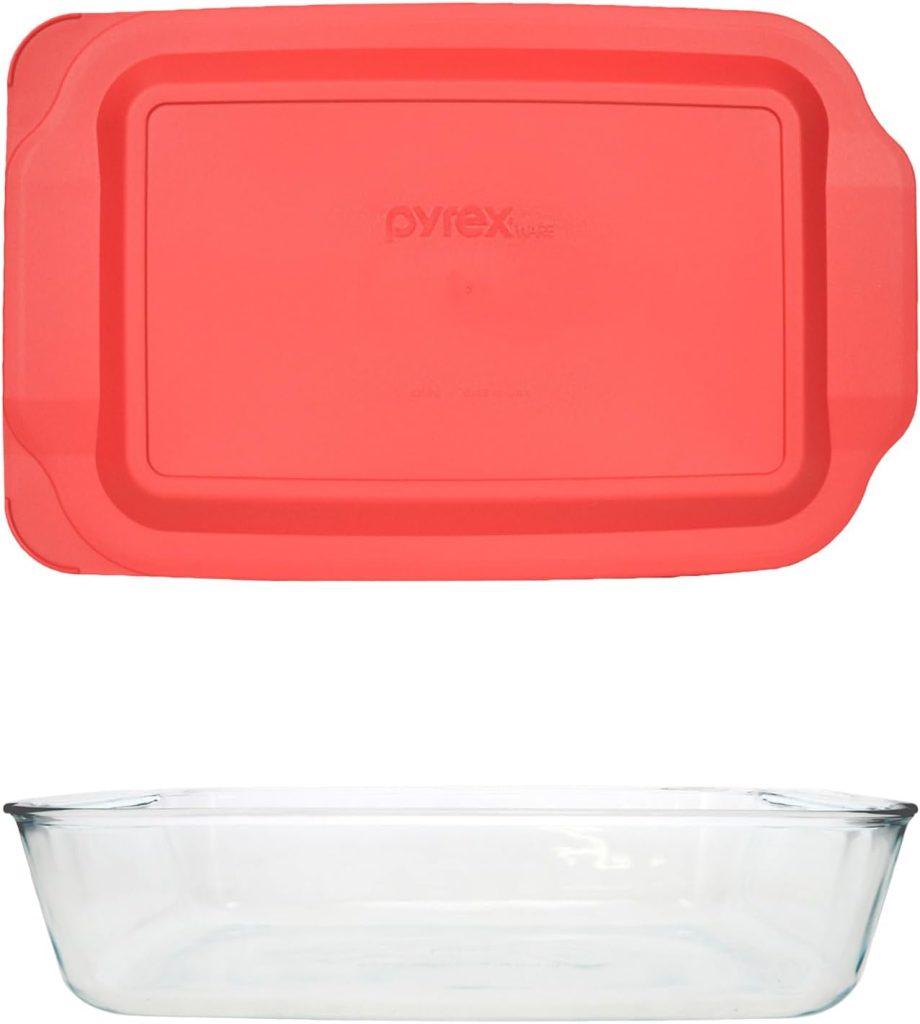
However, thermal expansion remains three times higher thanthat of borosilicate, limiting thermal shock resistance.
US Pyrex performs adequately when users follow instructions: no stovetop use, no broiler exposure, and avoid extreme temperature changes.
Problems arise from the failure mode, when tempered glass breaks, it shatters into thousands of small fragments rather than cracking gradually.
Consumer Product Safety Commission reports document injuries from explosive failures, particularly when cold dishes contact hot oven racks or hot dishes touch wet countertops.
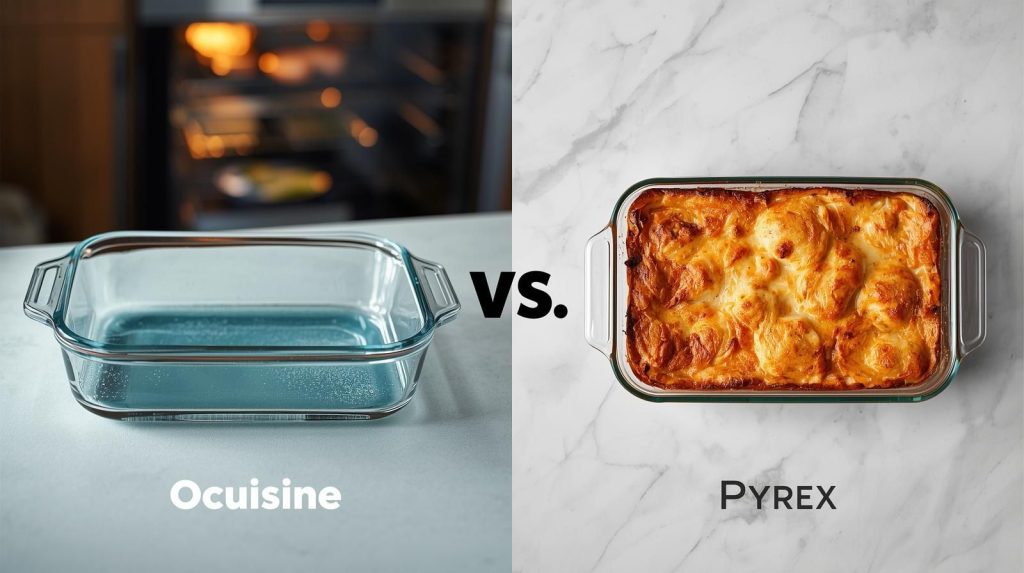
Ocuisine vs Pyrex — Material Comparison
| Feature | Ocuisine | Pyrex (US) | Pyrex (EU) |
|---|---|---|---|
| Glass Type | Borosilicate | Tempered soda-lime | Borosilicate |
| Thermal Shock Resistance | High | Low-Moderate | High |
| Shattering Behavior | Cracks gradually | Can explode | Cracks gradually |
| Oven Safety | Excellent | Good with caution | Excellent |
| Thermal Expansion Coefficient | ~3.3 × 10⁻⁶ K⁻¹ | ~9 × 10⁻⁶ K⁻¹ | ~3.3 × 10⁻⁶ K⁻¹ |
| Maximum Temperature Differential | 165°C | 60°C | 165°C |
| Freezer-to-Oven Safety | Yes | No | Yes |
| Price Point | Mid-High | Low-Mid | Mid-High |
Material composition creates the performance gap. Borosilicate’s boron trioxide content reduces thermal expansion by approximately 66% compared to soda-lime glass.
This difference isn’t subtle; it fundamentally changes how the material responds to cooking stress.
US Pyrex’s tempering process adds strength but cannot overcome the base material’s thermal expansion properties.
For more brand comparison, read our guide on Pyrex vs Simax glassware.
Thermal Shock — Why It Matters More Than Heat Resistance
Heat resistance measures maximum temperature tolerance, while thermal shock resistance measures temperature change tolerance.
Glass bakeware rarely approaches its absolute temperature limits; few home ovens exceed 300°C.
However, thermal shock occurs constantly: removing hot lasagna from the oven onto a granite countertop, adding cold ingredients to a preheated dish, or placing frozen casseroles in preheated ovens.
These everyday actions create rapid, uneven temperature changes that stress the glass structure.
Cold-to-Hot Transitions
Moving bakeware from the refrigerator or freezer directly into a hot oven creates maximum thermal shock.
The dish’s exterior heats rapidly while the interior remains cold, causing differential expansion.
Borosilicate glass accommodates this difference through its low expansion coefficient; the outer surface doesn’t expand significantly more than the cold interior.
Tempered soda-lime glass experiences three times the expansion differential, creating internal stress that can exceed the material’s strength.
Uneven Heating
Oven heating isn’t uniform. Dishes near heating elements or on lower racks experience higher temperatures than those at the oven center.
Food itself creates temperature variations; wet areas heat differently from dry spots. These gradients stress the glass unevenly.
A casserole’s corners heat faster than its center, creating expansion differences across the dish.
Borosilicate flexes to accommodate these differences; tempered soda-lime accumulates stress until failure occurs.
Why Borosilicate Survives Stress Better
Borosilicate’s molecular structure includes boron-oxygen bonds that require less energy to flex than silicon-oxygen bonds alone.
This flexibility allows the material to absorb thermal stress without permanent damage.
When stress exceeds the material’s limit, cracks form gradually, often starting at edges or existing flaws.
Users notice these cracks before catastrophic failure. Tempered soda-lime stores stress in its compressed surface layer, creating a metastable state.
Once this layer fails, stored energy releases explosively.
Safety Comparison — Which Is Less Likely to Explode?
Safety encompasses both failure frequency and failure severity. Borosilicate glass (Ocuisine and European Pyrex) fails less frequently under normal use but also fails predictably when it does.
Cracks form visibly, allowing users to discard damaged pieces before complete breakage.
US Pyrex tempered soda-lime glass withstands many uses successfully, but can shatter without warning when thermal stress or physical damage exceeds critical thresholds.
The explosive failure mode poses risks beyond simple breakage.
Ocuisine’s Predictable Failure Mode
When Ocuisine experiences excessive stress, visible cracks appear first. These cracks propagate slowly, typically starting at corners, edges, or existing chips.
Users spot the damage during inspection or cleaning, discarding the piece before it breaks during use.
This graceful degradation prevents sudden failures during cooking.
Even when borosilicate completely fractures, it produces larger fragments rather than fine shards, reducing injury risk and making cleanup simpler.
Pyrex (US) Explosive Shattering Risk
Tempered soda-lime glass stores internal tension throughout its structure. Surface compression balances interior tension, creating stability under normal conditions.
When a defect penetrates the compressed surface from chips, deep scratches, or thermal stress exceeding the material’s limit, the stored tension releases catastrophically.
The glass explodes into thousands of small, relatively uniform fragments. This temper pattern, designed to reduce sharp edges, creates different dangers: widespread contamination of food and cooking areas.
Injury & Contamination Concerns
Consumer reports document injuries from explosive Pyrex failures, including cuts from flying glass and burns when hot contents scatter.
Food contamination represents another concern; small glass fragments can embed in food, potentially going unnoticed until consumed.
Kitchen cleanup after an explosive failure requires thorough attention, as fragments travel several feet from the failure point.
Borosilicate’s crack-then-break pattern keeps damage localized, with larger, more visible fragments that don’t embed in food as easily.
Oven, Microwave & Freezer Safety
Glass bakeware’s versatility comes from its temperature tolerance across cooking and storage methods.
Understanding each brand’s limits prevents accidents and extends product life.
Manufacturers provide maximum temperature ratings, but real-world safety depends more on temperature transitions than absolute limits.
Microwave and freezer use present different challenges than oven cooking, requiring material properties beyond simple heat resistance.
Oven Temperature Limits
Ocuisine rates its bakeware to 300°C (572°F), exceeding most recipes’ requirements. European Pyrex carries similar ratings for borosilicate products.
US Pyrex officially supports 232°C (450°F), adequate for most baking but limiting for high-temperature roasting.
However, absolute temperature matters less than proper preheating practices.
Both brands require gradual oven preheating with bakeware inside, preventing thermal shock from cold glass entering hot environments.
Microwave Heating Behavior
Glass remains cool during microwave heating while food heats rapidly. This creates internal thermal shock as hot food contacts relatively cool glass.
Borosilicate better tolerates this stress, particularly with dense foods reaching high temperatures.
All glass types handle microwave use safely when food doesn’t superheat.
Problems occur when reheating thick casseroles or fatty foods that exceed 100°C locally, creating hot spots against glass surfaces.
Adequate stirring and power level adjustment prevent issues across all brands.
Freezer-to-Oven Risks
This transition creates maximum thermal shock, bakeware at -18°C enters a 180°C oven, generating a 198°C differential.
Borosilicate handles this stress; manufacturers explicitly allow the practice with Ocuisine and European Pyrex.
US Pyrex instructions strictly prohibit freezer-to-oven transitions, requiring gradual warming to room temperature first.
Violating this guidance accounts for many reported US Pyrex failures. The three-times-higher thermal expansion of soda-lime glass makes this transition fundamentally unsafe regardless of tempering quality.
Which Brand Handles Transitions Better
Ocuisine and European Pyrex tie for transition tolerance, both using borosilicate with similar thermal properties.
US Pyrex requires careful temperature management, avoiding rapid changes and always allowing gradual adjustment between extreme temperatures.
For users who frequently move between freezer storage and oven cooking, borosilicate variants eliminate worry and extra steps.
US Pyrex demands disciplined adherence to temperature transition protocols that many home cooks find inconvenient.
Durability & Longevity
Glass durability depends on accumulated stress rather than simple age. Each thermal cycle, impact, and cleaning session potentially weakens the structure.
Borosilicate and tempered soda-lime glass degrade differently over time.
Understanding these patterns helps predict replacement timing and identify dangerous damage before failure occurs.
Proper handling extends service life significantly, but material properties ultimately determine maximum longevity.
Chip Sensitivity
Edge chips expose internal glass structure to stress, creating crack initiation points.
Borosilicate tolerates minor chips better, as its lower thermal expansion generates less stress concentration around defects.
Small rim chips rarely propagate into complete failure. Tempered soda-lime’s compressed surface layer, once breached by chips, loses its strengthening effect locally.
Even small chips can trigger catastrophic failure when thermal stress or impact occurs near the damaged area.
Scratch & Stress Accumulation
Surface scratches accumulate from contact with utensils, abrasive cleaning, and stacking in storage.
Borosilicate’s softer surface scratches more easily but tolerates scratches better; the material’s inherent flexibility prevents scratch-induced failure under thermal stress.
Tempered glass’s harder surface resists initial scratching but turns scratches into potential failure points.
Deep scratches penetrating the compression layer create weak spots that can cause the entire piece to shatter when stressed.
Which Lasts Longer with Daily Use
Reports suggest borosilicate bakeware serving 20-30 years isn’t uncommon. The material’s flexibility and gradual failure mode mean pieces remain functional until visible cracks appear.
Users report tempered Pyrex lasting 5-15 years, typically, though careful handling can extend this.
The unpredictable failure mode means some pieces break after minimal use, while others last decades.
Borosilicate offers more consistent longevity, though careful users achieve good results with either material.
Cleaning & Maintenance
Maintenance practices affect both hygiene and structural integrity.
Glass bakeware’s non-porous surface resists bacterial growth and doesn’t absorb food odors, but cleaning methods can introduce damage.
Dishwasher use, thermal cycling during washing, and cleaning chemical exposure all impact long-term durability.
Regular inspection for damage becomes part of effective maintenance, particularly with tempered glass that can fail without visible warning.
Dishwasher Impact
Both materials tolerate dishwasher cleaning, and chemical detergents don’t degrade the glass structure.
However, dishwasher thermal cycling adds stress. Water temperature reaches 60-80°C during washing, then the pieces cool to room temperature.
This cycle repeats hundreds of times over the bakeware’s life. Borosilicate handles this stress easily.
Tempered glass accumulates minor stress with each cycle, contributing to eventual failure.
Positioning matters contact with metal racks during wash cycles, which can chip edges or scratch surfaces.
Visibility of Stress Cracks
Borosilicate cracks appear as clear fracture lines, easily visible during inspection.
Holding pieces up to the light reveals damage before it progresses. Tempered glass rarely shows visible stress before failure.
The compressed surface maintains optical clarity even as internal tension builds.
Cloudiness or surface changes can indicate damage, but tempered glass often looks perfect immediately before shattering.
This makes pre-failure detection nearly impossible with US Pyrex.
Descaling & Residue Buildup
Hard water leaves mineral deposits on glass surfaces. Both materials accumulate these deposits equally.
Acidic cleaners (vinegar, citric acid) dissolve deposits without damaging the glass structure.
Abrasive scrubbing removes stubborn residue but risks scratching. Borosilicate’s softer surface shows scratches more readily but tolerates them structurally.
Tempered glass’s harder surface resists scratching initially but turns deep scratches into potential failure points.
Plastic scrubbers provide effective cleaning without excessive scratch risk for either material.
Which Should You Choose? (Use-Case Based Verdict)
Selection depends on cooking habits, risk tolerance, and availability. No single answer suits everyone.
Safety-conscious users prioritize borosilicate’s predictable behavior. Budget-focused shoppers accept US Pyrex’s limitations in exchange for lower cost and wide availability.
Frequent freezer-to-oven transitions make borosilicate essential. Understanding your specific needs clarifies which trade-offs matter most for your kitchen.
For Safety-Focused Users – Ocuisine
Prioritizing safety makes Ocuisine or European Pyrex the clear choice.
Borosilicate’s gradual failure mode, superior thermal shock resistance, and predictable degradation minimize injury and contamination risk.
The material tolerates user error better; cold dishes placed in hot ovens or hot dishes set on wet surfaces rarely cause failure.
Users report feeling confident with borosilicate bakeware, using it freely without constant worry about temperature management.
For Availability & Cost – Pyrex (with Care)
US Pyrex’s widespread availability and lower price point make it accessible. Walmart, Target, and grocery stores stock it extensively.
Careful users who follow instructions and avoid extreme temperature changes achieve satisfactory results.
The key is understanding limitations and never violating freezer-to-oven or cold-surface restrictions.
Budget constraints make US Pyrex reasonable when users accept added responsibility for proper handling.
For Frequent Freezer-to-Oven Use – Borosilicate Only
Meal preppers who freeze casseroles and then bake them directly need borosilicate. The convenience of freezer-to-oven cooking eliminates
US Pyrex from consideration—its material simply cannot handle this stress safely. Ocuisine and European Pyrex are specifically designed for this use case.
The time savings and reduced planning make borosilicate worthwhile even at a higher cost for users who regularly employ this cooking method.
FAQs — Ocuisine vs Pyrex
Is Ocuisine better than Pyrex?
Ocuisine uses borosilicate glass consistently across all products, offering superior thermal shock resistance and safer failure characteristics than US Pyrex’s tempered soda-lime glass.
European Pyrex matches Ocuisine’s material performance since both use borosilicate construction.
For American consumers, Ocuisine provides more predictable safety than domestically produced Pyrex.
Does Pyrex still use borosilicate glass?
European and internationally-sold Pyrex continues to use borosilicate glass, manufactured primarily by Arc International.
The US-market Pyrex switched to tempered soda-lime glass in 1998 when World Kitchen acquired the brand.
This regional difference means “Pyrex” describes two different materials depending on purchase location, causing significant consumer confusion about product capabilities.
Why does Pyrex shatter suddenly?
US Pyrex’s tempered soda-lime glass stores internal tension throughout its structure.
When surface damage or excessive thermal stress penetrates the compressed outer layer, this stored energy releases explosively, shattering the entire piece instantaneously.
Unlike borosilicate, which cracks gradually, tempered glass exhibits no warning signs before catastrophic failure occurs.
Can Ocuisine go under the broiler?
Ocuisine tolerates temperatures up to 300°C (572°F), exceeding typical broiler temperatures.
However, broiler use creates extreme thermal gradients—intense top surface heating while the bottom remains cooler.
While the material handles this technically, manufacturers often recommend against broiler use to prevent warranty issues. European Pyrex carries similar guidance for the same reasons.
Final Verdict — Ocuisine vs Pyrex
Ocuisine delivers superior safety through consistent borosilicate construction worldwide.
Its thermal shock resistance, predictable failure behavior, and freezer-to-oven capability make it ideal for users prioritizing safety and versatility.
European Pyrex offers equivalent performance at similar price points. US Pyrex provides adequate functionality at a lower cost but requires careful temperature management and acceptance of explosive failure risk.
The material science is clear: borosilicate outperforms tempered soda-lime for thermal stress resistance.
Regional Pyrex variations complicate purchasing decisions; verify manufacturing origin before buying.
For most users, especially those frequently transitioning between temperature extremes,
Ocuisine’s reliable borosilicate composition justifies its price premium.
Safety-conscious cooks benefit from predictable degradation that warns before complete failure, while convenient freezer-to-oven transitions streamline meal preparation without safety concerns.