It’s 7 AM on a Tuesday, and you’re shuffling around the kitchen in your dressing gown, pouring cereal into bowls whilst simultaneously packing lunch boxes and reminding someone—again—that socks don’t go on the dining table.
Fast forward twelve hours, and those same bowls have seen porridge, pasta, and possibly a sneaky biscuit or two.
Your dinnerware isn’t just sitting pretty in the cupboard; it’s working harder than you are.
Every single day, families like yours navigate breakfast chaos, lunchtime grazing, and the sacred ritual of dinner around the table. And through it all, there’s one constant companion: your plates, bowls, and cups.
They’re the silent workhorses of family life, witnessing burnt toast disasters and Sunday roast triumphs alike.
Wheat straw dinnerware, though not new, has been quietly making its way onto kitchen tables.
But here’s what nobody’s really talking about: how families actually use it. Not the science, not the marketing spiel, just the real, messy, wonderful reality of mealtimes.
So let’s dive into what everyday family eating truly looks like when wheat straw dinnerware joins your table.
What Everyday Family Meals Look Like
Breakfast, Lunch, and Dinner at Home
Your family’s eating rhythm probably looks something like controlled chaos punctuated by brief moments of actual sitting down.
Mornings kick off with the breakfast scramble, cereal bowls hastily filled, toast plates balanced precariously near the edge of countertops, and juice cups that somehow always end up in the oddest places (yesterday’s was behind the bread bin, wasn’t it?).
Lunch tends to be more fragmented. Someone’s eating leftovers straight from the fridge. Another family member assembled a sandwich on whatever plate was closest.

Kids home from school are requesting “something quick” whilst simultaneously complaining there’s nothing to eat.
The dinnerware gets a proper workout during these in-between moments, serving everything from yesterday’s curry reheated to emergency cheese toasties.
Then comes dinner—the main event. This is when plates, serving bowls, and side dishes all emerge together.
Roast chicken gets carved onto a large platter. Vegetables sit in medium bowls. Sauces occupy smaller dishes.
Everyone’s got their own dinner plate, and suddenly the table looks like an actual table rather than a launchpad for the day’s chaos.
Different foods require different vessels, and your dinnerware collection proves its worth when everything comes together at once.
Shared Mealtimes and Family Interaction
There’s something quietly significant about everyone reaching for dishes from the same set. Dad passes the salad bowl to your teenager.
Mum slides the water jug across to whoever’s closest. Little ones attempt (with varying success) to serve themselves from the communal pasta dish.
The dinnerware becomes part of the conversation—literally and figuratively.
“Pass your plate” might be the most-said phrase at your dinner table.
Clearing away afterwards involves a small convoy of dishes making their way from table to kitchen, usually accompanied by negotiations about whose turn it is to load the dishwasher.
These shared eating moments are where family happens, and the plates and bowls are more than just functional; they’re props in the daily theatre of family life.
Nobody’s writing sonnets about their dinnerware, but try having a family meal without it, and you’ll quickly appreciate how central these items are to the whole operation.
How Wheat Straw Dinnerware Is Used During Family Meals
Serving Food on Plates and Bowls
Let’s get practical. When dinner’s ready, you need something to put it on. Fairly obvious, that. But the how matters more than you might think.
Wheat straw plates receive their cargo differently depending on what’s being served—a full English gets carefully arranged (beans in their designated zone, definitely not touching the eggs), whilst a stir-fry gets unceremoniously dumped in the centre and called done.
Portion control becomes a visible negotiation. Your eight-year-old insists their bowl is “basically empty” despite containing enough spaghetti to feed a small village.
You’re eyeing your own plate, wondering if there’s room for seconds or if that ship has sailed along with your pre-parenthood metabolism.
Serving dishes make multiple trips from kitchen to table and back again as people inevitably return for more (or in some cases, less—we’re looking at you, Brussels sprouts).
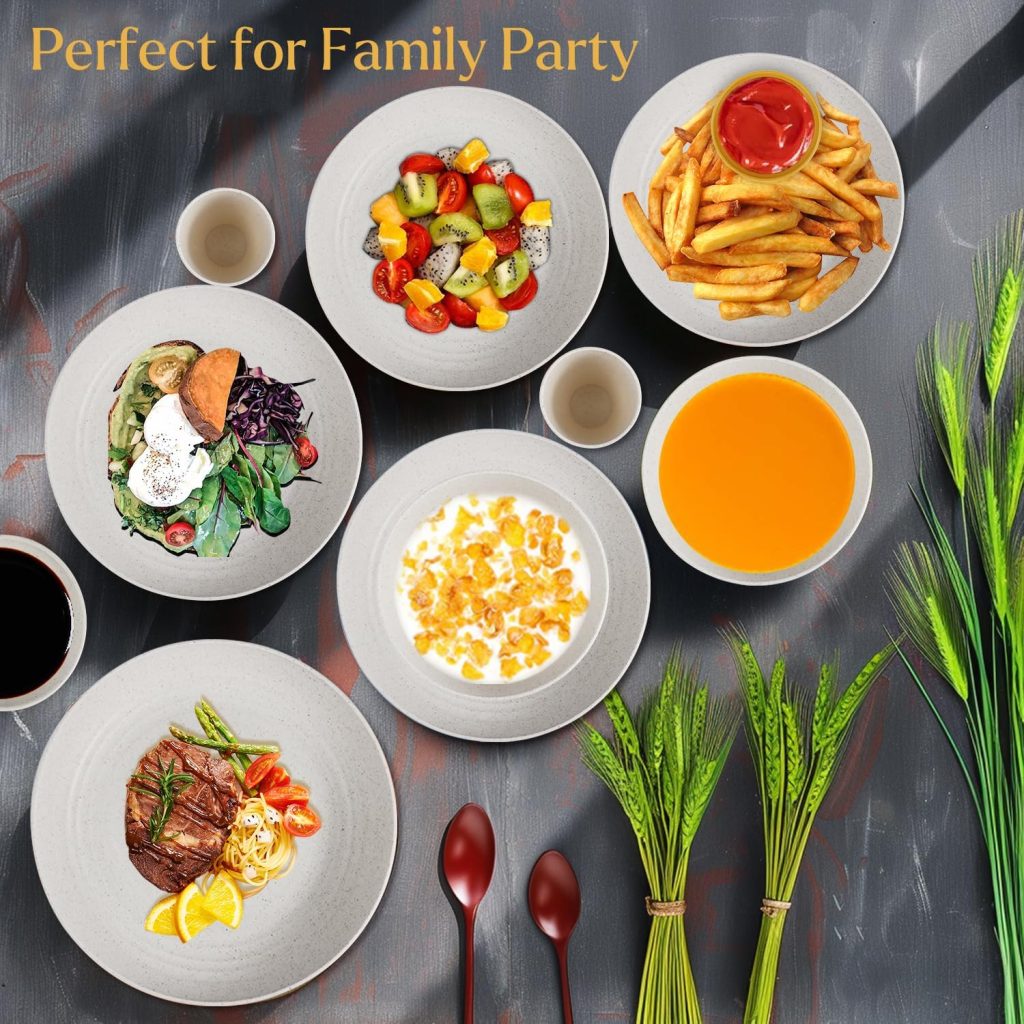
Multiple dishes often appear simultaneously. Main plate, side bowl for salad, smaller dish for condiments or dipping sauce.
A proper family meal can easily require three to four pieces of dinnerware per person, not counting serving vessels.
That’s when you realise your dinnerware collection isn’t decorative, it’s essential infrastructure.
Drinking and Snacking with Matching Cups
Meals need drinks. Revolutionary concept, we know. But the steady parade of cups throughout the day tells its own story.
Morning tea or coffee, juice with breakfast, water throughout lunch, squash or milk with dinner, and possibly a cheeky hot chocolate before bed. Your cups are basically doing laps.
Then there’s the between-meal action. A mid-morning snack of fruit gets deposited in a small bowl.
After-school biscuits land on a plate (if you’re lucky—sometimes they go straight from packet to mouth, bypassing dinnerware entirely).
Evening snacks whilst watching telly involve yet another round of plates and bowls emerging from cupboards.
Having matching cups means nobody’s arguing about who got the “good” one. When your dinnerware coordinates, these small moments of potential conflict simply… don’t happen.
It’s the invisible benefit nobody mentions, but everyone appreciates when it’s there.
Using Wheat Straw Dinnerware Across Different Family Members
Adults Using Wheat Straw Dinnerware at Meals
Your grown-up dining experiences span from “eating standing up over the sink” to “an actual civilised dinner party.”
The reality is probably somewhere in between most days. Adults tend to be the ones doing the heavy lifting with dinnerware, serving everyone else first, using multiple dishes when cooking, and inevitably ending up with their own meal going lukewarm whilst dealing with everyone else’s requirements.
There’s a particular routine to adult meal consumption. You plate up dinner. You sit down. Someone needs something. You get up. You sit down again. Your food’s cold. You eat it anyway.
The plate bears witness to this entire performance. When you’re making your own lunch, the dinnerware choice is automatic: grab a plate, assemble food, and eat whilst answering emails. It’s functional, repeated, unremarkable, and essential.
Adults also notice the practical aspects more. Is this comfortable to hold? Does it stack well in the cupboard? Can I grab it quickly when I’m running late?
These aren’t glamorous considerations, but they’re the ones that matter when you’re using the same dinnerware three, four, five times daily.
Children Using Wheat Straw Dinnerware at the Table
Kids interact with dinnerware in ways that would horrify restaurant staff but are perfectly normal at home. Plates get pushed, pulled, and occasionally used as impromptu drums.
Bowls become repositories for rejected peas. Cups get gripped with varying degrees of success depending on age and current enthusiasm levels.
Younger children are learning the mechanics of eating. Fork to plate, plate to mouth, bowl to face (sometimes), cup to—whoops, all over the table.
The dinnerware participates in this education process, getting handled, tested, and occasionally dropped as coordination skills develop.
You’ll find yourself saying “gently with the plate” more than you ever imagined possible.
Older children develop their own patterns. The teenager who always fills their bowl to the absolute brim. The ten-year-old who arranges their food in very specific patterns.
The toddler who’s convinced that food tastes better from Mum’s plate than their own.
Through all these phases, dinnerware remains the constant, durable enough to survive childhood whilst being used exactly as intended during every single meal.
Everyday Eating Routines with Wheat Straw Dinnerware
Morning to Evening Meal Cycles
Let’s map out a typical day in the life of your dinnerware, shall we? Breakfast bowls make their debut around 7 AM—or 6:30 if you’ve got an early riser who treats weekends as suggestions rather than rules.
These get used, washed (or at least rinsed), and return to the cupboard by mid-morning.
Lunchtime sees a different cast of characters. Plates for sandwiches, smaller bowls for crisps or fruit, cups for whatever’s on offer.
These tend to linger a bit longer—lunch is less formal, more grazing than an event.
By 2 PM, they’ve usually made their way to the washing-up area, though teenage bedrooms are known to harbour rogue plates and cups well past their intended stay.
Then comes the dinner crescendo. Out comes the full ensemble, dinner plates, serving bowls, side plates if you’re being fancy, cups for everyone, and possibly those nice dishes you save for when food deserves proper presentation.
The table fills up, the eating happens, and then the clearing away begins. By 8 PM, you’re either washing up or loading the dishwasher, and the dinnerware completes its daily circuit.
This rhythm repeats. Tomorrow’s breakfast bowls are drying as you read this, ready to start the whole cycle again.
Weekday vs Weekend Family Meals
Weekdays are in efficiency mode. Everything moves faster. Breakfast is functional fuel. Lunch is often a solitary affair with everyone doing their own thing.
Dinner brings everyone together, but there’s homework to finish, activities to rush to, and the general momentum of Getting Things Done.
Your dinnerware gets deployed quickly, used efficiently, and cleared away to make room for the next thing.
Weekends shift the tempo. Saturday breakfast might actually happen at a table, everyone present, nobody rushing.
Lunch could involve proper cooking rather than reheating. Sunday dinner becomes an event—multiple courses, longer conversations, maybe even dessert plates making a rare appearance.
The dinnerware gets to slow down and actually be part of leisurely eating rather than facilitating speed-dining.
This variation matters. Your plates and bowls need to handle both modes—the weekday sprint and the weekend stroll.
They’re present for a hurried toast on Tuesday morning and leisurely pancakes on Sunday. Different eating events, same essential tools.
Where Wheat Straw Dinnerware Fits in the Family Dining Space
Kitchen and Dining Table Use
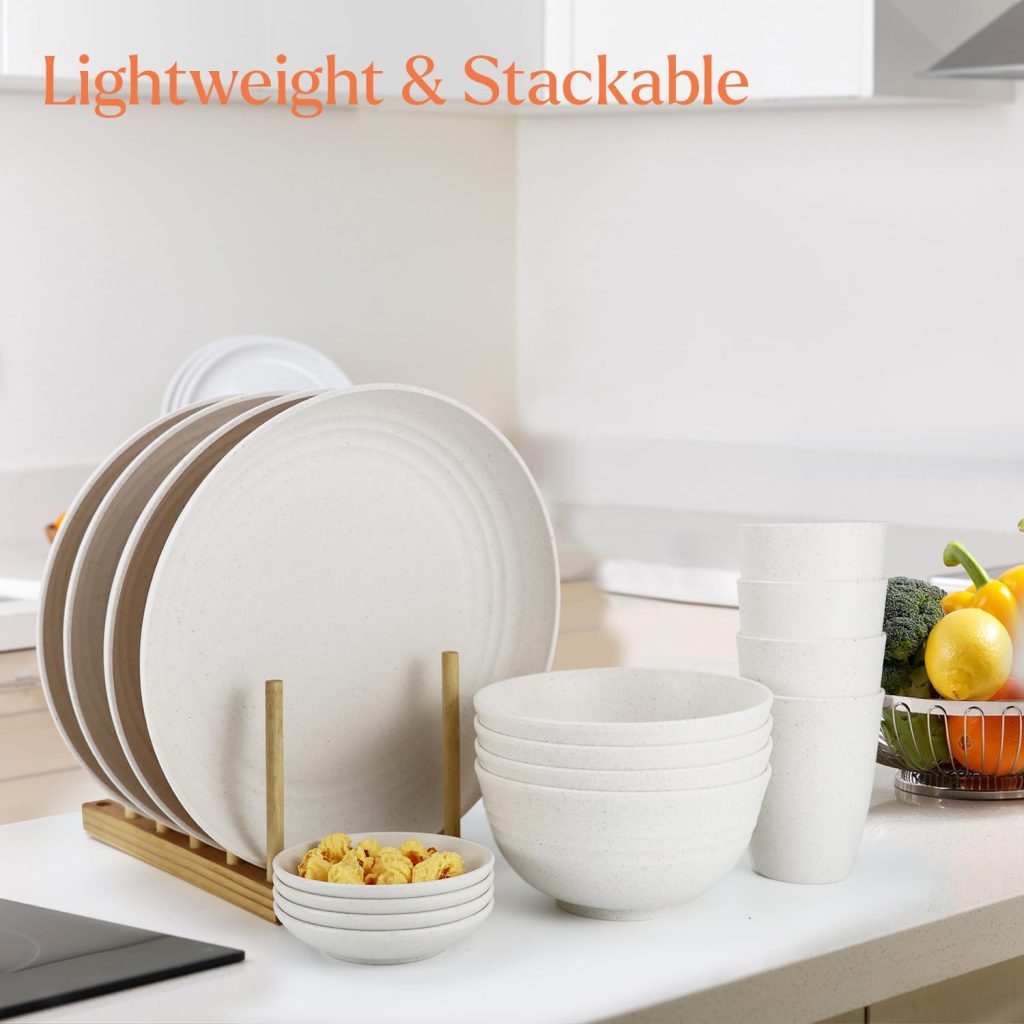
Your dinnerware lives in the kitchen cupboard, stacked and waiting. When mealtime approaches, out it comes, a practised grab of however many plates you need.
Setting the table becomes automatic: plates at each spot, bowls if needed, cups positioned just so. It’s choreography you don’t even think about anymore.
The journey from storage to table varies by household. Some families eat exclusively at the dining table.
Others split between the kitchen counter, the dining table, and “wherever’s comfortable today.” Your dinnerware makes all these journeys, adaptable to whatever eating geography your home requires.
Breakfast at the kitchen island? Sorted. Formal dinner in the dining room? Covered. Quick lunch on the coffee table because you’re working from home and pretending you have boundaries? Your plates go there, too.
After meals, the reverse journey happens. Table to kitchen, kitchen to washing area, washing area back to cupboard (eventually—let’s be honest, sometimes there’s a lengthy stay on the drying rack first).
This circulation is the hidden rhythm of family eating, and dinnerware is both the vehicle and the cargo.
Indoor and Casual Outdoor Family Eating
When the weather permits, meals migrate outside. The garden table gets set up, and your dinnerware follows.
There’s something particularly pleasant about eating dinner in the garden on a warm evening—same food, same plates, different setting entirely. Kids might take snacks to the back garden, bowls of crisps or fruit, accompanying outdoor play.
Balcony dining is having a moment, isn’t it? Even a small outdoor space becomes viable for meals when the weather cooperates.
Your dinnerware handles these transitions seamlessly—inside to outside, formal to casual, dining table to garden bench.
The flexibility to eat wherever you fancy without needing separate “outdoor” dishes is quietly convenient.
These outdoor meals often feel special even when they’re not particularly fancy. Beans on toast tastes better al fresco, and your everyday dinnerware makes these impromptu garden dinners possible without any additional fuss or planning.
Why Families Choose Wheat Straw Dinnerware for Daily Meals
Here’s where we talk about choice—not the eco-credentials or health angles, but the practical, behavioural reasons families reach for wheat straw dinnerware day after day.
Daily use consistency
This matters more than you’d think. When everything matches and everything works the same way, family meals become simpler.
You’re not hunting for the “special” plates or avoiding the “annoying” bowls that don’t stack properly.
Grab any plate—it’ll do the job. This consistency removes friction from an already complicated daily routine.
Repeated use without fuss
This is the real winner. Your dinnerware takes a beating—multiple meals daily, frequent washing, occasional dropping, and the general chaos of family life.
Being able to use the same set for breakfast through dinner without worry creates a kind of eating ease that’s hard to articulate but easy to appreciate.
You’re not babying your dishes or saving them for “good.” They’re present for the everyday, and that’s exactly their job.
Practical fit for family eating patterns
This means your dinnerware adapts to how you actually live. Quick weekday meals? Sorted. Relaxed weekend brunches? Handled. Kids’ unpredictable eating habits? No problem.
The dinnerware doesn’t dictate how you eat—it accommodates how your family naturally consumes food throughout the day.
This isn’t about marketing claims or product features. It’s about behavioural fit. Does it work for your family’s actual eating patterns? Can you use it repeatedly without thinking about it?
Does it make daily meals easier rather than more complicated? These are the questions that matter when you’re using dinnerware multiple times every single day.
Conclusion: Wheat Straw Dinnerware as Part of Daily Family Eating
So here’s what we’ve covered: families eat a lot. Multiple times daily, in fact, involving different foods, different family members, and different eating contexts from rushed weekday breakfasts to lazy weekend brunches.
Through all of it, dinnerware plays its essential supporting role.
Wheat straw dinnerware functions as a regular meal companion in these everyday eating events.
It holds your breakfast, serves your lunch, presents your dinner, and accommodates countless snacks in between.
Adults use it whilst juggling family logistics. Children use it whilst learning to eat independently. The whole family uses it together when shared mealtimes bring everyone to the table.
From kitchen cupboard to dining table to outdoor garden meals, these plates, bowls, and cups follow your family’s eating patterns wherever they lead.
Morning to evening, weekday to weekend, casual to slightly less casual, your dinnerware shows up consistently for every eating event.