The search for non-toxic, durable cookware almost inevitably leads to glass and, more specifically, to the question of which borosilicate glass cookware brands are worth buying.
The category has grown significantly, but it has also become more confusing. Some products labelled as glass cookware are not borosilicate at all.
The most famous name in glass cookware, Pyrex, has not been borosilicate in the United States since 1998.
Other brands claim borosilicate without explicitly stating it, and at least one well-regarded glass cookware brand uses a glass-ceramic material that is not borosilicate but actually performs better for stovetop cooking.
This guide cuts through all of it, brand by brand, material by material.
Not All Glass Cookware Is Borosilicate — the Material Distinction That Changes Everything
Before any brand is reviewed, the material difference matters. Borosilicate and soda-lime glass are both used in cookware, look identical on a shelf, and are priced similarly, but they behave very differently under thermal stress.
| Borosilicate glass | Soda-lime tempered glass | |
|---|---|---|
| Coefficient of thermal expansion (CTE) | 3.3 × 10⁻⁶/K | ~9.0 × 10⁻⁶/K |
| Thermal shock resistance | Excellent — rapid temperature changes tolerated | Moderate — more vulnerable to sudden thermal transitions |
| Safe temperature range | Up to ~300°C practical cooking use | Oven safe to ~218°C (425°F); avoid sudden transitions |
| Freezer-to-oven transfer | Generally safe with preheating | Risky if transferred too quickly |
| Typical brands | Simax, European Pyrex, Borcam, Borosil | US pyrex, Anchor Hocking, standard OXO glass bakeware |
The practical implication: borosilicate handles the thermal demands of a real kitchen, going from fridge to oven, sudden cold-water exposure, more reliably than soda-lime tempered glass.
It is the right material if thermal versatility matters to you. See our glass dinnerware materials guide for a full breakdown of glass types and their properties.
The Pyrex Problem — Why the Most Famous Name in Glass Cookware Is Not What Most Buyers Think
Pyrex is the name most people associate with glass cookware. For decades, that association was accurate.
Today, it depends entirely on which Pyrex you are buying because there are now three distinct products sold under variations of that name, and they are not made from the same material.
PYREX, pyrex, and European Pyrex — three products, three materials
| Brand name | Owner | Region sold | Material | Genuine borosilicate? |
|---|---|---|---|---|
| PYREX (all caps) | Corning | Worldwide (laboratory) | Borosilicate glass | ✓ Yes |
| pyrex (all lowercase) | Corelle Brands (formerly World Kitchen) | US, Canada, Latin America, Asia | Tempered soda-lime glass | ✗ No — since 1998 |
| European Pyrex | Arc International (France) | Europe, UK, Australia | Borosilicate glass | ✓ Yes |
What changed in 1998 — and why US Pyrex is still safe, just not borosilicate
In 1998, Corning sold its consumer cookware business to a company then called Borden, which rebranded as World Kitchen and is now Corelle Brands.
The new owner concluded that borosilicate glass was more expensive to produce than was required for everyday cooking conditions, and switched the US consumer line to tempered soda-lime glass.
This switch is not clearly labelled on US Pyrex products. Corning retained the laboratory PYREX business and continues to manufacture it from borosilicate to this day, which is why the capitalization distinction exists.
US pyrex is not unsafe. Tempered soda-lime glass is a legitimate cookware material, durable under normal oven conditions up to approximately 425°F.
Its higher CTE makes it more vulnerable to sudden extreme temperature transitions, such as moving a cold dish directly into a very hot oven, or placing a hot dish on a cold, wet surface, than borosilicate would be.
If borosilicate specifically is your priority, European Pyrex or any of the brands in the next section are the right choice over US Pyrex.
Brands That Are NOT Borosilicate — Called Out Before the Positive Reviews
- US pyrex (Corelle Brands) — Tempered soda-lime glass since 1998. Safe for standard oven use; not borosilicate. The product itself does not state this on its packaging, which is the source of most buyer confusion.
- Anchor Hocking — American glass manufacturer since 1905; standard baking and storage range uses tempered soda-lime glass, not borosilicate. A reliable product for standard baking; not the material buyers are seeking when they search for borosilicate.
- Standard OXO glass bakeware — OXO’s glass food containers and baking range use soda-lime tempered glass. Some OXO products in other categories may specify borosilicate; always verify the specific product’s material before purchasing.
Genuine Borosilicate Glass Cookware Brands — Reviewed and Compared
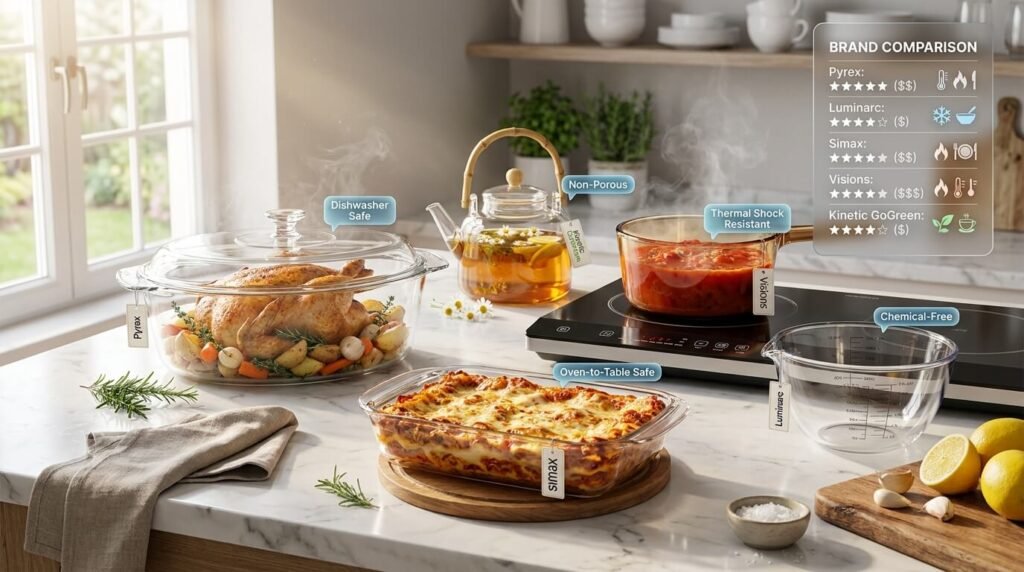
The brands below are confirmed borosilicate across their core product ranges. Each has a different profile in terms of product range, price point, and regional availability.
| Brand | Origin | Material confirmed | Product range | US availability | Price tier | Best for |
|---|---|---|---|---|---|---|
| Simax | Czech Republic | ✓ Borosilicate — all lines | Baking, pots, storage | Widely available | Mid | All-round best recommendation |
| European Pyrex | France (Arc Int’l) | ✓ Borosilicate | Baking, storage, and measuring | Limited in the US | Mid | Baking-focused households |
| Borcam | Turkey (Şişecam) | ✓ Borosilicate | Baking dishes, casseroles | Amazon US and UK | Budget–mid | Best value bakeware |
| Borosil | India | ✓ Borosilicate | Storage, baking, serving | Amazon (growing) | Mid | Storage + baking dual use |
| HARIO | Japan | ✓ Borosilicate | Coffee, tea, glass pots | Widely available | Mid–premium | Coffee/tea; some stovetop pots |
Simax — best all-round genuine borosilicate brand
Simax is manufactured in the Czech Republic by a company with nearly two centuries of glass manufacturing history.
Every Simax product line uses confirmed borosilicate glass; there is no ambiguity about which products within their range qualify and which do not.
Their catalogue covers baking dishes, casseroles, glass pots, and food storage containers, making Simax the most complete genuine borosilicate range for everyday kitchen use.

- SERVING MADE SIMPLE. With this oven-to-table-to fridge-microwave dish, you can serve directly in the baking pan without …
- TIGHT FITTING LID keeps moisture and heat contained so you can slow-cook your food at a lower temperature. Easy to remov…
- HEAT AND COLD SAFE WITH A HIGH THERMAL SHOCK RESISTANCE. Pop your casserole in the oven, stick it in the fridge to cool …
The brand is widely available in the US through Amazon and specialist kitchenware retailers, sits at a mid-price point that does not require a premium budget, and its products are oven, microwave, and dishwasher safe.
For buyers who want verified borosilicate without navigating brand qualifications, Simax is the most straightforwardly reliable recommendation.
If a piece ever breaks, see our guide on repairing borosilicate glassware for what is — and is not — worth attempting at home and also read our comparison guide on: Simax vs Pyrex.
European Pyrex — the best-known genuine borosilicate brand for baking
European Pyrex, manufactured under licence by Arc International in France, continues to use genuine borosilicate glass across its consumer product range, maintaining the formula and quality that made the Pyrex name famous before the 1998 US ownership change.
The range is particularly strong for baking dishes, measuring jugs, and storage containers. European Pyrex is widely available across the UK and Europe, but US availability is more limited.
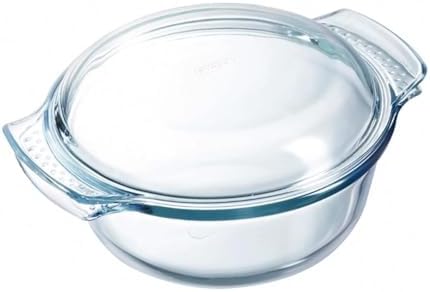
- Borosilicate Glass: Promotes optimal cooking, for a tender and juicy result
- Colour: Multi colour
- Model number: 118A000/5043
It can be found through specialist importers and some Amazon marketplace listings, but is not stocked in mainstream US retailers.
For buyers in Europe or the UK, European Pyrex represents an excellent combination of brand familiarity, confirmed borosilicate quality, and broad product availability.
Borcam — best budget genuine borosilicate bakeware
Borcam is produced by Şişecam Group, one of Turkey’s largest glass manufacturers. The product range focuses on baking dishes and casseroles in rectangular and oval formats in a variety of sizes and uses, with confirmed borosilicate glass throughout.
Borcam is widely available on Amazon in both the US and UK markets, typically at a price point below Simax and European Pyrex for comparable piece sizes.

- It is especially well suited to use both in the microwave.
- It is easy in the fridge and freezer. In short, it is a 4 in 1.
- It is dishwasher safe.
The products are oven, microwave, and dishwasher safe, and the brand has built a solid reputation in home baking communities for delivering genuine borosilicate quality at accessible pricing.
For buyers whose priority is bakeware specifically rather than a full cookware range, Borcam offers the best value among confirmed borosilicate options.
Borosil — best borosilicate brand originating outside Europe
Borosil is an Indian glass manufacturer with over sixty years of borosilicate glass production history, originally supplying the scientific and laboratory market before expanding into consumer cookware and storage.
The brand produces a wide range of borosilicate food storage containers, baking dishes, and serving ware, and is increasingly available globally through Amazon.

- √ NON POROUS GLASS: Will never absorb stains or odor
- √ DISHWASHER PROOF: Will never turn milky or cloudy with repeated use
- √ FLAME PROOF: 100% flameproof – easily moves from freezer/fridge to stovetop/microwave/oven and back again
Borosil’s particular strength is its storage and serving range of borosilicate containers designed to go from freezer to microwave without any transition concern.
For households that prioritize food storage as much as baking, Borosil offers a more complete storage ecosystem than Borcam while maintaining confirmed borosilicate throughout.
HARIO — best borosilicate for coffee and tea with some cookware crossover
HARIO is a Japanese glass manufacturer with a specific identity in the coffee and tea equipment space — the V60 pour-over dripper and the HARIO range of glass teapots and carafes are their signature products.
All HARIO products use genuine borosilicate glass. Their relevance as a cookware brand is narrower; their glass pots are designed for stovetop coffee and tea brewing rather than general meal preparation.
For households where glass brewing equipment is the priority, HARIO is the premium borosilicate choice.
Some HARIO glass kettles and pots are suitable for stovetop use on gas and electric hobs, making them a niche crossover option for buyers who want glass for liquid-based cooking.
Visions Cookware — Glass-Ceramic, Not Borosilicate, and Better for Stovetop
Visions deserves a dedicated section because it is consistently either miscategorized as borosilicate or omitted from borosilicate brand guides, and both treatments mislead buyers about what is actually the best glass-category option for stovetop cooking.
Visions cookware is made from Calexium glass-ceramic — a material related to but distinct from standard borosilicate glass.

- Visions Cookware’s see-through design allows for easily monitoring foods while they cook instead of constantly removing …
- Extremely resilient to temperature changes; can be used on stovetop or in the oven, fridge or freezer
- Healthier cooking, non-prous glass ceramic won’t absorb food odors or flavors
Its coefficient of thermal expansion is near zero, compared to borosilicate’s 3.3 × 10⁻⁶/K. A CTE near zero means Calexium expands and contracts so minimally under temperature change that it can withstand the direct, sustained heat of a gas or electric stovetop flame, something standard borosilicate glass cannot reliably handle over repeated use without risk of thermal fatigue.
This makes Visions the only major glass-category cookware brand with genuine stovetop capability for soup, stew, and sauce cooking on gas and electric hobs.
It is not induction compatible. The amber-tinted and clear versions of Visions pots have a dedicated following among cooks who want the transparency and non-reactivity of glass for monitoring their cooking, combined with the stovetop versatility that no standard borosilicate brand currently offers.
If your priority is cooking on the stovetop in a glass pot, Visions is the answer, not Simax, not Borcam, not any standard borosilicate brand.
Full Compatibility Reference — Which Brands Work Where
| Brand | Oven | Microwave | Gas stovetop | Electric stovetop | Dishwasher | Freezer-to-oven |
|---|---|---|---|---|---|---|
| Simax | ✓ | ✓ | ✗ | ✗ | ✓ | ✓ with preheating |
| European Pyrex | ✓ | ✓ | ✗ | ✗ | ✓ | ✓ with preheating |
| Borcam | ✓ | ✓ | ✗ | ✗ | ✓ | ✓ with preheating |
| Borosil | ✓ | ✓ | ✗ | ✗ | ✓ | ✓ with preheating |
| HARIO (pots) | ✓ some | ✗ | ✓ (check product) | ✓ (check product) | ✓ | With care |
| Visions (Calexium) | ✓ | ✓ | ✓ | ✓ | ✓ | ✓ |
| US pyrex (soda-lime) | ✓ to 425°F | ✓ | ✗ | ✗ | ✓ | Use caution |
How to Verify Whether Glass Cookware Is Genuinely Borosilicate
- Check the product packaging or label for the explicit word “borosilicate.” Any manufacturer using genuine borosilicate and aware of the market’s interest in it will state this clearly. If the label says “glass,” “tempered glass,” or “heat-resistant glass” without specifying borosilicate, assume soda-lime until confirmed otherwise.
- Check the manufacturer’s official website under material specifications. The product page or FAQ should confirm the glass composition. For Simax and Borcam, this is clearly stated. For US pyrex, the Corelle Brands FAQ confirms soda-lime since 1998.
- Check the country of manufacture as a supporting signal. Czech Republic (Simax), France (European Pyrex), Turkey (Borcam), and India (Borosil) are reliable borosilicate-origin signals. US-manufactured Pyrex is soda-lime. This is a supporting signal, not a definitive test — always verify material explicitly.
- As an indicative (not definitive) practical test: Place the empty piece in a 200°C oven for 15 minutes, then pour room-temperature water into it. Borosilicate will tolerate this without issue. Soda-lime tempered glass may crack under this transition. Note: Do not perform this test on a piece you are not prepared to potentially damage.
Which Brand Suits Your Kitchen — Matched by Use Case
| Use case | Recommended brand | Why | Avoid |
|---|---|---|---|
| All-round everyday kitchen (baking + storage) | Simax | Widest confirmed borosilicate range; widely available in the US | US pyrex (soda-lime); unverified glass labelled brands |
| Baking-focused household (EU/UK buyer) | European Pyrex | Confirmed borosilicate; extensive baking range; familiar brand | US pyrex — different product entirely |
| Best value bakeware on a budget | Borcam | Confirmed borosilicate at the lowest price among reliable brands | Cheap unbranded “borosilicate” with no verified manufacturer |
| Food storage + baking combined | Borosil | Strongest storage ecosystem in confirmed borosilicate | Soda-lime containers for microwave or hot food use |
| Stovetop glass cooking | Visions (Calexium) | Only glass-category cookware with genuine stovetop capability | All standard borosilicate brands — not designed for stovetop |
Frequently Asked Questions About Borosilicate Glass Cookware Brands
Is US Pyrex actually borosilicate glass?
No — not since 1998. When Corning sold its consumer cookware business to World Kitchen (now Corelle Brands), the new owner switched US pyrex from borosilicate to tempered soda-lime glass.
US pyrex is still safe for standard oven use up to 425°F, but it has a higher coefficient of thermal expansion than borosilicate and is more vulnerable to sudden thermal transitions. European Pyrex, sold under Arc International’s licence, continues to use genuine borosilicate.
What is the safest borosilicate glass cookware brand?
All confirmed borosilicate glass is chemically inert and non-toxic — there is no meaningful safety difference between Simax, European Pyrex, Borcam, and Borosil on material safety grounds.
The safety differentiation is between genuine borosilicate and soda-lime tempered glass, not between brands within the borosilicate category.
For overall reliability, Simax is the most consistently recommended because its entire range is confirmed borosilicate with no product-line ambiguity.
Is Anchor Hocking the same as Pyrex?
No. Anchor Hocking is a separate American glass manufacturer with its own product lines. Like US pyrex, Anchor Hocking’s standard bakeware and storage range uses tempered soda-lime glass rather than borosilicate.
Both are safe for standard oven use; neither is borosilicate. They compete in the same market segment — tempered glass bakeware — but are entirely different brands under different ownership.
Can borosilicate glass go on the stovetop?
Standard borosilicate glass cannot be used directly on gas or electric stovetops and is not rated for direct flame contact.
Its low CTE makes it far more thermally stable than soda-lime glass, but it is not rated for the sustained, concentrated heat of a stovetop burner over repeated use.
For stovetop glass cooking, Visions (Calexium glass-ceramic with near-zero CTE) is the correct choice; it is specifically designed and rated for gas and electric stovetop use.
Which borosilicate glass cookware brands are available in the US?
Simax and Borcam are both widely available in the US through Amazon and kitchenware retailers. Borosil is increasingly available through Amazon US. HARIO is available through specialty coffee retailers and Amazon.
European Pyrex has limited US availability through specialist importers. Visions (Calexium, not borosilicate) is available in the US through Amazon and select retailers.
Is borosilicate glass cookware truly non-toxic?
Yes. Borosilicate glass is non-porous and chemically inert — it contains no glaze, no coating, and no heavy metals in any form that can migrate into food.
It does not react with acidic foods, absorb odours, or leach any substances under any normal cooking temperature. It is the safest cookware material available from a chemical standpoint.
See our non-toxic cookware and non-toxic dinnerware guide for a full material comparison.
How is European Pyrex different from American Pyrex?
European Pyrex is manufactured by Arc International in France under licence from the Pyrex trademark, and uses genuine borosilicate glass — the same material the original Pyrex was made from.
American pyrex (note the lowercase p) is manufactured by Corelle Brands and has used tempered soda-lime glass since 1998. The two products share a brand name but are made from different materials by different companies in different countries.
If you are buying Pyrex outside the US — in Europe, the UK, or Australia — you are almost certainly getting genuine borosilicate. If you are buying pyrex in the US, you are getting soda-lime tempered glass.
See our safe kitchen guide.