You’re standing in your cramped kitchen, looking at your limited counter space, and wondering if you can just stack your toaster oven on top of your microwave.
After all, both appliances are right there, and that flat microwave top looks like the perfect spot to free up some precious workspace.
But before you make that move, there’s something you need to know: this seemingly simple space-saving solution could actually be a recipe for disaster.
The question isn’t just about whether it’s physically possible, but whether it’s safe for your appliances, your home, and most importantly, you.
In this article, we’ll dive deep into the safety concerns, weight considerations, heat issues, and practical alternatives that will help you make the smartest decision for your kitchen setup.
Can You Put a Toaster Oven on Top of a Microwave?
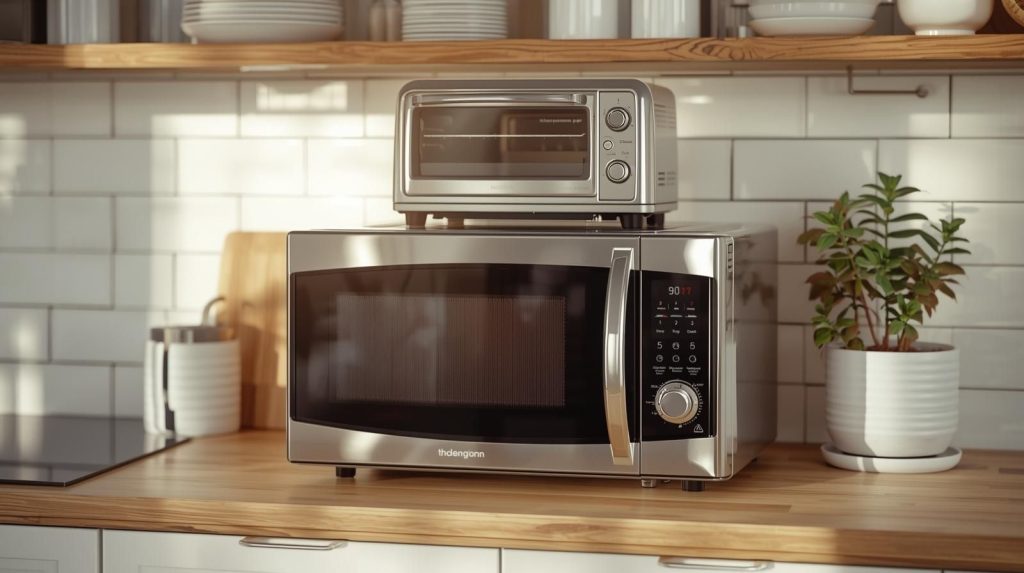
The short answer is no, you should not put a toaster oven on top of a microwave.
While it might seem like a convenient way to maximize your counter space, this combination creates several serious safety hazards that outweigh any space-saving benefits.
Let me explain why this matters so much.
First, toaster ovens generate intense external heat during operation. Unlike microwaves that primarily heat food from the inside using electromagnetic waves, toaster ovens work like miniature conventional ovens, radiating heat in all directions.
The top, sides, and especially the bottom of a toaster oven can reach temperatures between 150°F to 500°F, depending on the cooking setting.
When you place this heat source directly on top of your microwave, you’re essentially baking your microwave’s exterior and internal components.
Microwaves aren’t designed to withstand this kind of sustained external heat.
The plastic components, control panels, and sensitive electronic circuitry inside can warp, malfunction, or even fail when exposed to the high temperatures a toaster oven produces.
I’ve seen microwaves with melted control panels and fried circuits because someone thought stacking was a good idea.
Beyond the heat issue, there’s the ventilation problem. Both appliances need proper airflow to function safely and efficiently.
Microwaves have ventilation slots (usually on the sides, back, or top) that release heat generated by the magnetron and other components.
When you block these vents with a toaster oven, you trap heat inside the microwave, causing it to overheat and potentially shortening its lifespan or creating a fire hazard.
The Electrical Load Problem
Here’s another critical issue most people don’t consider: both appliances draw significant power. A typical microwave uses 600-1200 watts, while a toaster oven uses 1200-1800 watts.
If you’re running both simultaneously and they’re plugged into the same circuit, you could easily overload your electrical system, trip breakers, or worse, create an electrical fire hazard.
This becomes even more dangerous if you’re using an extension cord with a microwave oven, which is another practice safety experts strongly advise against.
Practical Application: If you’re currently using this setup, unstack them immediately. Place each appliance on a heat-resistant surface with at least 4-6 inches of clearance on all sides.
Your appliances will last longer, work more efficiently, and most importantly, your kitchen will be safer.
How Much Weight Can You Put on Top of a Microwave?
Understanding the weight of a microwave and its load-bearing capacity is crucial for anyone considering placing items on top of it.
Most standard countertop microwaves can safely support between 20 to 50 pounds on their top surface, but this comes with significant caveats that you need to understand.
The weight capacity isn’t just about whether the microwave can physically hold something without collapsing.
It’s about maintaining proper function and preventing damage to internal components.
Microwaves have cooling vents, and excessive weight can block these vents or put pressure on the microwave’s casing, potentially warping it and affecting the door seal.
A compromised door seal can allow microwave radiation to leak, which is a serious safety concern.
The weight of a microwave itself typically ranges from 25 to 50 pounds for standard models, with larger or more powerful units weighing up to 70 pounds.
The structural integrity of the appliance is designed to support its own weight and internal components, not necessarily to serve as a shelf for other items.
Why Weight Distribution Matters
Even if an item falls within the weight limit, poor weight distribution can cause problems.
Heavy items placed unevenly can cause the microwave to tilt, strain one side of the casing, or interfere with the internal turntable mechanism.
Additionally, any item that vibrates during use (like certain small appliances) can cause the microwave to move or shift, potentially damaging both appliances or causing them to fall.
Most toaster ovens weigh between 10 to 25 pounds, which technically falls within the weight capacity of many microwaves.
However, weight alone isn’t the determining factor for safety; the heat generation and ventilation issues we discussed earlier are far more critical concerns.
Just because something is light enough doesn’t mean it’s safe enough.
Practical Application
Before placing anything on top of your microwave, check your owner’s manual for the manufacturer’s recommendations.
If you must place lightweight, heat-free items on top (like a decorative bowl or cookbook), ensure they don’t block any vents and don’t interfere with the microwave’s door opening and closing properly.
Weigh the item if you’re uncertain; a simple kitchen scale can help you stay within safe limits.
Can I Put a Microwave on Top of an Oven?
This is another common question that deserves a clear answer: placing a microwave on top of a conventional oven is generally not recommended unless you have a specifically designed over-the-range microwave or a microwave shelf unit meant for this purpose.
The primary concern here mirrors what we discussed with the toaster oven situation, but in reverse—heat rising from the oven below can damage the microwave above.
Conventional ovens reach temperatures of 350°F to 500°F during normal cooking, and even higher during self-cleaning cycles.
This intense heat radiates upward, and even if your oven is well-insulated, the exterior surfaces can become extremely hot.
Microwaves have temperature limitations. Most manufacturers specify that microwaves should not be operated in environments exceeding 104°F to 113°F ambient temperature.
When you place a microwave directly on top of or very close to an active oven, you’re exposing it to temperatures well beyond these safe operating conditions.
This can cause the microwave’s plastic components to warp, electronic controls to malfunction, and in extreme cases, the unit could overheat and pose a fire risk.
The Exception: Built-In and Over-the-Range Solutions
There are safe ways to have a microwave positioned above an oven, but they require proper installation.
Over-the-range microwaves are specifically engineered with enhanced heat resistance, proper ventilation systems, and mounting hardware that maintains safe clearance from the cooking surface below.

These units include built-in exhaust fans and are designed to handle the heat and steam rising from stovetop cooking.
Similarly, some kitchen designs incorporate a microwave into a wall unit or cabinet that’s positioned above a wall oven, but these installations include adequate spacing (usually 12-18 inches minimum) and proper ventilation to protect the microwave from heat exposure.

If you’re working with limited space and considering a stacked arrangement, invest in a proper microwave shelf or stand that creates adequate clearance between appliances.
These stands typically provide 12-24 inches of space and allow for proper heat dissipation and airflow.
Practical Application
If your kitchen layout requires vertical stacking, consult with a professional installer or kitchen designer who can assess your specific appliances and recommend safe installation methods.
Never improvise by simply placing a microwave on top of your oven. The few inches of counter space you save aren’t worth the risk of appliance damage or fire.
Can You Put a Fruit Bowl on Top of a Microwave?
Yes, you can safely put a fruit bowl on top of a microwave, and this is actually one of the better uses for that space.
However, there are some considerations to keep in mind to ensure you’re doing it properly and not inadvertently creating problems.
A fruit bowl is an ideal candidate for microwave-top placement because it’s lightweight, doesn’t generate heat, and doesn’t require electrical power.
Most fruit bowls weigh just a few pounds, even when full, well within the safe weight capacity of any microwave.
Additionally, fruit bowls don’t vibrate or move during use, so they won’t cause any shifting or instability.
Best Practices for Placing Items on Your Microwave
When placing a fruit bowl or any decorative item on your microwave, make sure it doesn’t block the ventilation slots.
Check the sides, back, and top of your microwave to identify where the air vents are located.
Your fruit bowl should sit in the center of the microwave’s top surface, leaving adequate clearance (at least 2-3 inches) around all vents.
Avoid placing items that could attract pests or create moisture problems.
Fresh fruit is generally fine, but if fruit becomes overripe or starts to decay, it can attract fruit flies and other pests that might find their way into your appliance through ventilation openings.
Keep your fruit bowl clean and rotate your fruit regularly.
Consider the material of your fruit bowl as well. Heavy ceramic or glass bowls are fine from a weight perspective, but avoid anything with a rough or unfinished bottom that could scratch your microwave’s surface.
A felt or rubber pad underneath can protect both surfaces and prevent the bowl from sliding when you open the microwave door.
One thing to note: if you use your microwave frequently throughout the day, the vibration from the turntable and the heat that naturally rises from the appliance during use might not be ideal for certain fruits.
Bananas, for example, might ripen more quickly in the warmer environment on top of a frequently-used microwave.
Practical Application: Choose a lightweight, stable fruit bowl with a smooth bottom. Place it centrally on the microwave top, ensuring vents remain clear.
Check weekly for overripe fruit and clean the bowl regularly. If you notice your fruit ripening faster than usual, consider relocating the bowl to a cooler spot in your kitchen.
Can You Put Things on Top of a Microwave?
The general answer is yes, but with important qualifications. Not everything belongs on top of your microwave, and understanding what’s safe versus what’s risky will help you make smart decisions about using this space effectively.
Safe items to place on top of a microwave include lightweight kitchen accessories that don’t generate heat, vibrate, or block ventilation.
This includes cookbooks, decorative items, small baskets, spice racks (if they’re not too heavy), bread boxes, and similar stationary objects.
The key criteria are: relatively light weight (under 20 pounds), stable and won’t tip over, doesn’t block vents, and doesn’t generate heat or require electricity.
What You Should Never Put on Your Microwave
Absolutely avoid placing any heat-generating appliances on your microwave.
This includes toaster ovens (as we’ve discussed), coffee makers, electric kettles, slow cookers, rice cookers, or any other cooking appliance.
These devices can overheat your microwave, block critical ventilation, and create serious fire hazards.
Don’t place other electronic devices like tablets, laptops, or digital assistants on your microwave either.
The electromagnetic field generated by your microwave during operation can potentially interfere with other electronics, and the heat generated by the microwave can damage sensitive electronic components.
Avoid storing cleaning products, especially anything flammable, on top of your microwave. The heat from the microwave could potentially cause aerosol cans to burst or chemicals to become unstable.
Similarly, don’t store plastic containers or plastic bags on top, as the heat can cause them to warp or even melt if the microwave is used for extended periods.
Heavy items like large mixers, multiple stacked cookware items, or heavy appliances should also be avoided.
Even if your microwave can technically support the weight, these items can strain the microwave’s casing over time and potentially interfere with its operation.
The Ventilation Rule
Here’s a simple rule to remember: if it blocks vents, don’t put it there. Microwave vents are essential for cooling the magnetron and other internal components.
Blocked vents can cause your microwave to overheat, leading to reduced performance, shortened lifespan, or even complete failure.
Before placing anything on top of your microwave, take a moment to locate all ventilation openings and ensure your item won’t obstruct them.
Audit what’s currently on top of your microwave. Remove any heat-generating appliances, heavy items, or anything blocking vents.
If you need the storage space, consider lightweight, decorative storage solutions like woven baskets or fabric-covered boxes that allow for airflow. Always maintain at least 3 inches of clearance around all vents.
What Surface Can You Put a Toaster Oven On?
Finding the right surface for your toaster oven is crucial for both safety and performance.
Toaster ovens need a stable, heat-resistant surface that can withstand high temperatures while providing proper ventilation and clearance on all sides.
The ideal surface for a toaster oven is a heat-resistant countertop made of materials like granite, quartz, solid surface, or stainless steel.
These materials can easily handle the heat that radiates from the bottom and sides of a toaster oven without warping, discoloring, or becoming damaged.
If you have laminate countertops, you’ll need to take extra precautions because laminate can be damaged by prolonged heat exposure.
Creating a Safe Toaster Oven Station
Place your toaster oven directly on the counter with at least 4-6 inches of clearance on all sides and a minimum of 8-12 inches of clearance above.
This spacing is critical—it’s not just a suggestion from manufacturers. Toaster ovens need this clearance to dissipate heat effectively and prevent fires.
Check your specific model’s manual, as some larger or more powerful units may require even more clearance.
Never place your toaster oven under cabinets or in enclosed spaces. The heat rising from the top can damage wood cabinets, cause paint to peel, or, in worst-case scenarios, ignite combustible materials.
I’ve heard too many stories of scorched cabinets and near-miss fires from people who thought they could squeeze a toaster oven into a tight spot.
If your countertop surface isn’t heat-resistant, use a proper toaster oven mat or heat-resistant cutting board underneath.
These accessories are made from materials like silicone or heat-resistant fiberglass and provide a protective barrier between the hot appliance and your counter.
Don’t use regular cutting boards, placemats, or towels—these can actually become fire hazards.
Location Considerations
Position your toaster oven away from curtains, paper towels, plastic containers, and anything else that could catch fire or melt.
Keep it away from the edge of the counter, where it could be accidentally knocked off or where children could reach the hot surfaces.
Also, ensure it’s near a grounded electrical outlet so you don’t need to use an extension cord (which isn’t recommended for high-wattage appliances).
Consider the workflow of your kitchen. Placing your toaster oven near your food prep area makes sense, but not so close that you risk knocking into it while it’s hot.
A corner location often works well, providing natural clearance on two sides while keeping the appliance out of the main traffic flow.
Practical Application
Measure the space where you plan to put your toaster oven. Mark out the clearance requirements with painter’s tape to visualize the needed space.
If you’re using a heat-resistant mat, clean both the mat and counter regularly; crumbs and grease buildup can become fire hazards.
Test the surface temperature of your counter after using the toaster oven; if it’s uncomfortably hot to touch, you need additional heat protection.
What Are the Benefits of a Toaster Oven Over a Microwave?
Understanding the strengths of each appliance helps you use them appropriately and appreciate why they serve different purposes in your kitchen.
While microwaves and toaster ovens might seem interchangeable for reheating food, they each have distinct advantages that make them better suited for specific tasks.
Toaster ovens excel at creating crispy, browned textures that microwaves simply cannot achieve.
When you reheat pizza in a toaster oven, you get a crispy crust and evenly melted cheese. T
ry that in a microwave, and you’ll end up with a soggy, rubbery mess. This browning capability comes from the dry heat that toaster ovens produce, which removes moisture from food surfaces while heating.
It’s the same principle as a conventional oven, just in a more compact, efficient package.
The versatility of toaster ovens extends far beyond reheating. You can bake cookies, roast vegetables, broil fish, toast bread, and even prepare small casseroles.
Many modern toaster ovens include convection settings that circulate hot air for even faster, more uniform cooking.
This makes them mini versions of your full-size oven, capable of handling many of the same tasks with less energy consumption and faster preheating times.
Energy Efficiency and Cooking Quality
For small portions, toaster ovens are significantly more energy-efficient than heating your full-size oven.
Why heat an entire oven cavity to cook four chicken thighs when a toaster oven can do the job using 60-70% less energy?
During hot summer months, this also means less heat added to your kitchen, keeping your space more comfortable.
Toaster ovens provide better temperature control for actual cooking compared to microwaves.
While microwaves heat food through electromagnetic radiation that agitates water molecules, they don’t offer precise temperature settings for baking or roasting.
A toaster oven lets you set specific temperatures (usually from 200°F to 450°F), giving you control over the cooking process similar to a conventional oven.
Where Microwaves Still Shine
That said, microwaves have their own irreplaceable advantages. They’re unbeatable for speed; reheating a cup of coffee takes 30 seconds in a microwave versus several minutes in a toaster oven.
Microwaves are also superior for steaming vegetables, heating soups and beverages, defrosting frozen foods, and cooking foods that benefit from moisture retention, like rice dishes or steamed fish.
Microwaves are also safer in some respects because their exteriors stay relatively cool, making them less likely to cause burns.
They’re often the better choice for households with young children or for quick tasks where you just need something hot and fast without any concern for texture.
The real answer is that most kitchens benefit from having both appliances because they serve complementary rather than competing functions.
Use your microwave for quick reheating, beverages, steaming, and defrosting. Use your toaster oven for anything that benefits from browning, crisping, baking, or roasting.
And for those wondering, you might also be curious about whether it’s safe to place an air fryer on top of a microwave, which raises similar concerns about heat and ventilation.
Practical Application
Assess your cooking habits to determine which appliance serves your needs better for specific tasks. Create a mental or written guide: “leftovers that need to stay moist—microwave; leftover pizza or French fries—toaster oven; morning coffee reheat—microwave; morning toast—toaster oven.”
This clarity will help you choose the right tool for each job, improving both your food quality and your kitchen efficiency.
Conclusion
The question of whether you can put a toaster oven on top of a microwave might seem simple, but as we’ve explored, the answer involves critical safety considerations that go far beyond just counter space management.
The bottom line is clear: don’t stack these appliances. The heat generated by toaster ovens can damage your microwave’s components, blocked ventilation creates fire hazards, and the combined electrical load poses additional risks.
Instead, give each appliance the space it deserves, a heat-resistant surface with adequate clearance on all sides.
Your microwave’s top can safely hold lightweight, non-heat-generating items like fruit bowls or cookbooks, as long as you don’t block the vents.
Your toaster oven needs its own dedicated spot with proper clearance and ventilation.
Yes, this might mean getting creative with your kitchen layout or even removing some items from your counters, but the trade-off is a safer kitchen where your appliances function properly and last longer.
Remember, these appliances are tools that serve different purposes in your kitchen.
Use your microwave for speed and convenience, your toaster oven for texture and browning, and give both the respect and space they need to do their jobs safely.
Your kitchen might be small, but smart organization, not risky stacking, is the real solution to limited counter space.
Comments are closed.