Category: Glass and Crystal Identification

  • Dating Baccarat Marks — How to Tell When Baccarat Crystal Was Made

    Determining when Baccarat crystal was manufactured requires understanding how marking practices evolved throughout the company’s 260-year history.

    Baccarat marks serve as temporal indicators, with distinct styles corresponding to specific production periods from the unmarked pre-1936 era through modern standardized logos.

    Dating Baccarat pieces accurately helps establish value, verify authenticity, and understand historical context.

    However, marks alone don’t tell the complete story—pattern styles, cutting techniques, and craftsmanship quality provide essential corroborating evidence.

    This comprehensive guide explores Baccarat’s marking timeline, explains how to identify marks from different eras, and demonstrates the step-by-step process for dating pieces using marks alongside other authentication factors to establish accurate production periods with confidence.

    Why Baccarat Marks Are Used to Date Crystal
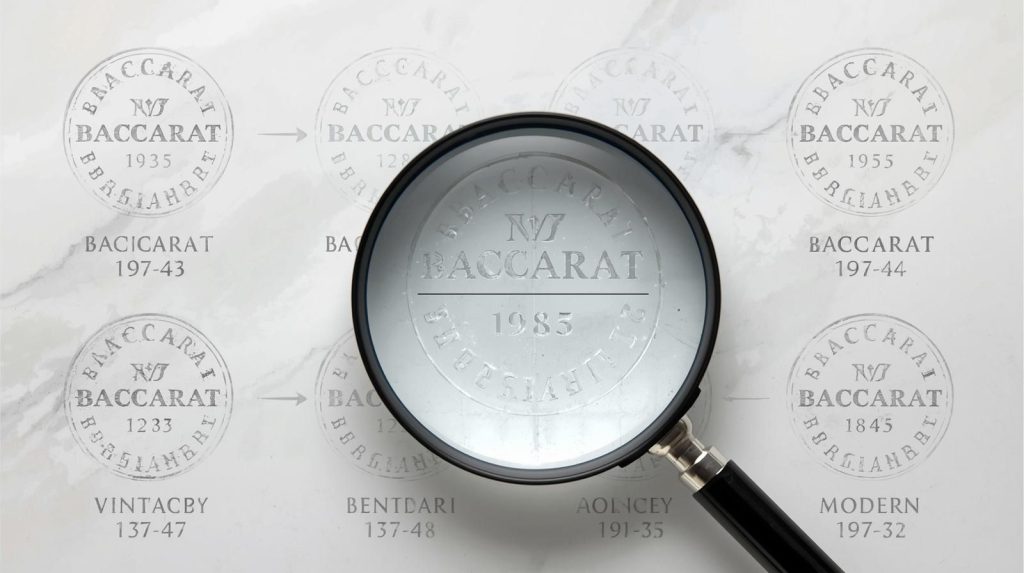
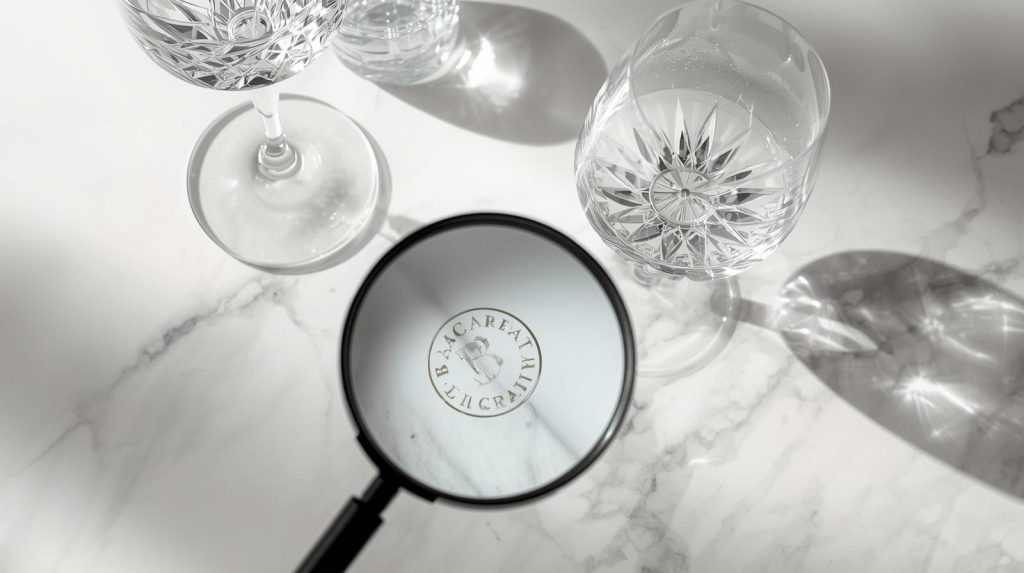
    dating baccarat marks

    Baccarat marks provide the most direct evidence for determining manufacturing periods, though they function best when combined with other dating methods for complete accuracy.

    Marks as Manufacturing Indicators

    Baccarat’s marking practices changed systematically throughout the company’s history, creating identifiable chronological markers.

    The presence, absence, style, and clarity of marks immediately narrow production timeframes.
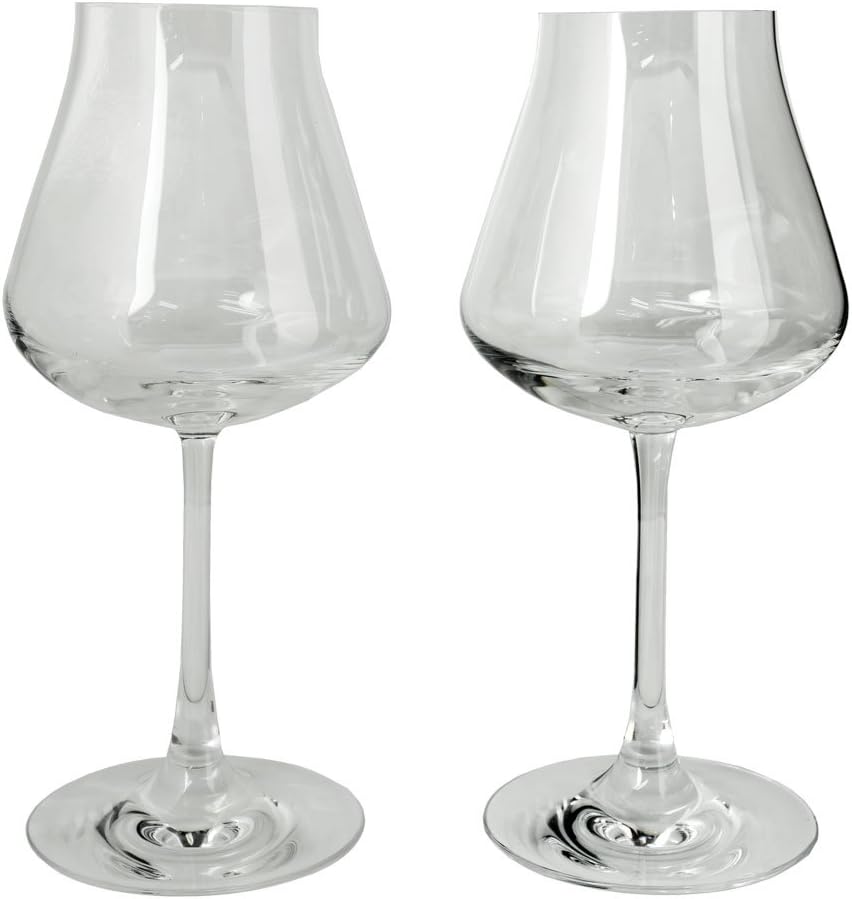
    Baccarat red wine glass set

    Early pieces lack marks entirely, mid-century items show transitional etching styles, and contemporary pieces display standardized logos.

    These marking evolution stages create a reliable timeline framework for dating authentic Baccarat crystal when properly understood and applied.

    Why Baccarat Changed Marks Over Time

    Baccarat evolved, marking practices in response to counterfeiting concerns, changing manufacturing technologies, and brand protection needs.

    Early confidence in craftsmanship quality made marks unnecessary. As crystal markets expanded and imitations proliferated, permanent identification became essential.
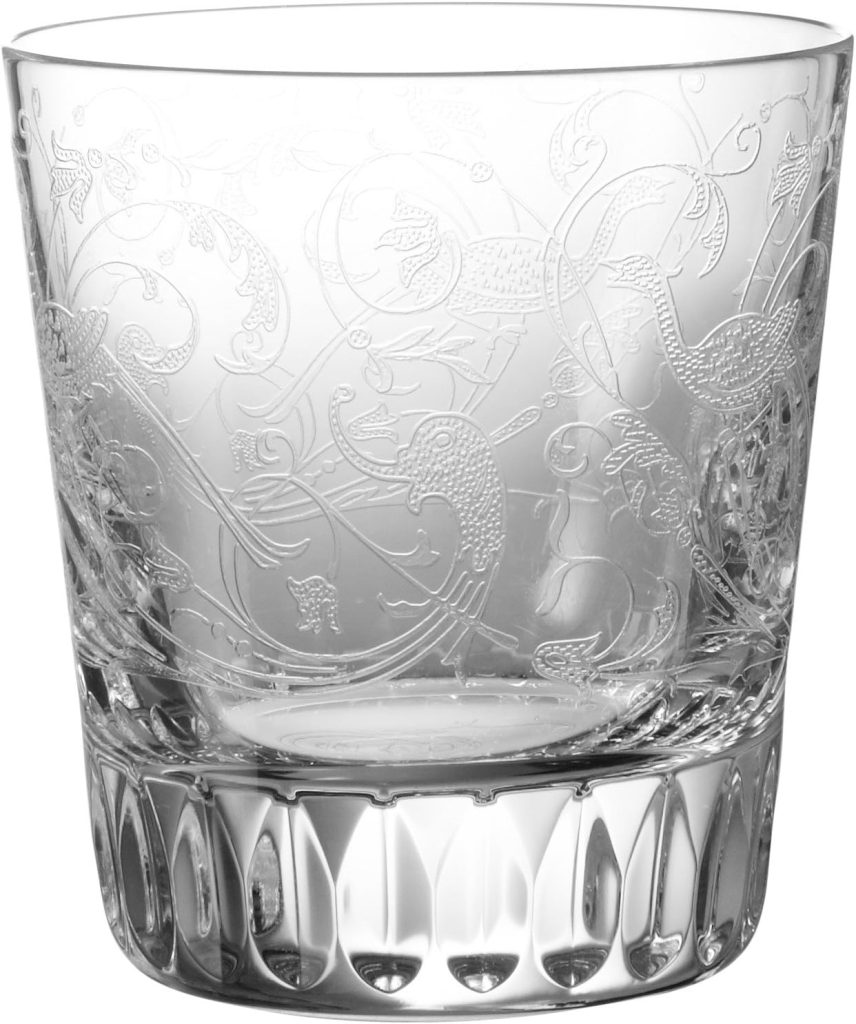
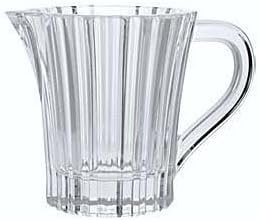
    Baccarat Parme tumbler

    Technical advances in acid-etching and later laser technology improved mark clarity and consistency.

    Each marking change reflected broader manufacturing and market conditions during specific historical periods.

    Relationship Between Marks and Production Eras

    Specific mark styles correlate directly with defined production periods, creating a chronological framework for dating.

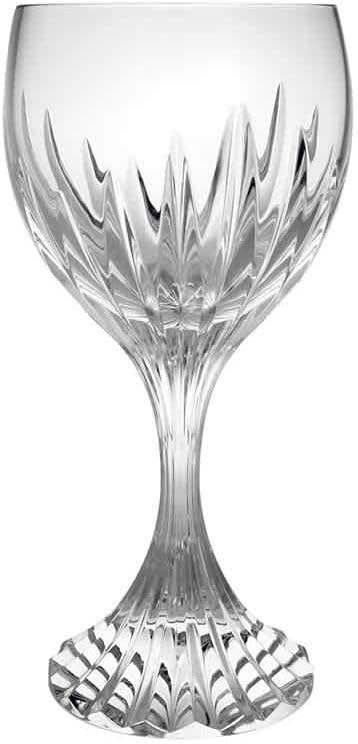
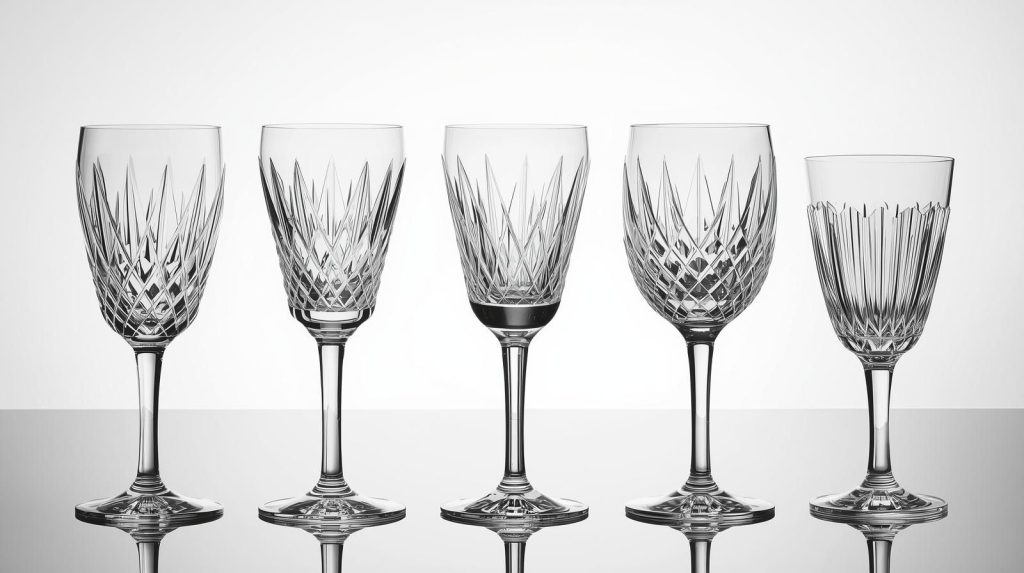
    Baccarat crystal stemware

    Pre-1936 pieces typically lack marks, 1936-1950s items show early, shallow etching, 1960s-1980s pieces display clearer logos, and post-1990s crystal features standardized modern marks.

    Understanding Baccarat stamps within these temporal contexts allows collectors to assign approximate production dates based primarily on mark characteristics observed on individual pieces.

    Overview of Baccarat Mark History

    Baccarat’s marking evolution spans three major phases reflecting changing manufacturing priorities, market conditions, and brand protection strategies across centuries.

    Early Unmarked Period

    From Baccarat’s 1764 founding through the mid-1930s, the company rarely marked pieces permanently.

    Craftsmen relied on superior quality and design recognition for authentication. Occasional paper labels provided temporary identification but rarely survived.

    This 170-year unmarked period means many valuable antique Baccarat items legitimately lack any manufacturer’s stamp, requiring alternative dating methods through pattern documentation and craftsmanship evaluation.

    Introduction of Acid-Etched Marks

    Around 1936, Baccarat began systematically applying acid-etched circular logos to finished pieces.

    Early implementations produced shallow, sometimes faint impressions requiring careful examination.

    This transitional period shows varying mark depths and placements as techniques are standardized.

    The introduction of permanent marks represented Baccarat’s response to expanding markets and growing counterfeit concerns, establishing brand protection through indelible identification.

    Standardization of Branding

    By the 1990s, Baccarat achieved complete mark standardization with consistent logo designs, uniform etching depths, and predictable placements.

    Modern manufacturing controls ensure every marked piece displays identical logo characteristics regardless of item type.

    This standardization simplifies authentication and dating for contemporary pieces while creating clear distinctions from earlier, more variable marking periods that reflected evolving manufacturing capabilities.

    Baccarat Crystal Marks by Time Period
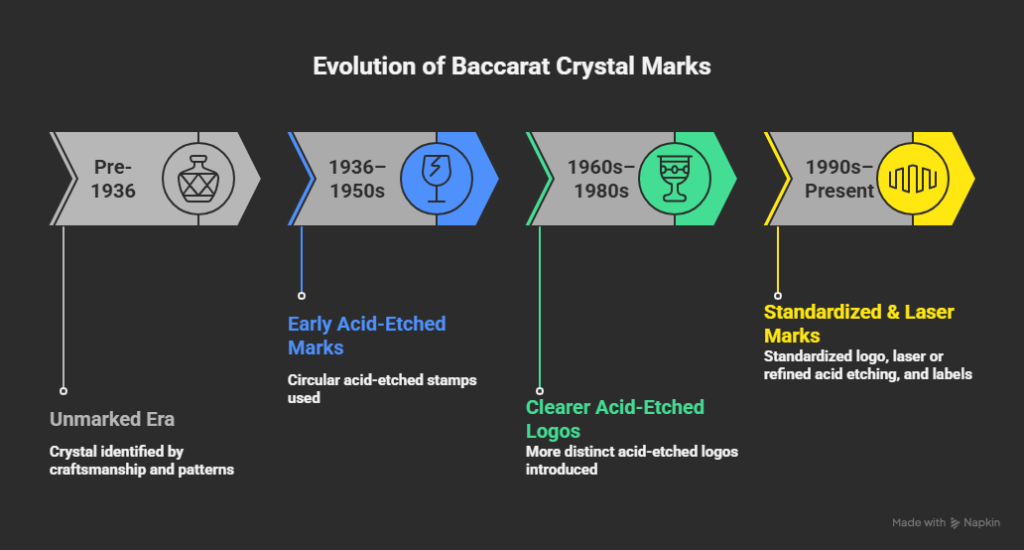
    Baccarat crystal marks by time period

    Understanding chronological mark evolution provides the foundation for accurate dating based on observable stamp characteristics.

    Pre-1936 Baccarat Crystal (Unmarked Era)

    Baccarat pieces manufactured before approximately 1936 typically bear no permanent marks whatsoever.

    This extensive period encompasses some of Baccarat’s most valuable antique items, including early Harcourt patterns and Victorian-era designs.

    No Permanent Marks

    The complete absence of acid-etched stamps, engraved signatures, or molded marks characterizes this era.

    Any pre-1936 piece claiming Baccarat origin without marks is potentially authentic, while marked pieces claiming early 19th-century dates warrant suspicion.

    Some pieces carried paper labels that have since disappeared, leaving no authentication trace beyond quality indicators.

    Identified by Craftsmanship & Patterns

    Dating unmarked pieces requires examining hand-cutting precision, crystal weight, and clarity, and comparing designs against historical catalogs and museum collections.

    Pattern-based dating support becomes essential when marks are absent, using documented production periods for specific cutting styles.

    Victorian elaborate patterns versus Art Nouveau flowing designs help narrow manufacturing timeframes through stylistic analysis.

    1936–1950s Baccarat Marks

    The introduction period for acid-etched marks shows transitional characteristics as Baccarat established marking protocols and refined etching techniques for consistent application.

    Early Acid-Etched Circular Stamps

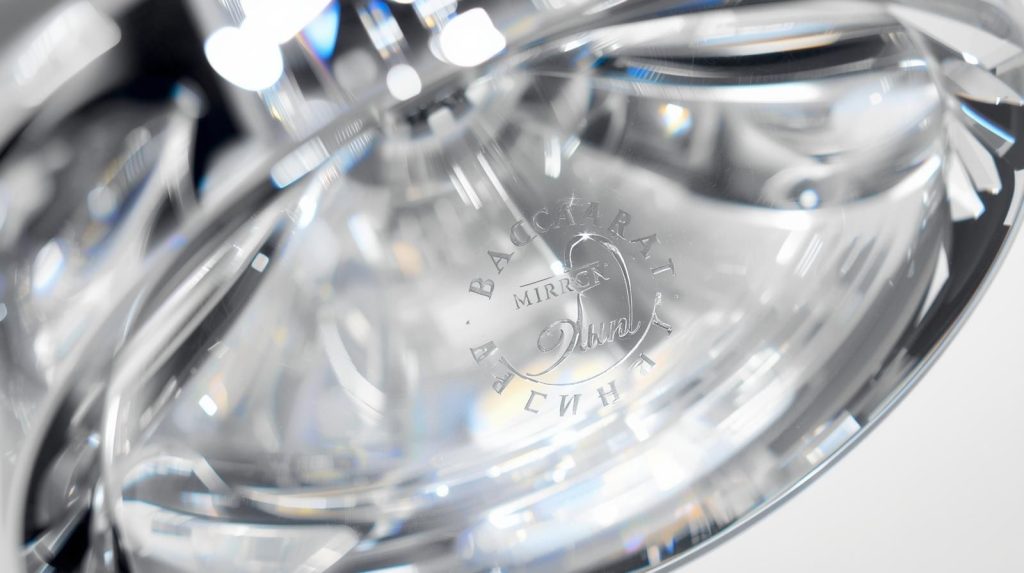
    Initial acid-etched logos appear as circular designs containing “BACCARAT” text and glass icons similar to modern marks but executed with less consistency.

    The circular border, internal text arrangement, and icon details match later versions, though execution quality varies.

    These pioneering marks established the design template Baccarat would standardize over subsequent decades.

    Often Faint and Shallow

    Early etching technology and developing techniques produced marks with noticeably shallower depth than modern versions.

    Many 1936-1950s marks require angled lighting and careful examination to detect. This faintness doesn’t indicate wear but reflects period manufacturing capabilities.

    Collectors should expect subtler marks from this era compared to bold contemporary stamping.

    1960s–1980s Baccarat Marks

    The mid-to-late 20th century marks show improved clarity and consistency as acid-etching techniques matured and quality control standardized.

    Clearer Acid-Etched Logos

    Marks from this period display enhanced visibility with deeper etching and sharper definition compared to earlier attempts.

    The circular border appears more distinct, the text shows better clarity, and the glass icon achieves finer detail.

    Technological improvements in acid application and etching precision created more reliably readable marks across all piece types.

    Increased Consistency

    Manufacturing standardization ensured marks appeared more uniformly across different items and production runs.

    Variation between pieces decreased significantly, with mark depth, size, and placement becoming predictable.

    This consistency aids dating—highly uniform marks suggest 1960s or later production, while variable marks indicate earlier manufacture.

    1990s–Present Baccarat Marks

    Contemporary Baccarat marks achieve complete standardization with modern manufacturing technologies producing perfectly consistent identification across all items.

    Standardized Logo

    Current marks display identical characteristics regardless of piece type, size, or production location.

    The circular logo, text placement, and icon details follow exact specifications.

    Every contemporary Baccarat piece receives marking meeting strict quality standards, creating immediate visual recognition of modern manufacture through mark perfection.

    Laser or Refined Acid Etching

    Modern technology enables extremely precise, consistent mark application.

    Whether using advanced acid-etching or laser techniques, contemporary marks show exceptional clarity and depth uniformity.

    The technology produces marks clearly visible without special lighting while maintaining the subtle elegance appropriate to luxury crystal.

    Supplemented by Labels

    Many current pieces include removable paper or foil labels providing additional information like pattern names, country of origin, and model numbers.

    These temporary labels complement permanent etched marks rather than replacing them, offering purchasers immediate authentication confidence while maintaining permanent identification after label removal.

    Types of Baccarat Marks Used for Dating
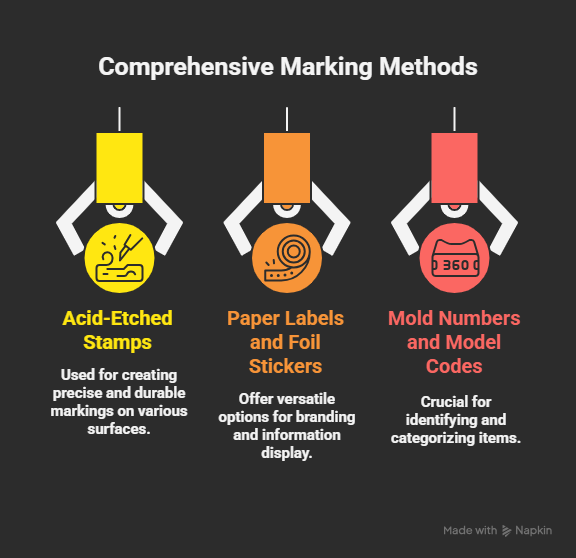
    Types of Baccarat marks used for dating

    Different mark types provide varying dating information, with some offering more precise temporal indicators than others.

    Acid-Etched Stamps

    The primary permanent marking method consists of acid-etched circular logos applied after piece completion.

    These indelible marks survive indefinitely, providing the most reliable dating evidence.

    Mark style evolution—from shallow early versions to bold modern stamps—allows chronological placement within defined production periods based on etching depth, clarity, and consistency characteristics.

    Paper Labels and Foil Stickers

    Temporary labels appear on many pieces, particularly from recent decades.

    These removable identifiers include “Baccarat” text and often additional details. Labels indicate relatively recent manufacture since older pieces have typically lost them.

    However, label absence doesn’t indicate age—many contemporary pieces lose labels quickly. Labels supplement but don’t replace permanent mark dating.

    Mold Numbers and Model Codes

    Some Baccarat pieces include small molded numbers or codes indicating specific patterns or production runs.

    These identifiers rarely appear on visible surfaces, sometimes hidden inside bases or under feet.

    When present and cross-referenced against Baccarat records or reference materials, these codes can narrow dating more precisely than general mark styles alone.

    What Does Not Indicate Age

    Certain characteristics mistakenly interpreted as dating indicators actually don’t reliably establish age.

    Crystal clarity, weight, and general quality remained consistently excellent throughout Baccarat’s history.

    Pattern popularity or perceived style also misleads—Harcourt spans nearly 200 years while looking “modern.”

    Focus on actual mark characteristics rather than subjective quality or aesthetic impressions.

    Where to Find Baccarat Marks on a Piece

    Mark location varies somewhat by piece type, though several standard placements apply across most Baccarat crystal items.

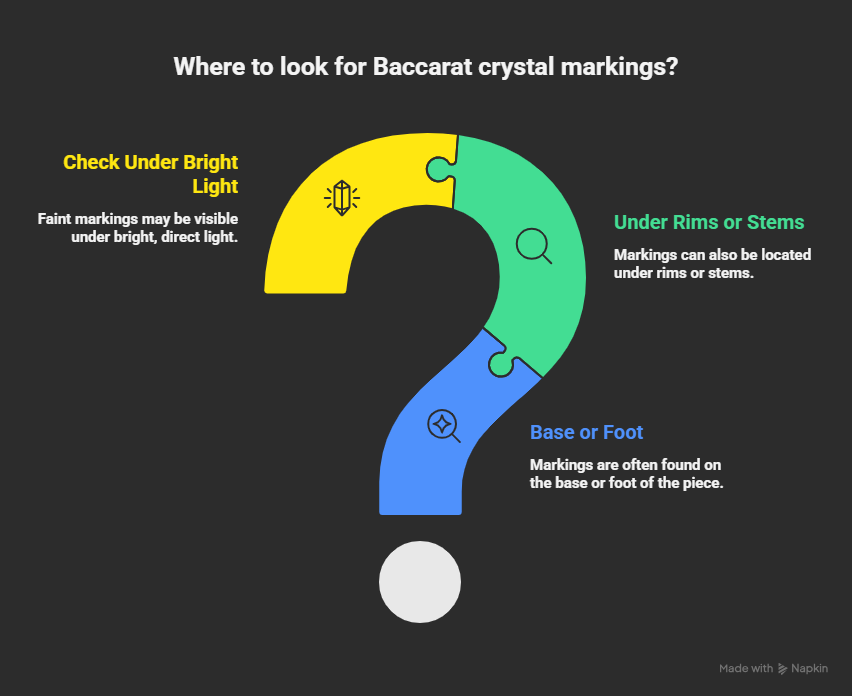
    Base or Foot

    The most common location for acid-etched marks is centered on the flat bottom surface where pieces rest on tables.

    Stemware shows marks on the circular foot bottom, while flat-bottomed vases, bowls, and decanters carry marks on their base centers.

    This placement keeps marks visible for authentication while remaining unobtrusive during display and use.

    Under Bowls or Stems

    Some pieces, particularly those with complex bases or decorative feet, place marks on stem undersides or where bowls meet stems.

    Examine junction points between different structural elements. Tilt pieces and check all potential marking surfaces when base centers show no stamps.

    Unusual base designs sometimes necessitate alternative mark placements.

    Why Marks May Be Worn Away

    While acid-etched marks are permanent and won’t disappear through normal handling, they can become less visible under certain circumstances.

    Extremely aggressive polishing over many decades might lighten marks slightly, though this rarely occurs with proper care.

    More commonly, scratches near marks or poor lighting make detection difficult, rather than actual mark degradation.

    How to Date Baccarat Crystal Using Marks (Step-by-Step)

    A systematic approach combining mark analysis with corroborating evidence produces the most accurate dating results.

    Locate the Mark

    Begin by thoroughly examining all potential marking locations, starting with the base center. Use bright direct lighting and rotate the piece to catch light at various angles.

    Check feet, stems, and bowl undersides if base examination proves unsuccessful.

    Remember that pre-1936 pieces legitimately lack marks entirely, so absence doesn’t always indicate non-Baccarat origin.

    Identify Mark Style

    Once located, carefully assess the mark’s characteristics, including etching depth, clarity, circle precision, and overall consistency.

    Note whether the mark appears faint and shallow (1936-1950s), moderately clear (1960s-1980s), or boldly standardized (1990s-present).

    Compare observed characteristics against known examples from different periods to establish the likely manufacturing era.

    Match to Known Timelines

    Cross-reference your mark’s characteristics against the established Baccarat marking chronology.

    Shallow, faint marks suggest 1936-1950s production, clearer marks indicate 1960s-1980s manufacture, and perfectly consistent marks point to 1990s or later production.

    Complete mark absence combined with authentic characteristics indicates pre-1936 manufacture requiring alternative dating methods.

    Confirm with Pattern & Craftsmanship

    Verify your mark-based dating against pattern style and cutting technique characteristics.

    Art Deco patterns support 1920s-1930s dates, and contemporary designs confirm recent manufacture.

    Hand-cutting precision, crystal clarity, and overall craftsmanship should align with your proposed date.

    The full authentication process combines marks with multiple corroborating factors for confident dating.

    Dating Baccarat Crystal Without Marks

    Many authentic Baccarat pieces, particularly antiques, lack marks entirely and require alternative dating approaches using style and craftsmanship indicators.

    Pattern Identification

    Specific patterns were produced during defined periods, providing strong dating evidence when marks are absent.

    Research when particular designs were introduced, remained in production, or were discontinued.

    Pattern catalogs and museum collections document production timelines.

    Matching your piece’s pattern to documented examples establishes likely manufacturing periods through design attribution.

    Cut Style and Symmetry

    Cutting techniques evolved throughout Baccarat’s history, with Victorian elaborate patterns, Art Deco geometric simplicity, and modern minimalism reflecting different eras.

    Examine cutting density, motif types, and overall aesthetic philosophy. Hand-cutting precision remained consistently excellent, but stylistic approaches changed with artistic movements, providing temporal context for unmarked pieces.

    Weight and Clarity

    While Baccarat maintained high quality throughout its history, subtle material and manufacturing differences exist between eras.

    Extremely heavy pieces with very high lead content often indicate earlier manufacture. Production techniques evolved gradually, affecting crystal characteristics in ways expert examination can detect.

    Material analysis complements pattern and style dating when marks are unavailable.

    Historical Catalogs

    Consult Baccarat’s historical sales catalogs, museum archives, and reference books documenting patterns and production periods.

    Many libraries and online resources provide access to vintage catalog scans.

    Matching your piece’s design to catalog illustrations establishes manufacturing timeframes through documented production evidence, essential for accurately dating unmarked items.

    Common Mistakes When Dating Baccarat Marks

    Avoiding frequent errors improves dating accuracy and prevents misattribution or incorrect chronological placement.

    Assuming All Pieces Are Marked

    Many collectors mistakenly believe all authentic Baccarat carries marks, leading them to dismiss genuinely unmarked antique pieces.

    The entire pre-1936 period produced unmarked items, and even later pieces occasionally lack stamps.

    Don’t automatically assume an unmarked crystal isn’t Baccarat; instead, apply comprehensive authentication methods examining craftsmanship, patterns, and material quality alongside mark presence.

    Confusing Labels with Permanent Marks

    Paper and foil labels provide useful information, but don’t reliably date pieces since they’re easily removed or lost.

    Some collectors assume label presence indicates recent manufacture while absence suggests age, but labels disappear quickly regardless of actual production date.

    Focus on permanent acid-etched marks for dating rather than temporary labels.

    Over-Reliance on One Indicator

    Dating based solely on marks without confirming through pattern styles, cutting techniques, and craftsmanship quality produces unreliable results.

    Counterfeiters can replicate marks, and authentic unmarked pieces exist.

    Always combine mark analysis with multiple authentication factors, including weight, clarity, pattern documentation, and manufacturing details for confident, accurate dating.

    How Mark Dating Affects Baccarat Crystal Value

    Accurately dating pieces through marks and other indicators directly impacts market valuation and collector interest across different factors.

    Antique vs Vintage vs Modern

    Market categorization depends partly on age: antiques (pre-1920s), vintage (1920s-1980s), and modern (1990s-present) command different prices.

    Generally, antique pieces in excellent condition with rare patterns achieve premium pricing. However, age alone doesn’t determine value—some contemporary limited editions exceed common antique values.

    Dating establishes a proper market category, affecting valuation significantly.

    Collector Demand by Era

    Different collector segments prefer specific periods.

    Some specialize in Victorian elaborate patterns, others focus on Art Deco streamlined designs, while contemporary collectors seek current limited editions.

    Accurately dating pieces helps target appropriate collector markets.

    Certain eras, like Art Deco or early Harcourt production, command particular enthusiasm, affecting prices beyond general age considerations.

    Completeness and Condition

    Dating helps assess whether complete sets remain obtainable or whether pieces represent rare survivors from discontinued production.

    Sets from still-produced patterns allow completion, while discontinued era pieces cannot be supplemented.

    Condition expectations also vary by age—minor wear seems acceptable on 19th-century pieces, but reduces modern item values substantially.

    Professional Ways to Confirm Baccarat Dating

    Expert verification provides definitive dating when self-assessment proves insufficient or high-value pieces require documentation.

    Auction Houses

    Major auction houses like Sotheby’s and Christie’s employ crystal specialists who expertly date Baccarat pieces through mark analysis, pattern identification, and manufacturing technique assessment.

    They access comprehensive reference libraries and comparison collections.

    Professional dating documentation from recognized auction houses provides valuable authentication for insurance, estate, and resale purposes.

    Antique Crystal Appraisers

    Certified appraisers specializing in decorative arts and crystal provide professional dating services.

    They examine marks, patterns, craftsmanship, and material properties to establish manufacturing periods.

    Written appraisals document dating conclusions with supporting evidence, offering authoritative authentication.

    Select appraisers with specific Baccarat expertise for the most reliable results.

    Baccarat Brand Archives

    The Baccarat Museum in Paris maintains historical manufacturing records, pattern catalogs, and production documentation.

    Contact them with detailed photographs showing marks, overall design, and construction details.

    While response times vary, archive staff can sometimes provide dating information for unusual pieces or confirm production periods through internal records unavailable elsewhere.

    FAQ — Dating Baccarat Marks

    Can Baccarat marks tell the exact year?

    No. Marks indicate general production periods (pre-1936, 1936-1950s, 1960s-1980s, 1990s-present) but rarely pinpoint exact years.

    Pattern introduction dates and design style sometimes narrow timeframes further when combined with mark characteristics.

    Why do some authentic pieces have no marks?

    Baccarat didn’t systematically mark pieces before 1936. All pre-1936 crystal typically lacks permanent stamps.

    Additionally, some items originally had paper labels that were removed, leaving authentic pieces without any visible identification.

    Do newer Baccarat marks reduce value?

    Not necessarily. While antiques sometimes command premiums, modern limited editions and rare contemporary patterns can exceed older pieces in value.

    Quality, rarity, and demand matter more than age alone for determining market prices.

    Can marks be added or faked?

    Yes. Counterfeiters attempt to replicate Baccarat marks, though fake stamps usually show poor etching quality, incorrect proportions, or improper placement.

    Always verify marks alongside craftsmanship quality, weight, clarity, and pattern authenticity for complete authentication.

    Final Verdict — How Reliable Are Baccarat Marks for Dating?

    Baccarat marks provide valuable dating evidence when properly understood within a historical context and combined with corroborating authentication factors.

    A mark’s presence or absence immediately establishes broad timeframes: unmarked pieces suggest pre-1936 manufacture, shallow, faint marks indicate 1936-1950s production, clearer marks point to 1960s-1980s manufacture, and perfectly standardized marks confirm 1990s or later production.

    However, marks alone don’t tell the complete story—pattern styles, cutting techniques, and craftsmanship quality must align with proposed dates for confident attribution.

    Successfully dating Baccarat crystal requires examining mark characteristics first, then confirming through pattern identification, manufacturing technique assessment, and material property evaluation.

    Avoid common mistakes like dismissing unmarked antiques or over-relying on single indicators without comprehensive verification.

    When uncertainty persists, or high-value pieces require documentation, seek professional authentication through auction houses, certified appraisers, or Baccarat archives.

    The most reliable dating combines mark analysis with pattern documentation and craftsmanship evaluation, creating multiple supporting evidence points that together establish accurate manufacturing periods with confidence.
  • Baccarat Crystal Patterns Identification — How to Recognize Authentic Designs

    Baccarat crystal patterns represent centuries of French craftsmanship, with each design reflecting specific cutting techniques, artistic periods, and manufacturing traditions.

    Identifying these patterns helps authenticate pieces, determine production dates, and assess market value.

    From the bold geometric cuts of Harcourt to the radiating diamonds of Masséna, Baccarat’s signature patterns distinguish authentic pieces from generic cut crystal and competing brands.

    Pattern recognition requires examining cut motifs, density, symmetry, and overall design philosophy that evolved from 19th-century classical styles through Art Deco innovations to contemporary minimalism.

    This comprehensive guide explores how to recognize Baccarat’s most iconic patterns, differentiate them from similar crystal designs, and use pattern identification alongside Baccarat crystal marks for complete authentication and valuation.

    Why Baccarat Crystal Patterns Matter

    Patterns serve as visual signatures that identify Baccarat pieces, influence market value, and reflect the brand’s artistic heritage across different production periods.

    Baccarat Crystal Patterns Identification

    Patterns as Brand Signatures

    Baccarat’s distinctive cutting patterns function like trademarks, instantly recognizable to collectors and experts.

    Each named pattern follows precise specifications passed down through generations of master cutters.

    These designs distinguish Baccarat from generic cut crystal and competing manufacturers, representing the company’s artistic identity and technical excellence.

    Collectibility and Resale Value

    Specific patterns command different prices based on rarity, popularity, and production period.

    Iconic designs like Harcourt retain exceptional value due to their timeless appeal and continuous production since 1841.

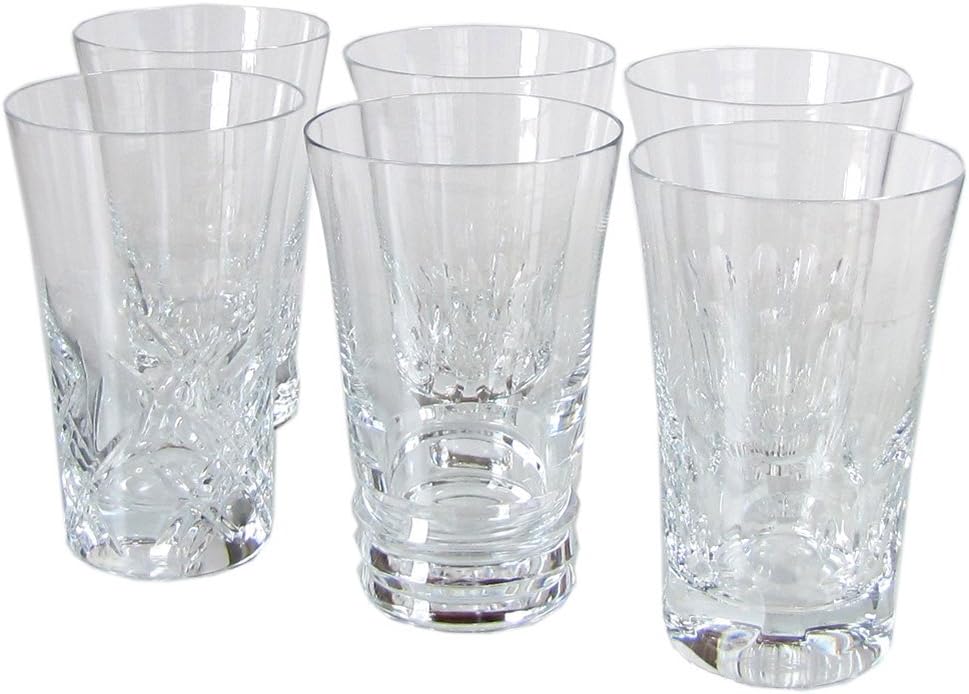
    Baccarat grande everyday highballs crystal glassware

    Limited edition patterns or discontinued designs often appreciate significantly. Pattern identification directly impacts appraisal values and collector interest levels.

    Pattern Consistency Across Forms

    Baccarat maintains pattern integrity whether applied to wine glasses, decanters, vases, or chandeliers.

    This consistency allows collectors to build matching sets and confirms authenticity through design uniformity.

    A pattern’s execution quality should remain identical regardless of piece size or function, demonstrating manufacturing precision.

    How Baccarat Crystal Patterns Are Created

    How Baccarat crystal patterns are created

    Understanding Baccarat’s manufacturing process explains why patterns appear so precise and how craftsmanship distinguishes authentic pieces from imitations.

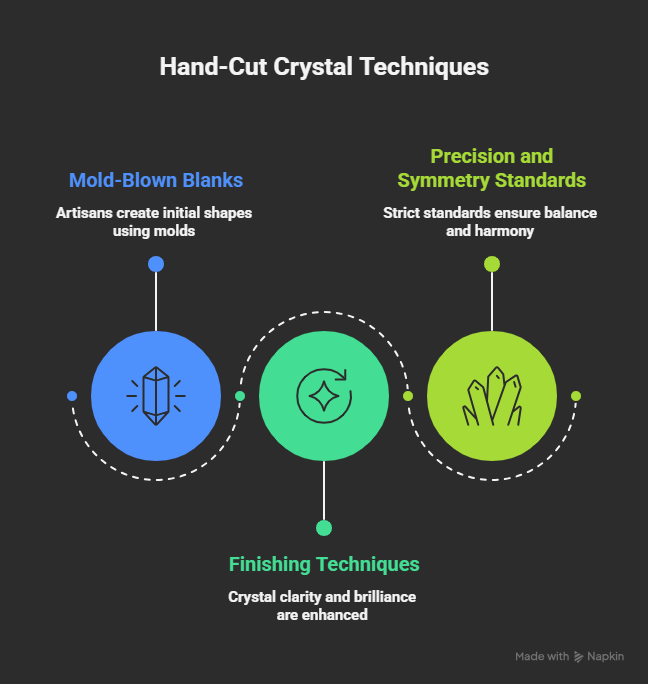
    Hand-Cut Crystal Techniques

    Master cutters use rotating copper wheels with diamond abrasives to carve patterns into finished crystal pieces.

    Each cut requires precise angle control, consistent pressure, and exact depth to match pattern specifications.

    This hand-cutting produces sharp edges, perfect symmetry, and the characteristic brilliance that machine cutting cannot replicate.

    Mold-Blown Blanks and Finishing

    Baccarat creates base forms through mold-blowing molten crystal into preliminary shapes. After cooling, these blanks undergo hand-cutting to add decorative patterns.

    The combination of molded forms and hand-finished patterns ensures consistency while maintaining artisanal quality.

    Final polishing removes any roughness, creating glass-smooth surfaces.

    Precision and Symmetry Standards

    Baccarat’s quality control demands mathematical precision in pattern execution. Cuts must align perfectly around circumferences, with identical depths and angles.

    Any deviation results in rejection. This exacting standard produces the flawless symmetry and pattern repetition that authenticate genuine Baccarat pieces and justify premium pricing.

    Key Visual Elements Used to Identify Baccarat Patterns

    Recognizing specific cutting elements and their arrangements helps identify patterns and distinguish Baccarat from other crystal manufacturers.

    Cut Motifs

    Baccarat employs recurring geometric shapes that define pattern character and visual impact.

    Diamonds

    Diamond cuts create faceted surfaces arranged in crosshatch or radiating patterns. These geometric cuts produce maximum light refraction and sparkle.

    Diamond motifs vary from small, densely packed facets to large, bold diamonds, depending on the specific pattern design.

    Fans

    Fan-shaped cuts radiate outward from central points, creating semicircular or quarter-circle patterns.

    These decorative elements add movement and elegance, often appearing on bowl bases or stem tops. Fans range from simple radiating lines to complex multilayered designs.

    Stars

    Star patterns feature pointed rays extending from central hubs, creating sunburst effects. These cuts often appear on bases or as accent elements within larger patterns.

    Star complexity varies from simple four-point designs to elaborate multi-pointed configurations.

    Panels

    Flat panel cuts create smooth, uncut sections bordered by cut edges. This technique, prominent in Harcourt and Talleyrand patterns, produces architectural boldness and modern aesthetics.

    Panels contrast sharply with densely cut areas, creating dramatic visual effects.

    Pattern Density

    The spacing and depth of cuts significantly impact pattern identification and visual character.

    Deep vs Shallow Cuts

    Deep cuts create dramatic shadows and bold visual impact, characteristic of traditional Baccarat patterns.

    Shallow cuts produce subtle elegance and contemporary aesthetics. Cut depth affects light refraction intensity and pattern visibility.

    Genuine Baccarat maintains consistent depth throughout each pattern element.

    Tight vs Open Spacing

    Tightly spaced cuts cover surfaces densely, maximizing sparkle and complexity. Open spacing emphasizes individual cut elements with more uncut crystal between motifs.

    Spacing consistency indicates authentic Baccarat, while irregular spacing suggests inferior quality or imitation pieces.

    Repetition & Symmetry

    Pattern organization and alignment reveal manufacturing quality and authentication markers.

    Consistency Around the Piece

    Authentic Baccarat patterns repeat identically around the entire circumference without variation or alignment errors.

    Check that diamond cuts, fans, or other motifs match perfectly when rotating the piece. Any irregularity in repetition indicates lower quality production or potential counterfeit.

    Most Popular Baccarat Crystal Patterns

    most popular Baccarat crystal patterns

    These iconic designs represent Baccarat’s most recognized and collected patterns, each with distinctive visual characteristics.

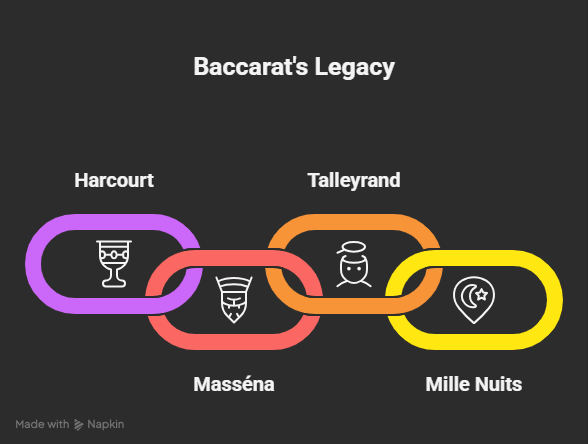
    Harcourt

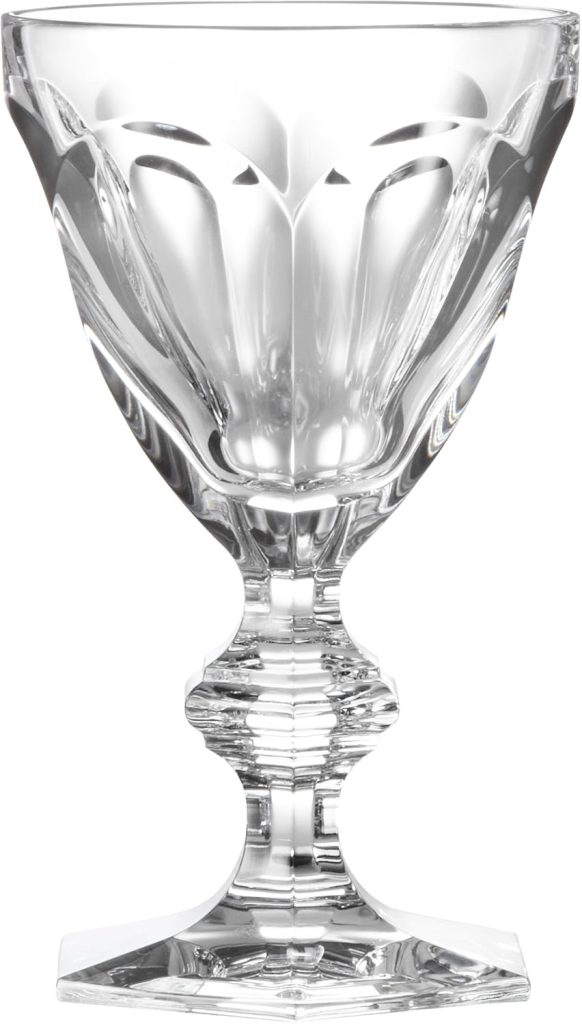
    Baccarat Harcourt Pattern

    First created in 1841, Harcourt remains Baccarat’s most famous pattern, commissioned by King Louis-Philippe for his château.

    Bold Geometry

    Harcourt features flat hexagonal panels alternating with vertical cuts, creating architectural boldness.

    The design emphasizes clean lines and geometric precision over ornate decoration. Large uncut panels showcase crystal clarity while cut sections provide contrasting brilliance.

    Architectural Cuts

    Sharp angles and flat surfaces give Harcourt a modern, structural aesthetic despite its 19th-century origins.

    The pattern’s geometry resembles Art Deco architecture decades before that movement emerged. This timeless quality ensures continued popularity and high collectibility.

    Masséna

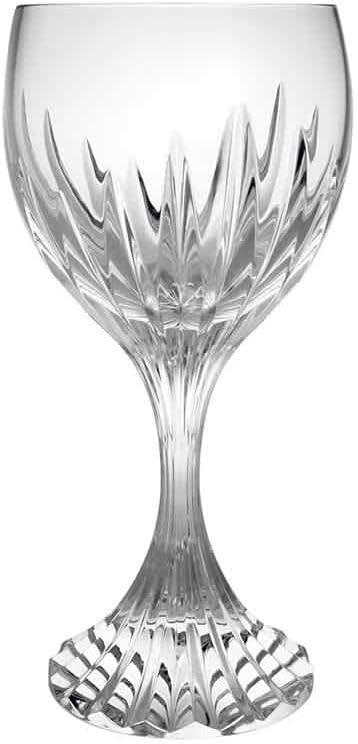
    Baccarat massena glass pattern

    Named after Napoleon’s marshal, Masséna showcases elaborate diamond cutting that maximizes light refraction and sparkle.

    Radiating Diamond Cuts

    Masséna employs densely packed diamond facets radiating from central points, creating complex geometric patterns.

    Multiple layers of diamonds intersect at varying angles, producing exceptional brilliance. This intricate cutting requires exceptional skill and precision.

    Highly Reflective

    The pattern’s dense faceting creates maximum light refraction, making Masséna pieces particularly sparkly and eye-catching.

    Light bounces through multiple diamond surfaces, creating rainbow effects. This reflectivity distinguishes Masséna from simpler cut patterns.

    Talleyrand

    Created in the 1930s, Talleyrand offers a streamlined interpretation of Baccarat’s cutting heritage with vertical emphasis.

    Vertical Panel Cuts

    Talleyrand features tall, narrow panels separated by vertical cuts running from base to rim. This elongated geometry creates elegant, modern proportions.

    The vertical emphasis flatters stemware shapes and adds contemporary sophistication.

    Modern Aesthetic

    Despite vintage origins, Talleyrand’s clean lines and minimal ornamentation feel thoroughly modern.

    The pattern demonstrates Baccarat’s ability to evolve aesthetically while maintaining technical excellence. Its simplicity appeals to contemporary collectors seeking understated elegance.

    Mille Nuits

    Baccarat crystal Mille Nuits

    Designed by Mathias in 2002, Mille Nuits reinterprets traditional cutting with contemporary sensibility and optical innovation.

    Contemporary Reinterpretation

    Mille Nuits combines traditional diamond cutting with modern proportions and placement. The pattern references historical Baccarat designs while feeling distinctly 21st-century.

    This bridge between tradition and innovation attracts both classic and contemporary collectors.

    Optical Distortion

    The pattern’s dense, multilayered cutting creates intentional optical effects, making images viewed through the crystal appear refracted and artistic.

    This visual playfulness distinguishes Mille Nuits from strictly traditional patterns, showcasing Baccarat’s continued innovation.

    How to Identify an Unknown Baccarat Pattern

    Systematic examination and comparison help attribute unmarked or unfamiliar patterns to specific Baccarat designs.

    Count and Map Cut Elements

    Document the types, quantities, and arrangement of cutting elements. Note how many diamond cuts appear per inch, whether fan motifs repeat consistently, and where panels or stars occur.

    Creating a simple sketch helps compare against reference images. This methodical approach reveals pattern structure.

    Examine Base, Bowl, and Stem Separately

    Different sections often feature distinct cutting patterns. Bases frequently display star or fan motifs, bowls show the primary pattern, and stems may have simple cuts or remain plain.

    Analyze each area independently, then consider how they combine into the complete design aesthetic.

    Compare Against Reference Catalogs

    Consult Baccarat pattern books, museum collections, or auction house archives showing named patterns.

    Match your piece’s cutting elements, density, and arrangement to documented examples. Online databases and collector resources provide comparison images.

    For comprehensive authentication, review the Baccarat crystal identification process.

    Cross-Check with Markings

    Verify any Baccarat crystal marks present on the piece to confirm authenticity before attributing patterns.

    Genuine marks combined with recognized pattern elements provide strong authentication.

    However, remember that pre-1936 pieces lack marks despite having authentic patterns.

    Baccarat Pattern Variations by Era

    Pattern styles evolved across Baccarat’s history, reflecting changing artistic movements and consumer preferences.

    19th-Century Classic Patterns

    Early Baccarat favored elaborate, densely cut patterns with complex geometric arrangements.

    Designs emphasized craftsmanship, virtuosity, and ornamental richness appropriate to Victorian tastes.

    Patterns like Masséna and early Harcourt variations showcase this period’s decorative abundance and technical ambition.

    Art Deco-Era Designs

    The 1920s-1930s brought geometric simplification and streamlined aesthetics to Baccarat patterns.

    Designs emphasized bold lines, symmetry, and architectural qualities. Talleyrand exemplifies this era’s modern sensibility while maintaining Baccarat’s quality standards.

    Art Deco patterns balance decoration with restraint.

    Modern Minimalist Patterns

    Contemporary Baccarat incorporates clean lines, strategic cutting placement, and negative space.

    Modern patterns use fewer but more impactful cuts, emphasizing crystal clarity alongside decoration.

    Designs like Mille Nuits demonstrate continued innovation while respecting traditional craftsmanship techniques.

    Baccarat Patterns vs Similar Crystal Patterns

    Understanding distinctions between Baccarat and competing manufacturers helps prevent misattribution and confirms authenticity.

    Baccarat vs Waterford

    Both produce premium cut crystal, but pattern execution and material properties differ noticeably.

    Cut Sharpness

    Baccarat cuts feel exceptionally sharp and precise with glass-smooth polishing. Waterford cuts, while high quality, typically feel slightly less crisp.

    Running fingers over patterns reveals these tactile differences. Baccarat’s superior polishing creates remarkable smoothness despite intricate cutting.

    Weight and Clarity

    Baccarat’s higher lead content produces greater weight and superior clarity compared to Waterford.

    When comparing similar pieces, Baccarat feels noticeably heavier. The crystal clarity appears more water-clear, with superior light refraction.

    These material differences complement pattern distinctions.

    Baccarat vs Val Saint Lambert

    The Belgian crystal manufacturer produces quality cut crystal, but with detectable differences from Baccarat.

    Pattern Depth

    Baccarat maintains more consistent cut depths throughout patterns compared to Val Saint Lambert’s occasionally variable depths.

    Baccarat’s quality control ensures uniform cutting across all pattern elements. Val Saint Lambert pieces sometimes show slight depth variations within the same pattern.

    Symmetry Consistency

    Baccarat’s pattern symmetry proves more mathematically precise than Val Saint Lambert’s generally good but not perfect alignment.

    Examine how patterns meet when rotating pieces. Baccarat shows flawless repetition, while Val Saint Lambert may display minor irregularities detectable upon close inspection.

    Common Mistakes When Identifying Baccarat Patterns

    Avoiding these frequent errors improves identification accuracy and prevents misattribution.

    Confusing Generic Cut Crystal with Baccarat

    Many manufacturers produce diamond-cut crystal resembling Baccarat patterns. Generic cut glass lacks Baccarat’s weight, clarity, and cutting precision.

    Don’t assume any cut crystal with diamonds or fans is Baccarat; examine material quality, weight, and craftsmanship details alongside pattern recognition.

    Relying on Pattern Alone Without Marks

    Patterns help identify pieces, but shouldn’t be the sole authentication factor. Other manufacturers copied popular Baccarat designs.

    Always verify marks when present, assess material properties, and evaluate overall craftsmanship quality.

    Pattern familiarity complements rather than replaces comprehensive authentication.

    Ignoring Craftsmanship Quality

    Focus on execution quality, not just pattern type. Genuine Baccarat demonstrates perfect symmetry, consistent cut depth, and flawless polishing.

    Poor quality cutting, irregular patterns, or rough edges indicate non-Baccarat origin regardless of pattern similarity to authentic designs.

    Using Pattern Identification to Determine Value

    Pattern recognition directly impacts market valuation and collector desirability across different factors.

    Rare vs Common Patterns

    Limited production patterns, discontinued designs, and special commissions command premium prices.

    Harcourt remains valuable due to its iconic status despite continuous production.

    Rare patterns in excellent condition often exceed common patterns regardless of age. Research production history and availability when valuing pieces.

    Pattern Condition and Wear

    Chips, scratches, or worn cutting edges reduce value significantly. Examine cut edges for damage and surfaces for scratches.

    Deep cuts show wear more visibly than shallow designs. Pristine pattern condition maximizes value, while damage substantially decreases worth even for rare patterns.

    Completeness of Sets

    Complete matching sets in single patterns command premium pricing over individual pieces.

    A full Harcourt stemware service holds significantly more value than random mixed pieces.

    Collectors pay substantially more for complete, matching pattern sets versus assembled groupings.

    Tools & Resources for Baccarat Pattern Identification

    Multiple reference sources aid pattern identification and authentication verification.

    Baccarat Archives

    The Baccarat Museum in Paris maintains comprehensive historical records, including pattern catalogs, production dates, and design documentation.

    Contact them with detailed photographs for pattern identification assistance.

    They provide authoritative information for unusual or rare patterns not documented in general references.

    Collector Books and Catalogs

    Reference books like “Baccarat: The Ultimate Collection” document patterns with photographs and production histories.

    Vintage Baccarat catalogs show original marketing materials. These resources provide visual comparisons and contextual information essential for accurate identification.

    Auction House Databases

    Major auction houses publish online archives of sold Baccarat items with pattern attributions and photographs.

    Search Christie’s, Sotheby’s, and regional auction records to find comparable pieces. These databases show market values alongside pattern identifications.

    Expert Appraisers

    Certified appraisers specializing in decorative arts and crystal provide professional pattern identification.

    They access comprehensive reference libraries and comparison collections. Professional authentication offers documentation valuable for insurance, estate planning, or resale purposes.

    FAQ — Baccarat Crystal Pattern Identification

    How many Baccarat crystal patterns exist?

    Baccarat has created hundreds of patterns since 1764, though many are discontinued.

    Approximately 50-75 patterns remain in current production.

    Vintage and antique patterns significantly expand the total number requiring identification expertise.

    Can patterns help date Baccarat crystal?

    Yes. Certain patterns were produced during specific periods, helping date pieces. Art Deco patterns indicate 1920s-1930s production.

    However, popular patterns like Harcourt span decades, requiring additional dating methods beyond the pattern alone.

    Are modern Baccarat patterns less valuable?

    Not necessarily. Limited edition contemporary patterns can be highly valuable. Value depends more on rarity, condition, and demand than age alone.

    Some modern patterns command higher prices than common vintage designs.

    Do all Baccarat patterns have names?

    No. While iconic patterns like Harcourt and Masséna have official names, many patterns, especially older or less prominent designs, lack documented names.

    Collectors sometimes use descriptive terms for unnamed patterns.

    Final Verdict — Identifying Baccarat Crystal Patterns With Confidence

    Successful Baccarat pattern identification requires systematic examination combining multiple verification methods.

    Begin by analyzing key visual elements, document cut motifs like diamonds, fans, stars, or panels present in the pattern.

    Assess pattern density through cut depth and spacing, noting whether designs appear bold or subtle.

    Examine symmetry and repetition quality around the entire piece, confirming mathematical precision that distinguishes authentic Baccarat.

    Compare your findings against reference materials, including collector books, museum archives, and auction databases, to match observed characteristics with documented patterns.

    Cross-reference pattern identification with any marks present, remembering that unmarked pieces require additional authentication through weight, clarity, and craftsmanship evaluation.

    Consider the piece’s era by evaluating whether cutting style reflects 19th-century elaboration, Art Deco streamlining, or contemporary minimalism.

    Avoid common mistakes by not assuming all cut crystal is Baccarat or relying solely on patterns without confirming material quality and manufacturing precision.

    When uncertainty persists, consult professional appraisers or contact Baccarat archives for expert verification, especially for rare or unusual patterns requiring specialized knowledge.

  • Baccarat Crystal Markings — How to Identify Authentic Pieces

    Baccarat crystal markings serve as the primary authentication tool for verifying genuine pieces from the legendary French manufacturer.

    Understanding these marks—from acid-etched logos to paper labels—helps collectors, buyers, and inheritors distinguish authentic Baccarat from counterfeits or unmarked vintage items.

    Markings have evolved significantly throughout Baccarat’s 260-year history, with pre-1936 pieces typically bearing no stamps at all.

    Modern pieces feature consistent acid-etched circular logos, while transitional periods show varying mark styles.

    This guide explores how to locate, read, and interpret Baccarat markings, what to do when pieces lack stamps, and how to spot fraudulent marks that attempt to deceive buyers in the luxury crystal market.

    What Are Baccarat Crystal Markings?

    Baccarat crystal markings

    Baccarat crystal markings are stamps, labels, or etchings that identify a piece as authentic Baccarat manufacture.

    These marks serve as the manufacturer’s signature and primary authentication method for collectors and buyers.

    Purpose of Markings

    Markings authenticate origin, establish production period, and deter counterfeiting.

    They provide immediate verification that a piece meets Baccarat’s quality standards and comes from their French workshops.

    Marks also help date items and confirm genuine provenance for insurance and resale purposes.

    Brand Identification vs Decoration

    Baccarat markings exist solely for authentication, not decoration.

    Unlike decorative engravings or pattern names sometimes added to crystal, the official Baccarat mark appears standardized and understated.

    This functional mark contrasts with ornamental elements that enhance aesthetic appeal rather than prove origin.

    Why Not All Pieces Are Marked

    Baccarat didn’t consistently mark pieces before 1936, leaving many authentic vintage items unmarked.

    Early manufacturing practices didn’t prioritize stamping every piece.

    Additionally, some paper labels used on certain items have been removed over decades of ownership, leaving otherwise genuine pieces without visible identification.

    The Official Baccarat Crystal Mark

    The authentic Baccarat mark appears as a precisely executed acid-etched stamp or temporary label, depending on the piece’s age and type.

    Baccarat Massena modern crystal glass

    Acid-Etched Baccarat Stamp

    The permanent marking method consists of an acid-etched circular logo that cannot be removed through normal use or cleaning.

    This etching creates a subtle but permanent indentation in the crystal surface visible under proper lighting.

    Circular Seal

    The mark forms a complete circle measuring approximately 10-15mm in diameter. The circle’s border maintains consistent thickness throughout, with clean edges that show no irregularities.

    This geometric precision distinguishes authentic marks from poorly executed counterfeits with uneven circles.

    “Baccarat” Text with Glass Icon

    Inside the circle, “BACCARAT” appears in capital letters along the top curve. Below sits a small icon depicting a wine glass and a decanter.

    Both elements display sharp definition and proper proportions, never appearing stretched, compressed, or poorly centered within the circular border.

    Usually on the Base

    The acid-etched mark typically appears centered on the flat base of stemware, vases, bowls, and decorative items.

    On stemmed pieces, check the bottom of the foot. The placement ensures visibility while keeping the mark discreet and not interfering with the piece’s aesthetic presentation.

    Paper Labels and Foil Stickers

    Some Baccarat pieces, particularly newer items or those sold in recent decades, feature paper labels or metallic foil stickers rather than acid etching.

    These temporary marks include “Baccarat” text and sometimes country of origin information.

    Used on Newer Pieces

    Contemporary Baccarat occasionally uses removable labels on certain product lines, especially gift items or smaller accessories.

    These labels complement rather than replace acid-etched marks on premium pieces.

    The label stock features distinctive Baccarat branding elements and quality paper or foil construction.

    Often Removed Over Time

    Paper and foil labels rarely survive years of ownership. Washing, handling, and storage remove these temporary marks, leaving authentic pieces without visible identification.

    The absence of a paper label doesn’t indicate a fake if other authentication factors align with genuine Baccarat characteristics.

    How Baccarat Markings Have Changed Over Time

    Marking practices evolved throughout Baccarat’s history, reflecting changing manufacturing standards and authentication needs across different eras.

    Pre-1936 Baccarat Crystal

    Baccarat pieces manufactured before 1936 generally lack any permanent marking.

    The company didn’t systematically stamp items during this early period, relying instead on quality and reputation for authentication.

    Typically Unmarked

    The absence of stamps on pre-1936 pieces is normal and expected. Many valuable antique Baccarat items show no marking whatsoever.

    Authentication requires evaluating weight, clarity, craftsmanship quality, and design patterns documented in historical catalogs rather than searching for nonexistent stamps.

    Identified by Craftsmanship

    Without marks, authentication depends on material properties and manufacturing details.

    Examine lead content through weight, assess hand-cutting precision, evaluate crystal clarity, and compare designs against known Baccarat patterns.

    Consult the identification guide for Baccarat crystal for comprehensive authentication methods beyond markings.

    1936–1970s Markings

    Baccarat began systematic marking around 1936, though early stamps vary in style and clarity. This transitional period shows evolution toward modern standardized marking practices.

    Early Acid-Etched Stamps

    Initial acid-etched marks appear subtler than modern versions, sometimes showing shallower etching depth.

    The logo style may differ slightly from contemporary marks, with variations in font or icon details. These legitimate early marks might be harder to locate without proper lighting.

    Subtle, Shallow Impressions

    Mid-century Baccarat marks often require careful examination to detect. Hold pieces at angles under bright light to reveal faint etching.

    The subtlety doesn’t indicate inauthenticity; it reflects earlier etching techniques before current standardization. Shallow marks remain permanent despite their delicate appearance.

    Modern Baccarat Markings

    Contemporary Baccarat pieces feature highly consistent, clearly visible acid-etched marks following strict quality standards established in recent decades.

    Clear, Consistent Etching

    Modern stamps show uniform depth, sharp definition, and perfect circle geometry. Current manufacturing produces marks easily visible without special lighting or angles.

    The etching quality matches Baccarat’s overall craftsmanship standards, reflecting precision in both product and authentication mark.

    Standardized Logo Placement

    Recent pieces position the mark consistently on the base center. Standardization ensures buyers can quickly locate and verify authenticity.

    This predictable placement contrasts with earlier periods when mark location varied more freely across different product types and manufacturing periods.

    Where to Find Baccarat Crystal Markings

    where to find Baccarat crystal markings

    Mark location varies by piece type, but several standard positions apply across most Baccarat items.

    Base or Foot of the Piece

    The most common location is the flat bottom surface where the piece rests. On footed stemware like wine glasses, check the underside of the circular foot.

    On flat-bottomed vases, bowls, or decanters, look at the center of the base where the piece sits on surfaces.

    Under Rims or Stems

    Some pieces, particularly those with complex bases or decorative feet, place marks on stem undersides or beneath rims where bases meet bodies.

    Tilt pieces and examine junction points between different structural elements where marks might hide from casual observation.

    Why Markings Can Be Faint

    Acid etching creates subtle impressions that may appear faint under certain lighting conditions.

    Angle pieces under bright direct light to reveal marks. Additionally, years of handling, washing, and polishing can make marks less immediately obvious, though they never completely disappear on authentically etched pieces.

    How to Read and Interpret Baccarat Markings

    Understanding mark components helps verify authenticity and date pieces more accurately.

    Logo Elements Explained

    The complete mark includes three components: the circular border, “BACCARAT” text, and the glass icon showing stemware and a decanter.

    All three elements must appear correctly proportioned and positioned. The text curves along the upper half of the circle, while the icon sits below the center.

    Size and Clarity Indicators

    Authentic marks measure 10-15mm in diameter with consistent proportions regardless of piece size.

    Etching depth remains uniform throughout the mark without fade or variation.

    Exceptionally large or small marks, relative to standard dimensions, suggest counterfeits that attempt to replicate without precise specifications.

    Differences Between Marks and Labels

    Acid-etched marks feel slightly recessed when touched and cannot be removed. Paper or foil labels sit on the surface, feeling raised or smooth, and peel away easily.

    Labels often include additional information like “Made in France,” while acid marks show only the circular logo design.

    What If Your Baccarat Crystal Has No Mark?

    Missing marks don’t automatically indicate fakes, especially on older pieces or those that originally had removable labels.

    Older Authentic Pieces

    Pre-1936 Baccarat legitimately lacks stamps. Many valuable antique items show no marking whatsoever.

    Age doesn’t diminish authenticity or value when other authentication factors confirm genuine manufacture.

    Historical documentation, design patterns, and material properties provide alternative verification when marks are absent.

    Wear from Polishing and Washing

    While acid-etched marks don’t disappear entirely, extremely aggressive polishing over decades might lighten them.

    However, this is rare; proper hand washing shouldn’t affect mark visibility. If you suspect wear has obscured a mark, examine under various lighting angles and consider professional authentication.

    Loss of Paper Labels

    Many authentic Baccarat pieces originally sold with paper or foil labels that owners removed during the first washing or over time.

    The label’s absence leaves no trace of identification despite a genuine origin.

    When evaluating unmarked pieces with other authentic characteristics, consider that temporary labels may have existed.

    How to Tell Real Baccarat Markings From Fake Ones

    Counterfeiters attempt to replicate Baccarat marks, but several telltale signs reveal fraudulent stamps.

    Etching Depth and Precision

    Authentic acid etching shows consistent depth throughout the mark with clean edges.

    Fakes often display uneven etching with some areas deeper than others, or edges that appear fuzzy rather than sharp.

    Run your finger over the mark, genuine etching feels uniformly recessed.

    Font Inconsistencies

    Examine letter spacing, proportions, and style carefully. Counterfeit marks frequently show incorrect fonts with letters too wide, narrow, or irregularly spaced.

    Compare questionable marks against verified Baccarat images, noting any differences in letter formation or the glass icon’s details.

    Placement Errors

    Fake marks sometimes appear off-center or in unusual locations where Baccarat wouldn’t place stamps.

    Authentic marks occupy predictable positions on bases or standard marking locations.

    Marks on sides, rims, or other non-traditional spots warrant suspicion and further authentication.

    Comparison with Known Originals

    Cross-reference your mark against authenticated Baccarat pieces or high-quality reference photographs.

    Discrepancies in circle size, text positioning, icon details, or overall mark quality indicate counterfeits.

    The Baccarat crystal patterns authentication guide provides detailed comparisons for verification purposes.

    Baccarat Crystal Markings vs Other Crystal Brands

    Understanding how different luxury crystal manufacturers mark their pieces aids in proper attribution and comparison.

    Baccarat vs Waterford Marks

    Waterford uses a different marking approach than Baccarat, helping distinguish between these premium crystal producers.

    Etched vs Stamped Styles

    Waterford traditionally employed a seahorse logo stamped or etched on pieces, distinctly different from Baccarat’s circular text mark.

    Recent Waterford items use acid-etched cursive “Waterford” script. The marking styles differ sufficiently that confusion between brands through marks alone is unlikely.

    Baccarat vs Lalique Marks

    Lalique, another French luxury crystal maker, marks pieces differently, reflecting their distinct design philosophies and manufacturing approaches.

    Clear vs Frosted Branding

    Lalique often incorporates its signature into frosted or molded designs, integrating the mark artistically into the piece.

    Baccarat maintains subtle, functional stamps on clear crystal bases. Lalique’s “R. LALIQUE” or “LALIQUE FRANCE” appears engraved or molded, contrasting with Baccarat’s understated circular acid-etched logo.

    Do Baccarat Markings Affect Value?

    The presence, absence, or condition of markings influences market value and collector preferences, though other factors matter equally or more.

    Marked vs Unmarked Pieces

    Marked pieces generally command higher prices due to immediate authentication confidence. Buyers prefer marked items requiring less expertise to verify.

    However, unmarked pre-1936 pieces with confirmed authenticity retain full value when properly authenticated through craftsmanship, design documentation, and material properties.

    Age, Rarity, and Demand

    Rarity and desirability often outweigh marking presence. A rare pattern in excellent condition holds more value than common marked pieces.

    Limited editions, discontinued designs, and historically significant items command premiums regardless of marking status.

    Age alone doesn’t determine value—condition and pattern scarcity matter more.

    Collector Preferences

    Serious collectors value authenticity over marks, understanding that many genuine antiques lack stamps.

    Beginning collectors and casual buyers prefer marked pieces for confidence. Investment-focused collectors research thoroughly regardless of marks, while decorative buyers might choose pieces based on appearance rather than authentication details.

    How to Verify Baccarat Markings Professionally

    When self-assessment proves inconclusive, professional authentication provides definitive verification and documentation.

    Antique Dealers

    Specialized dealers in fine crystal and decorative arts can evaluate Baccarat markings alongside other authentication factors.

    They maintain reference libraries and comparison pieces for verification. Reputable dealers provide written authentications useful for insurance documentation and resale purposes.

    Auction Houses

    Major auction houses like Sotheby’s and Christie’s employ crystal specialists who authenticate pieces for consignment consideration.

    Even without selling, these experts offer evaluation services. Regional auction houses with decorative arts departments provide more accessible authentication options for owners seeking professional verification.

    Baccarat Brand Archives

    The Baccarat Museum in Paris maintains historical manufacturing records and can assist with authentication inquiries.

    Contact them with detailed photographs showing marks and overall piece characteristics.

    They occasionally provide dating information and pattern identification, particularly for unusual or rare items requiring specialized knowledge.

    FAQ — Baccarat Crystal Markings

    Does all Baccarat crystals have a marking?

    No. Pre-1936 pieces typically have no marks. Some items originally had paper labels that owners removed.

    Unmarked pieces require authentication through weight, clarity, craftsmanship, and design pattern verification.

    Can Baccarat markings fade or disappear?

    Acid-etched marks are permanent and won’t disappear through normal use. They may appear faint under poor lighting but remain visible when properly illuminated. Paper labels can fall off, leaving no trace.

    Are paper labels enough to prove authenticity?

    Labels alone aren’t definitive proof since they’re easily counterfeited and applied to non-Baccarat pieces.

    Verify material quality, weight, and craftsmanship alongside any labels. Authentic pieces show excellence beyond just having labels.

    Are newer Baccarat pieces more clearly marked?

    Yes. Modern Baccarat uses standardized, clearly visible acid-etched marks with consistent depth and placement.

    Older pieces show subtler, more varied marking styles, while pre-1936 items typically lack marks entirely.

    Final Verdict — Using Markings to Confirm Baccarat Crystal

    Baccarat markings provide valuable authentication evidence when present and genuine, but their absence doesn’t automatically indicate fakes.

    Begin by thoroughly examining the base and other standard locations for the circular acid-etched logo containing “BACCARAT” text and glass icon.

    Verify the mark shows proper etching depth, precise circle geometry, correct font style, and appropriate placement.

    Remember that pre-1936 pieces legitimately lack stamps, and paper labels may have disappeared from otherwise authentic items.

    When evaluating marks, check for counterfeiting signs, including poor etching quality, font inconsistencies, or unusual placement.

    Compare questionable marks against verified examples. For unmarked pieces, authenticate through weight, clarity, craftsmanship, precision, and design pattern documentation.

    Marked pieces offer authentication confidence, but don’t dismiss unmarked items with strong supporting characteristics.

    Consider professional authentication when uncertainty persists or for high-value pieces.

    Ultimately, combine marking evaluation with a comprehensive assessment of material properties and manufacturing quality for complete authentication confidence.

  • How to Identify Baccarat Crystal — Authenticity, Marks & Expert Tips

    Baccarat crystal represents centuries of French craftsmanship and luxury, making authentic pieces highly sought after by collectors and enthusiasts.

    However, distinguishing genuine Baccarat from imitations requires knowledge of specific markings, physical characteristics, and manufacturing details.

    Whether you’ve inherited a crystal piece, found one at an estate sale, or are considering a purchase, knowing how to identify authentic Baccarat crystal protects you from counterfeits and ensures you understand the true value of what you own.

    This guide walks you through the essential markers of authenticity, from signature stamps to craftsmanship details that separate genuine Baccarat from ordinary glass.

    What Is Baccarat Crystal?

    Baccarat crystal is luxury glassware produced by the Baccarat company in France, renowned for exceptional clarity, weight, and artistry.

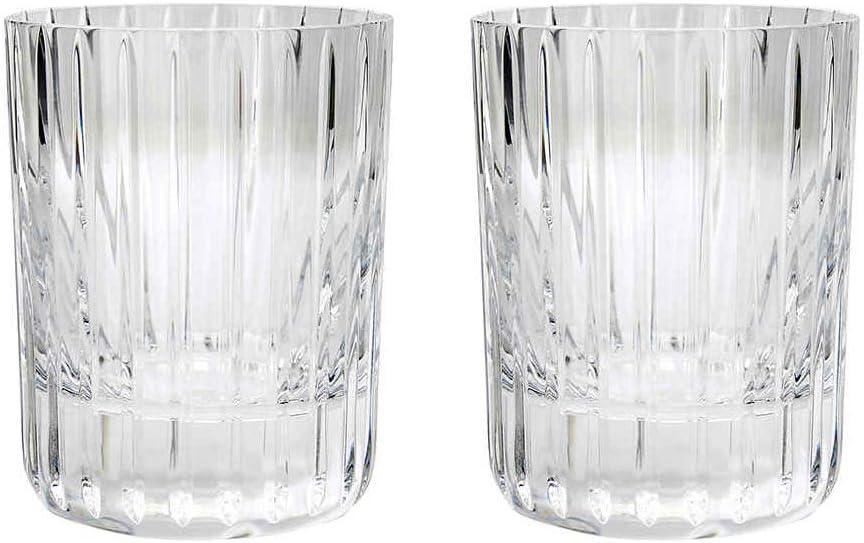
    Baccarat Crystal Tumbler

    The brand has maintained its reputation through centuries of meticulous craftsmanship and innovative designs.

    History of Baccarat (France)

    Founded in 1764 in the Lorraine region of France, Baccarat began as a glass workshop commissioned by King Louis XV.

    The company gained international recognition in the 19th century, winning gold medals at major exhibitions and becoming the official supplier of crystal to royalty worldwide.

    Luxury Crystal Manufacturing

    Baccarat employs traditional methods, including hand-blowing, hand-cutting, and polishing by master craftsmen.

    Each piece undergoes rigorous quality control, with only flawless items receiving the Baccarat mark.

    The manufacturing process combines molten crystal with precise lead oxide formulations for superior brilliance.

    Why Baccarat Is Highly Collectible

    Rarity, historical significance, and unmatched quality drive Baccarat’s collectibility.

    Limited edition pieces, discontinued patterns, and items commissioned for royalty command premium prices.

    The brand’s consistent excellence over 260 years ensures lasting value and desirability among serious collectors.

    Why Identifying Authentic Baccarat Crystal Matters

    Knowing how to properly identify Baccarat crystal protects your investment and ensures you understand what you own.

    The difference between authentic and fake pieces carries significant financial and historical implications.

    Market Value Differences

    Authentic Baccarat pieces can be worth hundreds to thousands of dollars, while imitations sell for minimal amounts.

    A genuine Harcourt glass retails for over $400, whereas similar-looking replicas cost under $50. Proper identification directly impacts resale potential and insurance valuation.

    Inheritance & Resale Concerns

    Family heirlooms require authentication before sale or appraisal. Many people discover they own valuable Baccarat collections without realizing it, particularly with older, unmarked pieces.

    Confirming authenticity helps you make informed decisions about keeping, selling, or insuring inherited crystal.

    Avoiding Counterfeit Crystal

    The luxury crystal market attracts counterfeiters who replicate Baccarat markings and designs.

    Fake stamps, poor etching, and cheap materials deceive uninformed buyers.

    Understanding authentication markers helps you avoid purchasing fraudulent pieces marketed as genuine Baccarat.

    Baccarat Crystal Marks and Stamps

    how to identify Baccarat crystal

    Official markings provide the most straightforward method to confirm brand authenticity, though not all genuine pieces bear stamps.

    Acid-Etched Baccarat Logo

    Modern Baccarat pieces feature an acid-etched circular logo on the base. The mark includes “Baccarat” text with a small wine glass and decanter icon underneath.

    This stamp appears crisp and precise, never fuzzy or uneven, and is typically located centered on the bottom.

    Circular Stamp

    The circular design measures roughly 10-15mm in diameter with clean borders.

    Authentic stamps show consistent depth and clarity throughout the etching.

    Counterfeits often display irregularities in the circle’s shape or thickness.

    “Baccarat” Text and Glass Icon

    The word “Baccarat” curves along the top of the circle in capital letters. Below sits the distinctive glass decanter and goblet symbol.

    Both elements maintain sharp definition without blur or incomplete etching.

    Placement on Base

    Look for the mark centered on the flat bottom of stemware, vases, or decorative items. It should be easily visible without turning the piece.

    Some larger items may have the stamp on the underside edge rather than the flat center.

    Older Baccarat Pieces (Pre-1936)

    Baccarat did not consistently mark pieces before 1936, meaning many genuine antique items lack any stamp.

    These pieces require identification through craftsmanship quality, weight, design patterns, and provenance documentation.

    Consult the full crystal patterning guide when evaluating an unmarked crystal.

    No Marks

    The absence of a mark doesn’t indicate a fake if the piece dates to the early 20th century or earlier.

    Paper labels were occasionally used but rarely survived. Authentication relies on material properties and expert evaluation.

    Identification Through Craftsmanship

    Examine cut precision, weight, clarity, and design complexity.

    Genuine unmarked Baccarat exhibits superior craftsmanship, matching known patterns from the era. Cross-reference with

    Baccarat catalogs or museum collections to identify specific designs and production periods.

    Physical Characteristics of Baccarat Crystal

    physical characteristics of Baccarat crystal

    Material properties distinguish authentic Baccarat from ordinary glass and inferior crystal. These tangible qualities remain consistent across all genuine pieces.

    Weight and Density

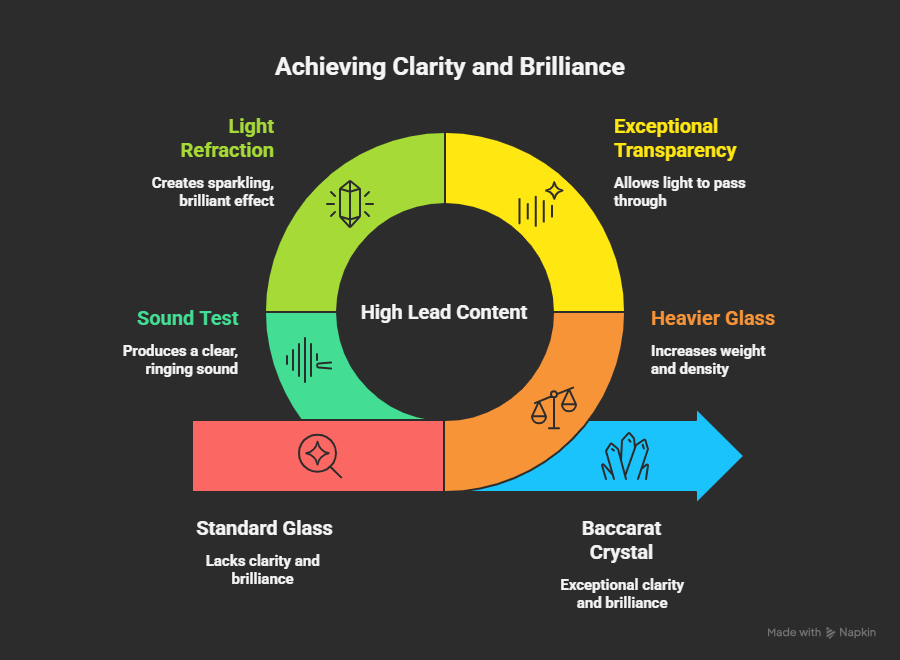
    Baccarat crystal feels substantially heavier than a standard glass of equivalent size due to high lead oxide content (typically 24-30%).

    A small wine glass weighs noticeably more than expected, while larger pieces require firm handling. This density contributes to durability and light refraction quality.

    Heavier Than Standard Glass

    Compare similar-sized items if possible. Authentic Baccarat feels solid in hand, never lightweight or hollow. Even thin-walled pieces carry surprising weight.

    High Lead Content

    The lead oxide formula creates the crystal’s characteristic heft, brilliance, and clarity.

    This traditional composition distinguishes true crystal from modern lead-free alternatives, which feel lighter despite a similar appearance.

    Clarity and Brilliance

    Genuine Baccarat exhibits flawless transparency without bubbles, cloudiness, or color tints. The crystal appears water-clear with exceptional light transmission.

    Hold pieces up to natural light to assess clarity—authentic Baccarat shows no internal imperfections.

    Exceptional Transparency

    The glass should be completely clear without streaks, waves, or distortions. Any cloudiness indicates lower-quality material.

    Baccarat’s manufacturing standards eliminate impurities that create haziness.

    Light Refraction

    When light passes through Baccarat crystal, it refracts dramatically, creating a rainbow-like sparkle and brilliant reflections.

    This optical quality surpasses regular glass and most other crystal brands, particularly visible in cut patterns.

    Sound Test

    Gently tap the rim or side with your fingernail or a pencil. Authentic Baccarat produces a clear, sustained bell-like ring that resonates for several seconds.

    Regular glass creates a dull thud or brief clink without resonance.

    Craftsmanship Details That Signal Authenticity

    Manufacturing quality reveals authenticity through details only master craftsmen achieve consistently.

    Hand-Cut Precision

    Baccarat’s hand-cutting creates perfectly aligned patterns with uniform depth. Each facet meets others at exact angles without deviation.

    Machine-cut imitations show slight misalignments or varying depths. Examine patterns under bright light for consistency.

    Sharp, Clean Edges

    All cuts and edges feel crisp and smooth without roughness or chips.

    Run your finger along the edges. Authentic Baccarat pieces are meticulously polished after cutting.

    Rough spots indicate poor quality control or inferior materials.

    Symmetry and Polish Quality

    Patterns mirror perfectly across centerlines with mathematical precision.

    The polishing creates glass-like smoothness on all surfaces without dull spots or uneven texture.

    This attention to detail extends to bases, rims, and decorative elements.

    How to Tell Baccarat Crystal From Regular Glass

    Several key differences separate crystal from standard glass, helping you distinguish premium pieces from ordinary glassware.

    Thickness vs Weight

    Baccarat crystal walls can be surprisingly thin while maintaining substantial weight. Regular heavy glass achieves weight through thickness.

    If a piece feels thick-walled and heavy, it’s likely glass rather than crystal.

    Mold Lines Absence

    Authentic Baccarat shows no visible seam lines from molds. The hand-finishing process removes all traces of manufacturing joins.

    Run your fingers around the piece; any raised seam indicates machine production and suggests a non-Baccarat origin.

    Optical Distortion Check

    Look through the crystal at straight lines or text. Baccarat’s optical quality transmits images clearly without warping.

    Regular glass often distorts or slightly bends images viewed through it due to impurities and a lower refractive index.

    Baccarat Crystal vs Other Luxury Crystal Brands

    Understanding distinctions between premium crystal manufacturers helps identify specific makers and appreciate different styles.

    Baccarat vs Waterford

    Irish Waterford crystal features intricate, deeply cut patterns with a distinctive crosshatch diamond design.

    Waterford pieces typically feel slightly lighter than Baccarat and emphasize elaborate cutting over sleek minimalism. Both produce hand-cut crystal, but design philosophies differ significantly.

    Cut Style Differences

    Waterford favors complex, ornate patterns covering entire surfaces. Baccarat often employs cleaner lines with strategic cutting that emphasizes crystal clarity.

    Baccarat’s Harcourt pattern uses flat panel cuts, while Waterford prefers deep crosshatching.

    Weight and Sparkle

    Baccarat generally weighs more due to higher lead content and thicker bases. Waterford’s sparkle comes from dense cutting patterns, while Baccarat achieves brilliance through crystal quality and selective cutting placement.

    Baccarat vs Lalique

    Lalique, another French luxury brand, specializes in frosted, sculptural crystal with artistic designs. Baccarat focuses on clear, brilliant crystal.

    Lalique pieces often feature molded relief patterns and satin finishes, making them easily distinguishable from Baccarat’s transparent aesthetic.

    Frosted vs Clear Crystal

    Lalique’s signature is matte frosted surfaces with polished highlights. Baccarat maintains crystal clarity and brilliance throughout most pieces.

    Lalique emphasizes texture and form; Baccarat prioritizes transparency and light play.

    Design Philosophy

    Lalique follows Art Nouveau and Art Deco traditions with nature motifs and sculptural elements.

    Baccarat emphasizes classical elegance, geometric precision, and timeless patterns that showcase the crystal itself rather than decorative overlays.

    Is Baccarat Crystal Lead Crystal?

    Understanding Baccarat’s material composition addresses safety concerns and explains the crystal’s exceptional properties.

    Lead Oxide Content

    Baccarat crystal contains 24-30% lead oxide, classifying it as full lead crystal.

    This high percentage creates the weight, clarity, and refractive qualities that define luxury crystal.

    The lead content has remained consistent throughout Baccarat’s history.

    Traditional Crystal Formulation

    The formula combines silica, potash, and lead oxide, heated to extreme temperatures.

    This composition has been perfected over centuries to achieve optimal brilliance and workability.

    Lead crystal remains the gold standard for luxury glassware despite modern lead-free alternatives.

    Food and Drink Use Considerations

    Lead crystal is safe for occasional use with food and beverages.

    However, avoid storing acidic liquids (wine, juice) in lead crystal decanters for extended periods, as acid can leach trace amounts of lead. Regular drinking and serving poses no health risk.

    Common Signs of Fake or Imitation Baccarat Crystal

    common signs of fake Baccarat Crystal

    Counterfeiters attempt to replicate Baccarat markings and designs, but several telltale signs reveal fraudulent pieces.

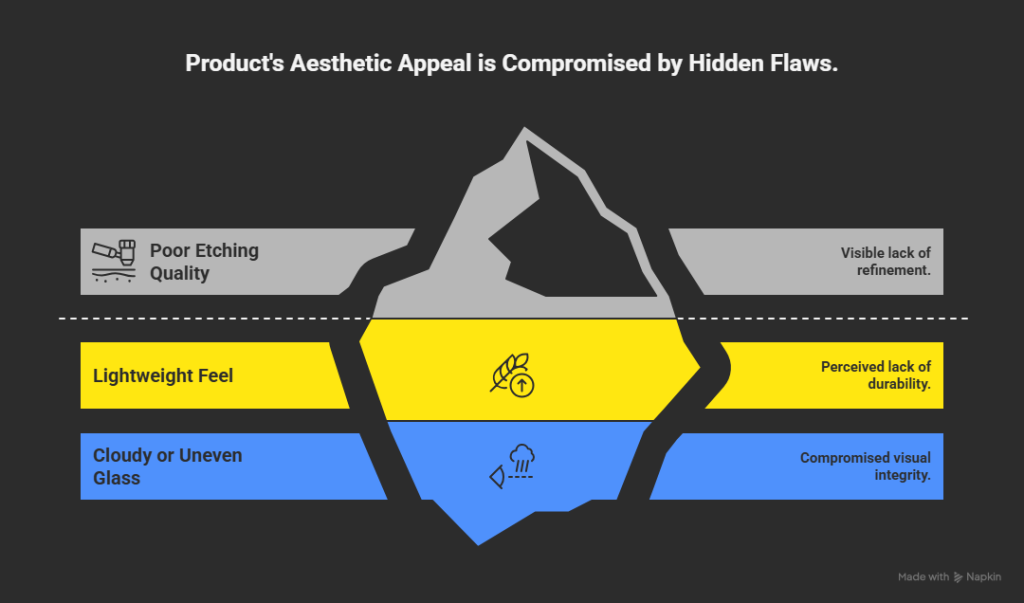
    Poor Etching Quality

    Fake stamps appear blurry, uneven, or incorrectly proportioned. The text may be poorly centered, and the glass icon lacks detail.

    Authentic acid etching shows crisp, clean lines with consistent depth throughout the mark.

    Lightweight Feel

    Imitations using regular glass or low-lead crystal feel noticeably lighter than genuine Baccarat. If a piece seems too light for its size, it’s likely not authentic crystal.

    Weight remains the easiest physical characteristic to assess.

    Cloudy or Uneven Glass

    Genuine Baccarat never appears cloudy, streaked, or tinted. Any haziness, bubbles, or color variation indicates inferior materials.

    Counterfeits often use cheaper glass that can’t match Baccarat’s flawless clarity and transparency.

    How to Verify Baccarat Crystal Professionally

    When self-assessment leaves doubt, professional authentication provides definitive answers and documentation.

    Appraisers and Antique Dealers

    Certified appraisers specializing in decorative arts can authenticate Baccarat pieces.

    They evaluate markings, craftsmanship, and design against known examples.

    Appraisals cost $100-300 but provide written documentation valuable for insurance and resale purposes.

    Baccarat Archives

    The Baccarat Museum in Paris maintains historical records and can authenticate pieces through design matching.

    Contact them with detailed photographs for preliminary assessment. They occasionally assist with dating and pattern identification, particularly for rare or unusual items.

    Auction House Authentication

    Major auction houses like Sotheby’s and Christie’s employ crystal experts who authenticate items for consignment.

    Even if not selling, their specialists provide expert opinions.

    Regional auction houses with decorative arts departments offer more accessible authentication services.

    Caring for Authentic Baccarat Crystal

    Proper maintenance preserves brilliance and prevents damage that diminishes value and beauty.

    Hand Washing Only

    Never put Baccarat crystal in dishwashers. Hand wash with mild soap and warm water, using a soft cloth or sponge.

    Rinse thoroughly and dry immediately with a lint-free towel to prevent water spots. Support bases and stems carefully during washing.

    Avoiding Thermal Shock

    Never expose the crystal to extreme temperature changes. Allow refrigerated items to reach room temperature before washing.

    Avoid pouring hot liquids into cold crystal or vice versa, as thermal shock can cause cracking or shattering.

    Storage Tips for Longevity

    Store pieces separately to prevent scratching and chipping. Use a soft cloth between stacked items or keep them in their original boxes.

    Avoid cabinets with wire racks that can scratch bases. Display the crystal away from direct sunlight, which can highlight imperfections over time.

    FAQ — Identifying Baccarat Crystal

    Do all Baccarat crystal have a mark?

    No. Pieces made before 1936 typically have no mark, and paper labels on some vintage items have disappeared.

    Unmarked pieces require authentication through weight, clarity, craftsmanship, and design pattern matching.

    Can Baccarat crystal lose its stamp?

    The acid-etched mark is permanent and cannot wear off under normal use. If a stamp appears faded or removable, it’s likely a fake paper label or poorly executed counterfeit marking rather than genuine acid etching.

    Is Baccarat crystal always leaded?

    Yes. All Baccarat crystal contains 24-30% lead oxide, which creates its characteristic weight, brilliance, and clarity.

    This traditional formulation has remained consistent throughout the company’s history and defines luxury crystal.

    How old does Crystal need to be to be valuable?

    Age alone doesn’t determine value—rarity, condition, and pattern matter more.

    Some modern limited editions are worth more than common vintage pieces.

    Generally, pre-1950 Baccarat items in excellent condition command premium prices among collectors.

    Final Verdict — How to Confidently Identify Baccarat Crystal

    Authenticating Baccarat crystal requires a systematic approach combining multiple verification methods.

    Start by checking for the acid-etched circular stamp with “Baccarat” text and glass icon—this immediately confirms pieces made after 1936.

    For unmarked items, assess physical characteristics: substantial weight, perfect clarity, and a bell-like ring when tapped indicate genuine crystal.

    Examine craftsmanship through hand-cut precision, sharp, polished edges, and flawless symmetry.

    Compare against known counterfeits by evaluating etching quality, weight, and glass clarity.

    When uncertainty persists, seek professional authentication through certified appraisers or experts from auction houses.

    Remember that older pieces legitimately lack markings, requiring pattern identification and material assessment.

    By methodically checking marks, weight, sound, clarity, and craftsmanship details, you’ll develop confidence in distinguishing authentic Baccarat from imitations, protecting your investment, and appreciating the true artistry behind each piece.

  • Crystal Glass Patterns Identification: A Complete Guide

    Ever held a beautiful crystal piece and wondered, “What pattern is this?” You’re not alone.

    Whether you’ve inherited your grandmother’s crystal collection, stumbled upon a stunning bowl at an estate sale, or you’re building your own collection, identifying crystal patterns can feel overwhelming.

    Those intricate cuts, swirls, and designs may all appear similar at first glance, but each tells a unique story about its maker, the era in which it was created, and its value.

    The good news? With the right knowledge, you can become confident in identifying crystal patterns, distinguishing quality pieces from imitations, and even spotting rare finds.

    In this guide, we’ll walk through everything from understanding crystal versus glass, recognizing famous patterns, identifying manufacturers, and mastering the art of pattern authentication, all in plain, practical language.

    Crystal vs. Glass: Understanding the Basics

    Before diving into patterns, let’s clear up the confusion between crystal and glass. This matters because authentic crystal holds both monetary and collectible value that regular glass simply doesn’t match.

    How to Tell Crystal from Glass Bowl

    Pick up the piece and feel its weight. The crystal is noticeably heavier than glass due to lead or other mineral content.

    Now, gently tap the rim with your fingernail. Crystal produces a clear, sustained ringing tone that can last several seconds, while glass makes a dull thud.

    Hold it up to light and notice how crystal refracts light into rainbow prisms, creating that signature sparkle.

    Lead free crystal wine glass

    The surface of the crystal also feels cooler to the touch and stays cool longer than glass.

    Finally, examine any cuts or engravings. Crystal accepts deeper, sharper cuts with cleaner edges because it’s softer than regular glass.

    Practical Application: Next time you’re at an antique shop, do the “tap test” on similar-looking pieces.

    You’ll immediately hear and feel the difference, helping you avoid overpaying for glass masquerading as crystal.

    How to Tell Lead Crystal from Cut Glass

    Here’s where it gets tricky: Lead crystal is a specific type of crystal containing at least 24% lead oxide, which gives it exceptional brilliance and weight.

    Full lead crystal (30%+ lead content) feels substantially heavier than regular cut glass.

    When you tap it, lead crystal produces a longer, more melodious ring compared to non-lead crystal. Lead crystal also has higher refractive brilliance, throwing more “fire” and rainbow colours.

    Because lead makes the material softer, cuts on lead crystal have smoother edges rather than the sharper, sometimes slightly rough edges on regular cut glass.

    Understanding lead content matters for dating pieces, too. Most modern crystal contains less lead due to health regulations, while vintage pieces (pre-1990s) often contain higher percentages.

    How to Identify Cut Glass Crystal

    Genuine cut glass crystal shows specific characteristics. Run your finger along the cuts—hand-cut crystal has sharp, precise edges with slight variations that prove human craftsmanship, while machine-cut pieces feel more uniform but can still be quality items.

    Examine the depth of cuts; quality crystal features deep cutting (sometimes 1/4 inch or more) that creates dramatic light refraction.

    Look at the bottom for a polished pontil mark or rough pontil scar where the piece was separated from the glassblower’s rod.

    The overall weight should feel substantial, and the clarity should be exceptional no bubbles, swirls, or cloudiness in quality crystal.

    Practical Application: When examining a piece, use a magnifying glass to check cut precision. Slight irregularities in hand-cut pieces actually increase value and authenticity.

    Understanding Crystal Glass Pattern Types

    Crystal glass patterns identification

    Crystal patterns fall into distinct categories, each created through different techniques. Recognizing these types is your first step toward accurate identification.

    Cut Glass Patterns

    Cut glass patterns are created by grinding designs into the crystal surface using stone or diamond wheels.

    Hand-cut patterns show slight variations in depth and spacing. This irregularity is actually desirable and indicates quality craftsmanship.

    Common motifs include diamond point (small pyramidal cuts creating diamond shapes), crosshatch (intersecting lines forming diamonds), and hobstar (pinwheel-shaped stars with numerous points).

    Fan cuts (radiating lines resembling an open fan), step cuts (parallel horizontal cuts), strawberry diamond (textured diamond shapes), and cane cuts (vertical parallel lines).

    Machine-cut patterns, introduced in the mid-20th century, show perfect uniformity but can still be valuable depending on the manufacturer.

    Etched Patterns

    Etching creates designs through acid treatment or wheel engraving rather than cutting.

    Acid-etched patterns have a frosted, slightly rough texture where the acid ate into the glass surface.

    Wheel-engraved patterns show finer detail and can include elaborate scenes, florals, or monograms.

    Deep etching creates dramatic contrast between frosted and clear areas, while shallow etching offers subtle, delicate designs.

    Many high-end manufacturers combined cutting and etching for stunning effects.

    Pressed Glass Patterns

    Pressed glass is made by pressing molten glass into molds, creating raised or recessed patterns.

    While technically not “cut” crystal, quality pressed glass patterns are collectible.

    Look for mold seams along the edges—cut glass never has these. Pressed patterns feel smoother and less sharp than cut patterns.

    Popular from the 1800s through the mid-1900s, pressed glass patterns like “Thousand Eye” or “Daisy and Button” remain collectible today.

    Practical Application: Create a simple test collection with one piece each of cut, etched, and pressed glass. Handle them regularly until you can identify the technique by touch alone.

    Major Pattern Style Periods

    Understanding when patterns were popular helps narrow down identification and dates pieces accurately.

    Early Cut Glass (Pre-1880s)

    Early cut glass featured simpler patterns with geometric cuts, primarily strawberry diamond, fan cuts, and basic crosshatching.

    The cutting was relatively shallow compared to later periods, and designs were less elaborate. These pieces are rare and highly collectible today.

    American Brilliant Period (1880-1915)

    This era represents the pinnacle of cut glass artistry. Patterns featured extremely deep cutting (often covering the entire surface), complex combinations of motifs, elaborate designs with multiple elements, and high-relief patterns creating dramatic light refraction.

    Dorflinger American cut crystal glass pattern

    Names like Hawkes, Libbey, and Dorflinger defined this period. American Brilliant pieces are heavy, incredibly detailed, and among the most valuable cut glass available.

    Art Deco Era (1920s-1930s)

    Authentic Lalique crystal glass vase floral pattern

    Art Deco introduced geometric, angular designs with streamlined patterns that reflected the modern aesthetic.

    Cutting became lighter and less elaborate than the Brilliant Period, focusing on clean lines and stylized motifs. European manufacturers like Baccarat and Lalique excelled in this style.

    Mid-Century Modern (1940s-1960s)

    Post-war crystal embraced simplified designs with Scandinavian influences, emphasizing clarity and form over elaborate cutting.

    Minimalist patterns with large uncut areas became fashionable. Manufacturers like Orrefors and Kosta Boda led this movement.

    Vintage Crystal Patterns (1970s-1990s)

    The vintage era saw both traditional pattern revivals and new contemporary designs.

    “Vintage” technically refers to items 25-100 years old, so pieces from this period are now entering collectible status.

    Popular patterns included Waterford’s Lismore (introduced in 1952 but hugely popular in this era), simplified geometric cuts, and combination cut-and-etched designs.

    Waterford Lismore crystal wine glass

    European manufacturers maintained traditional techniques while American makers experimented with modern interpretations.

    Practical Application: When you find an unmarked piece, analyze the pattern complexity and style.

    Deep, elaborate cuts suggest pre-1920, while cleaner, minimal designs indicate mid-century or later.

    How to Identify Crystal Manufacturers

    how to identify crystal manufacturers

    Identifying who made a piece is crucial for valuation and authentication. Patterns provide vital clues even without maker’s marks.

    Through Pattern Recognition

    Each manufacturer developed signature elements. Waterford is known for deep cutting with wedge cuts and specific diamond patterns.

    Baccarat favors flat panel cuts with geometric precision and clean lines.

    Lalique specializes in frosted glass with Art Nouveau and Art Deco motifs.

    Stueben emphasizes clarity with minimal, elegant cutting. Learning these signatures helps identify unmarked pieces.

    Pattern Style Clues

    European crystal typically features more precise, geometric patterns with formal elegance, while American cut glass (especially Brilliant Period) shows more elaborate, covering patterns with varied motifs.

    Irish crystal, like Waterford and Edinburgh, tends toward deep, traditional cuts with specific regional motifs.

    Czech crystal often includes coloured overlays and intricate etching.

    Cross-Referencing Patterns with Marks

    Even when marks are present, confirming pattern consistency ensures authenticity.

    Manufacturers used specific patterns during specific years, so a pattern/mark mismatch signals reproduction or a fake.

    Pattern evolution within brands helps date pieces. For example, Waterford’s Lismore pattern has subtle variations across decades.

    Practical Application: Build a reference folder (digital or physical) with images of signature patterns from major manufacturers.

    When examining pieces, compare them against your references to narrow down possibilities.

    How to Identify Crystal Glass Patterns: Step-by-Step Guide

    how to identify crystal glass patterns

    Here’s your practical roadmap for identifying any crystal pattern you encounter.

    Visual Examination Process

    Start with the overall impression. Is the pattern formal and geometric or flowing and organic?

    Note whether cutting covers the entire surface or leaves clear areas. Identify the primary motif.

    What’s the dominant design element? Look for secondary elements that complement the main pattern.

    Examine borders and base patterns, as these often differ between manufacturers. Check for symmetry and repetition. Is the pattern identical on all sides?

    Measuring and Documenting

    Take clear, well-lit photographs from multiple angles, including close-ups of distinctive elements.

    Measure pattern dimensions, star diameters, spacing between cuts, and panel widths. Use a ruler to gauge cut depth where possible.

    Note the piece’s overall dimensions and weight, as patterns often corresponded to specific forms and sizes.

    Breaking Down Pattern Components

    Count star points (6-point, 8-point, 16-point hobstars). Identify specific cut types used—fans, diamonds, steps, prisms.

    Notice how patterns flow and transition from one area to another. Look for unique identifying features like unusual motif combinations or distinctive border treatments.

    Common Pattern Elements to Look For

    Stars come in various forms—simple 6-point stars, elaborate 8-point stars, and complex hobstars with 16+ points radiating from a center.

    Diamonds include crosshatch (simple intersecting lines), strawberry diamond (textured surfaces), and beaded diamond.

    Fans and feathers create radiating lines. Prism cuts are vertical, parallel grooves that catch light. Block patterns feature large, flat-cut panels.

    Floral motifs range from simple leaves to elaborate roses and vines.

    Practical Application: Practice by selecting one pattern element (like hobstars) and finding it across multiple pieces. You’ll quickly learn to spot variations and manufacturer-specific interpretations.

    Famous Patterns by Manufacturer

    Knowing iconic patterns helps you identify valuable pieces and understand market value.

    Waterford Crystal

    Lismore, introduced in 1952, remains Waterford’s most famous pattern, featuring deep diamond cuts with wedge cuts creating dramatic brilliance.

    Colleen shows a shorter, squatter diamond pattern with a thumbprint base.

    Kylemore features delicate cutting with vertical wedge cuts. Araglin displays a more contemporary interpretation with cleaner lines.

    Authentic Waterford shows exceptional depth and precision in cutting.

    Baccarat

    Harcourt, created in 1841, features flat panel cuts and a hexagonal stem—one of the most recognizable patterns worldwide.

    Montaigne displays elegant vertical cuts with ornate detailing. Massena combines elaborate cutting with geometric precision.

    Nancy features delicate diamond point cutting. Baccarat’s identifying feature is impeccable clarity and architectural precision in cutting.

    Edinburgh Crystal

    Edinburgh deserves special attention (see our detailed article on Edinburgh Crystal marks). The thistle pattern incorporates Scotland’s national flower with deep cutting.

    Star of Edinburgh features an elaborate star motif with intricate detailing.

    Lomond shows more contemporary styling with clean lines. Edinburgh pieces are known for exceptional quality and depth of cut.

    Other Notable Manufacturers

    Lalique creates frosted glass masterpieces with Art Nouveau and Art Deco designs; Bacchantes and Poissons patterns are iconic.

    Stueben produces minimalist designs emphasizing optical clarity with subtle cutting.

    American makers Hawkes, Libbey, and Dorflinger created spectacular American Brilliant Period patterns with deep, elaborate cutting covering entire surfaces.

    European makers Orrefors and Kosta Boda pioneered Scandinavian modern designs with clean lines and minimal ornamentation.

    Practical Application: Visit museum collections or high-end retailers to examine authentic examples of these famous patterns. Handle them, feel the weight and quality, and photograph details for your reference library.

    Common Pattern Identification Challenges

    Even experienced collectors face these obstacles. Here’s how to overcome them.

    Similar Patterns from Different Makers

    Many manufacturers created variations on popular themes. The key is examining quality indicators—sharpness of cuts, depth of cutting, overall weight, and clarity.

    Small details like the number of star points or specific border treatments differentiate makers.

    Regional variations exist, too—Irish, Czech, and American makers each interpreted similar motifs differently.

    Unmarked Pieces

    When marks are absent (common with older pieces where labels wore off), rely entirely on pattern recognition, quality assessment, and attribution techniques.

    Compare your piece against documented examples in reference books and online databases.

    Join collector forums where experts can provide insights. Consider a professional appraisal for valuable pieces.

    Reproductions and Imitations

    Modern reproductions flood the market. Warning signs include patterns that look “too perfect” with no slight variations expected in hand-cut pieces, lighter weight than authentic vintage crystal, shallow cutting depth, and patterns that don’t match any documented examples.

    Modern manufacturing creates uniform perfection, while authentic vintage pieces show a subtle human touch.

    Research when specific patterns were produced. If your “American Brilliant” piece has a pattern documented as starting in 1985, it’s not an authentic Brilliant Period.

    Practical Application: Purchase one known reproduction alongside an authentic piece in similar patterns.

    Study them side-by-side to train your eye for spotting differences in weight, cut quality, and overall execution.

    Pattern Authentication and Quality Assessment

    Beyond identification, assessing quality and authenticity protects your investment.

    Quality indicators include cut precision (clean, sharp edges without chips), depth and clarity of cutting (deep cuts creating brilliant light refraction), polish and finish (smooth, well-polished surfaces), and pattern execution (consistent spacing and alignment).

    Authenticating rare patterns requires research verification through manufacturer archives and reference materials, expert consultation with appraisers or specialized dealers, and provenance documentation tracing the piece’s history.

    Pattern condition affects the value significantly. Check for chips and damage within cuts (common in heavily cut areas), wear patterns (particularly on bases and high-contact areas), cloudiness or etching damage from harsh detergents, and signs of restoration (re-polishing can diminish value).

    Practical Application: Use a jeweler’s loupe or magnifying glass to examine cuts closely. Learn to spot the micro-chips and wear that indicate age versus damage that significantly reduces value.

    Caring for Patterned Crystal

    Proper care preserves both the beauty and value of your crystal patterns.

    Clean intricate cuts using warm water with mild dish soap, a soft brush (an old toothbrush works well) to gently reach into cuts, and thorough rinsing followed by air drying or a soft lint-free cloth.

    Never use dishwashers, heat, and harsh detergents damage crystal and loosen adhesives in older pieces.

    Store with pieces separated by felt or cloth to prevent scratching, avoid stacking, and maintain consistent temperature and humidity.

    Display away from direct sunlight (can fade any painted or gilt elements), on stable surfaces, and where pieces won’t be knocked over.

    Practical Application: Establish a regular cleaning routine, quarterly for displayed pieces, annually for stored pieces. This prevents buildup that can etch the crystal surface permanently.

    Conclusion

    Identifying crystal patterns is a skill that develops with practice and patience. Start by understanding the fundamental differences between crystal and glass, then learn to recognize pattern types and historical periods.

    Study the signature patterns of major manufacturers, and develop your systematic approach to examining and documenting pieces.

    Remember, even experts sometimes need references and consultation. There’s no shame in researching or asking for help.

    Whether you’re building a collection, identifying inherited pieces, or simply appreciating beautiful craftsmanship, understanding crystal patterns connects you to centuries of artistic tradition.

    Start with the pieces you have, practice the techniques we’ve covered, and gradually expand your knowledge.

    Before long, you’ll confidently identify patterns and appreciate the artistry behind each cut, star, and diamond. The world of crystal pattern identification awaits. Enjoy the journey!


    Additional Resources: For information on identifying maker’s marks, see our comprehensive guide on Crystal Glass Markings and our specialized article on Edinburgh Crystal Marks.

  • Glass Patterns Identification Guide

    Have you ever held a stunning piece of glass, mesmerized by its intricate design, but had no idea what pattern you were looking at?

    You’re staring at swirls, florals, geometric cuts, or delicate etchings, wondering if it’s valuable depression glass, elegant cut crystal, or just a pretty reproduction.

    The pattern holds the key to its identity, age, and worth, but where do you even start?

    Glass patterns are the decorative designs that define a piece’s style and era. Unlike glass marks or crystal marks that identify manufacturers, patterns reveal artistic movements, production techniques, and collecting categories.

    Whether you’ve discovered a box of inherited glassware, spotted an intriguing piece at an antique shop, or you’re building a serious collection, learning to identify patterns transforms confusion into confidence.

    In this comprehensive guide, you’ll discover how to recognize etched, cut, and pressed glass patterns, date pieces by their designs, distinguish authentic vintage patterns from reproductions, and use pattern knowledge to make smart collecting decisions.

    Understanding Glass Patterns: What They Are and Why They Matter

    Glass patterns are the decorative designs applied to or formed in glass, the visual motifs that make each piece unique and identifiable.

    These patterns can be created through various techniques: cutting, etching, pressing, engraving, or moulding.

    glass patterns identification

    Each method produces distinctive characteristics that help with identification.

    Patterns serve multiple purposes beyond decoration. They identify production eras—certain designs were popular in specific decades and vanished afterward.

    Art Deco geometric patterns dominated the 1920s-1930s, while elaborate Victorian florals characterized earlier periods.

    Patterns also indicate manufacturing techniques and quality levels.

    Hand-cut patterns show craftsmanship and command higher values than similar-looking molded patterns, even though both might appear beautiful to untrained eyes.

    Understanding the different types of glass helps you anticipate what patterns to expect.

    Lead crystal takes cutting beautifully, producing sharp, brilliant patterns. Pressed glass accepts intricate moulded patterns during production.

    Art glass showcases hand-applied decorative techniques. Each glass type has characteristic pattern styles that match its glass properties and intended use.

    Pattern identification matters because it’s often your primary dating and valuation tool.

    Many beautiful vintage pieces lack manufacturer marks, making the pattern your best—sometimes only—identification clue.

    Certain patterns were produced for limited periods, providing tight date ranges.

    Others remained in production for decades but changed slightly over time, allowing you to pinpoint manufacturing years through subtle design variations.

    How to Apply This Knowledge

    Start building a visual library of patterns you encounter frequently. Take photographs of pieces from multiple angles, capturing pattern details clearly.

    Create a digital folder organized by pattern type (cut, etched, pressed) and era. When evaluating new pieces, compare them to your reference photos.

    Notice repeating motifs, stars, fans, hobknobs, florals, and how they’re arranged.

    Over time, you’ll develop pattern recognition skills that work almost instinctively, allowing you to spot familiar designs across different piece shapes and sizes.

    Etched Glass Identification Pattern

    Etched glass patterns are created by removing or roughening the glass surface through chemical or abrasive processes, creating designs that contrast with the smooth, clear glass.

    These patterns range from delicate floral motifs to bold geometric designs, and learning to recognize etching techniques helps you identify and date pieces accurately.

    Acid etching uses hydrofluoric acid to eat away at the glass surface, creating a permanent frosted design.

    etched glassware patterns

    This technique became popular in the late 1800s and remains common today. Acid-etched patterns feel smooth to the touch. You’ll see the design, but you won’t feel significant texture changes.

    The frosted areas contrast beautifully with polished, clear glass, creating elegant visual effects.

    High-quality acid etching shows crisp, clean edges and even frosting throughout the pattern.

    Needle etching (also called wheel etching or copper-wheel engraving) uses rotating wheels of various sizes to literally carve designs into glass.

    This method creates patterns you can feel when you run your finger across the surface, and you’ll detect grooves and texture.

    Needle-etched patterns often feature incredibly fine detail: delicate leaves, intricate scrollwork, and precise geometric elements.

    This technique requires skilled artisans and indicates higher-quality pieces. Many elegant glassware lines from Cambridge, Fostoria, and European makers featured needle-etched patterns.

    Sandblasting represents a more modern etching technique that uses pressurized sand or other abrasives to roughen glass surfaces.

    Sandblasted patterns typically show less precise edges than acid etching and create a coarser frosted appearance.

    This method became common in the mid-20th century for both artistic and commercial applications. Sandblasted designs feel slightly rough and grainy to the touch.

    Identifying Etching Methods in Practice

    To identify etching methods, use your senses. Look closely at pattern edges—acid etching produces sharp, clean boundaries while sandblasting creates slightly softer, more diffused edges.

    Touch the pattern gently, smooth indicates acid etching, textured grooves suggest needle etching, and grainy roughness points to sandblasting.

    Hold the piece up to light and examine the frosted areas—even, consistent frosting typically indicates acid etching, while needle etching shows varying depths creating dimensional effects.

    Document your findings with photos taken under different lighting conditions, as etched patterns reveal different details depending on how light hits them.

    Vintage Etched Glass Patterns

    Vintage etched glass from the 1920s through 1960s represents some of the most collectible and elegant glassware available today.

    Understanding the popular patterns and styles from this era helps you identify pieces, assess quality, and build a cohesive collection.

    The elegant glass era (1920s-1950s) produced stunning etched patterns on high-quality glass.

    Companies like Cambridge, Heisey, Fostoria, and Tiffin created elaborate floral and scenic patterns that defined sophisticated dining.

    Cambridge’s “Rose Point” pattern features delicate roses with intricate leaves and tendrils—it’s one of the most sought-after etched patterns and was produced on numerous piece shapes.

    Fostoria’s “June” pattern showcases scrolling florals, while “Versailles” combines florals with elegant borders.

    These patterns appeared on complete stemware lines, serving pieces, and decorative items.

    Floral patterns dominated vintage etching, but styles evolved through the decades.

    Early patterns (1920s-1930s) featured naturalistic flowers with fine detail—roses, lilies, and wildflowers rendered realistically.

    Mid-century patterns (1940s-1950s) moved toward more stylized florals, simplified forms, and modern interpretations.

    Geometric and Art Deco influences appeared in patterns featuring angular elements, repeating shapes, and streamlined designs.

    Scenic and pictorial etchings represent another vintage category. Some patterns featured landscape scenes, hunting motifs, or decorative borders with architectural elements.

    These patterns often appeared on decorative pieces like vases, bowls, and plates rather than full dining sets. Tiffin’s “Cherokee Rose” and various grape patterns exemplify this category.

    Tips for Evaluating Vintage Etched Glass

    When evaluating vintage etched patterns, examine the etching quality carefully. Authentic vintage pieces show consistent, crisp etching without blurring or weak areas.

    Hold the piece up to strong light—quality etching reveals even more detail with backlighting.

    Research pattern names once you’ve identified the general style; many vintage patterns have names and extensive documentation in collector guides and online databases.

    Compare your piece to documented examples, checking that the pattern details match exactly—reproductions sometimes simplify complex vintage patterns.

    Join collector groups focused on elegant glass, where members can help identify obscure patterns and provide production information.

    Building relationships with knowledgeable collectors accelerates your learning and helps you avoid costly mistakes.

    Cut Glass Patterns Identification

    Cut glass patterns are created by grinding designs into the glass surface using rotating wheels made of stone, iron, or diamond-impregnated materials.

    This technique produces brilliant, prismatic effects as light refracts through the cuts. Identifying cut glass patterns requires understanding both the cutting techniques and the design motifs popular in different eras.

    Cut Glass Patterns Identification

    The brilliant period of American cut glass (roughly 1880-1915) represents the pinnacle of this craft.

    During this era, glassmakers created incredibly complex patterns combining multiple cutting styles.

    Typical brilliant period patterns include deep cuts creating a three-dimensional effect, high polish that makes cuts sparkle intensely, and elaborate combinations of motifs like stars, fans, hobstars, and crosshatching.

    Famous patterns from this period include “American” (a simple but elegant pattern of vertical and horizontal cuts forming rectangular blocks), “Hobstar” variations (circular star patterns), and “Russian” (complex combinations of cuts forming geometric designs).

    Identifying specific cut patterns requires recognizing common motifs and how they’re combined. Hobstars are star patterns contained within circles, often with many points radiating from a central hub.

    Fans resemble open folding fans with radiating lines. Strawberry diamonds are created by crosshatching within diamond-shaped areas.

    Pinwheels show radiating curved cuts creating spinning effects. Single stars feature pointed shapes cut deeply into the glass.

    Quality cut glass combines these elements harmoniously, creating balanced designs that enhance the piece’s form.

    Later cut glass (1920s onward) generally features simpler patterns with fewer cuts and less depth than brilliant period work.

    These patterns still create attractive designs but require less labor and skill, making them more affordable when new.

    Modern cut glass sometimes mimics earlier styles but often uses pressed glass techniques to create “fake cuts”—raised or depressed areas that look like cuts but lack the sharp edges and brilliant refraction of genuine cutting.

    Verifying Authentic Cut Glass

    To verify authentic cut glass, use the touch test. Real cut glass has sharp edges that you can feel distinctly.

    Run your finger gently across the cuts; genuine cutting creates crisp transitions between facets. Fake cut glass (pressed glass imitating cuts) shows rounded edges and lacks the sharp definition of real cutting.

    Examine the pattern under bright light or sunlight. Authentic cut glass creates brilliant light refraction with rainbow effects, while pressed imitations appear duller.

    Check the weight—quality cut glass typically uses thick, heavy blanks that feel substantial.

    Use a jeweler’s loupe to examine cut edges closely; real cutting shows slight irregularities from wheel work, while molded “cuts” appear too uniform.

    Research specific patterns in cut glass reference books or online databases; knowing pattern names helps with authentication and valuation.

    How to Identify Cut Glass Patterns

    Successfully identifying specific cut glass patterns requires systematic observation, knowledge of common motifs, and understanding how different elements combine to create signature designs.

    This skill develops over time, but following a structured approach accelerates your learning.

    Start by identifying the primary motifs. Look at the piece and determine what basic shapes appear: stars, fans, diamonds, crosshatching, or curved elements?

    Count the points on stars. Some patterns feature 8-point stars, others use 16, 24, or even 32 points.

    Notice how motifs are arranged, do they appear in medallions (circular or oval contained areas), in borders, or covering the entire surface? The arrangement pattern often provides important identification clues.

    Examine the cutting depth and complexity. Brilliant period pieces show deep, substantial cuts creating significant three-dimensional relief.

    Later pieces often feature shallower cuts. Count how many different cutting techniques appear in a single piece—brilliant period patterns commonly combine five or more different motifs, while simpler patterns might use only two or three elements.

    Check for pattern variations and names. Many cut glass patterns exist in multiple versions—”Russian,” for example, has numerous variations with slightly different motif arrangements, all called “Russian” but with different manufacturer interpretations.

    Pattern names often describe the primary motif or design inspiration. “Strawberry Diamond and Fan” tells you exactly what to look for. “Monarch” suggests a regal, elaborate design.

    Learning common pattern names helps you communicate with other collectors and research pieces effectively.

    Your Pattern Identification Checklist

    Create a pattern identification checklist for each piece you examine.

    Note the primary motifs (stars, fans, etc.), count star points, describe the overall arrangement (geometric, floral, border design), estimate cutting depth (deep/medium/shallow), and list any distinctive elements that stand out.

    Take multiple photographs, including overall views and close-ups of specific motifs. Compare your observations to pattern references—books like the “Standard Encyclopedia of Pressed Glass” or online resources maintained by collector organizations.

    When you find a potential match, verify that every element matches the documented pattern—cuts should appear in the same locations, star points should match, and the overall design should be identical.

    Remember that some patterns are very similar, differing only in subtle details, so careful comparison prevents misidentification.

    Pressed Glass Patterns

    Pressed glass patterns are formed when molten glass is pressed into molds, creating raised or recessed designs as an integral part of the piece.

    This manufacturing technique allowed mass production of decorative glassware, making beautiful patterns accessible to average households.

    Pressed glass patterns

    Pressed glass dominated American production from the 1850s through the Depression era.

    Depression glass (1920s-1940s) represents the most recognized category of pressed glass.

    During economic hardship, glass companies produced inexpensive colored glassware in numerous patterns, often given away as premiums or sold cheaply at five-and-dime stores.

    Popular depression glass patterns include “Mayfair” (ornate florals with scrolling elements), “Princess” (geometric design with pointed elements), “Sharon” (cabbage rose pattern), “American Sweetheart” (delicate florals), and “Cameo” (dancing girl pattern).

    These patterns came in various colors: pink, green, clear, amber, and blue—with color often affecting value significantly.

    Pattern glass (1850s-1920s) predated depression glass and featured clear or colored pressed patterns, often with names reflecting their designs.

    “Daisy and Button” shows exactly that—daisy-like flowers surrounded by button-shaped elements. “Thousand Eye” creates an overall textured appearance with tiny raised hexagonal shapes.

    “Wildflower” features naturalistic floral elements. Pattern glass served everyday use in American homes and represents an important collecting category with hundreds of documented patterns.

    Elegant pressed glass bridges the gap between mass-market and high-end glassware. Companies like Heisey, Cambridge, and Imperial produced pressed glass in more refined patterns with better quality glass and finishing than typical depression glass.

    These pieces are sometimes combined with pressing additional hand-finishing, creating products that look more expensive than their production method suggests.

    Recognizing Pressed Glass Patterns

    When identifying pressed glass patterns, examine mold seams. Pressed glass always shows mold lines where the mold sections joined. Look for these lines running vertically or horizontally on the piece.

    Check pattern sharpness. Well-made pressed glass shows crisp, detailed patterns, while poorly made pieces have soft, indistinct designs from worn molds.

    Compare the pattern to reference materials specifically for pressed glass; numerous books and websites catalog depression glass and pattern glass designs with photographs.

    Consider the color, as it significantly affects identification and value—some patterns were made in many colors, others in only one or two.

    Feel the pattern with your fingers; pressed patterns create texture you can feel, unlike etched patterns that remain smooth.

    Join pattern-specific collector groups (Depression Glass groups, Pattern Glass societies) where members share knowledge about specific patterns, colors, and rare variations.

    Dating Glass Through Pattern Styles

    Glass patterns provide excellent dating clues because design trends changed distinctly across different eras.

    Learning to recognize period-appropriate styles helps you date pieces accurately even without manufacturer marks.

    dating glass through pattern styles

    Victorian era patterns (1840s-1900)

    This era featured ornate, nature-inspired designs with elaborate detail. Cut glass from this period showed complex combinations of motifs without the extreme depth of later brilliant period pieces.

    Pressed glass featured romantic patterns, florals, naturalistic scenes, and intricate borders. Etched glass showcased detailed pictorial elements and realistic renderings.

    If you’re examining a piece with highly detailed, naturalistic designs and romantic motifs, you’re likely looking at Victorian-era glass.

    Brilliant period cut glass (1880-1915)

    This represents the peak of American glass cutting with extremely deep cuts, elaborate pattern combinations, and heavy crystal blanks.

    Patterns featured geometric precision combined with multiple cutting styles. The weight, brilliance, and cutting depth from this period remain unmatched.

    If you’re holding an extremely heavy piece with deep cuts creating substantial three-dimensional effects, it likely dates to this era.

    Art Deco and the Depression era (1920s-1940s)

    This brought dramatic style changes. Geometric patterns dominated—stepped designs, angular elements, stylized florals, and streamlined forms.

    Colors became important in pressed glass production. Etched patterns moved toward simpler, more stylized designs compared to Victorian elaboration.

    The economic pressures of the Depression pushed manufacturers toward efficiency, so patterns from this era often show less complex designs than earlier periods.

    Mid-century modern (1950s-1970s)

    This era featured clean lines, minimalist patterns, and Scandinavian influences. Cut glass patterns simplified dramatically.

    Etched designs became more abstract. Many pieces moved away from elaborate patterns toward showcasing the glass itself—form became more important than surface decoration.

    If you’re looking at simple, elegant patterns with restrained decoration and modern forms, you’re likely examining mid-century pieces.

    Using Pattern Styles to Date Your Glass

    When dating a piece through pattern style, consider multiple factors together. Look at the design complexity; more elaborate generally means earlier.

    Examine the manufacturing technique; hand processes suggest older pieces, while a more mechanized appearance indicates later production.

    Consider the color; certain colors were popular in specific eras (pink and green dominated Depression glass, while earlier periods favored clear).

    Check how the pattern relates to the piece’s form. Victorian pieces often covered surfaces completely with pattern, while mid-century pieces used pattern sparingly as an accent.

    Cross-reference pattern style with any marks present; inconsistencies between pattern style and marking era suggest reproductions.

    Build a mental timeline of style evolution by studying dated examples in museums, collector publications, and documented collections.

    This knowledge allows you to narrow date ranges confidently, even when examining unmarked pieces.

    Regional and Manufacturer Pattern Styles

    Different manufacturers and regions developed distinctive pattern styles that help with identification.

    Recognizing these style signatures allows you to attribute pieces even without marks and understand the context of your glassware.

    American brilliant cut glass manufacturers developed regional styles. Companies in Corning, New York (like Corning Glass Works and Steuben) favored certain motif combinations.

    Midwest manufacturers had different style preferences. However, pattern piracy was common; successful patterns were quickly copied by competitors, so attributing unmarked brilliant period pieces remains challenging without additional evidence.

    Depression glass manufacturers each had signature patterns. Anchor Hocking produced “Mayfair,” “Princess,” and many other popular patterns with distinctive design elements.

    Federal Glass Company created “Sharon” and “Rosemary.” Jeannette Glass made “Cherry Blossom” and “Doric.”

    Learning to recognize these companies’ design aesthetics helps with identification.

    Some manufacturers favored geometric precision while others preferred flowing florals; these tendencies create recognizable styles.

    European glass patterns differ distinctly from American designs.

    Bohemian (Czech) glass often features elaborate cuts combined with colored glass overlays—designs that combine cutting with color layers.

    English cut glass tends toward more restrained patterns than American brilliant period work.

    Scandinavian glass emphasized simple, elegant designs with minimal pattern, allowing glass quality and form to dominate.

    Irish cut glass (Waterford and others) developed signature patterns featuring deep cutting and specific motif combinations like vertical flutes combined with diamond cuts.

    Identifying Manufacturer Signatures

    Study manufacturer catalogs and documented pattern books available through collector organizations and specialized dealers.

    Many glass museums maintain online resources showing manufacturers’ signature patterns.

    When examining a piece, ask yourself what region or country’s design aesthetic it reflects: does it show American exuberance with dense pattern coverage, European restraint with selective decoration, or Scandinavian minimalism emphasizing form?

    Compare pattern styles to documented examples from specific manufacturers.

    If you’re collecting a particular manufacturer or region, become an expert in their design language, know their favorite motifs, typical pattern density, and distinctive combinations.

    This specialized knowledge allows you to spot their unmarked pieces confidently.

    Network with collectors who focus on the same manufacturers or regions; shared knowledge accelerates learning and helps you discover rare patterns and variations.

    Pattern Reproductions and Fakes

    The glass collecting world faces ongoing challenges with reproductions—new pieces made to imitate valuable vintage patterns.

    Learning to distinguish authentic vintage patterns from modern reproductions protects your investment and helps you collect confidently.

    Depression glass reproductions are particularly common because these patterns remain popular, and original molds sometimes still exist.

    Colors provide crucial clues; reproductions often appear in colors that were never used originally.

    Pink depression glass reproductions sometimes show a slightly different pink tone than vintage pieces, appearing either too bright or with a peachy cast.

    Glass quality also differs; reproductions typically use clearer, more modern glass lacking the subtle imperfections, bubbles, and waviness common in vintage pieces.

    Cut glass reproductions attempt to imitate brilliant period patterns but usually fall short in execution.

    Real brilliant period cutting shows extremely deep cuts with sharp edges and brilliant refraction.

    Reproductions often feature pressed glass imitating cuts; the pattern looks similar but lacks sharp edges and brilliant light play.

    Some reproductions use actual cutting but with shallow depth, creating designs that look right but don’t have the substantial feel and weight of authentic pieces.

    New glass in old patterns represents another challenge. Some manufacturers still produce patterns that originated decades ago, creating legitimate new pieces that match vintage patterns.

    These aren’t technically reproductions or fakes—they’re current production in historic patterns. Waterford, for example, still makes some patterns that originated years ago.

    The key is knowing whether a pattern is still in production and being honest about whether you’re buying vintage or current production.

    Conclusion

    Glass patterns are the artistic signatures that define eras, reveal manufacturing techniques, and unlock the mysteries of unmarked pieces.

    From intricate Victorian etchings to bold Art Deco geometrics, from brilliant cut glass to colorful depression patterns, each design tells stories about craftsmanship, style evolution, and the collectors who treasure them.

    Understanding patterns transforms random, pretty glass into identifiable, dateable treasures with documented histories.

    Remember that pattern identification combines observation skills, reference knowledge, and hands-on experience.

    Examine patterns systematically, noting motifs, techniques, and quality indicators. Build your reference library through photos, books, and community connections.

    Trust your growing expertise, but verify important findings through multiple sources.

    The most successful collectors develop specialized knowledge in specific pattern categories, becoming experts who can identify subtle variations that casual observers miss.

    Finally, we recommend you read our guide on crystal patterns to know more about crystal identification from glass.