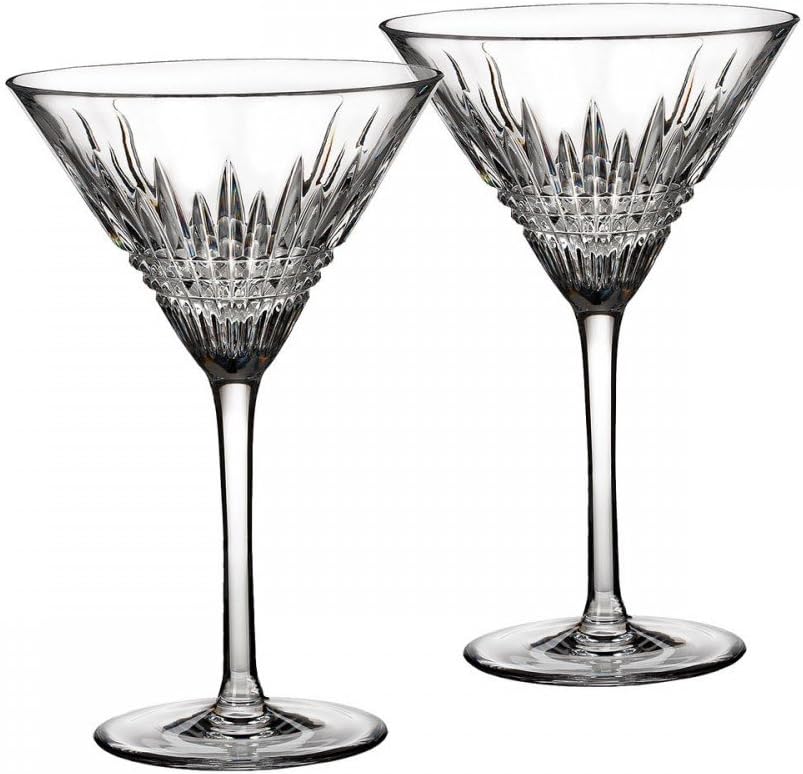
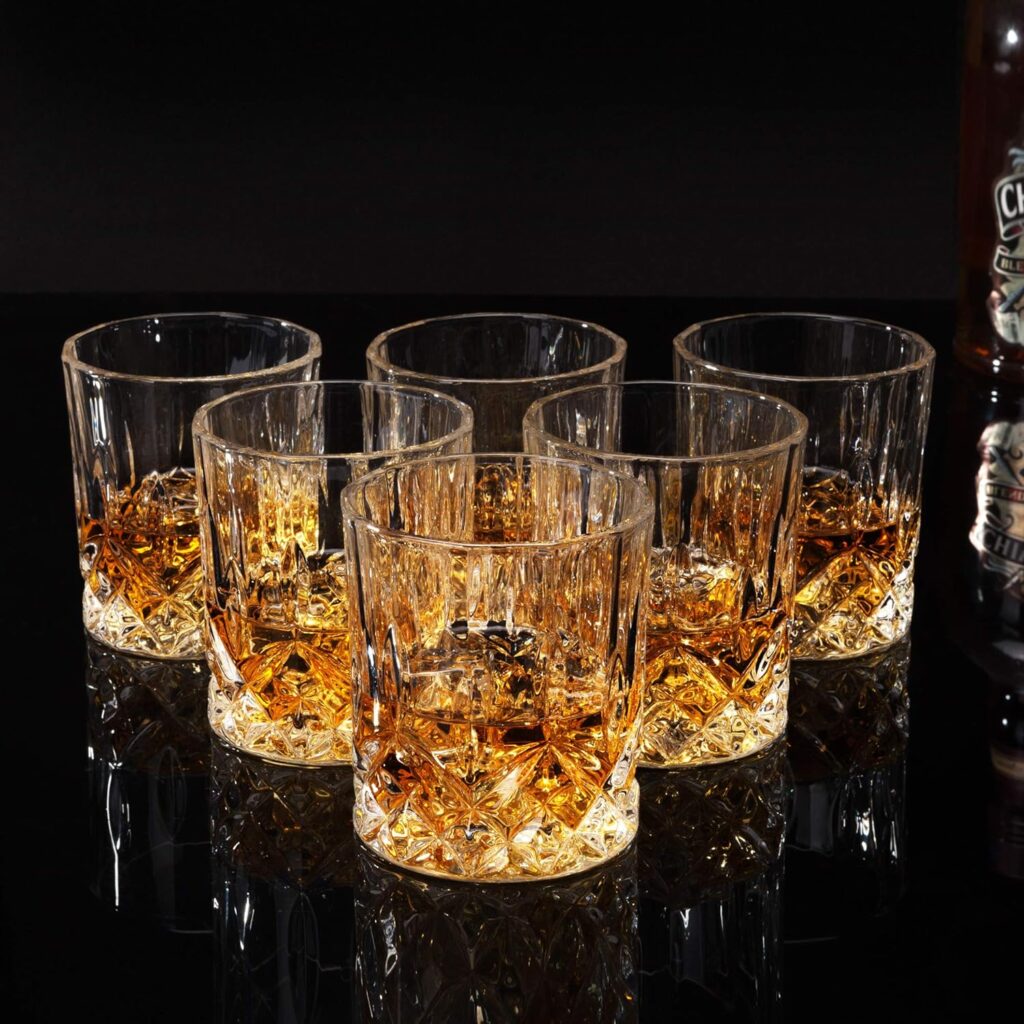
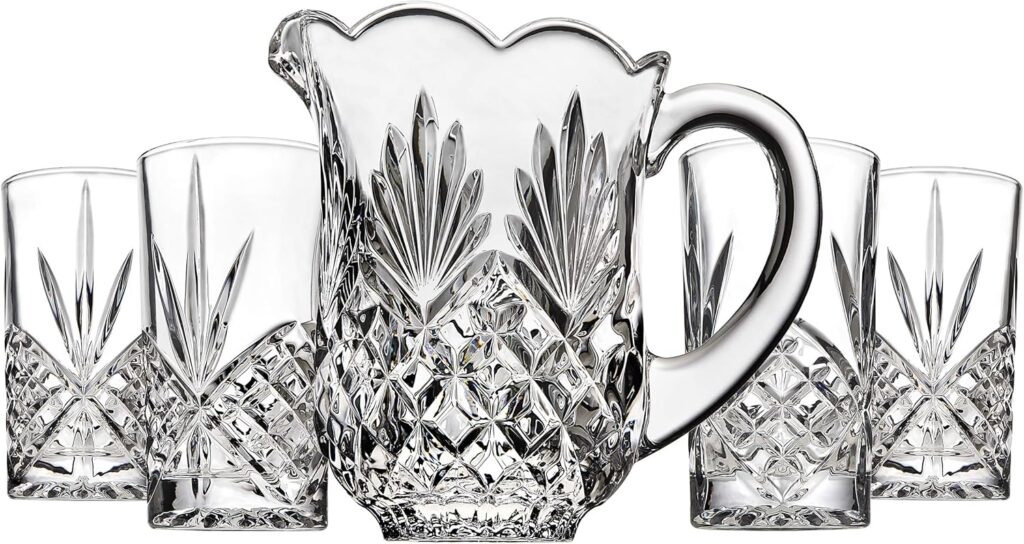
You’re hosting an intimate dinner party, and as the candlelight dances across your dining table, it catches the intricate cuts of your Waterford crystal patterns, casting rainbow prisms that make your guests pause mid-conversation.
There’s something almost magical about how crystal patterns transform ordinary moments into extraordinary memories.
Whether you’ve inherited a treasured piece from your grandmother or you’re just beginning your crystal-collecting journey.
Understanding these magnificent patterns opens up a world where Irish craftsmanship meets timeless elegance.
THE RICH HERITAGE BEHIND EVERY PATTERN
When you hold a piece of Waterford crystal, you’re not just holding glassware; you’re cradling over 240 years of Irish artistry.
Founded in 1783 in the port city of Waterford, Ireland, this prestigious brand has become synonymous with luxury crystal worldwide.
Each Waterford crystal pattern tells a story, from the traditional cuts that echo Georgian elegance to contemporary designs that speak to modern sensibilities.
The magic begins in the workshops where master craftsmen, many with decades of experience, hand-cut each piece using techniques passed down through generations.
It’s rather like watching a sculptor work with diamond-hard precision, except their canvas is molten crystal cooled to perfection.
WHAT MAKES WATERFORD CRYSTAL PATTERNS SO SPECIAL?
You might wonder what sets Waterford apart from other crystal manufacturers. The answer lies in three key elements that make these pieces extraordinary:
Lead Crystal Composition: Waterford crystal contains a minimum of 30% lead oxide, which gives it its distinctive weight and brilliant clarity. When you tap a genuine piece, it produces a clear, resonant ring that’s music to a collector’s ears.
Hand-Cutting Mastery: Every pattern is meticulously hand-cut by skilled artisans using diamond-tipped wheels. This process can take anywhere from several hours to days for complex pieces, ensuring each item is unique.
Design Innovation: Waterford doesn’t just rest on tradition; they continuously create new patterns whilst respecting their heritage. From the iconic Lismore pattern to contemporary collections, there’s something for every taste.
COMPLETE LIST OF WATERFORD CRYSTAL PATTERNS
Classic/Traditional Patterns (Still in Production)
Most Popular Current Patterns:
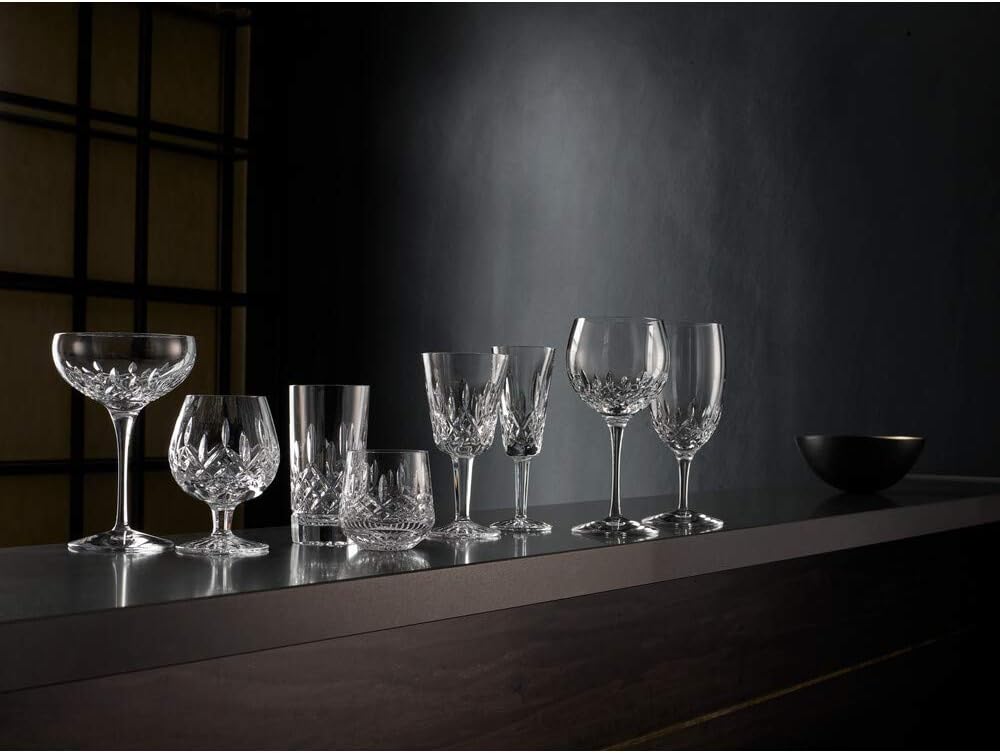
Lismore – The world’s best-selling crystal pattern (distinctive diamond and wedge cuts, as seen in Goblet glassware patterns) since 1952.
Alana – Criss-cross diamond pattern (1952-discontinued)
Ashling – Celtic knotwork motifs
Ballymore – Traditional Irish cutting
Curraghmore – Estate-inspired design
Donegal – Castle architecture influence
Kenmare – Ring of Kerry inspiration
Kildare – County Kildare tribute
Kinsale – Maritime rope detailing
Tramore – Art Deco geometric patterns
Shannon – River-inspired flowing lines
Rosslare – A Coastal town inspiration
Dungarvan – Traditional Irish port design
Kylemore – Discontinued patterns, inspired by the romantic Kylemore Abbey and manufactured from 1966 to 2017. This pattern features squares created by star cuts that are intersected by straight, upright blaze cuts.
Master Cutter Series – Individual artist signatures
Heritage Reproductions:
Georgian Period reproductions
Victorian Era-inspired pieces
Edwardian design tributes
18th-century historical patterns
Pattern Identification Notes
By Era:
1950s-1960s: Deeper cuts, heavier crystal
1970s-1980s: Introduction of lighter patterns
1990s-2000s: More geometric, contemporary designs
2010s-Present: Mix of traditional and ultra-modern
By Marking:
Acid-etched script (pre-1950)
Block letters (1950-1999)
Seahorse logo (2000-present)
Laser etching (current production)
Collector Value Categories
Highest Value (Investment Grade):
Early Christmas ornaments (1982-1990)
Complete Ashling sets
Master Craftsman pieces
Pre-1970 Lismore pieces
Any piece with provenance
High Value (Strong Collectible):
Discontinued patterns in excellent condition
Limited edition pieces
Commemorative items
Complete vintage sets
Moderate Value (Growing Interest):
Recently discontinued patterns
Contemporary designer collaborations
Specialty barware collections
Heritage reproductions
Entry Level (Accessible Collecting):
Current production classics
Marquis collection pieces
Contemporary everyday patterns
Common vintage pieces in good condition
Notes on Pattern Availability
Still in Production: Lismore, Colleen, Powerscourt, Marquis collections, and most contemporary lines remain available through authorized dealers.
Recently Discontinued: Patterns discontinued within the last 10 years may still be found through specialty retailers and estate sales.
Vintage/Rare: Pre-1990 patterns are primarily available through auctions, estate sales, and specialized crystal dealers.
Regional Variations: Some patterns were produced exclusively for certain markets or periods, making them particularly rare in specific regions.
HOW MANY PATTERNS DOES WATERFORD HAVE?
Collectors often ask, “How many patterns does Waterford have?” The answer might surprise you.
Waterford has created well over 100 distinct patterns throughout its history. From the classic designs that have graced tables for decades to the limited edition pieces that appear for special occasions.
THE EVOLUTION OF DESIGN
What’s fascinating about Waterford’s pattern collection is how it reflects changing tastes and occasions.
Early patterns focused heavily on traditional Irish motifs and Georgian-inspired cuts.
However, as international markets expanded, Waterford began incorporating influences from around the world whilst maintaining its distinctive Irish character.
Recent years have seen the introduction of more contemporary patterns that appeal to younger collectors.
These designs often feature cleaner lines and more minimalist approaches, proving that Waterford can adapt without losing its essence.
DATING YOUR WATERFORD CRYSTAL: A COLLECTOR’S DETECTIVE WORK
One of the most intriguing aspects of collecting Waterford crystal is determining the age of pieces.
If you’re wondering, “How can you tell how old a Waterford crystal is?” there are several telltale signs that can help you date your treasures.
The Signature Evolution
Pre-1999: Look for the traditional Waterford signature etched in Gothic script. This elegant marking was used for decades and is considered highly desirable by collectors.
1999-2009: During this period, pieces featured the “Waterford Crystal mark“, often accompanied by the year of manufacture.
2009-Present: Modern pieces display the simplified “Waterford” signature, reflecting the brand’s contemporary approach.
Additional Dating Clues
Paper Labels: Vintage pieces often retain their original paper labels, which can provide valuable dating information. However, these labels are fragile, and many have been lost over time.
Pattern Documentation: Waterford maintains excellent records of when specific patterns were introduced and discontinued. Cross-referencing your piece with these records can provide accurate dating.
Manufacturing Marks: Some pieces feature small etched numbers or symbols that correspond to specific production periods or craftsmen.
CARE AND MAINTENANCE
Proper care ensures your collection maintains its beauty and value. Here are essential maintenance tips:
Cleaning: Hand wash with mild soap and warm water. Avoid harsh detergents or dishwashers, which can cause clouding or etching.
Storage: Store pieces with adequate padding between them. Tissue paper or soft cloth prevents scratching during storage.
Display: Keep pieces away from direct sunlight and extreme temperature changes. A well-lit display cabinet showcases your collection whilst providing protection.
MODERN COLLECTING: WHERE TRADITION MEETS CONTEMPORARY LIFE
New Patterns for New Generations
Waterford continues to innovate with patterns that speak to contemporary lifestyles.
The Marquis collection offers Waterford quality at more accessible price points, making various luxury crystal glassware available to a broader audience.
These pieces maintain the brand’s commitment to excellence whilst embracing modern design sensibilities.
The Digital Age of Collecting
Today’s collectors have advantages that previous generations couldn’t imagine.
Online marketplaces, collector forums, and digital catalogues make it easier than ever to find specific pieces and connect with fellow enthusiasts.
Social media platforms showcase collections and provide authentication help from experienced collectors worldwide.
THE FUTURE OF WATERFORD CRYSTAL PATTERNS – SUSTAINABLE PRACTICES AND ECO-FRIENDLY PRODUCTION
New patterns are also more durable and allow for deeper, sharper cuts, increasingly reflecting this commitment, incorporating recycled materials and eco-friendly production methods without compromising the luxury experience collectors expect.
Collaboration and Limited Editions
Recent years have seen exciting collaborations between Waterford and renowned designers, resulting in unique patterns that blend traditional craftsmanship with contemporary vision.
These limited edition pieces represent the cutting edge of crystal design and are highly sought after by collectors.
WRAPPING UP YOUR WATERFORD CRYSTAL JOURNEY
So, there you have it – the wonderful world of Waterford crystal patterns! From the famous Lismore that’s been sparkling on tables since 1952 to rare discontinued treasures like Kylemore, each pattern tells its own story.
Whether you’re just starting or you’re a seasoned collector, remember that the best collection isn’t about having the most expensive pieces.
It’s about choosing patterns that make you smile every time you see them catch the light.
Start with what you love – maybe a simple Lismore goblet or a beautiful Colleen bowl. Use your pieces, enjoy them, and don’t be afraid to hunt for bargains at estate sales and antique shops.
The magic of Waterford isn’t just in the crystal itself – it’s in the memories you create when you pour that special wine or light those candles for dinner. That’s when your collection truly comes alive.
Happy collecting, and may your crystal always sparkle!
This list represents the most comprehensive collection of known Waterford Crystal patterns. Due to the company’s long history and numerous limited editions, some specialty or one-off pieces may not be listed. Pattern availability and names may vary by region and period.
You’re hosting a dinner party, and as you reach for your grandmother’s cherished Waterford Crystal glasses, a friend casually mentions something about lead content.
Your hand freezes midair. These stunning pieces have graced your family’s celebrations for generations, their brilliant sparkle marking countless memorable toasts.
But now, amidst the shimmer and sparkle, a question lingers in your mind. Does Waterford Crystal contain lead?
And if so, what does this mean for those special moments when you bring out these treasured pieces?
The answer might surprise you, and it’s not as straightforward as you might think…
THE LEGACY OF WATERFORD CRYSTAL: A BRIEF HISTORY
Before we go into the chemistry of crystal, let’s understand why Waterford Crystal has maintained its prestigious position in the world of fine glassware.
Founded in 1783 in the Irish port city of Waterford, the company established itself as a pioneer in crystal manufacturing.
Unlike standard glass products, which we’ll explore in comparison to Borosilicate glass, Waterford Crystal’s distinction comes from its unique composition.
THE CHEMICAL COMPOSITION OF CRYSTAL
Traditional crystal, by definition, contains a minimum of 24% lead oxide (PbO).
Waterford Crystal traditionally contains approximately 33% lead oxide, which gives it several distinctive characteristics:
1. Enhanced brilliance and clarity
2. Greater weight than standard glass
3. Superior sound resonance
4. Increased durability
5. Higher refractive index
Glass Type
Lead Content
Classification
Standard Glass
0%
Non-crystal
Crystal Glass
24-32%
Full Lead Crystal
Waterford Crystal
~33%
Full Lead Crystal
Lead-free Crystal
0%
Modern Alternative
THE LEAD QUESTION: DOES WATERFORD CRYSTAL HAVE LEAD? – UNDERSTANDING THE FACTS.
Yes, traditional Waterford Crystal contains approximately 33% lead oxide (PbO), which exceeds the standard 24% minimum requirement for full lead crystal classification.
While modern Waterford offers lead-free alternatives, its classic crystal pieces still maintain this traditional composition.
While researching this topic, it’s important to note that traditional depression glass, which also raises lead concerns, serves as an interesting comparison point.
The presence of lead in crystal isn’t accidental – it’s intentional and serves specific purposes.
The addition of lead oxide to glass creates several desirable properties:
Enhances brilliance and clarity
Increases the glass’s weight
Improves sound resonance
Creates superior light refraction
Makes the crystal easier to cut and engrave
Increased Refractive Index
Creates the signature “sparkle”
Produces rainbow effects
Lower melting point
Better malleability during production
SAFETY CONSIDERATIONS AND MODERN ADAPTATIONS
In recent years, concerns about lead exposure have prompted important questions about crystal usage.
While Waterford crystal glassware remains highly coveted, understanding proper usage is crucial.
Safe Usage Guidelines:
1. Storage Recommendations:
– Don’t store beverages in crystal containers long-term
– Avoid using crystal decanters for daily storage
– Clean thoroughly after each use
2. Special Considerations:
– Use alternative glassware for acidic beverages
– Reserve crystal for special occasions
– Follow manufacturer guidelines
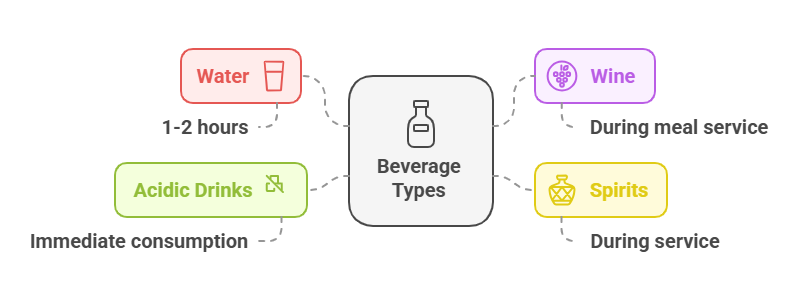
Beverage Type
Maximum Recommended Contact Time
Water
1-2 hours
Wine
During meal service
Spirits
During service
Acidic Drinks
Immediate consumption
MODERN ALTERNATIVES AND INDUSTRY EVOLUTION
Responding to health concerns, many manufacturers, including Waterford, have developed lead-free alternatives.
These modern crystals use different minerals to achieve similar aesthetic properties:
– Barium oxide
– Zinc oxide
– Potassium oxide
UNDERSTANDING LEAD LEACHING
Scientific studies have shown that lead can leach from the crystal under certain conditions:
Factors affecting lead leaching:
1. Contact time
2. Temperature
3. Acidity of contents
4. Age and condition of the crystal
WATERFORD’S MOVE TOWARDS SUSTAINABLE CRYSTAL: A NEW ERA
Waterford Crystal is making an exciting change to become more environmentally responsible while maintaining their legendary quality.
Here’s what’s happening:
The New Formula:
– They’re replacing traditional lead oxides with barium oxide
– The new crystal will be 100% recyclable
– This change will be complete by the end of 2025
Benefits of the New Crystal:
– Same beautiful clarity and brilliance as traditional Waterford
– Maintains the distinctive Waterford “ping” sound
– Twice as strong as the traditional formula
– Better heat resistance
– Allows for deeper and sharper cuts in the design
Environmental Impact:
– Factories will use significantly less energy
– More sustainable production process
– Better for the environment
What This Means for Collectors:
The new crystal formula delivers everything people love about Waterford – the sparkle, sound, and feel – while being more durable and environmentally friendly.
Craftsmen can create even more intricate designs thanks to the improved cutting properties of the new material.
Riedel produces both leaded and lead-free crystal collections. Their traditional full-lead crystal lines contain 24% lead oxide, while their lead-free collections use alternative materials like titanium and zirconium oxide.
However, Baccarat has introduced some lead-free collections in response to modern preferences and regulations.
Their classic pieces still maintain the traditional high-lead formula that gives Baccarat its characteristic brilliance, weight, and sound resonance.
For daily use, Baccarat recommends its lead-free alternatives.
CARE AND MAINTENANCE
Proper care not only preserves your crystal but also minimizes any potential risks:
1. Cleaning Protocol:
– Hand wash with mild detergent
– Avoid extreme temperatures
– Dry immediately with a lint-free cloth
2. Storage Requirements:
– Store in a dust-free environment
– Avoid stacking pieces
– Use protective padding
THE FUTURE OF CRYSTAL MANUFACTURING
The industry continues to evolve, with manufacturers exploring innovative solutions:
1. Lead-free Alternatives
2. Hybrid Technologies
3. Sustainable Production Methods
FREQUENTLY ASKED QUESTIONS ABOUT WATERFORD CRYSTAL
Q: What is so special about Waterford Crystal?
A: Waterford Crystal is renowned for its exceptional quality and craftsmanship, distinguished by:
– A unique crystal formula that creates superior clarity and brilliance
– Hand-cutting techniques perfected since 1783
– Distinctive deep cutting patterns that create maximum light refraction
– A signature “ping” sound when gently tapped
– Higher weight due to its crystal composition
– Heritage of Irish craftsmanship
– Each piece is created by master artisans with years of training
Q: Does Marquis by Waterford have lead in it?
A: Marquis by Waterford contains lower lead content than traditional Waterford Crystal. It’s made with crystalline, which contains less lead oxide than full-lead crystal. However, for the most current information about specific pieces, it’s best to contact Waterford directly, as formulations have changed over time.
Q: When did Waterford stop using lead in its Crystal?
A: According to Waterford’s sustainability report above, they are currently transitioning from lead oxide to barium oxide in their crystal formula. This transition will be complete by the end of 2025. However, the exact timeline of when different collections began transitioning varies.
You’re browsing through an antique shop when a gleaming piece of crystal catches your eye.
The shopkeeper claims it’s authentic Waterford, but how can you be certain?
Whether you’re a seasoned collector or inherited your grandmother’s prized crystal collection, understanding Waterford Crystal markings is like learning a secret language that opens doors to the fascinating world of fine crystal collecting.
Today, we will unlock that knowledge, helping you distinguish genuine pieces from clever imitations, and perhaps even discover hidden treasures gathering dust in your china cabinet.
WHAT IS WATERFORD CRYSTAL MADE OF?
Waterford crystal is made of lead crystal, which contains:
Silica (sand)
Lead oxide (minimum 24% for full lead crystal)
Potash
Other trace minerals
Lead crystal – a “crystal”-clear, strong, durable compound that chimes when tapped with the fingers and feels warm in the hand.
IS WATERFORD CRYSTAL MADE IN CHINA?
No, authentic Waterford crystal is made in Ireland at the House of Waterford Crystal facility in Waterford, Ireland, where traditional Irish craftsmanship is maintained.
IS WATERFORD LEAD CRYSTAL OR IS WATERFORD CRYSTAL LEADED?
Yes, authentic Waterford crystal is lead crystal, containing at least 24% lead oxide, which gives it its distinctive weight, clarity, and brilliance.
WHAT DOES THE WATERFORD CRYSTAL MARK LOOK LIKE?
The Waterford mark typically appears as:
“WATERFORD” in block letters, acid-etched
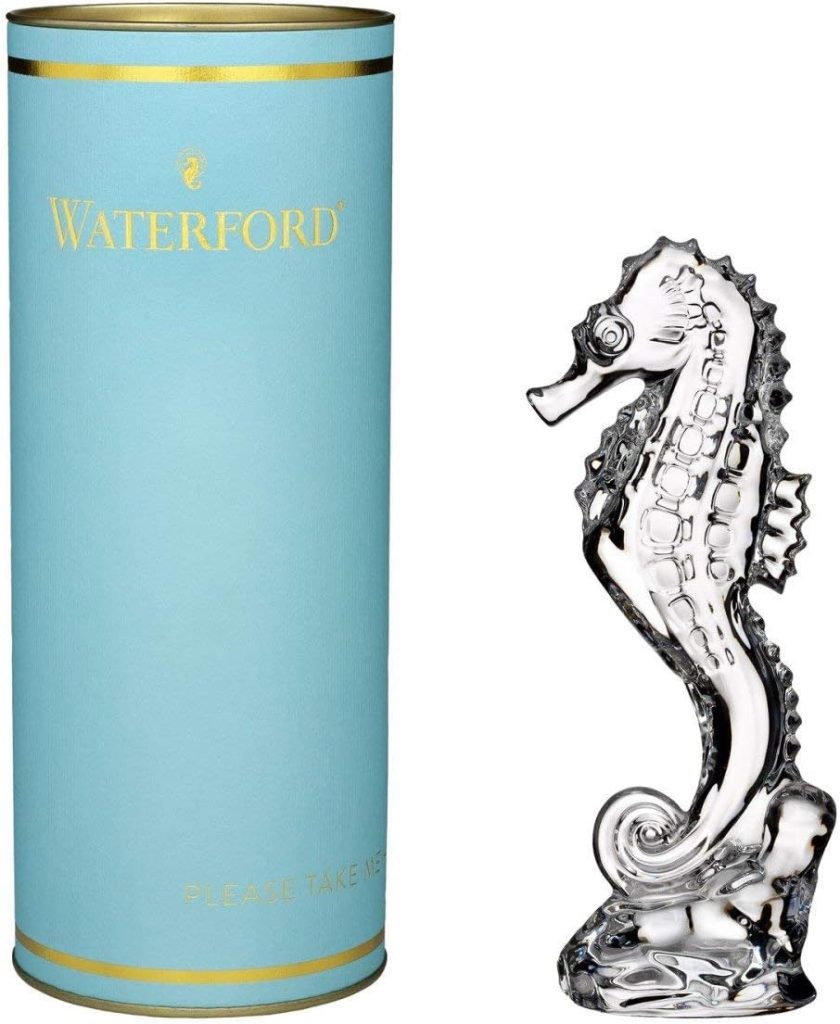
Seahorse logo (used since 1947)
Sometimes a combined logo with text
Usually small and requires magnification to see clearly.
THE EVOLUTION OF WATERFORD CRYSTAL MARKS: A JOURNEY THROUGH TIME
When we delve into Waterford Crystal markings, we explore over two centuries of craftsmanship.
The story begins in 1783, in the bustling port city of Waterford, Ireland, where George and William Penrose established what would become one of the most prestigious crystal manufacturers in the world.
THE EARLY YEARS (1783-1851)
During Waterford’s initial period, pieces rarely carried marks, making the authentication of these earliest treasures particularly challenging. Experts primarily rely on:
– Design patterns characteristic of the period
– Quality of craftsmanship
– Historical documentation
– Scientific analysis of the glass composition
THE MODERN ERA (1947-PRESENT)
After a century-long hiatus, Waterford Crystal’s rebirth in 1947 brought standardized marking practices that have evolved:
1. Acid Etching (1947-1999)
The traditional acid-etched mark features:
– “Waterford” name
– Made in Ireland (on some pieces)
– Distinctive cursive script
2. Laser Etching (2000-Present)
Modern pieces showcase:
– Laser-etched “Waterford” name
– Seahorse logo
– Year of manufacture (on special pieces).
WATERFORD MARKS DATING
Waterford Crystal marking periods:
Pre-1950: Primarily identified by green-and-gold seahorse paper stickers
1950s onwards: Acid-etched marks saying “Waterford” or featuring the iconic seahorse logo
1947: The Seahorse logo was designed by their chief designer in 1947, an adaptation of the sea creature that is on the City of Waterford’s Coat of Arms.
Modern era (2021): New branding introduced while maintaining traditional markings.
The Waterford logo features the iconic seahorse design, which echoes the curves of the sea creature’s tail and the ridges along its back. An homage to the Waterford city crest, which features a seahorse.
The curved shape of the seahorse would lend itself far more artistically to the type of label.
The seahorse was a truly original and unique sea creature, given that the male seahorse carries the offspring, making it symbolically appropriate for the brand.
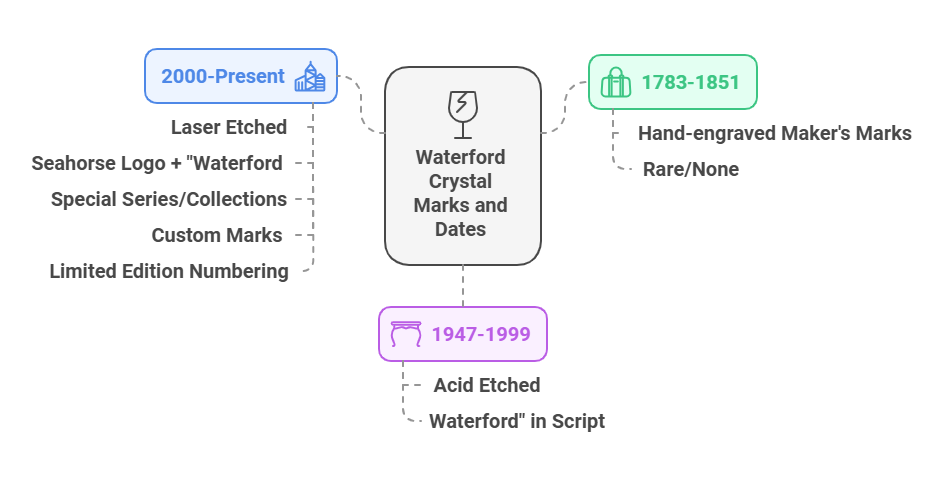
IDENTIFICATION OF WATERFORD CRYSTAL MARKS AND DATES
Understanding the chronology of Waterford marks helps date pieces accurately:
Time Period
Mark Type
Distinct Features
1783-1851
Rare/None
Hand-engraved maker’s marks
1947-1999
Acid Etched
“Waterford” in script
2000-Present
Laser Etched
Seahorse logo + “Waterford”
Special Series/collections
Custom Marks
Limited edition numbering
WATERFORD CRYSTAL STAMPS
Waterford uses acid-etched marks rather than traditional stamps. These marks are created using acid to permanently etch into the glass surface, making them difficult to counterfeit.
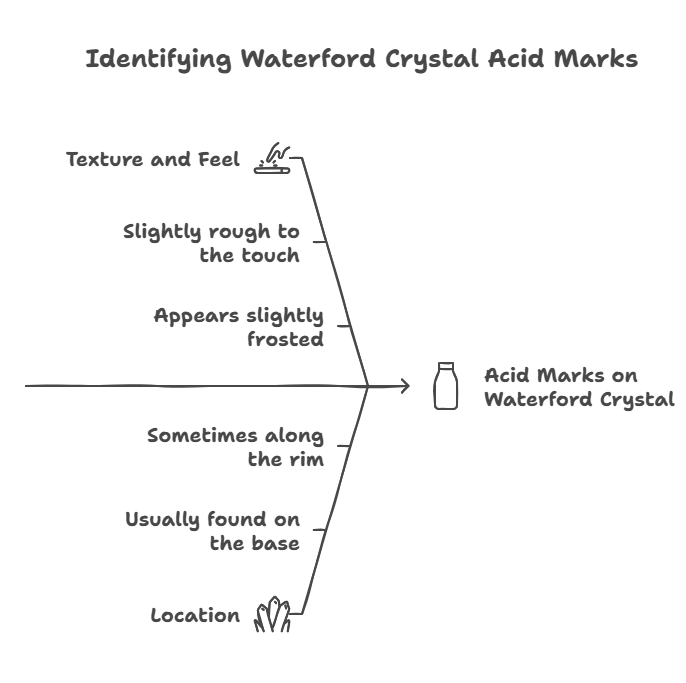
WATERFORD CRYSTAL ACID MARKS
Genuine Waterford Crystal pieces produced since the 1950s bear an acid-etched mark that says “Waterford” or features the iconic seahorse logo. These marks are permanent and created during manufacturing.
DOES WATERFORD CRYSTAL HAVE A MARKING?
Yes, authentic Waterford crystal typically has markings. Waterford Crystal often features an etched mark as a hallmark of authenticity, though the type of marking varies by production period.
DOES ALL WATERFORD CRYSTAL HAVE MARKINGS?
The short answer is no, not all authentic Waterford Crystal pieces bear markings. This is particularly true for pieces crafted during certain periods:
– First Period (1783-1851): Rarely marked
– Modern Era (1947-present): Usually marked
– Special Commissioned Pieces: May have unique identifiers
Understanding this variance is crucial because the absence of a mark doesn’t automatically indicate a fake.
Just as collectors need to familiarize themselves with Mikasa crystal marks and other prestigious brands, Waterford’s marking evolution tells its own unique story.
AUTHENTICATION GUIDE: SPOTTING GENUINE WATERFORD MARKS
1. Location of Marks
– Base of stemware
– Bottom of vases and bowls
– Edge of flat pieces
– Rim of larger items
2. Characteristics of Authentic Marks
Era
Mark Type
Characteristics
1947-1999
Acid Etched
Slightly rough to the touch, permanent
2000-Present
Laser Etched
Smooth surface, precise detail
Special Items
Both Methods
Additional commemorative marks
HOW CAN I TELL IF MY UNMARKED CRYSTAL IS WATERFORD?
Even without visible markings, authentic Waterford Crystal exhibits distinct characteristics:
– Notable weight and density
– Clear, bell-like ring when tapped
– Sharp, precise cutting patterns
– Perfect symmetry in design
WHAT IS THE MOST POPULAR WATERFORD PATTERN?
The Lismore pattern, introduced in 1952, reigns as Waterford’s most beloved design. Created by Miroslav Havel, it features:
Fun fact: The Lismore pattern, while containing lead crystal characteristics that give it exceptional brilliance, has been adapted in recent years to meet modern safety standards.
Some limited editions had special markings for specific years.
DISCONTINUED WATERFORD PATTERNS
While some patterns cease production, they often become collectors’ items:
1. Recently Discontinued:
– Alana (1952-2019)
– Carina (1968-2018)
– Colleen (1953-2015)
2. Rare Discontinued:
– Polish Princess (1957-1960)
– Sheila (1958-1962)
– Avoca (1961-1965).
IS WATERFORD CRYSTAL DISHWASHER SAFE?
Generally, Waterford crystal is not recommended for dishwashers. Hand washing in warm, soapy water is preferred to preserve the crystal’s integrity and prevent damage from harsh detergents and high temperatures.
CARE AND PRESERVATION OF MARKED PIECES
To preserve your Waterford Crystal’s markings:
1. Avoid abrasive cleaners near marked areas
2. Hand wash with mild soap and warm water
3. Dry with a lint-free cloth
4. Store pieces separately to prevent scratching
THE INVESTMENT VALUE OF PROPERLY MARKED PIECES
Authentic Waterford Crystal with clear, identifiable marks typically commands premium prices:
– First period pieces (1783-1851): Extremely valuable, often museum-worthy
Understanding Waterford Crystal markings isn’t just about authentication; it’s about connecting with a legacy of craftsmanship that spans generations.
Whether you’re starting your collection or verifying inherited pieces, this knowledge empowers you to make informed decisions and appreciate the artistry behind each marking.
Ready to start exploring your crystal collection? Begin by examining the base of each piece with a magnifying glass and good lighting.
Remember, authentic Waterford Crystal tells its story through its markings, waiting for discerning collectors like you to discover its secrets.
You’re rummaging through your grandmother’s china cabinet, and there it is, a stunning crystal glass that catches the light just so, creating a mesmerizing rainbow of reflections across your dining room.
But as you turn it over in your hands, you notice some peculiar markings at the base. What stories do these enigmatic crystal markings tell? What secrets about your family’s heritage might they unlock?
For countless collectors and inherited treasure keepers, these mysterious marks hold the key to understanding not just the value of their pieces but their authentic history and legacy.
As you embark on this journey of discovery, you’ll soon realize that these seemingly simple marks are anything but – they’re the crystalline fingerprints that can transform your curious findings into verified treasures.
UNDERSTANDING GLASS VS CRYSTAL: THE FUNDAMENTAL DIFFERENCES
Before diving into identification markings, it’s essential to understand what distinguishes crystal from regular glass.
This knowledge forms the foundation for proper identification and helps explain why certain pieces are marked differently.
Physical and Chemical Composition
Regular Glass:
Made from silica (sand), soda ash, and limestone
Contains no lead oxide
Melting point around 1400-1600°C
Lower refractive index (typically 1.5)
Less brilliant appearance
Crystal Glass:
Contains a minimum of 24% lead oxide (PbO) for traditional lead crystal
A higher melting point requires specialized manufacturing
Refractive index of 1.545 or higher
Superior brilliance and light dispersion
Distinct resonance when tapped
Lead-Free Crystal Alternatives: Modern manufacturers now produce lead-free crystal using:
Zinc oxide
Potassium oxide
Barium oxide. These materials achieve similar optical properties while addressing health and environmental concerns.
Key Property Comparisons
Optical Properties: Crystal’s higher lead content creates superior light refraction, producing the characteristic “sparkle” and rainbow effects that glass cannot replicate.
This prismatic quality is one of the most reliable identification features.
Weight and Density: The crystal is significantly heavier than glass of the same size due to lead content. This weight difference is immediately noticeable when handling pieces and serves as a quick preliminary test.
Sound Characteristics: When gently struck, the crystal produces a clear, sustained ringing tone that can last several seconds.
Glass creates a duller, shorter sound. This acoustic difference results from the crystal’s molecular structure.
Durability: Despite common misconceptions, quality crystal is more durable than regular glass. The lead content makes it more resistant to chipping and allows for deeper, more precise cutting without fracturing.
GLASS MARKINGS IDENTIFICATION
While crystal markings often receive more attention, understanding glass markings is equally important for comprehensive identification, especially when distinguishing between the two materials.
Usually marked with mold numbers rather than maker’s marks
Common Patterns: Depression glass comes in hundreds of patterns, many unnamed by manufacturers. Pattern identification guides are essential for proper attribution.
Milk Glass (1800s-1970s)
Characteristics:
Opaque white appearance
Made with bone ash, tin oxide, or fluorides
Popular for decorative pieces and serving ware
Often features hand-painted or fired-on decorations
Markers include Westmoreland, Fenton, Imperial
Cut Glass (1880s-1920s)
Characteristics:
Hand-cut geometric patterns
American Brilliant Period (1876-1916) represents the peak production
Deep, precise cuts with sharp edges
Heavy weight
Often unmarked or with small acid signatures
Carnival Glass (1907-1930s)
Characteristics:
Iridescent surface treatment
Mass-produced pressed glass
Wide range of colors and patterns
Most pieces unmarked
Manufacturers include Northwood, Fenton, Imperial, and Millersburg
CRYSTAL GLASS MARKS IDENTIFICATION CHART
A crystal glass marks identification chart is a reference guide that catalogs the various markings, signatures, and logos used by crystal and glassware manufacturers.
These charts typically include:
Manufacturer signatures: Renowned crystal manufacturers normally mark their pieces with a logo, name, or signature on the bottom
Dating codes: Numbers or letters indicating production periods
Pattern marks: Specific identifiers for particular designs
Quality marks: Indicators of lead content or craftsmanship level
Country of origin marks: Required by law in many jurisdictions
Common manufacturers featured in these charts include Waterford, Edinburgh, Baccarat, Lalique, Steuben, and others, each with distinctive marking systems.
VINTAGE CRYSTAL GLASS MARKS IDENTIFICATION CHART
Vintage crystal identification charts focus specifically on older pieces, typically pre-1960s, and include:
Early manufacturer marks: Often simpler designs than modern equivalents
Paper labels: Many vintage pieces used adhesive labels that may have fallen off
Engraved signatures: Hand-etched marks common in the early 20th century
Regional variations: Different marks used for export vs. domestic markets
Discontinued manufacturers: Companies no longer in business
Vintage marks often require magnification and careful examination due to age-related wear.
UNDERSTANDING THE LANGUAGE OF CRYSTAL MARKS
Crystal markings are rather like the DNA of fine glassware – they tell us everything from the piece’s origin to its age and authenticity.
Crystal glassware contains a minimum of 24% lead oxide (PbO), which gives it its distinctive properties:
– Enhanced clarity and brilliance
– Greater light refraction
– Increased durability
– Superior resonance when “clinked.”
– Higher weight than regular glass
Modern lead-free crystal alternatives use minerals like zinc oxide or potassium oxide to achieve similar characteristics while being more environmentally friendly.
CRYSTAL GLASS MAKERS MARKS
Major crystal manufacturers use distinctive marking systems:
Waterford: Acid-etched “WATERFORD” or seahorse logo
Baccarat: Typically shows “Baccarat France” in script
Lalique: Usually signed “Lalique France.”
Steuben: Often features “Steuben” in block letters
Moser: Moser often marks their pieces with their brand name
Royal Doulton: Various marks, including crown symbols
Orrefors: Swedish maker with distinctive marking
Each manufacturer has evolved their marking system over time, making dating possible through mark variations.
LEAD CRYSTAL MAKERS MARKS
Leading manufacturers of lead crystal use specific marking systems:
Premium Brands:
Waterford (Ireland): Acid-etched marks, seahorse logo
Baccarat (France): Script signature, often with “France.”
Lalique (France): Distinctive signature, sometimes with “R” for René
Steuben (USA): Block letter marking
Royal Doulton (England): Crown symbols and text.
Quality Indicators:
Many marks include lead content percentage
“Full Lead Crystal” indicates 24%+ lead content
The country of origin is often included for export compliance.
PREMIUM CRYSTAL BRAND IDENTIFICATION GUIDES
Understanding the distinctions between major crystal brands helps collectors make informed decisions and properly identify pieces in their collections.
Waterford Crystal Identification
Waterford remains one of the most recognized crystal brands worldwide. Key identification features include:
Waterford Markings Evolution:
Pre-1999: Acid-etched “WATERFORD” in serif font
1999-2000: Introduction of the seahorse logo
2000-present: Seahorse mark standard on most pieces
Some pieces feature both the company name and logo
Pattern recognition is crucial for completing sets, determining value, and proper authentication.
Pattern Documentation Resources
Manufacturer Catalogs:
Original catalogs provide definitive pattern names
Dating information through catalog publication dates
Piece availability and original pricing
Pattern variation documentation
Online Databases:
Collector websites maintain pattern libraries
User-submitted photographs aid identification
Discussion forums for difficult identifications
Cross-referencing capabilities
Common Pattern Categories
Cut Crystal Patterns:
Geometric designs (diamonds, crosshatching, fans)
Floral motifs
Architectural elements
Abstract modern designs
Etched Crystal Patterns:
Acid-etched decorative designs
Often feature naturalistic scenes
Lighter, more delicate appearance
Popular in stemware
Combined Techniques:
Cutting and etching together
Gilding or enameling additions
Multiple pattern elements
More valuable due to complexity
Waterford Pattern Identification
Classic Waterford Patterns:
Lismore (1952-present): Most iconic pattern
Colleen (1953): Short and tall stem variations
Tramore (1968): Vertical cutting style
Araglin (1976): Contemporary design
Powerscourt (1969): Bold, geometric
Dating Through Patterns:
Introduction dates narrow production timeline
Discontinued patterns increase collectibility
Pattern variations indicate production periods.
HOW TO IDENTIFY CRYSTAL GLASSWARE
To identify crystal glassware effectively:
Location of Marks: You could find the mark on the rim or center of the foot, on the stem, or on the bottom of the bowl. The mark could be an initial, a logo, a word, or coded numbers and letters
Examination Techniques: A magnifying glass and holding the stemware up to light can help you spot the mark and read it
Physical Tests:
Sound test: Crystal will have a pleasant pinging noise, while glass will thunk
Light refraction: A Crystal may refract the light and create prismatic effects
Weight: Crystal feels heavier due to the lead content
Temperature: Crystal feels cooler to the touch initially.
HOW TO IDENTIFY UNMARKED CRYSTAL?
When a crystal lacks visible markings, use these identification methods:
Physical Properties:
The easiest method to determine if a crystal is to see if it forms prisms and makes a bell sound when gently tapped
Lead content test: Due to the lead content, the crystal will have a blue or purple tint to it, whereas the glass just looks a dull green color under black light
Thickness examination: Crystal typically has thinner, more refined edges
Clarity: Superior optical clarity compared to regular glass
Style and Pattern Analysis:
Research characteristic design elements of known manufacturers
Compare proportions and cutting patterns
Consider the complexity and precision of cuts
Evaluate overall craftsmanship quality.
HOW TO IDENTIFY LEAD CRYSTAL VASE
To identify a lead crystal vase:
Physical Tests:
Take a butter knife or other metal utensil and gently tap the glass; if it makes a drawn-out ringing sound, it is more than likely crystal
Weight test: Lead crystal vases are noticeably heavier than glass
Light test: Hold up to the light to check for brilliant refraction
Temperature test: Feels cool initially, then warms in the hand
Visual Inspection:
Look for manufacturer marks on the base
Examine cut patterns for precision and depth
Check for optical clarity and brilliance
Assess overall craftsmanship quality.
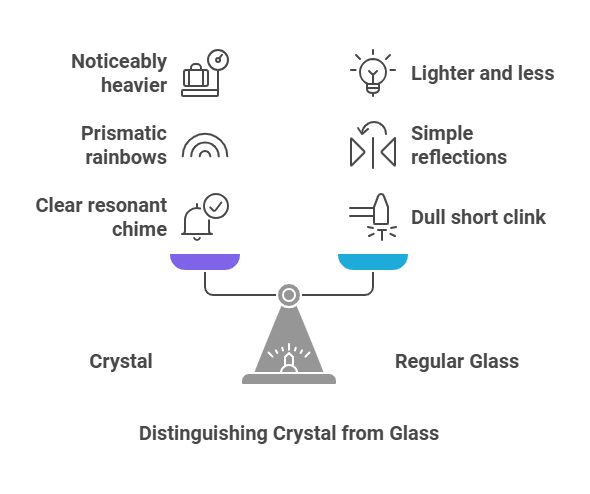
HOW TO TELL IF IT’S REAL CRYSTAL?
There are several foolproof methods to distinguish genuine crystal from regular glass:
The Ring Test
Hold the glass by the stem and gently flick it with your finger:
– Crystal produces a clear, resonant chime
– Regular glass makes a dull, short-lived ‘clink.’
The Light Test
Hold the piece up to a light source:
– Crystal creates prismatic rainbows
– Regular glass produces simple reflections
The Weight Test
Compare similar pieces:
– Crystal feels noticeably heavier
– Regular glass feels lighter and less substantial.
CRYSTAL SAFETY: LEAD CONTENT CONCERNS
Understanding lead content in crystal is essential for safe use and informed collecting decisions.
Lead Crystal Safety Guidelines
Daily Use Considerations:
Avoid storing acidic beverages (wine, juice) in lead crystal long-term
Don’t use lead crystal for children’s drinkware
Minimize daily use of lead crystal for food service
Lead-free crystal alternatives are available for frequent use
Manufacturer specifications provide the lead percentage
Vintage pieces may have higher lead content
Health Recommendations:
Occasional use of lead crystal poses minimal risk
Lead leaching increases with acidic contents and extended storage
Decorative display carries no health concerns
Follow FDA guidelines for food-safe glassware
Lead-Free Crystal Alternatives
Modern Formulations:
Zinc oxide crystal
Potassium oxide crystal
Barium oxide crystal
Titanium oxide additions
Performance Comparison:
Optical properties are nearly identical to lead crystal
Slightly different resonance characteristics
Equal durability for cutting and use
No health concerns for food service
Brand Offerings: Many traditional manufacturers now offer lead-free lines while maintaining their lead crystal heritage collections.
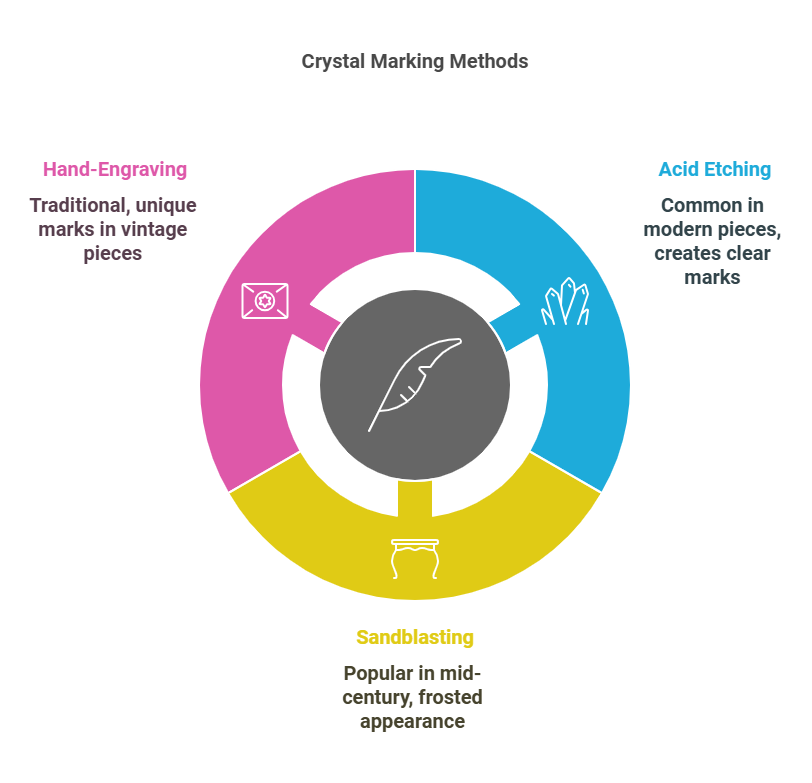
THE EVOLUTION OF CRYSTAL MARKING METHODS
Throughout history, manufacturers have employed various techniques to mark their crystal pieces:
1. Acid Etching
– Most common in modern pieces
– Creates clear, precise marks
– Usually found on the bottom of the piece
2. Sandblasting
– Popular in mid-century pieces
– Creates a frosted appearance
– Often used for larger marks
3. Hand-Engraving
– Traditional method
– Each mark is unique
– Found in vintage and antique pieces
COMMON TYPES OF CRYSTAL MARKS
Understanding different types of marks is crucial for proper identification. While some collectors might be familiar with identifying Mikasa crystal marks, each manufacturer has its own distinctive style.
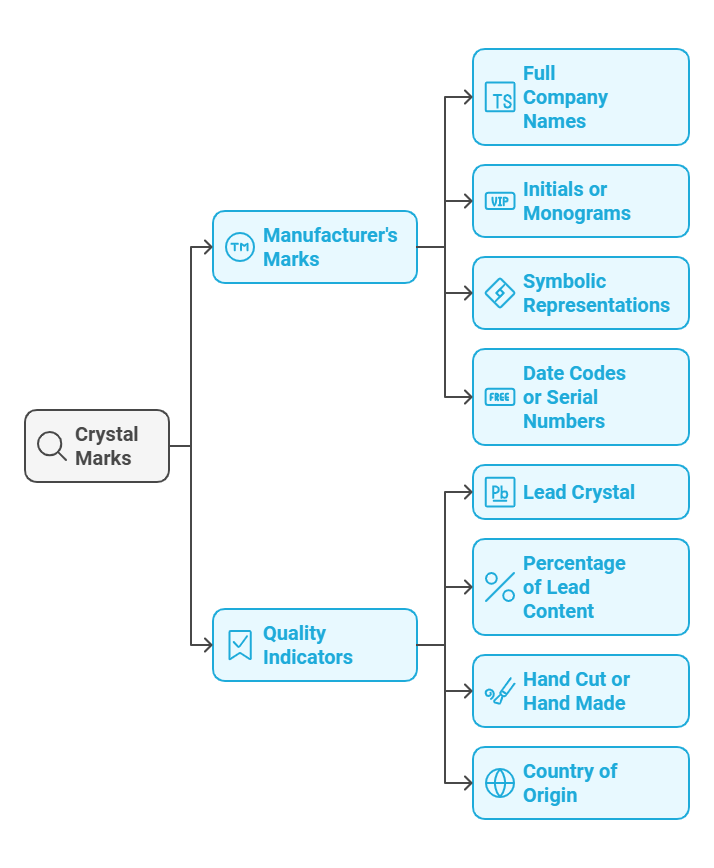
Manufacturer’s Marks
The most common type of crystal marking is the manufacturer’s signature or logo. These can appear as:
– Full company names
– Initials or monograms
– Symbolic representations
– Date codes or serial numbers
Quality Indicators
Quality marks often appear alongside the manufacturer’s marks and can include:
– “Lead Crystal” or “Full Lead Crystal”
– Percentage of lead content (24% PbO)
– “Hand Cut” or “Hand Made”
– Country of origin
READING AND INTERPRETING CRYSTAL MARKS
Much like Fiestaware with markings, crystal pieces tell their stories through various symbols and codes.
Here’s how to decode them:
Step-by-Step Authentication Process
1. Clean the piece carefully
– Use a soft, lint-free cloth
– Avoid harsh chemicals
– Ensure proper lighting
2. Locate the marking
– Check the base
– Look for marks on the stem
– Examine the rim
3. Document what you find
– Photograph the marks
– Note their location
– Measure their size
Table: Common Manufacturer Marks and Their Meanings
Manufacturer
Common Marks
Years Used
Notable Features
Waterford
Acid-etched seahorse
1950-present
Bold, clear etching
Mikasa
“M” in crystal
1970-present
Often includes a year code
Lalique
“R. LALIQUE”
1925-1945
Cursive script
Baccarat
Registered trademark symbol
1936-present
Often includes year code
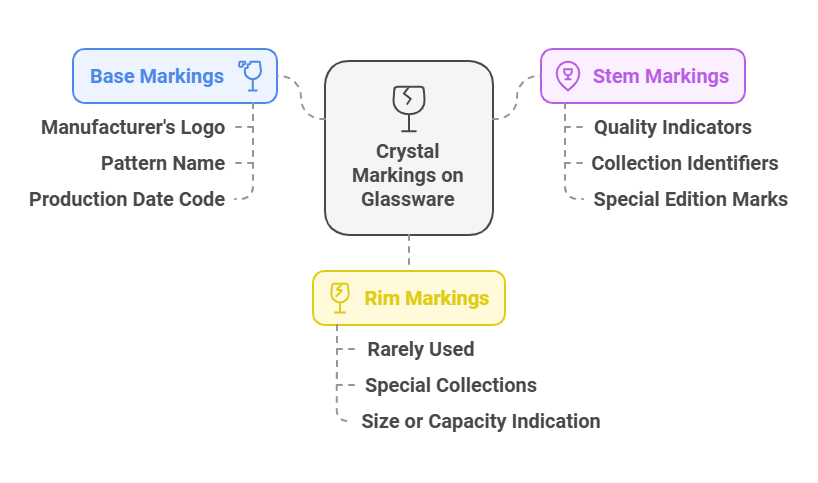
CRYSTAL MARKINGS ON GLASSWARE
Below are the various ways manufacturers employ to mark their glass products.
Techniques and common locations include:
1. Base Markings
– Manufacturer’s logo
– Pattern name
– Production date code
2. Stem Markings
– Quality indicators
– Collection identifiers
– Special edition marks
3. Rim Markings
– Rarely used
– Usually denotes special collections
– Sometimes indicates size or capacity.
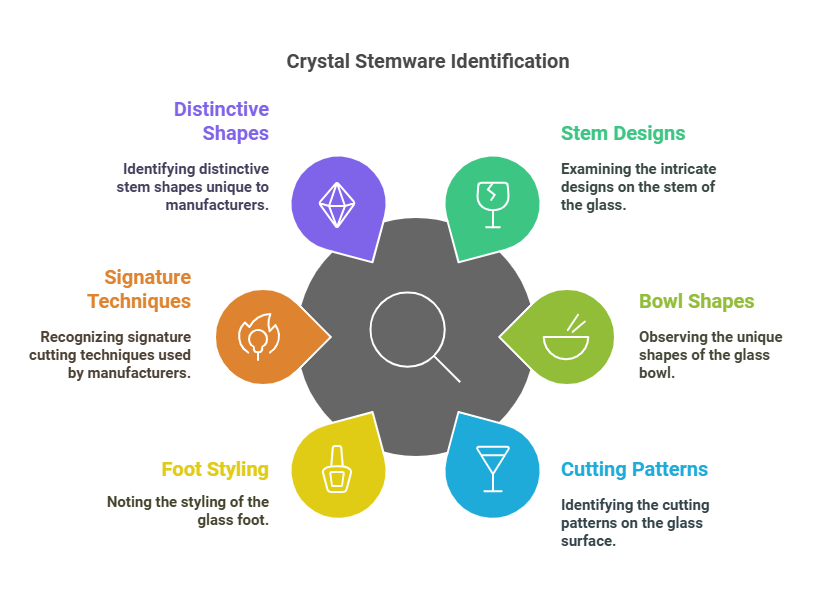
CRYSTAL STEMWARE IDENTIFICATION GUIDELINES
Just as collectors learn about various ways of identifying various glassware brands, here are the specific guidelines that exist for stemware identification:
Pattern Recognition
– Study stem designs
– Note bowl shapes
– Examine cutting patterns
– Compare foot styling
Manufacturer-Specific Features
– Signature cutting techniques
– Distinctive stem shapes
– Unique marking placements
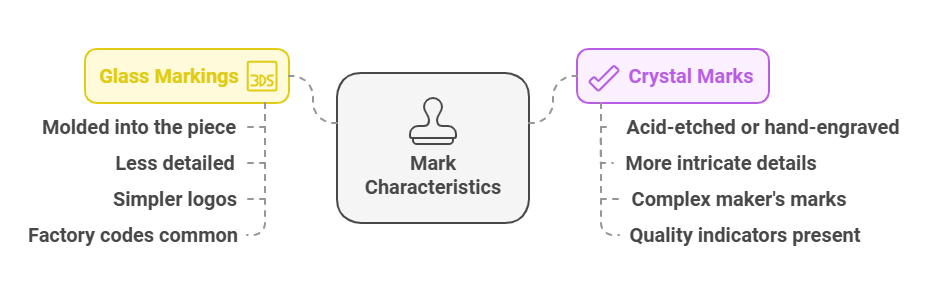
HOW TO IDENTIFY GLASS MARKINGS VS CRYSTAL MARKS
Glass and crystal markings differ in several key ways:
Glass Markings Characteristics
– Often molded into the piece
– Less detailed
– Usually simpler logos
– Factory codes are common
Crystal Marks Characteristics
– Usually acid-etched or hand-engraved
– More intricate details
– Complex maker’s marks
– Quality indicators present
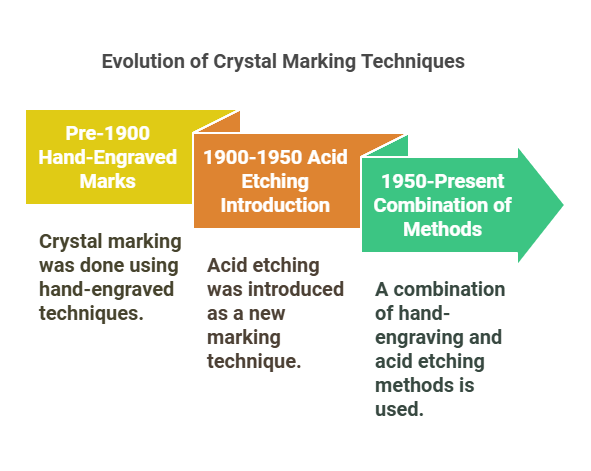
DATING YOUR CRYSTAL THROUGH MARKS
Understanding the age of your crystal involves more than just reading the marks.
Consider these factors:
Period-Specific Characteristics
– Pre-1900: Often hand-engraved marks
– 1900-1950: Introduction of acid etching
– 1950-present: Combination of methods
HOW TO IDENTIFY VINTAGE ETCHED GLASSWARE?
1. Examine the Etching
– Hand-etched pieces show slight irregularities
– Machine-etched patterns are perfectly uniform
– Period-specific motifs help date pieces
2. Study the Pattern
– Record pattern names
– Research production dates
– Note any pattern variations
HOW TO TELL IF GLASSWARE IS VINTAGE OR ANTIQUE
1. Age Indicators
– Wear patterns on the base
– Style of cutting
– Type of glass composition
2. Manufacturing Techniques
– Hand-finishing marks
– Pontil marks
– Mould lines.
HOW TO TELL IF A VASE IS CRYSTAL?
To determine if a vase is crystal rather than glass:
Sound Test: The lead content, weight, rim thickness, and UV reaction. The easiest method to determine if a crystal is to see if it forms prisms and makes a bell sound when gently tapped
Visual Tests:
Optical clarity: Crystal appears more brilliant and clear
Light refraction: Creates rainbow effects when light passes through
Edge examination: Crystal has sharper, more precise edges
Cut quality: Deeper, more precise cuts with better finishing
Physical Properties:
Weight: Significantly heavier than the equivalent glass piece
Temperature: Cooler initial touch, slower to warm
Durability: More resistant to chipping and scratching
UV Light Test: One of the best ways to identify a crystal is to shine a black light on it.
Due to the lead content, the crystal will have a blue or purple tint to it, whereas the glass just looks a dull green color under black light
These identification methods, when used together, provide reliable ways to distinguish genuine crystal from regular glass and identify specific manufacturers, even when dealing with unmarked pieces.
The combination of physical testing, visual examination, and mark identification creates a comprehensive approach to crystal authentication and valuation.
AUTHENTICATION AND AVOIDING REPRODUCTIONS
With valuable crystal pieces commanding premium prices, reproductions and fakes have entered the market. Understanding authentication is essential for collectors.
Common Reproduction Red Flags
Marking Inconsistencies:
Marks that don’t match documented examples
Poorly executed etching or engraving
Marks in unusual locations
Modern techniques on “vintage” pieces
Quality Issues:
Lower quality cutting (shallow, imprecise)
Inferior optical clarity
Lighter weight than authentic pieces
Machine-made characteristics on supposedly hand-cut items
Documentation Problems:
Lack of provenance for rare pieces
Suspicious pricing (too good to be true)
The seller is unable to provide the history
Missing pattern documentation
Professional Authentication Services
When to Seek Expert Opinion:
High-value purchases
Rare or unusual pieces
Uncertain attribution
Insurance or estate purposes
Authentication Resources:
Certified appraisers specializing in crystal
Auction house experts
Manufacturer authentication services
Crystal collector associations
Building Authentication Skills
Study Authentic Examples:
Visit museum collections
Attend antique shows and auctions
Join collector groups and forums
Build a reference library of manufacturer materials
Develop Comparative Eye:
Handle both authentic and reproduction pieces
Study marking techniques up close
Learn period-appropriate characteristics
Understand manufacturing evolution.
CARE AND PRESERVATION OF MARKED CRYSTAL
To maintain the legibility of crystal marks:
1. Proper Cleaning
– Use lukewarm water
– Avoid abrasive materials
– Pat dry immediately
2. Storage Recommendations
– Store pieces separately
– Avoid stacking
– Keep away from direct sunlight.
CRYSTAL MARKS INDEX
A Crystal Marks Index is a comprehensive reference system (systematic database) that catalogs and organizes the various markings, signatures, and identifying features used by crystal and glassware manufacturers throughout history.
This specialized index serves as an essential tool for collectors, dealers, appraisers, and enthusiasts to identify and authenticate crystal pieces. It includes:
Manufacturer Signatures: A collection of signatures and markings that can be found on many types of antique and vintage collectable glassware.
Organizational Structure: The index typically organizes information by:
Acid-Etched Marks: Permanent marks created using acid during manufacturing.
Molded Marks: Integrated into the glass during the forming process.
Paper Labels: Adhesive labels (often missing on vintage pieces).
Engraved Signatures: Hand-etched or machine-engraved identifiers.
Pattern Numbers: Numerical codes for specific designs.
Quality Indicators: Lead content percentages, craftsmanship levels.
HOW TO USE A CRYSTAL MARKS INDEX
Step-by-Step Process:
Locate the Mark: You could find the mark on the rim or center of the foot, on the stem, or on the bottom of the bowl
Examine Carefully: A magnifying glass and holding the stemware up to the light can help you spot the mark and read it
Cross-Reference: Match found marks with index entries
Verify Details: Confirm manufacturer, dating, and authenticity.
PROFESSIONAL CRYSTAL MARKS INDEX RESOURCES
Published Guides: The most extensive stemware guide ever published, this is an ideal reference guide for the thousands of glass dealers across the country who search for the many patterns of etched, plain, blown, or molded designs.
Digital Databases: A searchable database of antique + collectable glassware, with pictures, sizes + pattern numbers of vintage glass from all over the world.
Specialized Collections: Many indexes focus on specific aspects such as:
Stemware patterns exclusively
Regional manufacturers
Specific time periods
Particular crystal types.
BENEFITS OF USING A CRYSTAL MARKS INDEX
Authentication: Verify genuine pieces versus reproductions.
Valuation: Determine market value through proper identification.
Dating: Establish production periods and historical context.
Pattern Identification: Match pieces to complete sets.
Educational Research: Learn about manufacturer histories and techniques.
LIMITATIONS AND CONSIDERATIONS
Unmarked Pieces: Many authentic vintage pieces lack marks entirely.
Worn Marks: Age and handling can obscure or remove markings.
Counterfeit Marks: Modern reproductions may include fake marks.
Incomplete Records: Some smaller manufacturers may not be well-documented.
CREATING YOUR OWN CRYSTAL MARKS REFERENCE
For serious collectors, maintaining a personal crystal marks index can include:
Photography of pieces in your collection
Detailed notes on acquisition and provenance
Cross-references to published guides
Documentation of any unique or unusual marks
A Crystal Marks Index serves as an indispensable tool in the world of crystal collecting and identification, providing the systematic approach needed to properly authenticate, date, and value crystal glassware.
Whether used by professional dealers or passionate collectors, these indexes represent decades of accumulated knowledge about the artistry and craftsmanship of crystal manufacturing.
This comprehensive reference system transforms what might otherwise be mysterious markings into valuable information that unlocks the history, origin, and significance of crystal pieces, making it an essential component of any serious crystal identification library.
CRYSTAL AND GLASS VALUATION FACTORS
Beyond identification, understanding what drives value helps collectors make informed decisions about purchases, sales, and insurance.
Primary Value Determinants
Manufacturer Prestige:
Heritage brands command premium pricing
Company history and reputation matter
Limited production makes manufacturers more valuable
Artist-signed pieces increase their worth significantly
Age and Rarity:
Antique pieces (100+ years) are often most valuable
Discontinued patterns are harder to find
Limited editions and commemoratives
Short production runs increase scarcity
Condition Assessment:
Mint condition is critical for maximum value
Even minor chips reduce the value by 30-50%
Cloudiness from dishwasher damage decreases the worth
Original boxes and documentation add value
Pattern Complexity:
Intricate cutting commands higher prices
Combined techniques (cutting + etching) more valuable
Hand-finishing versus machine-cutting affects pricing
The world of crystal markings is a fascinating journey through craftsmanship and history.
Whether you’re a serious collector or simply curious about family heirlooms, understanding these marks opens up a world of appreciation for these beautiful pieces.
Remember, each mark tells a story – it’s up to us to learn how to read it.
This comprehensive guide serves as your foundation for glass and crystal identification, covering everything from basic glass versus crystal distinctions to advanced authentication techniques.
As you explore specific manufacturers, patterns, and identification challenges, use the linked resources throughout this guide to deepen your knowledge.
Each article provides detailed information on particular aspects of crystal and glass identification, helping you build expertise systematically.
Whether you’re identifying a single inherited piece or building a significant collection, the combination of physical testing methods, mark identification, pattern recognition, and brand knowledge will serve you well.
Start with the basics—learn to distinguish crystal from glass, familiarize yourself with major manufacturer marks, and practice the identification techniques outlined here.
Over time, you’ll develop an eye for quality, authenticity, and value that makes crystal identification both rewarding and enjoyable.
How to identify Mikasa crystal is a common question among antique lovers and people who discover beautiful glassware at estate sales or in their family collections.
These stunning pieces, manufactured long ago, have decorated homes for generations, catching light and adding elegance to special occasions.
Whether you’ve inherited some pieces or found them at a thrift store, knowing what you have can be both exciting and valuable.
Many collectors wonder, “Is Mikasa crystal or glass?” when they hold these sparkling pieces in their hands. It’s an important question, as the difference can mean a lot in terms of both value and care requirements.
In this guide, we’ll walk you through simple ways to tell if your piece is genuine Mikasa crystal, from checking manufacturer marks to performing simple tests that reveal a piece’s authenticity.
Whether you’re a curious collector or just trying to identify a family heirloom, we’ve got you covered.
HOW DO I KNOW IF I HAVE CRYSTAL OR GLASS?
Telling the difference between crystal and regular glass is hard to tell at first sight but some clues will enable you to tell crystal from regular glass.
To determine whether you have crystal or glass, you can consider the following factors:
Crystal tends to produce a clear, melodious ring when tapped, while glass often produces a duller, less resonant sound.
Crystal is generally clearer and has more brilliance than regular glass. It often has fewer impurities, resulting in greater transparency and sparkle.
Crystal is typically heavier than glass due to its lead content. If the item feels heavier than you’d expect, it might be crystal.
Crystal often features intricate patterns, cuts, and facets that create a distinctive, sparkling effect, while regular Glass items may have simpler designs.
High-quality Crystal is often more expensive than glass due to its craftsmanship and lead content. Items from well-known crystal manufacturers, like Waterford or Baccarat, are likely to be crystals.
Regular glasses have thicker rims and lips, while Crystal glass does not have thick rims and Lips.
IS MIKASA CRYSTAL OR GLASS
Mikasa is both crystal and glass, which means Mikasa manufactures glassware using crystal and regular glass material.
WHERE IS MIKASA CRYSTAL MADE?
Mikasa Crystal is made outside the USA, in other countries like China, Slovenia, or even Germany.
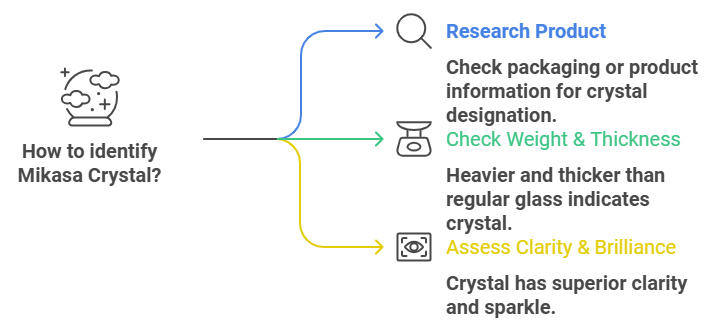
HOW TO IDENTIFY MIKASA CRYSTAL
Identifying Mikasa crystal shouldn’t be an issue; once you can identify crystal from the regular glass, you can employ the same method to identify Mikasa crystal.
Let’s now see a few methods you can use to identify Mikasa crystal:
Research the Product: If you have the packaging or access to product information, check the label or description. It should specify whether the item is made of crystal or glass.
Check the weight and thickness of the Mikasa glass. If it’s heavier and thicker than the regular glass, then it is Crystal glassware.
Check for Clarity and Brilliance: Crystal is known for its clarity and brilliance. Hold the Mikasa glassware up to the light and observe how it reflects and refracts light. High-quality crystal will have a more brilliant sparkle compared to regular glass.
Mikasa glassware brand also provides a range of barware, such as cocktail glasses, whiskey glasses, and highball glasses, designed for various beverages and cocktails.
Mikasa glasses come in various collections and patterns with elegant and intricate designs tailored to meet your special occasions, such as weddings, everyday drinking, outdoor parties, holidays, casual family gatherings, or anniversaries.
Mikasa glassware, especially crystal, should be hand-washed with mild soap and warm water to maintain its brilliance. Avoid abrasive scrubbers and harsh detergents.
Dry Mikasa glasses with a lint-free cloth or allow them to air dry to prevent water spots.
Store your glassware carefully, ensuring they don’t touch each other to prevent chipping or breakage.
Avoid exposing crystal glasses to extreme temperatures or sudden temperature changes, as this can lead to cracks.
Finally, remember that the specific Mikasa glasses you choose will depend on your personal preferences, the type of beverages you plan to serve, and the occasion.
Proper care and maintenance will help preserve their beauty and functionality over time.
MIKASA CRYSTAL MARKINGS
It is normal for products to bear markings or labels as a sign of authenticity to their brand; these markings also denote quality craftsmanship that provides information about the product.
Normally, most brands either on their dinnerware or glassware have their Logos or markings on the body of the product or underneath the product.
So, does Mikasa crystal glass have markings? It is very difficult to see Mikasa’s crystal markings on the body or underneath their collection.
Instead, we recommend you check the package of the Mikasa Crystal for the Label.
Secondly, Mikasa often labels their crystal patterns with specific names or item numbers. This helps identify the design of the crystal pattern.
Some Mikasa pieces have etched or engraved markings that may include signatures of designers or artists, as well as limited edition numbers.
In certain cases, Mikasa may include the year of production on their crystal products. This is common for limited-edition or commemorative pieces.
In addition, Mikasa has been known to use date codes to identify the year a specific pattern was introduced. These codes are usually a combination of letters and numbers.
Finally, these markings serve to authenticate and provide information about the Mikasa crystal item, making it easier for collectors and enthusiasts to identify and appreciate the piece’s history and quality.
MIKASA GLASSWARE DISCONTINUED
Not every pattern or collection of Mikasa Glassware is still in production; some vintage Mikasa Glassware collections or other patterns have been discontinued.
An example of Mikasa Glassware that has been discontinued is the Arctic Lights, which was discontinued in 2020.
The Mikasa Cheers White Wine Glasses are still in production and haven’t been discontinued yet.
IS MIKASA CRYSTAL WORTH ANYTHING?
Of course, Mikasa Crystal is valuable, maybe not all Mikasa crystal, but definitely, some specific vintage Mikasa crystal or some very limited Mikasa crystal collections are in high demand among lovers of vintage or specially designed Mikasa Crystal glass.
So, if you’re thinking of getting one or selling your Mikasa Crystal? The worth of the Mikasa Crystal will be affected by the demand, history, age, condition, and scarcity of the Mikasa Crystal collection.
Finally, to determine if your Mikasa crystal is valuable, we recommend you check online auction websites that offer insights into the current market value of Mikasa crystal collections.
MIKASA CRYSTAL BOWL VALUE
Mikasa Crystal Bowl’s worth can vary significantly depending on factors like the pattern, age, condition, and the current demand in the market.
To determine the value of your specific Mikasa Crystal Bowl, consider these steps:
Consult an Appraiser: A professional appraiser who specializes in glassware and crystal can provide an accurate valuation based on the bowl’s unique characteristics.
Online Research: Look for similar Mikasa Crystal Bowls on online marketplaces and auction websites to see what similar items have sold for recently. This can give you a ballpark estimate of its value.
Collector’s Guides: Some collector’s guides and reference books may provide information on Mikasa crystal patterns and their estimated values. You can find these at your local library or online.
Condition Assessment: The condition of the bowl plays a significant role in its value. Assess any chips, cracks, or scratches, as these can decrease its worth.
Rarity and Age: Consider the rarity of the pattern and the age of the bowl. Older and rarer patterns tend to be more valuable.
Remember that the value of collectible items can fluctuate over time, so it’s a good idea to periodically reevaluate their worth if you plan to sell or insure them.
WHICH IS BETTER, GLASS OR CRYSTAL?
Choosing between regular glass and crystal all boils down to choice, use, and preference.
For everyday use and affordability, we recommend regular glass, while for special occasions, especially for wine and bar, we recommend crystal.
Overall, individuals who are conscious of their health will stick with regular glass that doesn’t contain lead content, as crystal has 24% lead in it.