You’re standing in the kitchen store, staring at rows of microwaves. The price tags are confusing. The features sound fancy. But there’s one question bugging you: will this thing actually heat your food properly?
Maybe your old microwave takes forever to warm up last night’s pizza. Or perhaps you’re tired of cold spots in your reheated soup.
You want something that works fast and heats evenly. You don’t want to waste money on too little power or pay extra for more than you need.
Is a 1000 watt microwave powerful enough? The wattage number seems important, but what does it really mean for your daily cooking?
Before you spend your hard-earned money, you need to understand how this affects your kitchen routine, your electricity bill, and whether it’ll actually solve your heating problems.
Let’s uncover the truth about microwave power and help you make the right choice.
WHO SHOULD READ THIS GUIDE?
This comprehensive guide is designed for homeowners, busy families, and anyone looking to buy a new microwave who wants to understand:
- How microwave wattage affects cooking performance
- Whether 1000 watts meets their specific heating needs
- How to save money on electricity while getting faster results
- Which wattage works best for different household sizes
IS A 1000 WATT MICROWAVE POWERFUL ENOUGH?

Yes, a 1000-watt microwave provides excellent power for home cooking needs. It heats food 25% faster than 800-watt models and matches the cooking times on most food packaging instructions.
UNDERSTANDING MICROWAVE WATTAGE: WHAT THE NUMBERS REALLY MEAN
Microwave wattage measures cooking power, not just electricity use. Think of it like horsepower in a car – more watts mean faster, more efficient heating.
Here’s how different wattage levels perform in real-world testing:
Wattage Performance Comparison
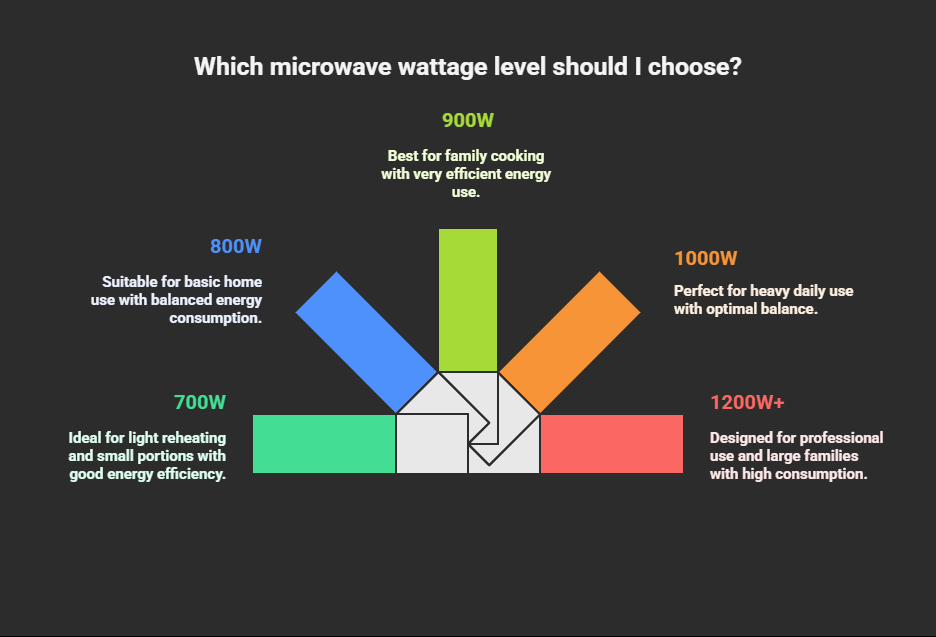
| Wattage Level | Cooking Speed | Best For | Energy Efficiency |
| 700W | Slow | Light reheating | Good for small portions |
| 800W | Moderate | Basic home use | Balanced consumption |
| 900W | Fast | Family cooking | Very efficient |
| 1000W | Very Fast | Heavy daily use | Optimal balance |
| 1200W+ | Professional | Large families | High consumption |
According to Consumer Reports, “Microwave ovens with wattages around 1000 watts are popular among consumers because they offer a good balance between cooking speed and energy efficiency.”
WHY 1000 WATTS MAKES A REAL DIFFERENCE IN YOUR KITCHEN
Faster Cooking Times Save You Time and Money:

A 1000-watt microwave cooks food approximately 20-25% faster than 800-watt models. Here’s what this means for common foods:
Real Cooking Time Comparisons:
- Reheating coffee: 45 seconds vs. 1 minute 15 seconds (800W)
- Cooking jacket potato: 5-6 minutes vs. 8-9 minutes (700W)
- Defrosting chicken breast: 3 minutes vs. 5 minutes (800W)
- Heating frozen vegetables: 2-3 minutes vs. 4-5 minutes (700W)
Better Heat Distribution Means Better Results
Higher wattage creates more even molecular excitation in food. This translates to:
- Fewer cold spots in reheated meals
- More consistent texture in cooked foods
- Better nutrient retention in vegetables
- Reduced risk of overcooking edges while centers stay cold.
HOW MUCH ELECTRICITY DOES A 1000 WATT MICROWAVE ACTUALLY USE?
A 1000-watt microwave typically draws close to 1000 watts from your electrical system when operating at full power.
The wattage rating of a microwave indicates its peak power consumption during operation.
While it pulses on and off at lower settings, the actual power draw averages around its rated wattage during use.
Microwaves generally use between 600 and 1000 watts, depending on the model. For example, a 1000-watt microwave running for 15 minutes a day uses about 91.3 kilowatt-hours (kWh) annually.
Monthly Electricity Cost Breakdown
Based on average U.S. electricity rates of $0.15 per kWh:
- Light use (15 minutes daily): $1.13 per month
- Moderate use (30 minutes daily): $2.25 per month
- Heavy use (60 minutes daily): $4.50 per month
Energy-Saving Tip: Because 1000-watt microwaves cook faster, they often use less total energy per cooking session compared to lower-wattage models that run longer.
IS 1000 WATTS TOO MUCH POWER FOR HOME USE?
No, 1000 watts is not excessive. It’s actually the industry standard that most food manufacturers use when creating heating instructions.
Why 1000 Watts Is the Sweet Spot?
- Package Instructions Match: Most frozen foods and microwave meals list cooking times for 1000-watt microwaves.
- Versatile Power Control: You can reduce power to 50% or 70% for delicate foods
- Future-Proof Investment: Handles everything from reheating to actual cooking
- Resale Value: Standard wattage maintains appliance value.
COMPARING 900W VS 1000W: WHICH SHOULD YOU CHOOSE?
The 1000-watt model wins for most households. Here’s why:
Performance Differences
- Speed: 1000W cooks 10% faster than 900W
- Consistency: Better heat distribution reduces hot/cold spots
- Convenience: No need to adjust package cooking times
- Versatility: More power settings available
Cost Considerations
The price difference between 900W and 1000W models is typically $20-40(depnds on brand and features), but the 1000W model:
- Saves time daily
- Provides better cooking results
- Offers more precise control options.
ELECTRICAL REQUIREMENTS: DO YOU NEED A DEDICATED CIRCUIT?
Yes, install a dedicated 20-amp circuit for your 1000-watt microwave. Here’s what you need to know:
Safety Requirements
- Dedicated circuit prevents overloading
- Reduces the risk of tripped breakers
- Ensures consistent performance
- Meets most local electrical codes
Installation Costs
Professional electrician installation may typically cost $150-300, depending on:
- Distance from the electrical panel
- Wall access requirements
- Local permit fees
PROFESSIONAL TIPS FOR MAXIMIZING YOUR 1000 WATT MICROWAVE
Power Level Guidelines for Different Foods:
100% Power (1000W):
- Boiling water
- Reheating liquids
- Cooking popcorn
- Heating pre-cooked foods
- Defrosting meat
- Cooking eggs
- Reheating delicate sauces
- Melting chocolate
50% Power (500W):
- Softening butter
- Proofing bread dough
- Gentle reheating of dairy products
Container Selection for Best Results
Microwave-Safe Materials:
- Glass (Pyrex, Anchor Hocking)
- Ceramic without metallic trim
- Microwave-safe plastic (look for symbol)
- Silicone containers
Never Use:
- Containers with metallic accents
- Metal containers or utensils
- Aluminum foil (unless manufacturer-approved)
- Plastic containers are not marked microwave-safe.
MAINTENANCE TIPS TO KEEP YOUR 1000 WATT MICROWAVE RUNNING EFFICIENTLY
Daily Maintenance
- Wipe interior after each use
- Clean spills immediately
- Leave the door open briefly after use to air-dry
Weekly Deep Cleaning
- Remove the turntable and wash it in the sink
- Clean interior with mild soap solution
- Wipe door seals carefully
- Clean exterior with appropriate cleaner
Monthly Performance Checks
- Test heating with water bowl (1 cup should boil in 2-3 minutes)
- Check door alignment and seals
- Inspect the power cord for damage
- Clean air vents.
COMMON QUESTIONS ABOUT 1000 WATT MICROWAVES
For 700W Microwave Recipes: Reduce time by 30%.
For 1200W Microwave Recipes: Add 20% more time.
Example: Recipe calls for 2 minutes at 700W
Your 1000W microwave: Cook for 1 minute 24 seconds.
Compact (0.7-1.0 cubic feet): 1-2 people, basic reheating.
Mid-size (1.1-1.4 cubic feet): 2-4 people, regular cooking.
Large (1.5+ cubic feet): 4+ people, frequent use.
Size doesn’t affect wattage – focus on cooking power for performance.
Yes, with proper techniques:
Use microwave-safe baking containers.
Reduce power to 50-70% for most baked goods.
Cover with a vented microwave-safe lid.
Expect different textures than oven baking.
BEST 1000 WATT MICROWAVE FEATURES TO LOOK FOR
Essential Features
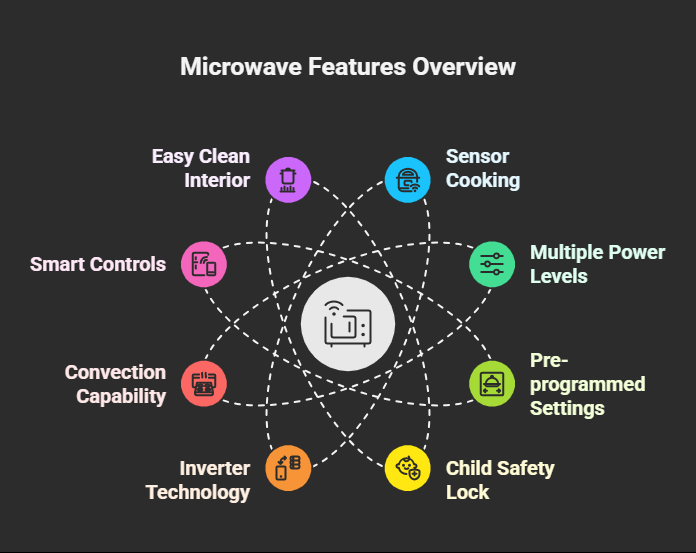
- Sensor Cooking: Automatically adjusts time and power
- Multiple Power Levels: At least 10 power settings
- Pre-programmed Settings: Popcorn, reheat, defrost options
- Child Safety Lock: Important for families
Advanced Features Worth Considering
- Inverter Technology: Provides consistent power levels
- Convection Capability: Combines microwave and oven cooking
- Smart Controls: WiFi connectivity and app control
- Easy Clean Interior: Non-stick or ceramic interior
ENERGY EFFICIENCY TIPS FOR 1000 WATT MICROWAVE USERS
Maximize Efficiency
- Use appropriate container sizes – smaller containers heat faster
- Cover food when possible – retains moisture and speeds heating
- Arrange food evenly – promotes uniform heating
- Use correct power levels – full power isn’t always best
Cost-Saving Strategies
- Batch heating: Heat multiple items together when possible
- Proper placement: Center items for even heating
- Regular maintenance: Clean microwaves run more efficiently
- Smart usage: Use the microwave instead of the oven for small portions.
MAKING THE RIGHT CHOICE: IS 1000 WATTS RIGHT FOR YOU?
Choose 1000 Watts If You:
- Cook or reheat food daily
- Have a family of 3+ people
- Want fast, consistent results
- Don’t want to adjust package cooking times
- Value convenience and efficiency
Consider Lower Wattage If You:
- Only reheat beverages occasionally
- Live alone or in a couple
- Have limited electrical capacity
- Prioritize lower electricity bills over speed
FINAL RECOMMENDATIONS
A 1000-watt microwave provides the optimal balance of cooking power, energy efficiency, and convenience for most households.
The faster cooking times often offset the slightly higher electricity consumption, and the ability to follow standard package instructions without adjustments makes daily use much more convenient.
Top Recommendation: Look for a 1000-watt microwave with sensor cooking, multiple power levels, and a size appropriate for your household. The investment in proper wattage will pay dividends in time saved and better cooking results.
Budget Tip: If choosing between a feature-rich 900W model and a basic 1000W model at the same price, choose the 1000W. The extra power provides more value than additional features you might rarely use.
Remember, your microwave is likely one of your most-used kitchen appliances.
Investing in the right wattage level ensures years of reliable, efficient performance that matches your cooking needs and lifestyle.