Tag: microwave appliances

  • How Much Do Microwave Weigh

    You’re standing in the kitchen section of your local retailer, eyeing that sleek microwave. It looks perfect for your tiny flat.

    But then reality hits – will your flimsy student desk hold it? Can you actually lift it when moving day arrives? Most importantly, how much does the bloody thing weigh?

    Here’s the thing about microwaves: their weight varies dramatically more than you’d expect. A compact model might tip the scales at just 20 pounds, whilst a full-sized beast can weigh over 60 pounds.

    That’s the difference between carrying a toddler and wrestling with a large suitcase.

    For students cramming into tiny dorms, seniors managing mobility challenges, or anyone planning their next house move, understanding microwave weights isn’t just helpful, it’s essential.

    But here’s what most people don’t realise about choosing the right weight.

    AT A GLANCE: HOW MUCH DO MICROWAVES WEIGH?

    How much do microwave weigh

    Microwaves typically weigh between 18-65 pounds (8-29 kg) depending on size and type:

    Compact microwaves: 18-30 pounds (0.5-0.9 cu ft) • Mid-size microwaves: 30-45 pounds (0.9-1.4 cu ft)
    Large microwaves: 45-65 pounds (1.4-2.2 cu ft) • Over-the-range models: 50-80 pounds (include ventilation systems) • Convection microwaves: 50-80 pounds (heaviest due to extra features)

    Factors affecting weight:

    • Internal capacity and power output
    • Build materials (stainless steel vs plastic)
    • Additional features like convection cooking
    • Brand and build quality

    Lightweight options under 25 pounds are ideal for students, seniors, and frequent movers, whilst models over 45 pounds typically require two-person lifting and professional installation for over-range mounting.

    UNDERSTANDING MICROWAVE WEIGHT CATEGORIES

    When it comes to microwave weights, size truly matters. However, it’s not just about the outer dimensions. The internal components, build quality, and additional features all play crucial roles.

    Compact Microwaves: The Lightweight Champions

    Compact microwaves typically weigh between 18-30 pounds (8-14 kg). These little workhorses are perfect for small spaces and easy handling.

    How much does a countertop microwave weigh

    Key Features:

    • Internal capacity: 0.5-0.9 cubic feet
    • Power output: 600-800 watts
    • Ideal for: Students, seniors, small flats

    Mid-size models generally weigh 30-45 pounds (14-20 kg). They offer the sweet spot between functionality and manageability.

    1250 Watts Panasonic Microwave Oven

    Typical Specifications:

    • Internal capacity: 0.9-1.4 cubic feet
    • Power output: 800-1100 watts
    • Perfect for: Young professionals, small families
    RELATED: HOW HOT DOES A MICROWAVE GET?

    Full-Size Microwaves: The Heavy Hitters

    Large countertop microwaves can weigh 45-65 pounds (20-29 kg) or more. These units pack serious cooking power but require careful consideration.

    What You Get:

    • Internal capacity: 1.4-2.2 cubic feet
    • Power output: 1100-1250+ watts
    • Best for: Large families, serious cooks.

    WEIGHT VARIATIONS BY MICROWAVE TYPE

    Not all microwaves are created equal. The type significantly affects the overall weight.

    Countertop Microwaves
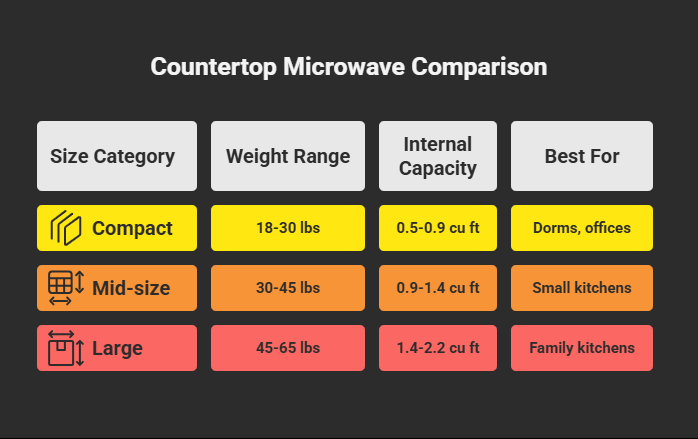
    countertop microwave weight comparison

    These free-standing units are the most common type. Their weights vary based on size and features.

    Size CategoryWeight RangeInternal CapacityBest For
    Compact18-30 lbs0.5-0.9 cu ftDorms, offices
    Mid-size30-45 lbs0.9-1.4 cu ftSmall kitchens
    Large45-65 lbs1.4-2.2 cu ftFamily kitchens

    Over-the-Range Microwaves

    Over-the-range models typically weigh 50-80 pounds (23-36 kg). They’re heavier because they include ventilation systems and mounting hardware.

    Additional Considerations:

    Samsung 1000 watts microwave oven
    • Built-in exhaust fans add weight
    • Stronger housing for overhead mounting
    • Professional installation is usually required

    Built-In Microwaves

    Built-in units can weigh 40-70 pounds (18-32 kg). Their weight depends on trim kits and additional insulation.

    Convection Microwaves: The Heaviest Option

    Convection microwaves are the heavyweight champions, often weighing 50-80 pounds (23-36 kg). The added convection fan and heating elements increase the overall weight significantly.

    WHAT MAKES MICROWAVES HEAVY?
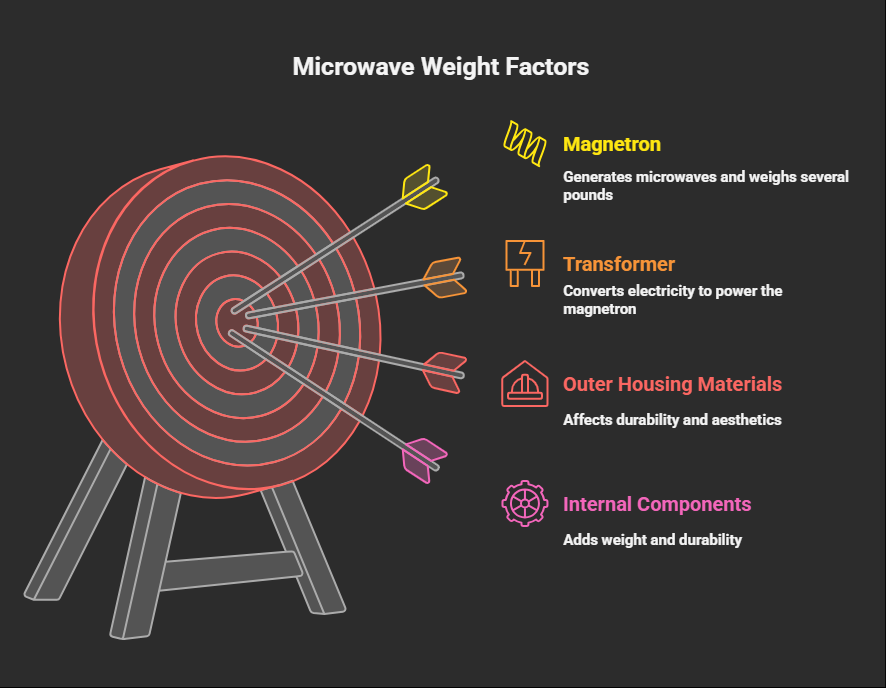
    microwave weight factors

    Understanding why microwaves weigh what they do helps you make smarter choices.

    The Magnetron: The Heart of the Matter

    The magnetron generates microwaves and weighs several pounds alone. Higher wattage units need bigger, heavier magnetrons.

    Transformer Weight

    The transformer converts household electricity to power the magnetron. More powerful microwaves need heavier transformers.

    Outer Housing Materials

    Stainless Steel: Heavier but more durable and stylish. Plastic: Lighter but less premium feeling. Combination: Balances weight and aesthetics

    Internal Components

    Turntables, racks, and interior coatings all add weight. Premium models often include heavier, more durable components.

    LIGHTWEIGHT MICROWAVE OPTIONS FOR SPECIAL NEEDS

    For seniors, students, and anyone with lifting limitations, lightweight options are crucial.

    Best Lightweight Models Under 25 Pounds

    Several manufacturers focus on creating lighter microwaves without sacrificing functionality:

    How much does a 20 Litre microwave weigh

    Compact Options:

    • 0.7 cu ft models: 20-25 lbs
    • Perfect power range: 700-800 watts
    • Suitable for most cooking needs

    Features to Look For:

    • Easy-grip handles
    • Simple controls
    • Lightweight turntable
    • Compact footprint

    Portable and Travel Microwaves

    Ultra-light models weighing 15-20 pounds (7-9 kg) are available for:

    • Caravans and motorhomes
    • Hotel room cooking
    • Temporary living situations.

    MOVING WITH MICROWAVES: WEIGHT CONSIDERATIONS
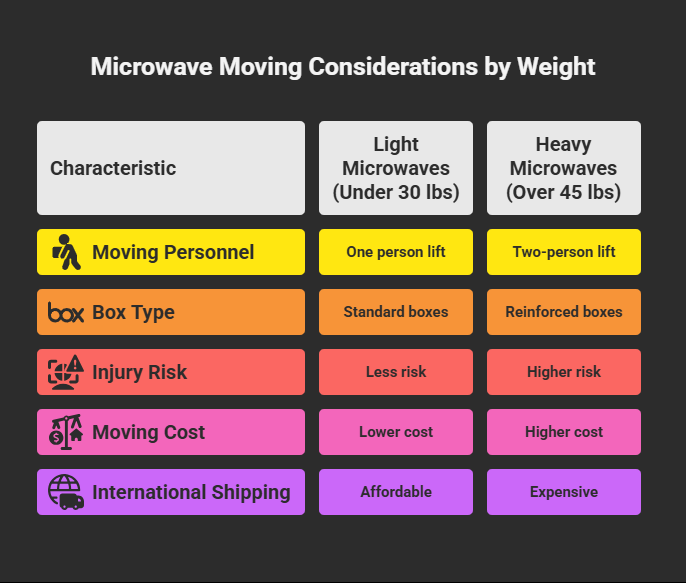
    microwave moving consideration by weight

    Planning a move? Your microwave’s weight affects everything from packing to transport costs.

    Packing Tips by Weight

    Light Microwaves (Under 30 lbs):

    • Can be moved by one person
    • Standard moving boxes work fine
    • Less risk of injury

    Heavy Microwaves (Over 45 lbs):

    • Require a two-person lift
    • Need reinforced boxes
    • Consider professional movers

    Moving Cost Implications

    Removal companies often charge by weight. A heavy microwave might add $50-100 to your moving bill. Sometimes, buying new at your destination costs less than moving an old, heavy unit.

    International Moves

    For overseas relocations, microwave weight becomes even more critical. Shipping costs can easily exceed the appliance’s value.

    COUNTER SUPPORT: CAN YOUR SURFACE HANDLE THE WEIGHT?

    Not all surfaces can support every microwave. This is especially important for students and renters.

    Standard Counter Capacity

    Most kitchen worktops handle 50-75 pounds per square foot. However, the support structure underneath matters more.

    Safe Bets:

    • Built-in kitchen counters: Usually fine for any microwave
    • Reinforced shelving: Check weight ratings
    • Microwave stands: Purpose-built for the job

    Risky Options:

    • Flimsy student desks: Often can’t handle mid-size units
    • Wire shelving: May bow under weight
    • Wall-mounted shelves: Check mounting hardware

    DIY Support Solutions

    For Students:

    • Microwave carts with wheels
    • Reinforced shelving units
    • Floor-standing options

    For Renters:

    • Removable reinforcement brackets
    • Adjustable microwave stands
    • Counter-top extensions.

    HEALTH AND SAFETY: MANAGING MICROWAVE WEIGHT

    Lifting and moving microwaves safely prevents injury, especially for seniors and those with mobility challenges.

    Proper Lifting Technique

    Before You Lift:

    1. Clear a path completely
    2. Get help for units over 30 lbs
    3. Use proper lifting posture
    4. Remove the turntable first

    Safe Lifting Tips:

    • Bend your knees, not your back
    • Keep the microwave close to your body
    • Take breaks during longer moves
    • Use dollies or carts when possible

    Accessibility Considerations

    For Seniors:

    • Choose models under 25 lbs when possible
    • Look for microwaves with easy-grip handles
    • Consider countertop height carefully
    • Ensure controls are easily reachable

    For Limited Mobility:

    • Lightweight options are essential
    • Roll-out shelves help with access
    • Voice-controlled models reduce physical interaction.

    BRAND COMPARISONS: WEIGHT DIFFERENCES ACROSS MANUFACTURERS

    Different brands have varying approaches to microwave construction, affecting weight.

    Lightweight Leaders

    Panasonic: Known for efficient, lighter designs. Toshiba: Offers several compact, lightweight options. Commercial Chef: Budget-friendly, lightweight models

    Premium Heavy Options

    KitchenAid: Built like tanks, often heavier. Breville: Premium materials increase weight. Wolf: Professional-grade, substantial weight

    BrandCompact WeightMid-Size WeightLarge Weight
    Panasonic20-28 lbs28-42 lbs42-58 lbs
    Samsung22-30 lbs30-48 lbs48-65 lbs
    LG21-29 lbs29-45 lbs45-62 lbs
    KitchenAid25-35 lbs35-55 lbs55-75 lbs

    POWER VS WEIGHT: FINDING THE RIGHT BALANCE

    More power usually means more weight, but not always proportionally.

    Efficient Design Matters

    Modern microwaves achieve better power-to-weight ratios through:

    • Advanced magnetron designs
    • Lighter transformer materials
    • Optimised internal layouts
    • Better insulation materials

    Power Sweet Spots

    700-800 Watts: Perfect for most cooking tasks, keeps weight reasonable 900-1000 Watts: Good balance of power and weight 1100+ Watts: Maximum power but significantly heavier

    Inverter Technology

    Panasonic’s inverter microwaves often weigh less than traditional models whilst delivering consistent power. This technology eliminates heavy transformers.

    SPECIAL SITUATIONS AND WEIGHT CONSIDERATIONS

    Different living situations require different approaches to microwave weight.

    Student Accommodation

    Challenges:

    • Weak furniture and surfaces
    • Frequent moving between accommodations
    • Limited lifting help is available
    • Budget constraints

    Solutions:

    • Stick to models under 25 lbs
    • Invest in a proper microwave cart
    • Keep original packaging for moves
    • Consider shared ownership with flatmates

    Rental Properties

    Landlord Considerations:

    • Some tenancy agreements restrict appliance weights
    • Kitchen surfaces may not support heavy units
    • Damage deposits at risk from overloading

    Tenant Strategies:

    • Check lease agreements for appliance restrictions
    • Get written permission for heavier units
    • Document existing surface conditions
    • Consider appliance insurance

    Senior Living

    Physical Limitations:

    • Reduced lifting capacity
    • Balance and stability concerns
    • Arthritis affecting grip strength
    • Height restrictions for safe use

    Adaptive Solutions:

    • Lightweight models under 20 lbs when possible
    • Slide-out shelves for easier access
    • Voice-activated controls
    • Professional installation services

    Tiny Homes and Caravans

    Unique Challenges:

    • Extreme space limitations
    • Weight affects vehicle performance
    • Power limitations
    • Vibration during transport

    Specialised Options:

    • RV-specific microwaves (often 15-25 lbs)
    • 12V power options available
    • Secure mounting systems
    • Compact dimensions prioritised.

    INSTALLATION WEIGHT REQUIREMENTS

    Professional installation becomes necessary when weight exceeds certain thresholds.

    Over-the-Range Installation

    These installations require:

    • Wall studs capable of supporting 80+ lbs
    • Professional mounting brackets
    • Proper ventilation connections
    • Electrical work compliance

    DIY vs Professional:

    • Units under 50 lbs: Possible DIY with help
    • Units over 60 lbs: Professional installation recommended
    • Always check manufacturer requirements

    Built-In Installation

    • Built-in microwaves need:
    • Trim kit compatibility
    • Cabinet reinforcement for heavier units
    • Proper ventilation clearances
    • Electrical compliance.

    The microwave industry continues evolving towards lighter, more efficient designs.

    Technological Advances

    Solid-State Technology: Eliminates heavy transformers and magnetrons. Advanced Materials: Lighter yet stronger housing materials. Integrated Designs: Combining multiple appliance functions. Smart Features: Adding functionality without significant weight.

    Environmental Considerations

    Lighter microwaves mean:

    • Reduced shipping costs and emissions
    • Easier recycling at end of life
    • Lower material usage
    • Better accessibility for all users.

    COST IMPLICATIONS OF MICROWAVE WEIGHT

    Weight affects price in several ways beyond the initial purchase.

    Purchase Price Factors

    Lightweight Premium: Some ultra-light models cost more due to advanced materials. Heavy-Duty Value: Heavier units sometimes offer better value per feature. Shipping Costs: Online purchases may include weight-based shipping fees.

    Long-Term Costs

    Moving Expenses: Heavy microwaves increase relocation costs. Installation Fees: Heavier units often require professional installation. Replacement Frequency: Lighter units might need more frequent replacement.

    Insurance Considerations

    Some renters’ insurance policies factor in appliance weight for:

    • Damage risk assessments
    • Replacement cost calculations
    • Liability coverage limits.

    PRACTICAL SHOPPING TIPS

    Armed with weight knowledge, here’s how to shop smart.

    In-Store Shopping

    Always Check:

    • Actual weight specifications
    • Handle quality and grip
    • Box weight for moving considerations
    • Return policy for weight-related issues

    Test Before Buying:

    • Lift the display model if possible
    • Check control accessibility at counter height
    • Ensure door opens smoothly
    • Test turntable operation

    Online Shopping

    Research Thoroughly:

    • Read detailed specifications
    • Check customer reviews for weight comments
    • Verify delivery and installation options
    • Understand return policies for heavy items

    Questions to Ask:

    • What’s included in the shipping weight?
    • Are installation services available?
    • What’s the actual product weight vs packaging?
    • Do delivery drivers assist with placement?

    MAINTENANCE AND WEIGHT OVER TIME

    Microwave weight can change slightly over time due to maintenance needs.

    Component Replacement

    Some parts may need replacement:

    • Turntables can crack and need heavier replacements
    • Door seals might require updates
    • Internal components occasionally fail

    Cleaning Considerations

    Heavy microwaves present cleaning challenges:

    • Difficult to move for thorough cleaning
    • Professional deep cleaning may be needed
    • Surrounding area maintenance becomes crucial.

    ENVIRONMENTAL IMPACT OF MICROWAVE WEIGHT

    Weight affects environmental considerations throughout the appliance’s lifecycle.

    Manufacturing Impact

    Heavier microwaves generally:

    • Use more raw materials
    • requires more energy to manufacture
    • Generate more packaging waste
    • Have higher transport emissions

    End-of-Life Considerations

    When disposal time comes:

    • Heavy units are harder to recycle
    • Transportation costs increase
    • Landfill impact is greater
    • Professional removal may be needed.

    FREQUENTLY ASKED QUESTIONS

    How much does a standard countertop microwave weigh?

    A standard countertop microwave typically weighs between 30 and 45 pounds (14-20 kg).

    However, this varies significantly based on size and features. Compact models start around 18 pounds, whilst large family-size units can exceed 60 pounds.

    What’s the lightest microwave available?

    The lightest microwaves currently available weigh around 15-18 pounds (7-8 kg).

    These are typically very compact models with 0.5-0.7 cubic feet of capacity and 600-700 watts of power. They’re perfect for students, seniors, or anyone prioritising portability.

    Can my kitchen counter support a heavy microwave?

    Most standard kitchen counters can support 50-75 pounds per square foot. However, the support structure underneath matters more than the counter material.

    If you’re unsure, check with a carpenter or use a microwave stand designed for the purpose.

    Do heavier microwaves cook food better?

    Not necessarily. Weight often indicates build quality and additional features, but cooking performance depends more on power output, technology, and design efficiency.

    Some lighter models with inverter technology actually perform better than heavier traditional units.

    How do I safely move a heavy microwave?

    Always get help for microwaves over 30 pounds. Remove the turntable and any loose parts first.

    Use proper lifting technique (bend knees, not back), keep the unit close to your body, and consider using a dolly or cart. Take breaks and clear your path completely.

    What’s the difference in weight between brands?

    Brand differences can be significant. Premium brands like KitchenAid often build heavier, more substantial units.

    Japanese brands like Panasonic focus on efficiency and tend to be lighter. Budget brands vary widely but often prioritise weight reduction to cut costs.

    Are over-the-range microwaves heavier than countertop models?

    Yes, over-the-range microwaves are typically heavier, weighing 50-80 pounds compared to 18-65 pounds for countertop models.

    The extra weight comes from built-in ventilation systems, stronger mounting hardware, and additional insulation required for overhead installation.

    How does microwave size affect weight?

    Generally, larger microwaves weigh more, but it’s not a perfect correlation. A 0.7 cubic foot compact might weigh 20 pounds, whilst a 2.0 cubic foot large unit could weigh 60 pounds.

    However, technology and build quality also play significant roles.

    Should seniors choose lighter microwaves?

    Absolutely. Seniors should prioritise microwaves under 25 pounds when possible.

    Look for models with easy-grip handles, simple controls, and consider the counter height carefully.

    Lightweight options don’t necessarily mean sacrificing functionality.

    Do convection microwaves weigh more?

    Yes, convection microwaves typically weigh 10-20 pounds more than standard models of similar size.

    The added convection fan, heating elements, and additional insulation increase the overall weight significantly. They usually range from 45-80 pounds.

    CONCLUSION: FINDING YOUR PERFECT WEIGHT MATCH

    Choosing the right microwave weight isn’t just about numbers on a spec sheet; it’s about matching your lifestyle, living situation, and physical needs with the right appliance.

    Whether you’re a student cramming into a tiny dorm, a senior managing mobility challenges, or a young professional planning frequent moves, understanding microwave weights empowers better decisions.

    The sweet spot for most people lies in the 25-35 pound range – light enough for safe handling yet substantial enough for reliable performance.

    However, your specific circumstances might call for something lighter or justify something heavier.

    Remember, the heaviest microwave isn’t always the best, and the lightest isn’t necessarily inferior.

    Modern technology delivers impressive performance across all weight categories. Focus on finding the right balance of features, weight, and price for your unique situation.

    Ready to find your perfect microwave match? Start by honestly assessing your physical capabilities, living situation, and cooking needs.

    Then use this guide to narrow down options that won’t literally weigh you down.


    Citations: Microwave size Chart Comparison

    Microwave size guide.

  • 900 watt vs 1000 watt Microwave

    You’re standing in your kitchen, desperately waiting for your ready meal to heat up after a long day at work.

    The minutes tick by, and you wonder if you should have splashed out on that more powerful microwave.

    It’s a scene that plays out in countless homes, where the humble microwave has become an indispensable kitchen companion.

    But when choosing between a 900-watt and a 1000-watt microwave, those hundred watts can feel like an enigmatic puzzle.

    Is it worth the extra power? Will it make a real difference to your cooking time? As someone who’s spent years testing and reviewing kitchen appliances, I’m here to help you navigate this common kitchen conundrum.

    Stay with me to the end for the answer.

    THE POWER PLAY: UNDERSTANDING WATTAGE BASICS

    Before we dive into the specifics of the sufficiency of a 900-watt microwave oven, let’s break down what wattage means for your cooking experience.

    Think of microwave wattage as the engine power of your car – it determines how quickly and effectively you can get from A to B, or in this case, from cold to piping hot.

    Sharp 1000 Watt Microwave Oven


    According to Appliance Doctors, Microwave wattage, which indicates the power output of the appliance, plays a crucial role in determining cooking efficiency and effectiveness by controlling how electromagnetic radiation excites water molecules within the food to generate heat.

    Panasonic 1000 watts compact microwave oven

    Higher wattage provides more energy for faster heating times, as demonstrated by the difference between a 1200-watt microwave that can heat a bowl of soup in approximately 1-1.5 minutes compared to a 700-watt microwave that may take 2-3 minutes for the same task.

    Ultimately, it affects both the speed of cooking and the overall safety of food preparation through more even heating distribution.

    IS MICROWAVE WATTAGE INPUT OR OUTPUT?

    Microwave wattage ratings refer to the output power – the actual cooking power delivered to your food.

    The input power, which is how much electricity the microwave draws from your wall socket, is typically 50-60% higher than the stated wattage.

    For example, a 700-watt microwave (output) usually requires about 1100-1200 watts of input power from your electrical outlet to operate.

    WHAT IS CFM IN MICROWAVE?

    CFM stands for “Cubic Feet per Minute” and measures the airflow capacity of a microwave’s ventilation system.

    This specification is particularly important for over-the-range (OTR) microwaves that function as both cooking appliances and range hood ventilators.

    CFM indicates how much air the microwave’s exhaust fan can move per minute, which determines its effectiveness at removing smoke, steam, cooking odors, and grease from your kitchen.

    Most over-the-range microwaves offer CFM ratings between 300-400 CFM, which is adequate for standard home cooking.

    For heavy cooking or larger kitchens, you may want 400+ CFM. A higher CFM rating means more powerful ventilation, but it may also produce more noise.

    When choosing an over-the-range microwave, consider your cooking habits and kitchen size to determine the appropriate CFM rating for your needs.

    PERFORMANCE COMPARISON

    900 watt vs 1000 watt microwave

    Let’s look at how these two power levels stack up in real-world situations:

    Food Item900W Cooking Time1000W Cooking TimeDifference
    Cup of Water (250ml)1:30 minutes1:15 minutes15 seconds
    Frozen Ready Meal (400g)7:00 minutes6:15 minutes45 seconds
    Jacket Potato (medium)6:00 minutes5:30 minutes30 seconds
    Popcorn (85g bag)3:00 minutes2:45 minutes15 seconds

    THE 900-WATT EXPERIENCE

    The 900-watt microwave oven is no slouch. These units offer:

    – Reliable performance for most everyday cooking tasks

    – More energy efficiency compared to higher-wattage models

    – Often more affordable pricing

    – Suitable for smaller households

    Black + Decker 900 Watts countertop microwave oven

    Furthermore, the 900-watt microwaves remain one of the most popular choices in households, providing an excellent balance of performance and efficiency.

    THE 1000 WATT ADVANTAGE

    If you are concerned about whether the 1000-watt microwave oven can handle your everyday cooking, the extra 100 watts in a 1000-watt microwave oven delivers:

    – Approximately 10-15% faster cooking times

    – More even heating distribution

    – Better results with frozen foods

    – Enhanced defrosting capabilities.

    ENERGY EFFICIENCY AND COSTS

    Higher-wattage microwaves use more power per minute but can actually save energy overall by cooking food faster.

    A 1000-watt microwave might use more electricity while running, but since it heats food more quickly than lower-wattage models, the total energy used is often similar.

    When comparing yearly running costs between different wattage microwaves, the difference is typically just a few pounds.

    Study by PubMed

    SPACE AND BUDGET CONSIDERATIONS

    Both wattage options come in various sizes and price points. Consider:

    – Available counter space

    – Initial purchase budget

    – Long-term operating costs

    – Additional features needed

    EXPERT TIPS FOR BOTH WATTAGES

    Regardless of which power level you choose, maximize your microwave’s effectiveness with these tips:

    1. Use microwave-safe containers

    2. Allow standing time after cooking

    3. Arrange food evenly on the turntable

    4. Follow the manufacturer’s instructions for cooking times.

    THE VERDICT

    Both 900-watt and 1000-watt microwaves are capable kitchen companions.

    The choice ultimately depends on your specific needs and circumstances.

    If you’re upgrading from an older, lower-wattage model, either option will feel like a significant improvement.

    WHO SHOULD CHOOSE 900 WATTS?

    – Small to medium households

    – Budget-conscious consumers

    – Those prioritizing energy efficiency

    – Users with basic reheating needs

    WHO SHOULD CHOOSE 1000 WATTS?

    – Larger families

    – Frequent microwave users

    – Those who regularly cook frozen foods

    – People who value faster cooking times.

    900 WATTS VS 1200 WATTS MICROWAVE

    The main difference is cooking time – a 1200-watt microwave cooks about 25% faster than a 900-watt model.

    Panasonic 1200 Watts Microwave Oven

    For example, a frozen meal that takes 6 minutes in a 900-watt microwave will take approximately 4.5 minutes in a 1200-watt model.

    While the 1200-watt microwave uses more power per minute, the shorter cooking time means overall energy usage is similar.

    950 WATTS VS 1000 WATT MICROWAVE OVEN

    A 1000-watt microwave is only slightly more powerful than a 950-watt model, with these key differences:

    Cooking Time:

    – 1000W: Cooks food approximately 5% faster

    – 950W: Takes about 3-5 seconds longer per minute of cooking

    Power Efficiency:

    – 1000W: Heats food more evenly

    – 950W: May require slightly longer to achieve the same results

    Real-world examples:

    Heating 1 cup of water:

      – 1000W: 1 minute 30 seconds

      – 950W: 1 minute 35 seconds

    Cooking a baked potato:

      – 1000W: 6 minutes

      – 950W: 6 minutes 20 seconds

    For most everyday cooking tasks, the 50-watt difference is barely noticeable. Both wattages are suitable for standard home use, and cooking times can be easily adjusted by adding a few extra seconds in the 950W model.

    Note: Always follow package cooking instructions and adjust times based on your microwave’s wattage.

    1000 WATTS VS 1500 WATTS MICROWAVE

    A 1500-watt microwave cooks about 33% faster than a 1000-watt model.

    A meal that takes 5 minutes in a 1000-watt microwave will take roughly 3.3 minutes in a 1500-watt unit.

    The 1500-watt microwave offers more even heating and better results with dense foods, but consumes significantly more power per minute, though actual energy usage may be comparable due to shorter cooking times.

    CONCLUSION

    In the battle of 900 watts vs 1000 watts, there’s no clear winner – only what works best for your kitchen.

    While the extra 100 watts might seem minimal, it can make a noticeable difference in your daily cooking routine.

    Consider your usage patterns, budget, and patience levels when making your choice.

    Remember, a well-chosen microwave, regardless of wattage, should serve you reliably for years to come.

  • 700 Watt Microwave vs 900 Watt

    You’re standing in your kitchen, stomach rumbling, with a plate of leftover lasagna that’s being reheated.

    Your old microwave just gave up the ghost, and now you’re faced with an endless array of options.

    Among the most common choices you’ll encounter are 700-watt and 900-watt microwaves. But here’s the thing – that 200-watt difference isn’t just a number.

    It could mean the difference between perfectly heated meals and frustrating cooking experiences that leave you with cold spots or overcooked edges.

    As someone who’s tested countless kitchen appliances, I’ve seen how this seemingly small power gap can significantly impact your daily cooking routine.

    But before you make your decision, there’s something crucial about these power ratings that most retailers won’t tell you…

    UNDERSTANDING MICROWAVE WATTAGE: THE BASICS

    Let’s start with what these numbers mean. Wattage in microwaves is like horsepower in cars – it’s all about power output.

    A Microwave watt or wattage is simply the amount of power a microwave oven gives out when it is used for a particular task, like cooking or reheating, and this power is measured in watts (W).

    We can also say that microwave wattage is the power output of a microwave oven.

    Toshiba 1200 Watt Microwave Oven

    Studies and customer usage have demonstrated that a higher microwave wattage results in faster food heating.

    Take, for instance, a 1200-watt microwave will generally cook food quicker than a 700-watt model.

    Higher wattage equals more microwave energy to excite the food molecules and generate heat.

    I recall my mother preparing a large casserole in our 600-watt microwave oven, but it took longer, and if we weren’t patient and careful, the casserole would end up uneven.

    1100 Microwave wattage Toshiba Oven

    This is when I learned that appropriate wattage/power was essential when preparing certain dishes.

    The higher the wattage, the more cooking power your microwave delivers, which typically translates to faster cooking times and more even heating.

    I am not saying this to diminish the power of a 700-watt microwave oven or the usefulness of an 800-watt microwave oven, but you must pay attention to the wattage guide, especially during cook times.

    High wattage can also cause problems if you aren’t careful.

    For example, if a recipe calls for 700 watts but you have a 1100-watt microwave oven, did you know that if you don’t use caution during the cooking time, your food may become overheated or dried out due to the power of the microwave wattage?

    Now that you understand why this is significant, let’s move on to establish the difference between the 900-watt microwave oven and the 700-watt microwave oven.

    700-WATT MICROWAVES: THE GENTLE GIANT

    If you’re wondering, can a 700-watt microwave handle all my cooking and reheating needs? The answer might surprise you.

    700-watt microwaves, while less powerful than their 900-watt counterparts, offer several advantages:

    • More controlled heating for delicate foods
    • Lower energy consumption
    • Often more compact and space-efficient
    • Generally more budget-friendly
    • Better for smaller portions

    These microwaves excel at tasks like:

    – Reheating beverages

    – Warming up small portions of leftovers

    – Defrosting frozen vegetables

    – Making popcorn (though it might take slightly longer)

    900-WATT MICROWAVES: THE POWER PLAYER

    Many people ask, is a 900-watt microwave good enough? For most household needs, a 900-watt microwave hits the sweet spot between power and functionality.

    Here’s why:

    – Faster cooking times

    – More even heating distribution

    – Better for larger portions

    – More versatile cooking capabilities

    – Ideal for most microwave-ready meals

    REAL-WORLD PERFORMANCE COMPARISON

    700 Watt Microwave vs 900 Watt

    Let’s break down how these two power levels perform in everyday situations:

    Task700 Watt Performance900 Watt Performance
    Cup of Water (240ml)2-2.5 minutes1.5-2 minutes
    Frozen Dinner (300g)6-7 minutes4-5 minutes
    Popcorn (100g bag)3.5-4 minutes2.5-3 minutes
    Baked Potato (medium)7-8 minutes5-6 minutes

    700W VS 900W – WHICH IS BETTER?

    900W is better for:

    – Faster cooking (20% quicker)

    – More even heating

    – Better for frozen foods

    700W is better for:

    – Small spaces

    – Lower power consumption

    – Budget-conscious buyers

    Finally, it is cooking needs and budget that determine your preference.

    700W VS 900W MICROWAVE PRICE

    700W microwaves typically cost $60-100

    900W microwaves typically cost $80-150

    Price difference: $20-50 more for 900W models

    Exact prices vary by brand and features

    MAKING THE RIGHT CHOICE: KEY CONSIDERATIONS

    Space and Installation – Both 700-watt and 900-watt microwaves come in various sizes, but generally:

    • 700-watt models tend to be more compact
    • 900-watt units often require more counter space
    • Installation requirements are typically similar

    ENERGY EFFICIENCY

    While 900-watt microwaves consume more power per minute, they often use less energy overall because they cook food faster.

    900 Watts Space Saver Microwave Oven with 10 Power Levels

    However, if you typically heat small portions, a 700-watt model might be more energy-efficient for your needs.

    COOKING HABITS ASSESSMENT

    Consider your typical usage:

    – Frequent reheating of single portions? A 700-watt might suffice.

    – Cooking for multiple people? A 900-watt could be more efficient.

    – Heavy use of frozen meals? 900 watts is recommended.

    – Primarily heating beverages and small items?A 700-watt will do fine.

    RELATED : COMPARISON BETWEEEN 900 WATTS AND 1000 WATTS MICROWAVE OVEN

    SMART USAGE TIPS FOR BOTH WATTAGES

    How much power does a 900 watt microwave use

    Here is how to adjust cooking times. When using recipes designed for standard 1000-watt microwaves:

    For 900-watt: Add 10-15% to the cooking time.

    For 700-watt: Add 25-30% to the cooking time.

    MAXIMIZING PERFORMANCE

    Regardless of wattage, follow these tips:

    – Use microwave-safe containers.

    – Cover foods to retain moisture.

    – Allow standing time after cooking.

    – Stir or rotate food when possible.

    – Use the proper power level for different foods.

    SPECIAL CONSIDERATIONS FOR SAFETY FEATURES

    Both wattages typically offer similar safety features:

    – Child locks

    – Door safety switches

    – Thermal cutoffs

    – Glass turntable plates.

    MAINTENANCE REQUIREMENTS

    Maintenance needs are generally the same for both:

    – Regular cleaning

    – Door seal inspection

    – Turntable care

    – Ventilation checks

    THE VERDICT

    The choice between a 700-watt and 900-watt microwave ultimately depends on your specific needs.

    For small households or occasional use, a 700-watt microwave offers sufficient power while potentially saving space and energy.

    However, if you frequently cook larger portions or use your microwave extensively, a 900-watt model might better serve your needs with its faster cooking times and more even heating.

    Remember, wattage is just one factor to consider. Features, size, and brand reliability should also play into your decision.

    FINAL RECOMMENDATIONS

    For Single Users/Small Spaces:

    – 700-watt microwaves offer adequate power for basic needs

    – Perfect for dormitories, small apartments, or office spaces

    – Ideal for those who primarily reheat single portions

    For Families/Regular Cooks:

    – 900-watt microwaves provide more versatility

    – Better suited for frequent use and larger portions

    – Recommended for those who rely heavily on their microwave

    Still unsure which wattage is right for you? Consider tracking your microwave usage for a week, noting portion sizes and types of foods you typically heat.

    This practical approach will help you make an informed decision based on your actual needs rather than specifications alone.

  • Is an 800 Watt Microwave Powerful Enough

    You’re standing in your kitchen, desperately waiting for your ready meal to heat up, watching the minutes tick by on your microwave display.

    We’ve all been there, haven’t we? The eternal question of whether your microwave is powerful enough to handle your cooking needs is more common than you’d think.

    With the countless wattage options available in the market, from 700-watt models that offer basic functionality to more powerful alternatives, it’s natural to wonder if an 800-watt microwave hits that sweet spot of power and efficiency.

    But here’s the twist – while many assume that higher wattage always means better performance, the reality might surprise you.

    As we delve into the world of microwave power ratings, you’ll discover why an 800-watt microwave might be exactly what your kitchen needs – or why it might fall short of your expectations.

    UNDERSTANDING MICROWAVE WATTAGE: THE BASICS

    Before we dive deep into the capabilities of an 800-watt microwave, it’s essential to understand what wattage means in the context of microwave ovens.

    Wattage is essentially a measure of power output – the higher the wattage, the more cooking power your microwave delivers.

    When compared to other models like the 900-watt microwaves, which are often considered the golden standard, 800-watt units sit in an interesting middle ground.

    According to Perch Energy, more watts, more expensive, and larger microwaves mean more electricity and increased efficiency.  

    WHAT DOES 800 WATTS MEAN?

    800 watts in a microwave indicates:

    – Power output for cooking

    – Energy consumption per second

    – Heat generation capacity

    – Electromagnetic wave strength

    – Standard measure of microwave power efficiency

    MICROWAVE WATTAGE CHART (WITH EXAMPLES)

    Standard cooking times for common foods across different wattage levels:

    600 Watts Microwave

    A cup of water for 600W will take 3:00 minutes

    Frozen Dinner for 600W: 8 – 9 min

    Popcorn for 600W will – 3:30 min

    Baked Potato for 600W – 9 – 10 min

    700 Watts Microwave

    Cup of Water – 2: 45 min

    Frozen Dinner: 7 – 8 min

    Popcorn: 3:15 min

    Baked Potato – 8 – 9min

    800 Watts Microwave

    Cup of Water: 2:30 min

    Frozen Dinner: 6 – 7 min

    Popcorn: 3: 00 min

    Baked Potato: 7 -8 min

    900 Watts Microwave

    Cup of Water: 2:15 min

    Frozen Dinner: 5 – 6 min

    Popcorn: 2:45 min

    Baked Potato: 6 – 7 min

    1000 Watts Microwave

    Cup of Water: 2: 00 min

    Frozen Dinner: 4 – 5 min

    Popcorn: 2: 30 min

    Baked Potato: 5 – 6 min

    HOW DO I TELL WHAT WATTAGE MY MICROWAVE IS?

    To determine your microwave’s wattage:

    1. Check the label inside the door

    2. Look at the serial number plate

    3. Consult the user manual

    Nostalgia Retro 800-Watt Countertop Microwave Oven with 12 Pre-Programmed Cooking Setting

    4. Search the model number online

    5. Perform the water test: Heat 237ml (1 cup) of water for 2 minutes – temperature rise indicates wattage.

    POWER EFFICIENCY AND COOKING TIMES

    Is an 800 Watt Microwave Powerful enough

    One of the most practical ways to understand if an 800-watt microwave is powerful enough is to look at typical cooking times:

    Food Item800-Watt Cooking TimeCompared to 1000-Watt
    Cup of Water2:30 minutes2:00 minutes
    Frozen Dinner5-7 minutes4-6 minutes
    Popcorn Bag2:30-3:00 minutes2:00-2:30 minutes
    Baked Potato7-8 minutes5-6 minutes

    If you’re curious about how this compares to lower-powered options, our article about comparing 900 watts and 700-watt microwaves provides an in-depth analysis of the differences.

    BETWEEN A 700 WATTS AND 800 WATTS MICROWAVE WHICH IS BETTER?

    An 800-watt microwave is generally better than a 700-watt model because:

    – Cooks food approximately 15% faster

    – Heats more evenly

    – Better suited for most standard recipes

    – More versatile for different types of food

    – Maintains better temperature consistency

    However, 700-watt microwaves are more energy-efficient and suitable for basic reheating tasks.

    REAL-WORLD PERFORMANCE

    The true test of whether an 800-watt microwave is powerful comes down to your specific needs.

    Let’s break down the scenarios where an 800-watt microwave shines:

    Best 800 watt microwave oven

    Perfect for Small to Medium Households

    For most small to medium-sized households, an 800-watt microwave provides adequate power for:

    – Reheating leftovers

    – Cooking frozen meals

    – Preparing microwave popcorn

    – Defrosting small portions of meat

    – Heating beverages

    If you’re particularly interested in compact options, our guide to the best cute microwave ovens you need includes several 800-watt models that combine style with functionality.

    Energy Efficiency Considerations

    While 700-watt microwaves might seem more energy-efficient at first glance, the longer cooking times often negate any potential energy savings.

    An 800-watt microwave typically offers the best balance between energy consumption and cooking efficiency.

    HOW HOT DOES AN 800-WATT MICROWAVE GET?

    An 800-watt microwave can heat food to these temperatures:

    – Water: Up to 100°C (boiling point)

    – Food internal temperature: 74-88°C (165-190°F)

    – Cavity temperature: Can reach 100-120°C

    – Surface temperature: Typically, 40-60°C

    Note: Actual temperatures vary based on food type and cooking duration.

    DIFFERENCE BETWEEN 800 WATTS VS 900 WATTS MICROWAVE

    Key differences between 800W and 900W microwaves:

    – Cooking time: 900W is approximately 12% faster

    – Power consumption: 900W uses about 100W more electricity

    – Cost: 900W models typically cost more

    – Size: 900W units are often slightly larger

    – Best use: 800W for regular home use, 900W for frequent cooking

    800 WATT VS 1000 WATT MICROWAVE

    Here is the comparison between 800-watt and 1000-watt microwaves:

    Power

    – 1000-watt microwaves are stronger than 800-watt models

    – The extra power makes a noticeable difference in how they perform

    Cooking Speed

    Black + Decker 1000 watt microwave oven

    – 1000-watt microwaves cook food about 20-25% faster

    – Example: A potato that takes 8 minutes in an 800-watt oven will take about 6 minutes in a 1000-watt oven.

    Size

    – 800-watt models: Usually 0.7 to 1.0 cubic feet

    – 1000-watt models: Usually 1.2 to 2.0 cubic feet

    – The bigger size means you can fit larger dishes

    Cooking Quality

    – 1000-watt microwaves heat food more evenly

    – Less chance of cold spots in your food

    Cost

    – 1000-watt models typically cost more

    – The price difference varies by brand and features

    If you want faster cooking and more even heating, choose a 1000-watt microwave. If you have limited space and don’t mind slightly longer cooking times, an 800-watt model will work fine.

    LIMITATIONS AND CONSIDERATIONS

    It’s important to acknowledge where an 800-watt microwave might fall short:

    1. Large Family Cooking

    For larger families or frequent entertainers, you might want to consider if a 900 watt microwave is good enough for your needs, as it offers slightly faster cooking times.

    2. Commercial Use

    Professional settings typically require higher wattage units for faster turnover and more consistent results.

    MAKING THE MOST OF YOUR 800-WATT MICROWAVE

    To maximize the efficiency of your 800-watt microwave:

    1. Use Microwave-Safe Containers

    According to the FDA’s guidelines on microwave safety, proper containerware can significantly impact cooking efficiency.

    2. Adjust Cooking Times

    When following recipes designed for 1000-watt microwaves, add approximately 20% more cooking time.

    3. Regular Maintenance

    Keep your microwave clean and well-maintained to ensure optimal performance.

    Expert Recommendations:

    Kitchen appliance testing specialist at the Consumer Electronics Testing Laboratory, notes: “An 800-watt microwave represents an excellent compromise between power consumption and cooking efficiency for most household uses.”

    WHAT IS THE BEST POWER LEVEL FOR A MICROWAVE?

    The optimal microwave power level depends on the food type:

    – Level 10 (100%): Boiling liquids, cooking vegetables

    – Level 7-9 (70-90%): Reheating leftovers, cooking poultry

    – Level 5-6 (50-60%): Cooking meat, eggs, casseroles

    – Level 3-4 (30-40%): Softening butter, cheese

    – Level 1-2 (10-20%): Defrosting, gentle warming

    WHAT LEVEL IS AN 800-WATT MICROWAVE?

    An 800-watt microwave is considered:

    – Medium-high power range

    – Level 8 on a standard 1-10 scale

    – Suitable for 80% of household cooking needs

    – Mid-tier in terms of market positioning

    – Standard power for most home kitchens

    HOW MUCH CURRENT DOES AN 800-WATT MICROWAVE DRAW?

    An 800-watt microwave typically draws:

    – UK (230V): 3.5 amps

    – US (120V): 6.7 amps

    – Input power: ~1,200 watts

    – Starting current: Up to 15 amps

    – Standby current: 0.5-1.0 amps

    CAN MICROWAVE OVENS LOSE POWER OVER TIME?

    Yes, microwave ovens can lose power over time due to:

    – Magnetron deterioration (main component)

    – Normal wear and tear (5-10% loss over 5 years)

    – Door seal degradation

    – Electrical component aging

    – Build-up of food particles and grease

    Regular maintenance can help maintain optimal performance.

    CONCLUSION

    So, is an 800-watt microwave powerful enough? For most households, the answer is a resounding yes.

    While it may not be the fastest option available, it offers a perfect balance of power, efficiency, and practicality for everyday use.

    Unless you’re cooking for a large family or need extremely quick cooking times, an 800-watt microwave should serve you well.

    Ready to Make Your Decision?

    Consider your typical usage patterns, household size, and cooking needs. If you frequently cook large portions or value speed above all else, you might want to explore higher wattage options.

    However, for most users, an 800-watt microwave provides more than enough power for everyday cooking tasks.


  • Is a 900 Watt Microwave Powerful Enough

    You’re standing in your kitchen, staring at that steaming cup of tea that took precisely 90 seconds to heat.

    Or perhaps you’re watching your perfectly popped popcorn, with barely a kernel unpopped.

    These everyday moments might seem mundane, but they’re small victories achieved by one of your kitchen’s most reliable warriors – your microwave oven.

    As you contemplate upgrading your current microwave or purchasing your first one, you might wonder: is a 900-watt microwave powerful enough to handle your culinary needs?

    It’s a question that puzzles many, especially when faced with options ranging from 600 to 1,200 watts.

    But before you dismiss the 900-watt contender, you might be surprised to learn just how capable these middle-ground machines are.

    UNDERSTANDING MICROWAVE POWER: WHAT DO WATTS MEAN?

    Before diving into the specifics of 900-watt microwaves, it’s essential to understand what wattage means in the context of microwave ovens.

    Panasonic 900 Watts Microwave Oven

    Wattage is essentially a measure of power output – the higher the wattage, the more energy your microwave can produce to heat your food.

    When comparing different models, it’s worth noting that the power of a 700-watt microwave oven is significantly different from higher-wattage options.

    THE POWER SPECTRUM: WHERE DOES 900 WATTS STAND?

    In the hierarchy of microwave power, 900 watts sits comfortably in the mid-range category.

    For context:

    Wattage RangeTypical Use CaseHeating Efficiency
    600 – 700 WattsBasic reheating, simple defrostingSlower, requires more time
    800 – 900 WattsMost household cooking needsEfficient for daily use
    1000 Watts+Professional/commercial useVery fast, requires careful monitoring

    When considering efficiency, it’s interesting to note that while a strong 800-watt microwave can handle most tasks, the extra 100 watts in a 900-watt model can make a noticeable difference in cooking times.

    THE SWEET SPOT: ADVANTAGES OF 900-WATT MICROWAVES

    1. Optimal Cooking Times

    A 900-watt microwave strikes an excellent balance between power and control.

    While comparing 700 to 900-watt microwave ovens, you’ll notice that the 900-watt model typically cooks food 20-25% faster than its lower-powered counterpart.

    Is a 900 Watt Microwave Powerful enough

    2. Versatility in Cooking

    These microwaves excel at:

    – Reheating leftovers evenly

    – Cooking frozen meals efficiently

    – Preparing popcorn with minimal unpopped kernels

    – Melting chocolate without burning

    – Defrosting meats safely

    3. Energy Efficiency

    While a 1000-watt microwave is strong enough, 900-watt models often provide better energy efficiency while delivering similar results.

    REAL-WORLD PERFORMANCE: WHAT CAN YOU COOK?

    Let’s look at common cooking scenarios and how a 900-watt microwave performs:

    Common Foods and Cooking Times:

    Is a 900 watt microwave good
    Food ItemApproximate Cooking TimeResults
    Cup of Water (237ml)1.5 minutesPerfect for tea/coffee
    Frozen Vegetables (1 cup)3-4 minutesEvenly cooked
    Baked Potato (medium)5-6 minutesThoroughly cooked
    Popcorn (standard bag)2-3 minutes95%+ kernels popped

    TOSHIBA COUNTERTOP MICROWAVE OVEN

    The Toshiba Countertop Microwave Oven has a 0.9 cu ft capacity and a 10.6-inch removable turntable for easy cleaning.

    Best 900 watts Microwave Oven

    The Toshiba brand isn’t a new player. I still remember our Toshiba microwave oven while growing up, which worked like a horse, and assisted us every morning before heading out to school.

    You get 10 power settings, safety child lock settings, and quick 1 to 6 minutes of full-power cooking.

    Included in the design is also a 2 pre-programmed menu for 6 popular foods like popcorn, pizza, potato, and more, you can also defrost by weight and time.

    The Toshiba countertop microwave oven is recognized for evenly heating meals, being quiet, and having settings and styles that mix with your kitchen layout.

    Finally, the Toshiba countertop microwave oven has a spacious interior and is equipped with an eco-mode power-saving function, which helps save power/utility.

    MAKING THE MOST OF YOUR 900-WATT MICROWAVE

    Best Practices for Optimal Results:

    1. Use Microwave-Safe Containers

       – Glass or ceramic dishes

       – Microwave-safe plastic containers

       – Avoid metal or aluminum foil

    2. Proper Food Placement

       – Center items for even cooking

       – Use the turntable feature

       – Allow proper spacing for steam release

    COMMON MISTAKES TO AVOID

    – Overcrowding the microwave

    – Ignoring standing time recommendations

    – Using incorrect power levels for different foods

    – Failing to cover foods that might splatter

    WHEN MIGHT YOU NEED MORE (OR LESS) POWER?

    While 900 watts is sufficient for most household needs, certain situations might call for different power levels:

    Consider Higher Wattage If:

    – You frequently cook for large families

    – Professional or commercial use is intended

    – Speed is your top priority

    Consider Lower Wattage If:

    – You primarily reheat beverages

    – Space and energy efficiency are primary concerns

    – Budget is a major consideration.

    EXPERT OPINION

    What’s the Best Microwave Power for Your Home? According to BluettiPower, microwaves between 800 and 1000 watts work best for most homes.

    These microwaves cook food quickly without using too much power.

    What to Know About Microwave Power:

    -The more watts, the more power your microwave has, which means faster cooking.

    -Most home microwaves have between 600 and 1200 watts.

    -Most people use 800-watt microwaves, which work well for everyday cooking.

    -1000-watt microwaves cook a bit faster but use more electricity.

    -You can find microwaves as low as 600 watts and as high as 1600 watts, but these aren’t as common for homes.

    Think of it like this: A 1000-watt microwave is like a sports car – very fast but uses more fuel.

    An 800-watt microwave is like a regular car – it gets the job done well without using too much fuel. Both will get you where you need to go!

    IS THERE MUCH DIFFERENCE BETWEEN 800-WATT AND 900-WATT MICROWAVE?

    The difference between 800 and 900 watts is noticeable:

    – 900-watt cooks about 12% faster

    – Food heats more evenly in 900-watt

    – 800-watt requires about 1 minute longer for typical frozen meals.

    MAINTENANCE AND LONGEVITY

    To ensure your 900-watt microwave maintains its efficiency:

    – Clean regularly to prevent food particle buildup

    – Check door seals monthly

    – Test wattage annually using the water test method

    – Keep vents unobstructed

    CAN YOU COOK FROZEN MEALS IN A 900-WATT MICROWAVE?

    900 Watts Microwave Oven for cooking Frozen meals

    Yes, you can cook frozen meals in a 900-watt microwave. Add 1-2 minutes to the cooking times listed for 1100-watt microwaves on package instructions.

    CAN YOU PLUG A 900-WATT MICROWAVE INTO A POWER STRIP?

    No, don’t plug a microwave into a power strip. Microwaves should be plugged directly into a wall outlet to prevent fire hazards and circuit overload.

    HOW MUCH ELECTRICITY DOES A 900-WATT MICROWAVE USE?

    According to Ugreen and Ecocostsavings, a 900-watt microwave pulls about 1,260 watts from your wall outlet and uses 0.94 kWh per week, 4.1 kWh per month, and 49 kWh per year with 10 minutes of daily use(an assumption).

    In simple terms, while “900 watts” is what goes into cooking your food, the microwave needs extra power to run its other components.

    Note: Actual costs vary by local electricity rates and usage.

    HOW HOT IS A 900-WATT MICROWAVE?

    A 900-watt microwave can reach temperatures between 100°F and 212°F (38°C – 100°C). The exact temperature depends on the food’s water content and cooking duration.

    DOES A 900-WATT MICROWAVE NEED A DEDICATED CIRCUIT?

    A 900-watt microwave doesn’t require a dedicated circuit but should be on a 15-amp circuit with minimal other high-draw appliances to prevent tripping.

    900W MICROWAVE TO CELSIUS

    “900w microwave to Celsius” refers to the cooking temperature a 900-watt microwave can reach, which is typically up to 100°C (212°F).

    The wattage (900W) indicates the microwave’s power output, not a direct temperature measurement. Higher wattage means faster heating, but the maximum temperature remains around 100°C due to the water’s boiling point limit.

    CONCLUSION

    A 900-watt microwave proves to be more than capable for most household cooking needs, offering an excellent balance of power, efficiency, and control.

    While higher-wattage options exist, the versatility and reliability of a 900-watt model make it a practical choice for most home kitchens.

  • Is 700 watts good for a Microwave

    You’re standing in your kitchen, desperately waiting for your microwave to heat last night’s curry.

    The minutes tick by, and your stomach growls impatiently. We’ve all been there – watching that turntable spin endlessly while questioning our life choices, particularly our microwave choices.

    Today, we’re diving into one of the most common questions in the world of kitchen appliances: is 700 watts good for a microwave?

    It’s a question that might seem simple on the surface, but like that curry you’re reheating, it’s got quite a few layers to it.

    Whether you’re a university student setting up your first flat or a seasoned home cook looking to upgrade your kitchen arsenal, understanding microwave wattage could be the difference between a perfectly heated meal and a culinary disappointment.

    And trust me, what I’m about to share might challenge everything you thought you knew about microwave power.

    UNDERSTANDING MICROWAVE WATTAGE: THE BASICS

    Before we dive into whether 700 watts is sufficient, let’s understand what wattage means in the context of microwaves.

    Is 700 watts good for a microwave

    Wattage is essentially a measure of power output – the higher the wattage, the more cooking power your microwave has at its disposal. 

    For example, when we talk about the power of a 900-watt microwave oven, it’s important to note that it sits at the higher end of the domestic microwave spectrum.

    A 700-watt microwave, by comparison, falls into the lower-middle range of household microwave power.

    COOKING POWER AND EFFICIENCY

    Let’s break down what 700 watts means in practical terms:

    COMFEE 700 watts powerful microwave oven

    1. Heating Speed

    – Takes approximately 20-30% longer than 1000-watt models

    – Requires adjustment of standard cooking instructions

    – May need multiple heating cycles for dense foods

    2. Energy Consumption

    – More energy-efficient than higher-wattage models

    – Lower electricity costs

    – Smaller carbon footprint

    For example, see the table below comparing microwave oven cooking times between the 700-watt and 1000-watt microwave ovens:

    Food Item700 Watts Time1000 Watts Time
    Cup of Water2:30 mins1:45mins
    Frozen Meal6 – 7 mins4 – 5 mins
    Popcorn3 – 4 mins2 – 3 mins
    RELATED : CUTE MICROWAVE OVENS

    ADVANTAGES OF A 700-WATT MICROWAVE

    Here are some benefits of choosing a 700-watt model:

    Black and Decker 700 watts Microwave Oven

    1. Cost-Effective

    – Lower initial purchase price

    – Reduced operating costs

    – More budget-friendly replacement parts

    2. Space-Efficient

    – Generally smaller footprint

    – Perfect for compact kitchens

    – Ideal for single-person households

    3. Better Control

    – Less likely to overcook food

    – Gentler heating process

    – Reduced risk of hot spots

    LIMITATIONS AND CONSIDERATIONS

    While 700 watts can be sufficient, it’s worth noting some limitations.

    However, we have found out that the 800-watt microwave offers a bit more cooking power while still maintaining energy efficiency.

    Here are some factors to consider with 700-watt models:

    1. Extended Cooking Times

    – Requires patience for larger portions

    – May need adjustments to standard recipes

    – Multiple heating cycles for frozen foods

    2. Food Type Restrictions

    – Better suited for reheating than cooking

    – May struggle with dense foods

    – Less effective for defrosting

    PERFECT USE CASES FOR 700-WATT MICROWAVES

    These microwaves are particularly well-suited for:

    Best 700 watt Microwave Oven

    1. Small Households

    – Single professionals

    – Students

    – Elderly individuals

    – Small flats or bedsits

    2. Specific Uses

    – Office break rooms

    – Secondary heating appliance

    – Light reheating duties

    – Beverage warming

    700W MICROWAVE TEMPERATURE

    Maximum temperature: Around 212°F (100°C)

    Typical cooking temperatures:

    High: 168-212°F (76-100°C)

    Medium: 140-167°F (60-75°C)

    Low: 100-140°F (38-60°C)

    Defrost: 100-120°F (38-49°C)

    EXPERT TIPS FOR MAXIMUM EFFICIENCY

    To get the most out of your 700-watt microwave:

    1. Use Microwave-Safe Containers:  According to the Food Standards Agency, proper containers ensure even heating and prevent harmful chemicals from leaching into food.

    2. Adjust Cooking Times: Expect an increased cooking time by 15-25% for the 700-watt models.

    3. Practice Proper Food Arrangement:  We recommend that you space items evenly, use turntables effectively, and avoid overcrowding.

    WHAT IS A GOOD WATTAGE FOR A MICROWAVE?

    Recommended wattage by usage:

    – Single person: 600-700 watts

    – Couples: 700-800 watts

    – Small families: 800-900 watts

    – Large families: 900-1000 watts

    – Heavy usage: 1000+ watts

    WHAT IS A GOOD SIZE MICROWAVE?

    Recommended sizes by household:

    – Single person: 15-20 litres

    – Couples: 20-25 litres

    – Small family: 25-32 litres

    – Large family: 32+ litres

    Consider kitchen space and typical usage patterns.

    ENERGY EFFICIENCY AND ENVIRONMENTAL IMPACT

    Research from the Energy Saving Trust, suggests that lower-wattage microwaves can contribute to reduced energy consumption:

    – Average annual energy savings: $10 – 15*

    – Reduced carbon footprint

    – Lower peak power demand

    [ Note: The average annual energy savings above is an estimate; the actual figure depends on your usage, country, or Location]

    MAKING YOUR DECISION

    Consider these factors when deciding if a 700-watt microwave is right for you:

    1. Usage Patterns

    – Frequency of use

    – Types of food typically heated

    – Household size

    2. Space Constraints

    – Available counter space

    – Kitchen Layout

    – Storage requirements

    3. Budget Considerations

    – Initial investment

    – Operating costs

    – Maintenance expenses

    HOW MUCH DOES IT COST TO RUN A 700-WATT MICROWAVE?

    According to Energy Sage, in the USA, a 700-watt microwave oven spends 91.3 Hours Per Year running and 63.9 KWH of Electricity yearly.

    Furthermore, on average:

    Microwaves use about 600 to 1000 watts of electricity. Using a microwave for 15 minutes per day will use about 6.1 kilowatt-hours of electricity per month and 73 kilowatt-hours of electricity per year. A microwave costs an average of $0.86 to use for a month and $10.36 to use for a year.

    – Energy Sage

    FAQ: EVERYTHING YOU NEED TO KNOW ABOUT 700-WATT MICROWAVES

    How much extra time does a 700-watt microwave need?

    A 700-watt microwave typically requires about 20-30% more cooking time compared to standard 1000-watt models. For example:

    – If a recipe calls for 2 minutes in a 1000-watt microwave, cook for approximately 2.5-3 minutes in a 700-watt model

    – Use this formula: (1000-watt time × 1.3 = 700-watt time).

    What’s the main difference between a 700-watt and an 800-watt microwave?

    The primary differences are:

    – Cooking time: 800-watt models are about 15% faster

    – Energy consumption: 800-watt units use slightly more power

    – Price: 800-watt models typically cost $20-30 more

    – Size: 800-watt units are often slightly larger

    Is there much difference between a 700-watt and a 900-watt microwave?

    Below are some of the differences between a 700 and 900 watts microwave:

    – Cooking time is about 25-30% longer in 700-watt models

    – 900-watt microwaves handle dense foods better

    – 900-watt units are typically larger and more expensive

    – Better defrosting capabilities in 900-watt models

    What is the difference between a 700-watt and a 1000-watt microwave?

    Key differences include:

    – Cooking time: 700-watt models take about 30-40% longer

    – Size: 1000-watt units are generally larger

    – Price: 1000-watt models cost significantly more ($50-100 difference)

    – Energy usage: 1000-watt units consume about 30% more power

    – Best use: 700W for small kitchens, 1000W for families

    What size microwave for a family of 4?

    Recommended specifications:

    – Capacity: 25-32 litres

    – Wattage: 800-1000 watts recommended

    – Interior dimensions: At least 35cm wide

    – Features: Multiple power levels and pre-set programs

    What can you cook with a 700-watt microwave?

    Suitable for:

    – Reheating leftovers

    – Cooking vegetables

    – Warming beverages

    – Defrosting small portions

    – Simple microwave meals

    – Rice and pasta (with longer cooking times)

    Can I run a 700-watt microwave on a 1000-watt outlet?

    Yes, absolutely. A 700-watt microwave:

    – Draws less power than a 1000-watt outlet provides

    – Is safe to use on standard household circuits

    – Won’t overload typical kitchen wiring

    Can a 700-watt microwave boil water?

    Yes, but with longer times:

    – 240ml (1 cup): 2-2.5 minutes

    – 480ml (2 cups): 4-4.5 minutes

    – 720ml (3 cups): 6-6.5 minutes

    – Results may vary based on starting temperature

    Can a 700-watt microwave cook popcorn, and for how long?

    Yes, with adjustments:

    – Standard microwave popcorn takes 3-4 minutes (vs 2-3 minutes in higher-wattage models).

    Typically, it may take around 2.5 to 4 minutes, depending on the specific brand and type of popcorn.

    To prepare popcorn in a 700-watt microwave oven, you’ll likely need to increase the cooking time compared to higher-wattage microwaves.

    It’s best to follow the instructions on the popcorn packaging and adjust the cooking time as needed based on your microwave’s wattage.

    CONCLUSION

    So, is 700 watts good for a microwave? The answer depends entirely on your specific needs and circumstances.

    For many users, particularly those in small households or with light reheating needs, a 700-watt microwave provides an excellent balance of efficiency, cost-effectiveness, and functionality.

    While it may require slightly longer cooking times, the energy savings and gentler heating process can be advantageous for many situations.